Karuta: Japan’s Card Games Begin with Listening
From illustrated cards to classical poetry, a spoken clue turns a quiet floor into a place of anticipation.
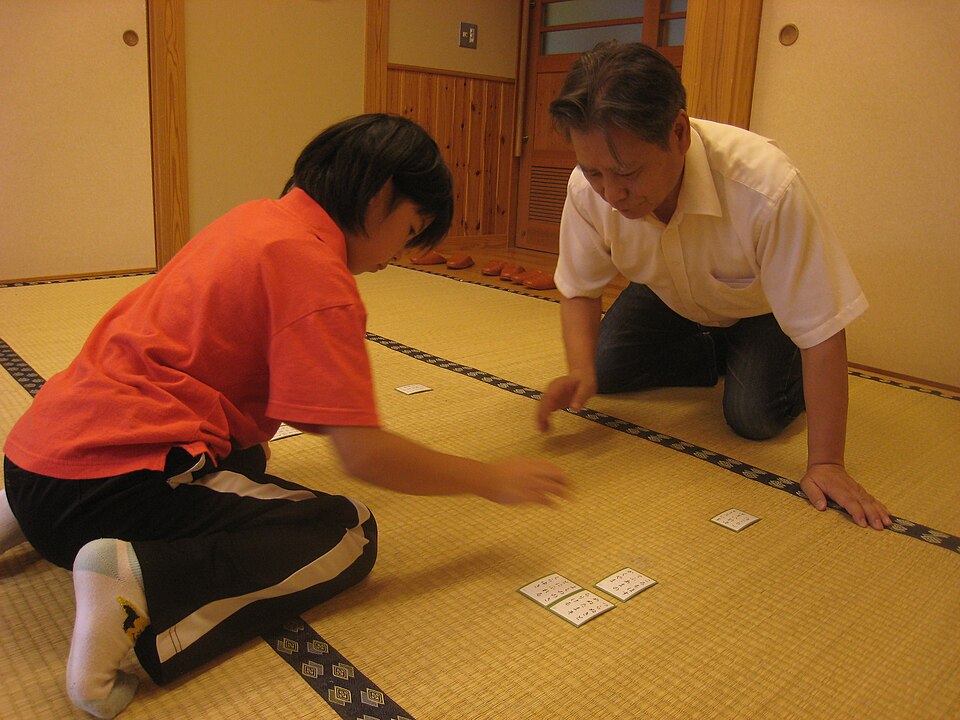
JoshBerglund19 / Wikimedia Commons, CC BY 2.0. Resized to 960 pixels wide; composition unchanged.
The hand moves quickly. The listening has already happened.
That small sequence is a useful way into karuta, Japan’s card games in which players listen to a reader and find a matching card. A colourful picture deck and a tense poetry match can look very different, yet both connect a voice with something waiting on the floor.1
For a newcomer, the first useful distinction is what appears on those cards. The next is how the game ends: collecting the most cards and clearing your own side are two different goals.
Picture cards: a sound, a scene, a saying
In iroha karuta, one person reads sayings from a separate deck. The other players look for the corresponding illustrated card, marked with the opening character or words. The quickest finder takes it, and the player with the largest collection wins. Kids Web Japan traces this form to the Edo period, when familiar sayings and lessons from everyday life helped give the cards their appeal.1
Look at the photograph below: even before you can read the characters, the pictures give you different shapes and colours to remember. It is easy to imagine following one particular image while waiting to hear its cue.
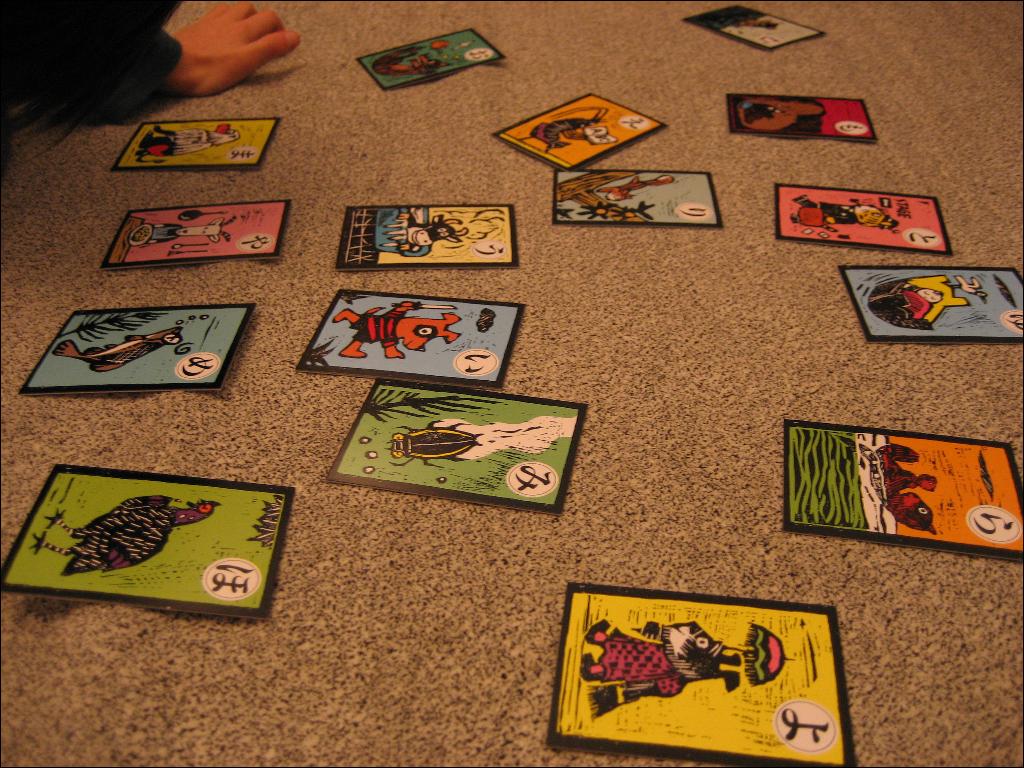
Gilgongo / Wikimedia Commons, CC BY 2.0. Original 1,024-pixel-wide photograph; no changes.
Poetry cards leave part of the answer out
Hyakunin Isshu brings another layer. The anthology contains one hundred short poems by one hundred poets and was compiled around 1235. Its adaptation into a card game came later. The collection is literature first; the cards provide a way to encounter it through play.2
A standard deck has two sets of one hundred cards. The yomifuda, or reading cards, show the full poem and an image of its poet. The torifuda, the cards players take, carry only the poem’s final part. The photograph of the matching pair below makes that difference visible: one side has a portrait and a complete verse; the other is almost entirely text.2
The opening words therefore point toward an ending printed somewhere else. Knowing that connection explains why a player may move before the reader has finished.
Competitive karuta: the goal is an empty side
In the All Japan Karuta Association’s competitive format, two players each receive twenty-five randomly chosen taking cards. They arrange their own cards in front of them and have fifteen minutes to memorise the layout. Only fifty of the hundred taking cards are in play.3
The first player to clear their own side wins. Taking a card from your side removes it; taking one from your opponent’s side allows you to send one of your remaining cards across. A successful reach changes the arrangement as well as the count.3
This is worth knowing before watching a match. A player handing over a card has not necessarily lost it through a mistake. That transfer may be the result of a successful take.
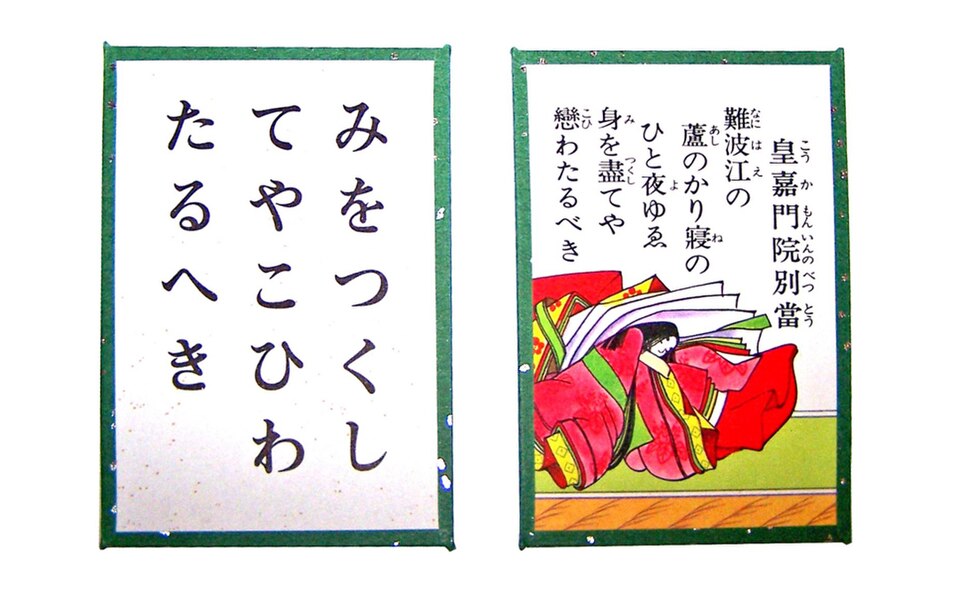
Ceridwen / Wikimedia Commons, CC BY-SA 2.0 France. Resized to 960 pixels wide; composition unchanged.
Sometimes the best move is no move
Skilled players listen for kimariji: the opening sound or sequence of sounds that identifies a poem. The Association’s introduction explains that these cues vary in length and can become shorter as other poems are read. Recognising a cue and remembering where its card sits are connected tasks.4
There is another complication: the reader can recite a poem whose card is absent from the playing area. These are known as karafuda. Touching a card during such a reading is a fault.4 Watch the stillness as carefully as the fast hands. A player who waits may have recognised exactly what was read.
If you know karuta from dramatic scenes of cards flying, this quieter decision is worth looking for. Speed only helps when the decision to move is right.
A gentler way to begin
You can try poetry karuta without starting with a formal match. The Japan Foundation, Sydney describes chirashi, a group version with one reader and cards spread out for everyone to find. Players collect matching cards, and the largest collection wins. The reader may repeat a poem’s ending if nobody finds it.5
For a first practice, choose a small set of matching reading and taking cards together. Read through them before adding speed. This is a suggested learning exercise, rather than tournament procedure: give everyone time to connect the sound, the written ending and the position on the floor.
The Foundation’s guide also flags historical spelling, which can differ from what a learner expects to hear.5 An unfamiliar reading does not mean you have misunderstood the whole game. Follow a reliable reading guide and get comfortable with a few cards first.
Listen as a guest, too
At a club or competition, quiet is part of participation. The Association’s manners guide asks players and spectators to avoid noise that interferes with the reader and to silence devices, including vibrations. It also stresses greetings, care for the cards and keeping footwear off tatami.6
Begin by watching one reading from start to finish. Notice who moves, who waits and what happens to the cards afterward. Even without knowing every poem, you can start to see the decisions inside a single round.
Sources & further reading
- Kids Web Japan, “Traditional Japanese Games” — iroha karuta and its play format.
- Kids Web Japan, “Hyakunin Isshu Karuta,” Part 1 — the poetry anthology and the two sets of cards.
- All Japan Karuta Association, competition rules — card numbers, memorisation time, transfers and the winning condition (Japanese).
- All Japan Karuta Association, introduction to competitive karuta — identifying sounds and absent cards (Japanese).
- The Japan Foundation, Sydney, Hyakunin Isshu instructions — an English guide to chirashi, historical spelling and learning the cards (PDF).
- All Japan Karuta Association, Competitive Karuta Manners Guide — guidance for players and spectators (English PDF).
Photo sources and licences are linked in each caption. The photographs retain their respective licences; the first and third were resized without changing their composition, and the second is reproduced unchanged.




Comments