Origami in Japan: What One Square of Paper Can Become
From a dog with folded ears to a crane carrying a wish, a small piece of paper can become something to play with, give or share.
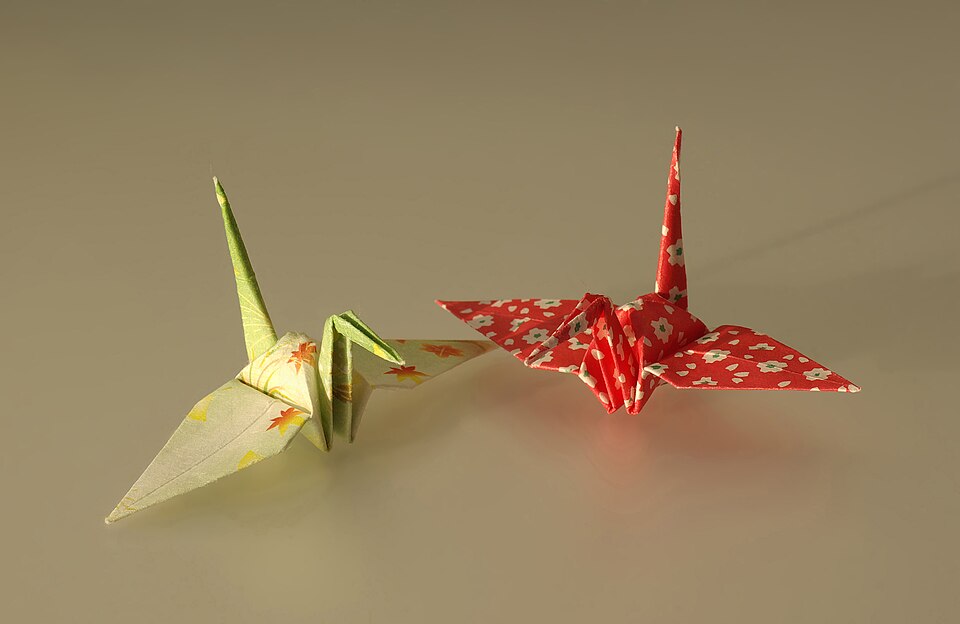
Photo: Laitche, Wikimedia Commons · Public domain (released by the photographer). Resized to 960 pixels wide; original composition retained.
A square becomes a triangle. Two corners turn down, and suddenly there are ears. Add a face, and a piece of paper has become a dog.
Origami offers a very small way into Japanese everyday culture: something you can hold, try again, and show to another person. A finished crane is beautiful, but the moment a shape becomes recognizable can be just as satisfying. For someone discovering the craft, that moment is a good place to begin.
How folding became part of childhood
Paper folding in Japan has several histories. Kids Web Japan distinguishes formal folds used in wrapping gifts and offerings from folding for enjoyment. As paper became more widely available during the Edo period, more people could take part in recreational folding. Origami later entered kindergarten and elementary-school activities during the Meiji period.1
Its place in education also reflects exchange with other countries. Researcher Yukiyo Nishida describes how Japanese folding practices met European paper-folding methods through Friedrich Froebel’s kindergarten approach. What feels like a familiar childhood tradition developed through adaptation as well as inheritance.2
That wider history leaves plenty of room for the beginner. You can approach origami as a shared activity, without assuming that every Japanese person knows the same models or remembers the same folds.
Choose a shape you want to play with
A crane is an appealing goal, but a simpler model can give you a quicker first success. The government-run Kids Web Japan places the dog, cup and helmet among its beginner projects; the crane and jumping frog appear in its intermediate group.3
Its dog tutorial finishes with a drawn face. Try changing the eyes or adding a spot to one ear after folding. Two people can follow the same sequence and end up with dogs that seem to have entirely different personalities.4
The kabuto, or helmet, is another beginner option. The tiny version in the photograph shows how changing the scale changes the effect. For your first attempt, give your fingers more space and use a larger square.5
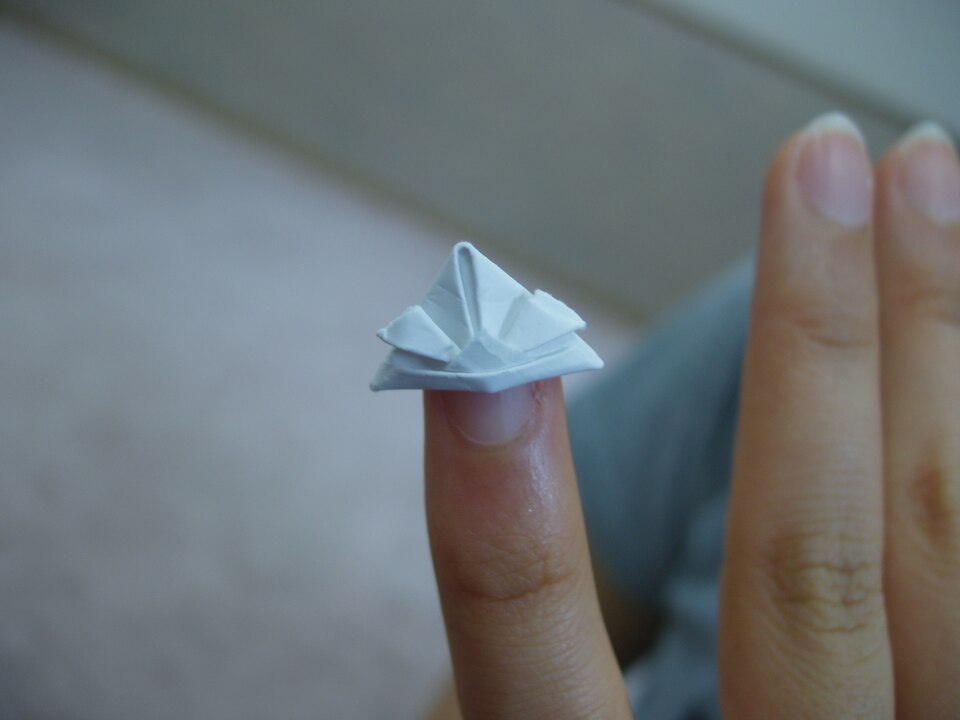
Photo: shikeroku, Wikimedia Commons · CC BY 2.0. Resized to 960 pixels wide; original composition retained.
The finished object can start a game
The jumping frog adds movement: pressing and releasing its back makes it hop. Follow the complete illustrated sequence on Kids Web Japan, including the folds near the end that give the frog its spring.6
Once you have two frogs, you could make a small game of reaching a pencil line on the table. One might travel farther; another might turn sideways. Comparing them gives you a reason to look again at how the paper was folded. The model becomes something to experiment with after the instructions end.
Fold side by side
When showing someone a model, try using two sheets. Make one fold on your own paper, pause, and let the other person do the same. Keep both sheets facing the same direction so that “this corner” points to the same place.
If a step goes wrong, return to the last shape you both recognize. It is often easier to compare two triangles than to explain a complicated crease in words. Leave the learner’s paper in their hands whenever possible; making the next fold themselves is part of the pleasure.
For an adult and child, or two people who do not share much language, this can be a gentle activity to try together. The result might be uneven. It can still be a dog worth naming or a helmet worth keeping.
When a paper crane carries a message
The crane has associations that go beyond its shape. Groups of a thousand folded cranes, often called senbazuru, may be made as an expression of hope or a wish for someone’s recovery. The significance lies in the care and intention of the people folding them.7
The same paper bird can be a practice model, a small gift or part of a collective message. Its setting helps explain which meaning matters. A crane on your desk and cranes offered at a memorial ask for different kinds of attention.
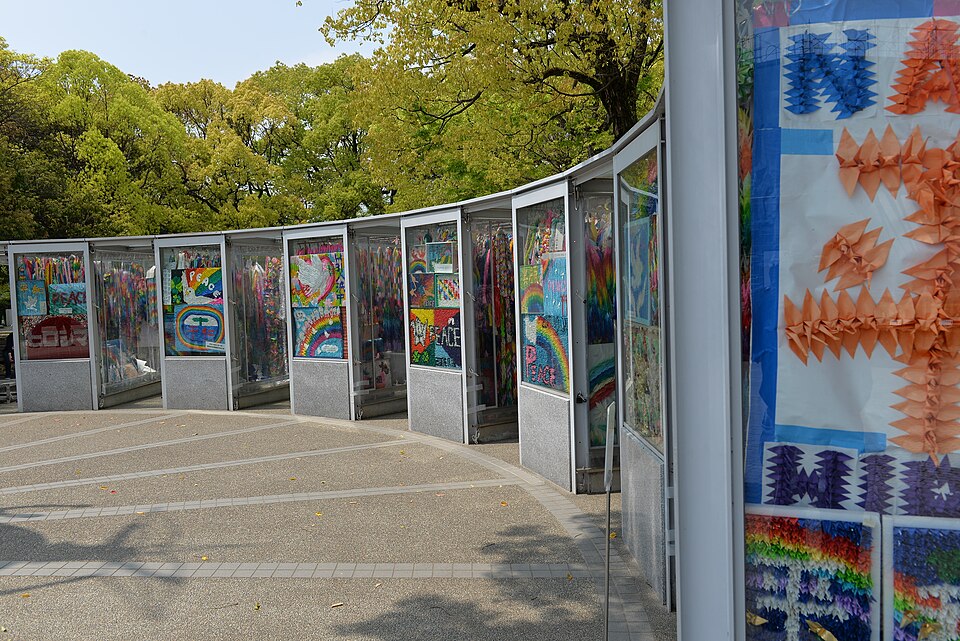
Photo: shankar s., Wikimedia Commons · CC BY 2.0. Resized to 960 pixels wide; original composition retained.
Why cranes gather in Hiroshima
Hiroshima’s connection with paper cranes centers on Sadako Sasaki, who survived the atomic bombing as a young child and later developed leukemia. She folded cranes while hoping to recover. After her death, a campaign led to the creation of the Children’s Peace Monument. Cranes sent from around the world now carry wishes for peace there.8
If you visit the displays, take time to read about the children commemorated by the monument. The city also encourages people making cranes to learn about the bombing and discuss peace. Anyone considering an offering can consult Hiroshima’s current guidance on arranging and sending cranes.8
A tradition with room for new shapes
Origami continues to attract new designs. The Kids Web Japan gallery, featuring work from the Nippon Origami Association, includes vehicles, dinosaurs, flowers and seasonal scenes alongside more familiar subjects. It gives a sense of how far people can take the activity once they start asking what else paper might become.9
For a first evening, choose just one model. Put a spare sheet beside you, keep the instructions where you can see them, and allow yourself a second attempt. Before putting the paper away, show someone what you made. They may ask how to make one too.
Sources & further reading
- Kids Web Japan — The History of Origami
- Yukiyo Nishida — Origami and early childhood education in Japan (keynote PDF)
- Kids Web Japan — Let’s Make Origami!
- Kids Web Japan — Origami Dog
- Kids Web Japan — Origami Soldier’s Helmet
- Kids Web Japan — Origami Jumping Frog
- Kids Web Japan — Origami Trivia
- City of Hiroshima — Paper Cranes and Children’s Peace Monument
- Kids Web Japan — Origami Gallery
The photographs show separately photographed examples, rather than the projects made for this article. Credits and reuse terms appear beneath each photograph.





Comments