Kendama: Why One Good Catch Is Only the Beginning
A wooden handle, a ball and a string. The pleasure lies in discovering how much there is to learn between a miss and a catch.
JeremyAStephenson / Wikimedia Commons, CC BY-SA 4.0. Resized to 960 pixels wide; composition unchanged.
The ball rises. The cup moves underneath it. For a moment, the catch looks certain—then the ball touches the rim and falls away. With a kendama, the next attempt is always close at hand.
That small gap between almost and success is a useful way into the toy’s appeal. You can understand the immediate goal without understanding every trick. And when one catch begins to feel familiar, another target is already waiting on the same piece of wood.
Look closely: there is more than one place to land
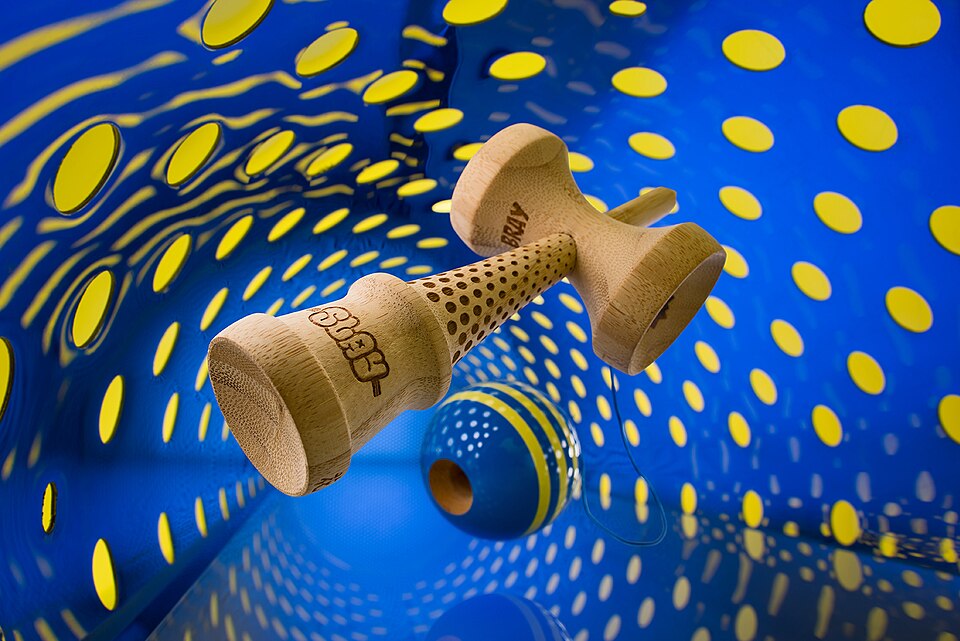
A kendama has a wooden handle, or ken, connected by a string to a ball, or tama. The ball has a hole. The handle has a spike and three cups: a large and a small cup on the crosspiece, plus a cup at the base. Catching the ball in a cup and landing its hole on the spike are different challenges.1
In the opening photograph, you can see the hole in the blue ball and the cup at the bottom of the handle. The string keeps the two main pieces together; it does not make the catch happen for you.
The first catch starts below your hand
It is tempting to stare at the cup and think only about moving your wrist. The beginner guidance from Kids Web Japan puts emphasis on the knees and the movement of the body as well as the hands.2
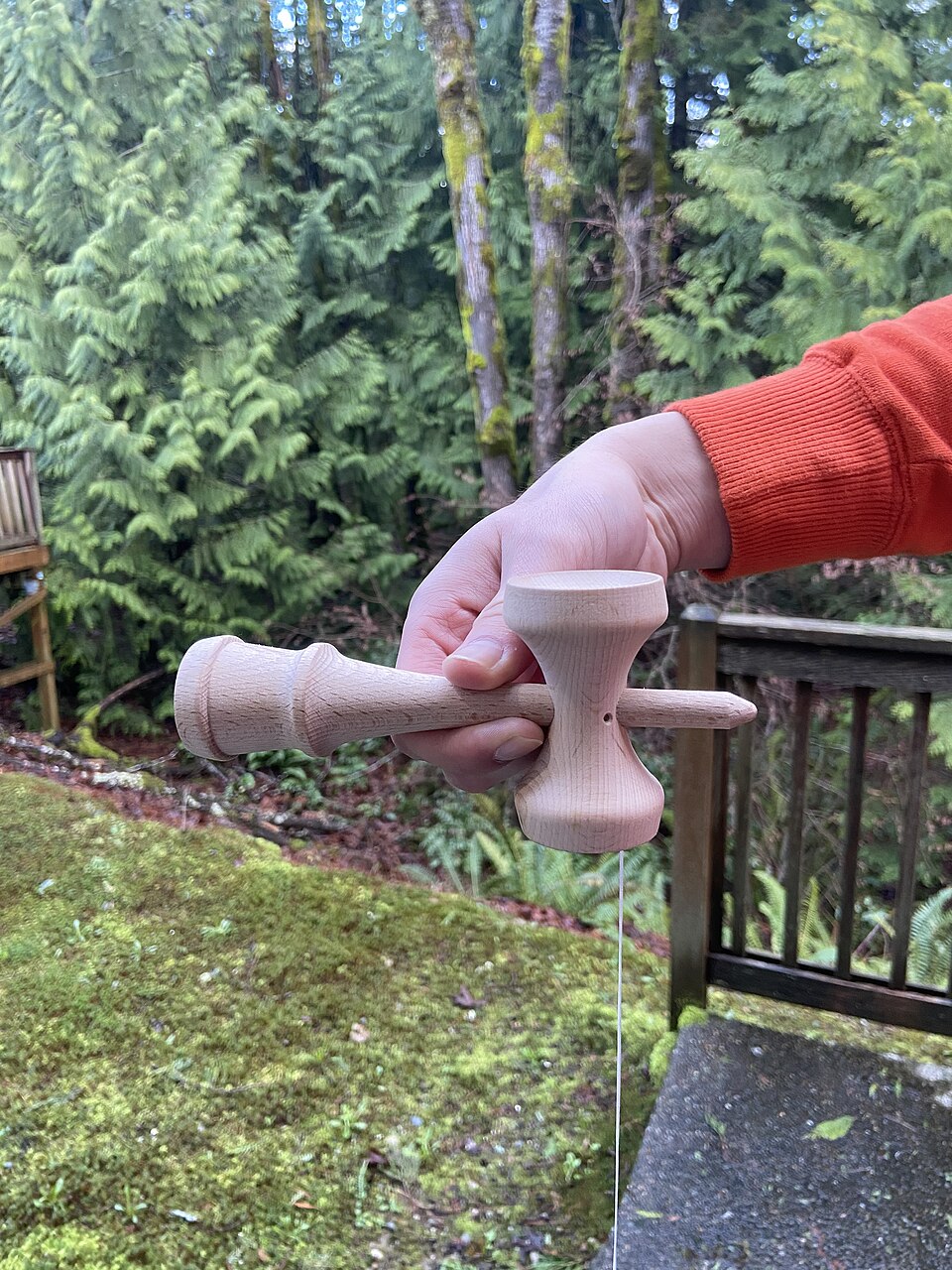
For a simple cup catch, begin with the ball hanging below the upward-facing cup. Bend your knees, then straighten them as you draw the ball upward. As it comes down, bend again to receive it gently. The aim is a soft landing, rather than a rigid cup meeting a falling ball.2
Watch someone demonstrate and look below their hand. The small rise and dip can be easier to miss than the flight of the ball.
Gallaz63 / Wikimedia Commons, CC BY-SA 4.0. Resized to 960 pixels wide; composition unchanged.
A smaller goal can make a better beginning
You do not have to begin by throwing the ball onto the spike. The Kendama Kentei programme’s introductory Medal Challenge includes simpler activities: an easy big-cup catch, a squat with the ball in the big cup, and walking five steps while keeping it there. Its later levels introduce more cups, longer sequences and more demanding tricks.3
That progression offers a practical way to approach your first session. Choose one thing to try. If the ball keeps falling, make the next goal smaller. Keeping it still while you bend your knees is a different task from catching it out of the air, and it is a perfectly good place to spend a few minutes.
A useful question is “What changed on that attempt?” Perhaps the ball rose straighter, or the landing felt softer. A session can have something to notice even before there is a new trick to show.
The woodworking town behind the toy
Kendama also leads to a particular place: Hatsukaichi, in Hiroshima Prefecture. The Chugoku Economic Federation traces the local production of the nichigetsu, an important predecessor of today’s kendama, to 1921. An inventor from Kure asked a Hatsukaichi furniture-accessory maker to manufacture it.4
The location mattered. Timber from the Chugoku Mountains and established wood-turning skills supported the town’s woodworking industry. Behind an object small enough to hold in one hand was a local knowledge of how to shape wood.4
Seen that way, a kendama belongs to more than a story about childhood. It is also a story about making things: turning a material into an object whose shape determines how it can be used.
JeremyAStephenson / Wikimedia Commons, CC BY-SA 4.0. Resized to 960 pixels wide; composition unchanged.
From a small personal challenge to a shared one
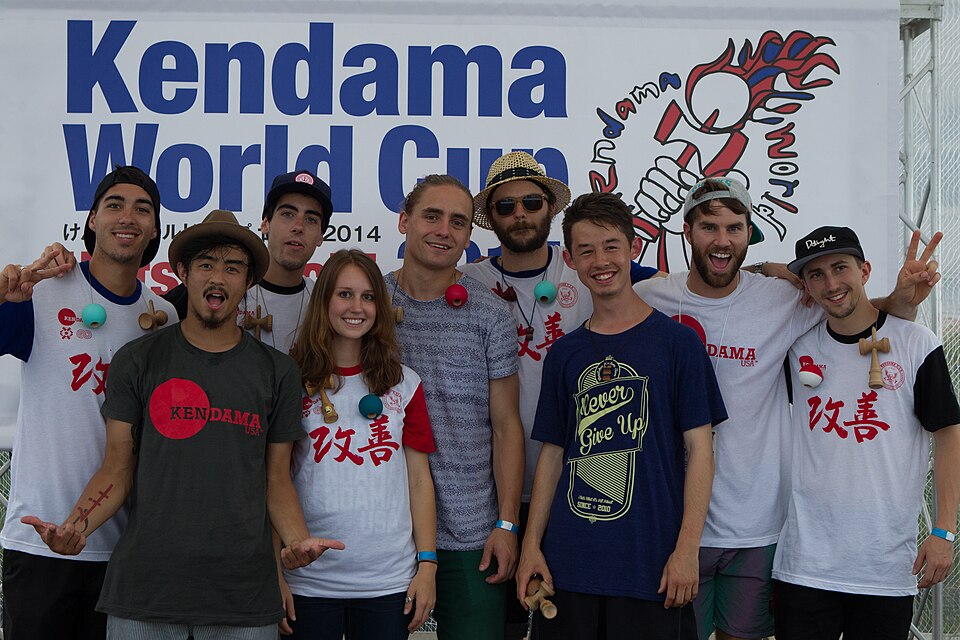
Hatsukaichi hosted its first Kendama World Cup in 2014. The group photograph above, showing the USA team at that event, makes the international connection visible. A toy associated with Japan had become a reason for players from elsewhere to gather there.5
Organised play also has a longer history in Japan. The Japan Kendama Association was established in 1975 and developed standards for equipment and competition. Kendama’s place in childhood culture has never meant that its challenges end with childhood.1
What to watch when the tricks get complicated
Start with the ending. Does the ball settle into a cup? Does its hole meet the spike? Then look at what happens before that finish. Which piece is the player holding, and where does the other one travel? You do not need a trick’s name to follow those questions.
The Kendama Kentei trick list links to demonstrations at different levels, so you can move from a simple catch to more complicated sequences at your own pace.3
And if you decide to try it yourself, one good catch is enough for a beginning. The next challenge does not need to be spectacular. It can simply be doing that same small thing again.
Sources & further reading
- Kids Web Japan — The History of Kendama. The toy’s parts, basic catching challenges and the Japan Kendama Association.
- Kids Web Japan — The Basics and Tricks. Grips, stance, knee movement and receiving the ball.
- Kendama Kentei — Trick List. Introductory activities, progressive levels and linked demonstrations.
- Chugoku Economic Federation — Japanese Cup-and-ball (Kendama). Hatsukaichi’s production history and woodworking background.
- Hatsukaichi Kendama 100th Anniversary — The History of Kendama. Local history and the first Kendama World Cup in 2014.
Photo sources, creators and licences appear beneath each image. The photographs are reproduced at a smaller size with their composition unchanged.






Comments