Noh Masks: How One Face Can Change on Stage
A small tilt can alter the feeling of a carved face. Looking at the mask—and then behind it—offers a way into one of Japan’s distinctive stage arts.
Tokyo National Museum / ColBase / Wikimedia Commons, CC BY 4.0. Resized to 960 pixels wide; composition unchanged.
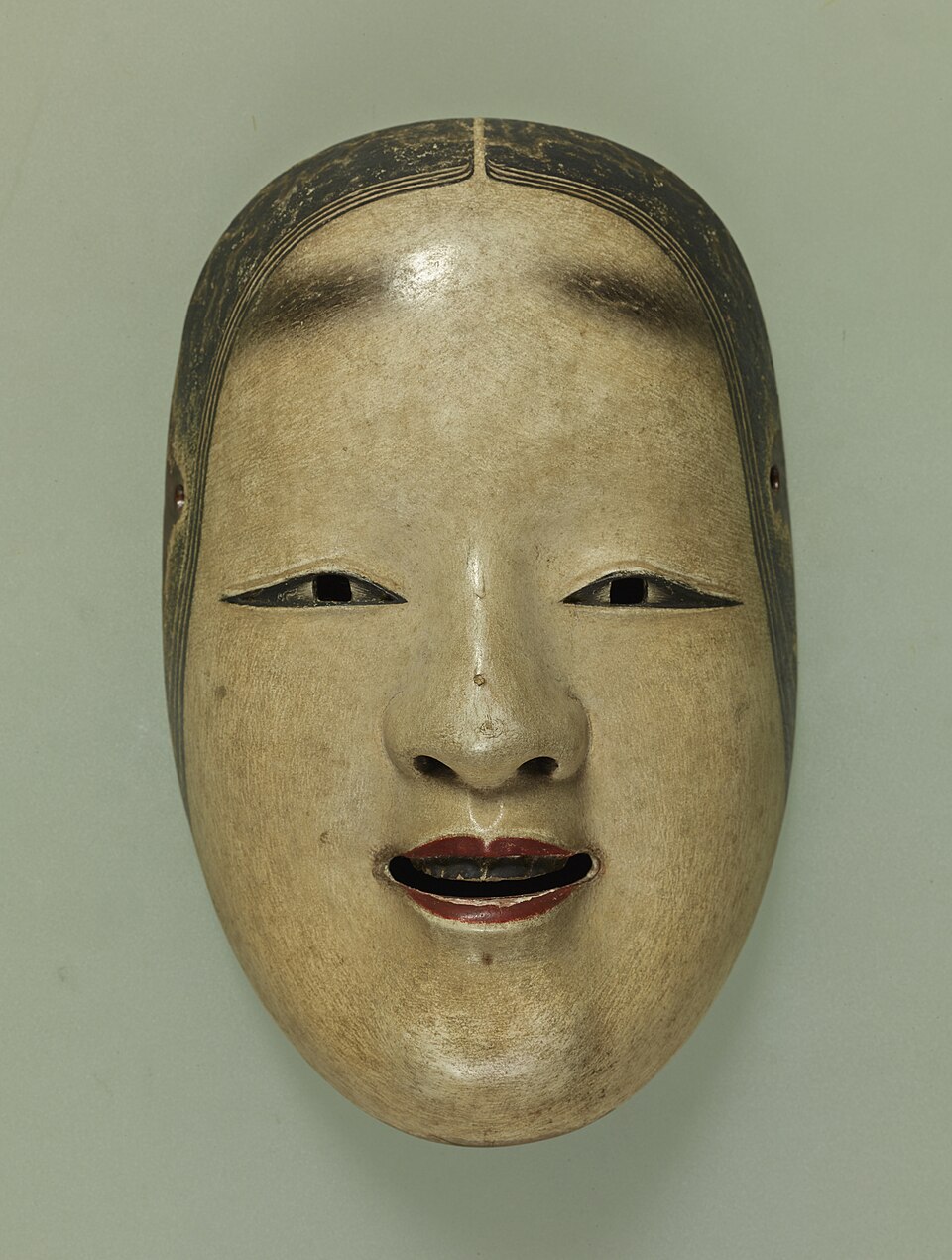
A face appears to smile. A moment later, it seems troubled. The mouth has not moved, and the eyes have not blinked. What changed was the angle—and perhaps the attention of the person watching.
This is a useful place to begin with a Noh mask. Instead of trying to memorize every mask type before seeing a performance, start with a smaller question: what happens to this face when the performer moves?
Noh combines stylized movement with chant and instrumental music. Its masked figures belong to a performance, not simply a display of beautiful objects. The Japan Arts Council’s introduction describes how even a slight tilt can alter the feeling conveyed by a mask.1
The expression is not fixed
The specialist resource the-Noh.com explains two familiar techniques: terasu, raising the face slightly, and kumorasu, lowering it. An upward angle can give a lighter, smiling impression; a downward angle can suggest sadness. The movements may be very small.2
For a first viewing, use that explanation as an invitation to observe. Watch the face during a pause, then again after a turn or a lowered head. Notice whether the impression changes before you can name an emotion.
There is no need to translate every movement into a single English word. A character’s situation matters too. Let the outline of the story guide you, while leaving room for an expression that feels harder to pin down.
One kind of mask, many individual faces
The mask pictured above is a Ko-omote, a type used for young female characters. This particular example belongs to the Tokyo National Museum and dates from the seventeenth century. Its painted hair, narrow eyes and small mouth give you details to study before imagining the face in motion.3
Yet a type name does not mean every example looks identical. In an interview, mask maker Koichi Takatsu describes subtle differences among Ko-omote masks and the performers who use them. He also explains how following an older model involves conveying its feeling, with small touches made by the individual carver.4
If you visit an exhibition, try looking at two masks of the same type. Compare the mouth, the line around the eyes and the fullness of the cheeks. Ask which details hold your attention, rather than which one is the “correct” face.
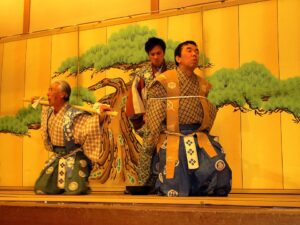
Yoshiyuki Ito / Wikimedia Commons, CC BY-SA 3.0. Resized to 960 pixels wide; composition unchanged. This photograph remains under CC BY-SA 3.0.
Look beyond the mask for a moment
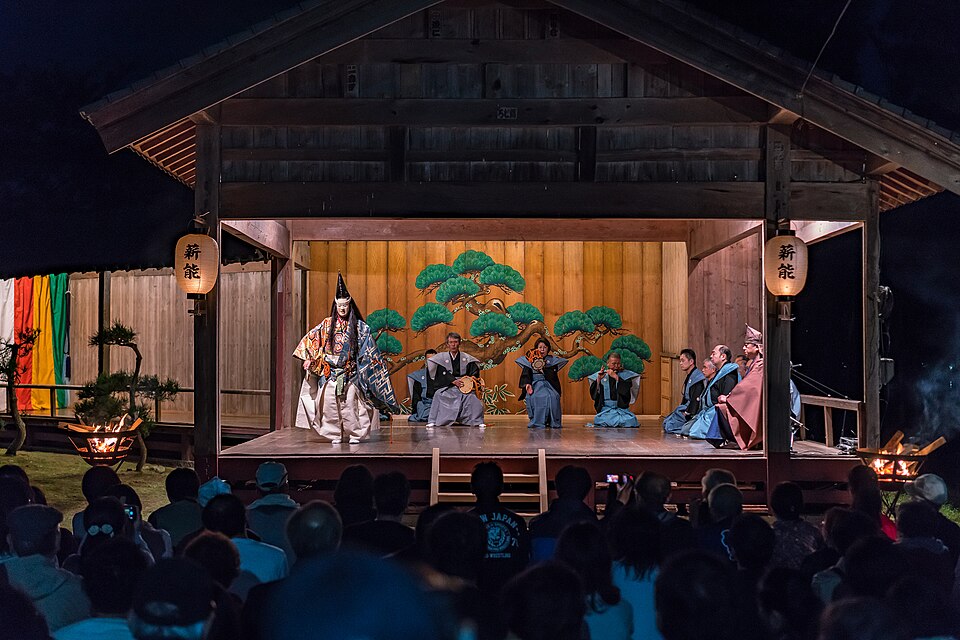
Not everyone on a Noh stage wears one. The central performer, the shite, often does; the waki, who interacts with that figure, generally does not. The Japan Arts Council describes the waki as commonly portraying a living adult man, such as a traveling monk, while many shite roles are spirits, deities or other beings beyond ordinary life.5
This gives a beginner something concrete to follow. Who approaches whom? Who listens? When does the masked figure turn away? Watch those relationships as well as the face itself. You can return to the mask after noticing the distance between the performers.
The stage helps the person inside
A Noh stage has its own clear structure: a square playing area, a pine painted at the rear and a bridgeway called the hashigakari. The four corner pillars have a practical role as well as an architectural one. They help performers orient themselves when a mask restricts their field of vision.6
Backstage, the mirror room is where the principal performer puts on the mask and prepares for the role. Thinking about that unseen preparation adds another perspective to the entrance: the audience sees an expressive face, while the person wearing it has a much narrower view.6
Tokyo National Museum / ColBase / Wikimedia Commons, CC BY 4.0. Resized to 960 pixels wide; composition unchanged.
The back tells another story
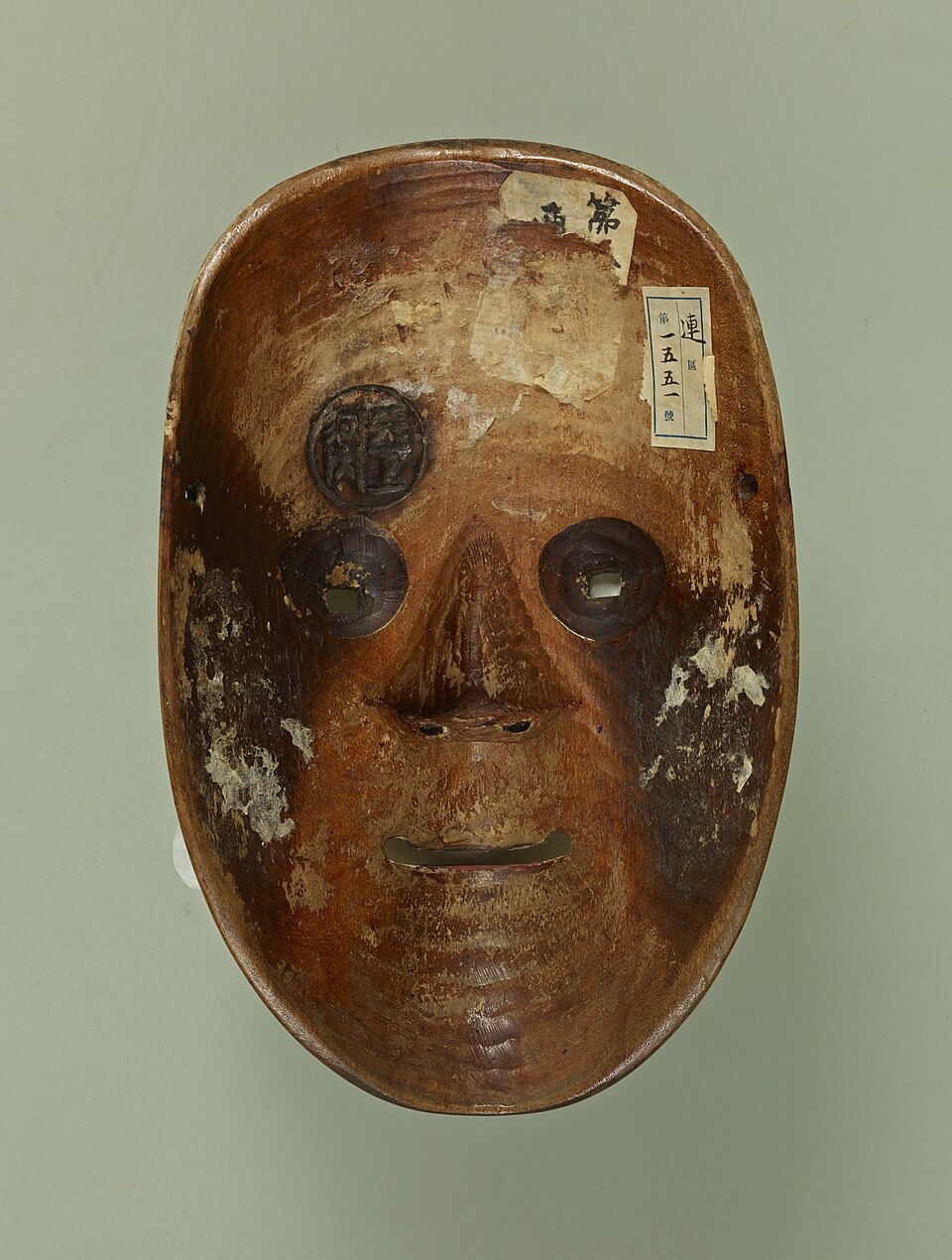
Turn to the photograph of the museum mask’s reverse. The face becomes a hollow wooden object with openings for the eyes, nose and mouth. These two photographs show the same mask, front and back; the Sado performance photograph shows a separate stage scene.
Takatsu emphasizes the importance of this inner surface. Fit matters, as do the openings through which the performer can see. He describes how the nostrils can help an actor look downward—a practical detail that is easy to miss when admiring the painted front.4
Keep both views in mind: an object made to be seen, and an object someone must wear while moving.
A simple way to approach your first performance
Read a short synopsis beforehand, so you know who appears and what draws the characters together. When choosing a show, check the particular program’s language support. The Japan Arts Council’s visitor guide describes English subtitle monitors for National Noh Theatre-produced performances; arrangements should be checked for the event you plan to attend.1
Then give yourself one small observation to follow: the angle of the face. Let the music, movement and story gather around it. You do not have to understand every convention to notice the moment when the same carved features begin to feel different.
Sources & further reading
- Japan Arts Council — Noh and Kyogen visitor guide: performance elements, mask movement and language support.
- the-Noh.com — Masks: upward and downward angles and expressive techniques.
- Tokyo National Museum / ColBase — Ko-omote, C-1551; collection details and licensed photographs are also available on the linked Wikimedia Commons file pages.
- the-Noh.com — Interview with mask maker Koichi Takatsu, part 2: individual variation, copying older models and the mask’s inner surface.
- Japan Arts Council — Noh performers: the roles of shite and waki.
- Japan Arts Council — Noh stage structure: pillars, bridgeway and mirror room.
Photo credits and individual licenses appear beneath each image. The stage photograph retains its CC BY-SA 3.0 license.






Comments