Koinobori: Why Carp Swim in Japan’s Spring Sky
From a small family display to a river full of flying fish, Japan’s carp streamers turn hopes for children into something a whole neighborhood can see.
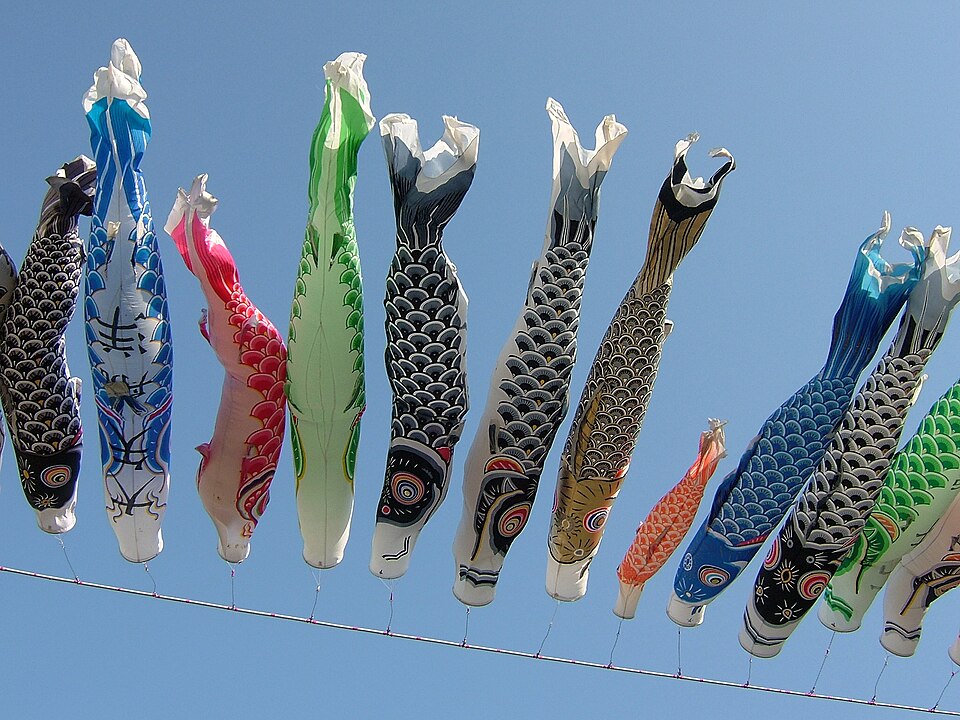
chaojikazu / Wikimedia Commons, CC BY 2.0. Resized to 960 pixels wide; composition unchanged.
Look up on a spring walk in Japan and you may find a fish where you expected a flag. Its mouth is wide open, its body lifts with the wind, and its tail follows a moment later. Nearby fish might be blue, black, red or green.
These are koinobori, carp-shaped streamers associated with Children’s Day on May 5. They carry wishes for children to grow up well.1 But the setting changes the experience: a small display beside a home feels quite different from a line stretching across a river.
Following that change in scale is one way to see more than a colorful holiday decoration.
Children’s Day, with an older history behind it
May 5 became a national holiday called Children’s Day in 1948, celebrating children’s growth and happiness. The older seasonal observance, Tango no Sekku, was particularly associated with boys. That history explains why descriptions of koinobori often mention sons, while the modern holiday has a broader name and purpose.1
The two layers exist together. You may also encounter miniature warrior helmets or dolls indoors, and kashiwamochi, sweet bean-filled rice cakes wrapped in oak leaves. Carp streamers are the part of this seasonal celebration most easily spotted from the street.1
Why a carp?
The choice comes with a story of effort and transformation. In a Chinese legend associated with the custom, a carp that climbs a waterfall becomes a dragon. The fish therefore offers an image of strength and achievement—a hopeful symbol for a child’s future.2
Kids Web Japan traces the streamers’ development to wealthy townspeople adopting elements of samurai households’ celebrations in the eighteenth century. Carp took the place of the flags flown by warrior families. Early examples were painted on Japanese paper, making rain a problem; dyed cloth versions developed later.2
That material history is useful to remember when looking at something so light and playful. The familiar fish has passed through different hands, materials and ways of living.
A family display that fits the home
A household set can include a large carp and smaller ones, with a multicolored fukinagashi streamer above them. The fish can represent family members. Over time, the range expanded from black carp to red, blue and other colors, creating the varied groups familiar today.3
Size has changed too. Smaller sets fit apartment balconies, while miniature versions can be displayed inside. A tall pole in a garden is one form of the custom; it is not the only way a family can keep it.1, 3
For a visitor, it is better to notice the arrangement than to use the fish as a census of the household. Enjoy the different sizes, the painted scales and the way the streamers move together, without trying to infer a particular family’s story.
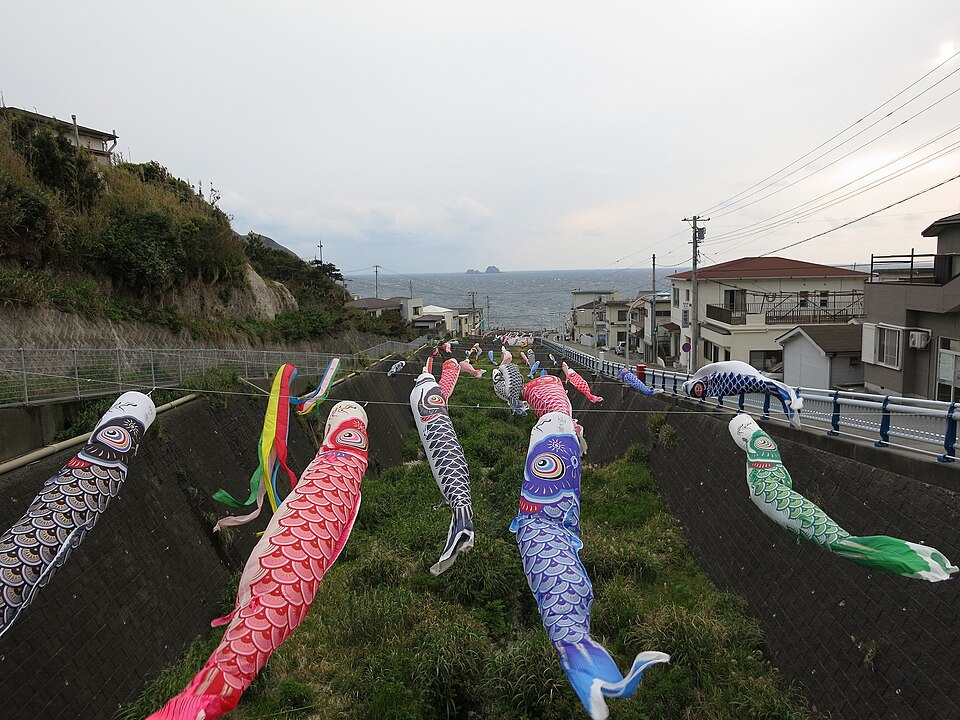
Michael Tsutsui / Wikimedia Commons, CC BY-SA 3.0. Resized to 960 pixels wide; composition unchanged. This photograph remains under CC BY-SA 3.0.
When the whole view fills with fish
Community displays take the same idea into a shared landscape. Japan Up Close describes long strings of koinobori hung over fields and rivers for Children’s Day.4 The photograph above shows one such arrangement over the Kozusawa River in Kozushima: fish in the foreground, houses on either side and the sea beyond.
Here the supporting line matters almost as much as each fish. It draws your eye along the watercourse and toward the village. The decoration gives a familiar place a temporary new outline.
Try looking at both scales: first the eyes and fins of one carp, then the whole row. A photograph of a single streamer tells you about its design; a wider view shows how it sits among roads, buildings and water.
In Kazo, a local industry becomes a giant
Kazo in Saitama takes the change of scale much further. The city’s fourth-generation jumbo koinobori is 100 meters long and weighs about 330 kilograms. Its history began with a giant made for the Saitama Expo in 1988; the first official flight at Kazo’s Citizens’ Peace Festival followed in 1989.5
The size has a local context. Kazo’s own history traces its streamer-making industry to lantern and umbrella craftspeople who began making seasonal goods in the early Meiji period. It later developed into specialized production.6
Seen beside the crane in the photograph, the carp becomes a piece of public spectacle. It also gives visitors a reason to ask what the town makes, and how that work became part of its identity.
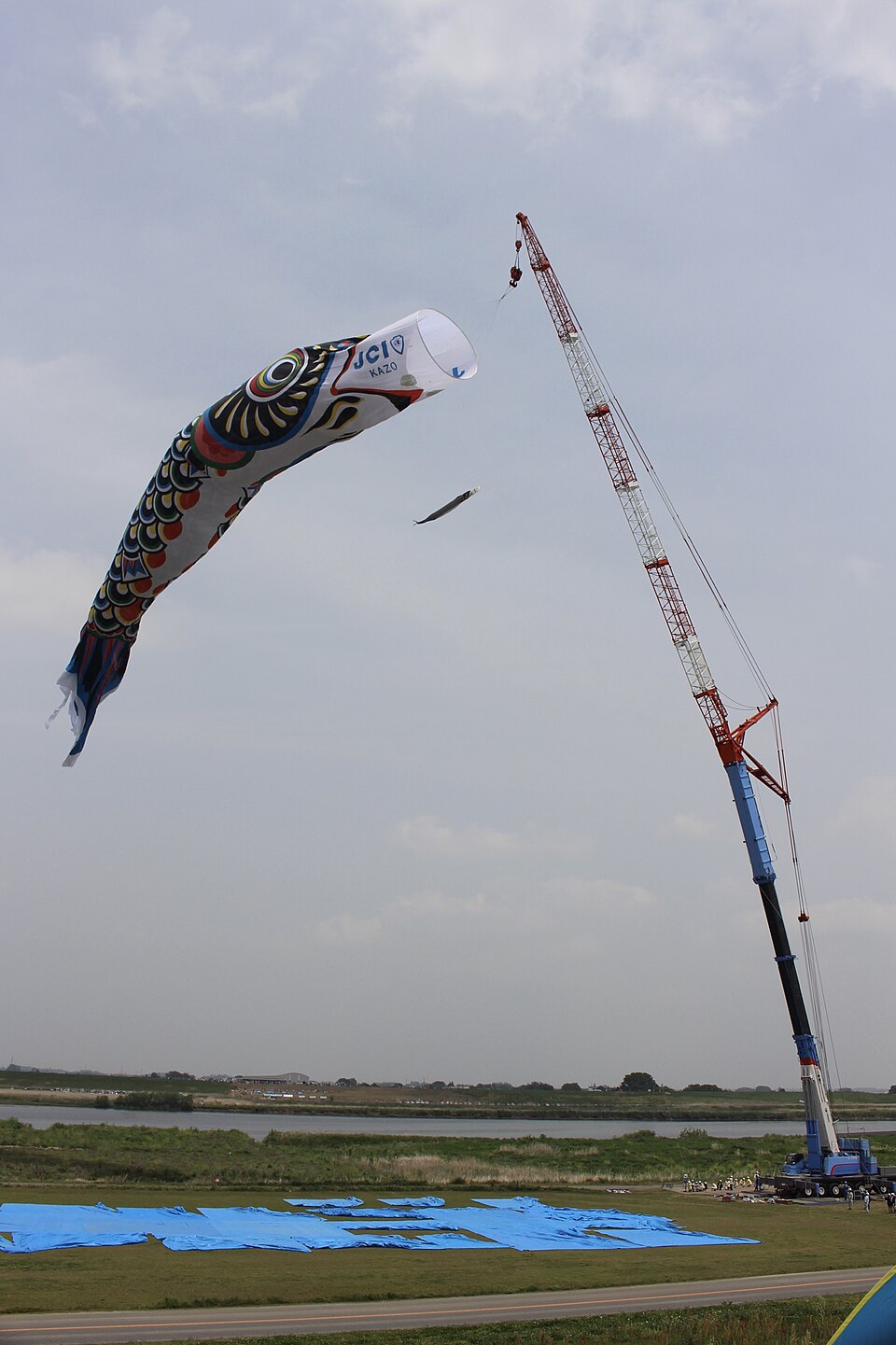
舟太郎 / Wikimedia Commons, CC BY-SA 4.0. Resized to 960 pixels wide; composition unchanged. This photograph remains under CC BY-SA 4.0.
Sometimes the carp really do enter the water
There is another view of koinobori in Gujo Hachiman, Gifu. During the winter practice called koinobori no kanzarashi, colorful streamers are immersed in the Kodara River. The town’s waterways are also part of the local Gujo Honzome dyeing tradition.7
This is a making-and-preparation scene, distinct from the spring displays overhead. It offers a reminder that a finished decoration has a life before it reaches a pole: fabric, color, water and the work of preparing it.
What to notice on a spring walk
Late April and the period around May 5 are a useful starting point for looking for koinobori.3 For a large display, check the organizer’s current dates before planning a visit; the photographs here show examples, rather than a schedule of upcoming events.
Give a display a little time. Notice how a gust lifts one row before another, or how the colors change against trees instead of sky. The fish may be the first thing you see. Behind them is a wish for children—and, sometimes, a town finding a way to share it.
Sources & further reading
- Kids Web Japan — Children’s Day: the holiday, older observance, household decorations and seasonal food.
- Kids Web Japan — Koinobori, part 1: the carp legend, early paper streamers and later cloth versions.
- Kids Web Japan — Carp streamers: colors, family arrangements, smaller balcony sets and the spring season.
- Japan Up Close — Children’s Day in photographs: community displays over fields and rivers.
- Kazo City — Jumbo koinobori (Japanese): the giant’s history and fourth-generation dimensions.
- Kazo City — The town’s koinobori industry (Japanese): the local craft’s origins and development.
- Niponica — Gujo Hachiman: waterways, dyeing and winter koinobori immersion.
Individual photo credits and licenses appear beneath each image. The Kozushima and Kazo photographs retain their respective ShareAlike licenses.




Comments