Real Life in Japan
Japan’s Coin Lockers: The Freedom to Put a Bag Down
A little rented space can change the shape of an afternoon. Japan’s lockers reveal how stations support the hours between journeys.
By Maki Kakudate · 6 minute read
You have two hours before meeting a friend, and a bag you would rather not carry. A bookstore sounds appealing. So does lunch somewhere beyond the station. But every possibility comes with the same practical question: where will the bag go?
A coin locker changes that calculation. Close a door, keep the key or the information needed to reopen it, and the next part of the day becomes easier to arrange. Japan’s lockers are interesting for precisely this modest reason: they make a small amount of temporary space available when you need it.
A station service with a longer history
According to manufacturer Alpha Locker, Japan’s first coin lockers were installed underground at Shinjuku Station on December 15, 1964. The company’s history records a technical partnership with the American firm Flexible in starting production and sales. This was an imported idea finding a place in Japan’s railway environment.1
The date deserves attention. It falls in the year of the Tokyo Olympics, but in December. Describing those first lockers simply as a facility introduced for the Games would blur the chronology. Their usefulness extended into the ordinary journeys that followed.
A locker separates two things that usually travel together: a person and their belongings. For someone continuing through the same station later, that separation can make an extra stop possible. The service is small; the change to an itinerary can be substantial.
The “coin” is no longer the whole story
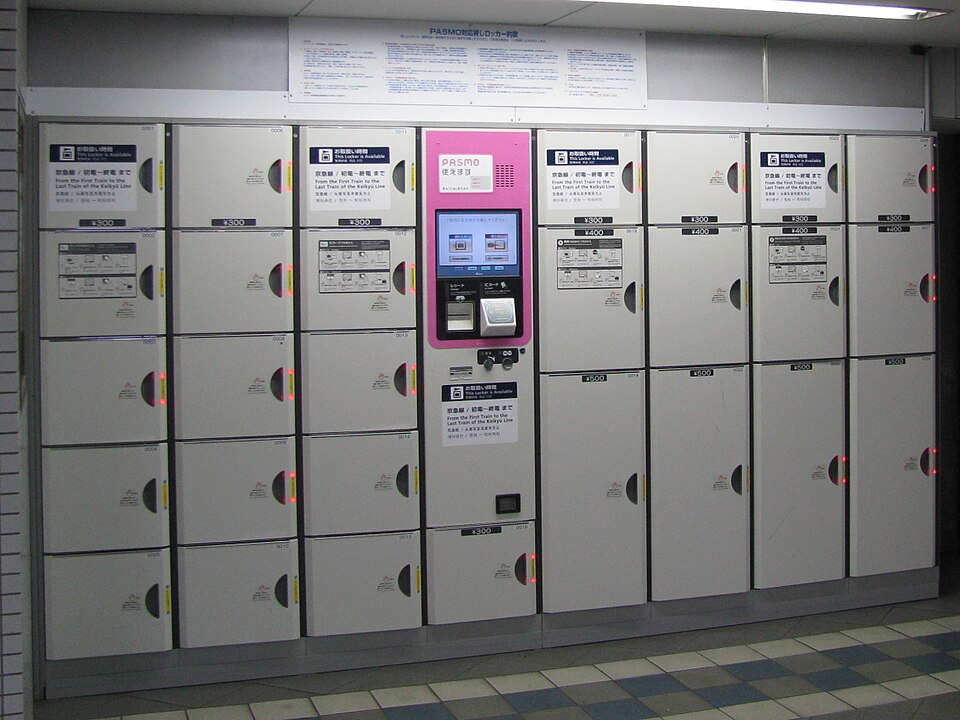
The familiar name covers different systems. Alpha’s history traces the move from mechanical lockers toward electronic locks and models in which Suica could serve as both payment and key.1 The 2010 photograph above already shows a PASMO payment panel among doors of different sizes.
Today, JR East Smart Logistics’ Multi-Ecube system accepts cashless payment rather than coins. It also offers reservations for a storage fee plus a booking fee. Payment methods and features depend on the system, so a row of doors should not be treated as a promise that every locker works in the same way.2
It helps to think of the payment step and the unlocking step separately. Before leaving, make sure you understand what will open the door again. For the operator’s IC-card system, that means retaining the card used for payment; where an unlocking receipt is issued, keep it safe.4
Useful between the things you came to do
The tourist use is easy to imagine: a suitcase needs somewhere to stay between accommodation and a train. But consider a less dramatic example. Someone has finished shopping and wants to meet a friend before going home. Temporarily leaving the purchases near the return route changes what is comfortable to do next.
These are illustrative situations, not a claim that everyone in Japan uses lockers this way. They show why storage belongs in a discussion of everyday life. A station can help organize the hours around a journey as well as the journey itself.
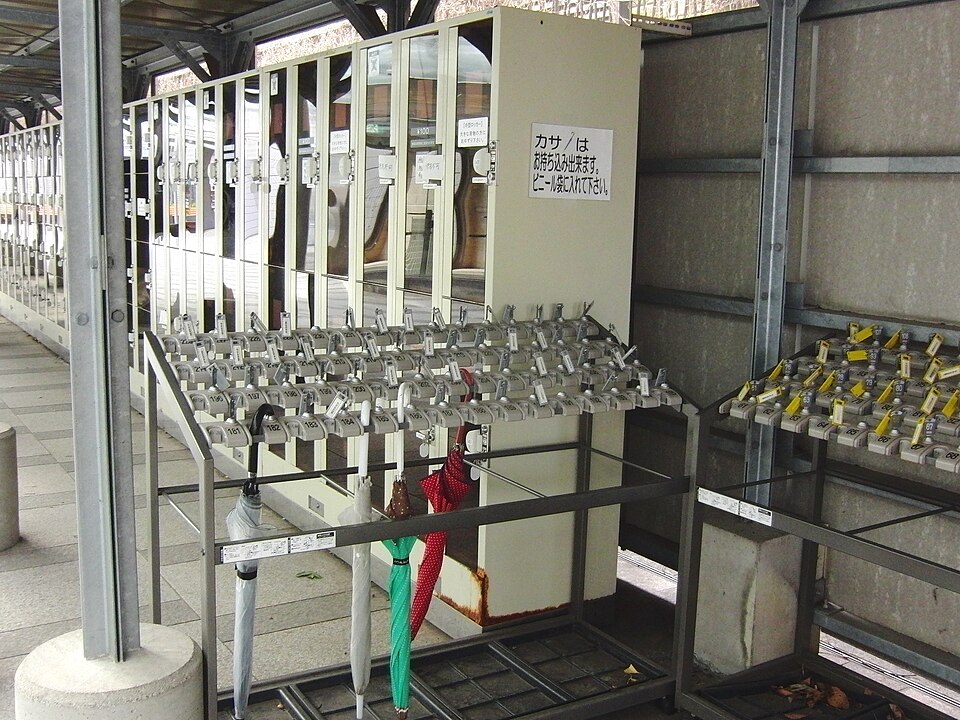
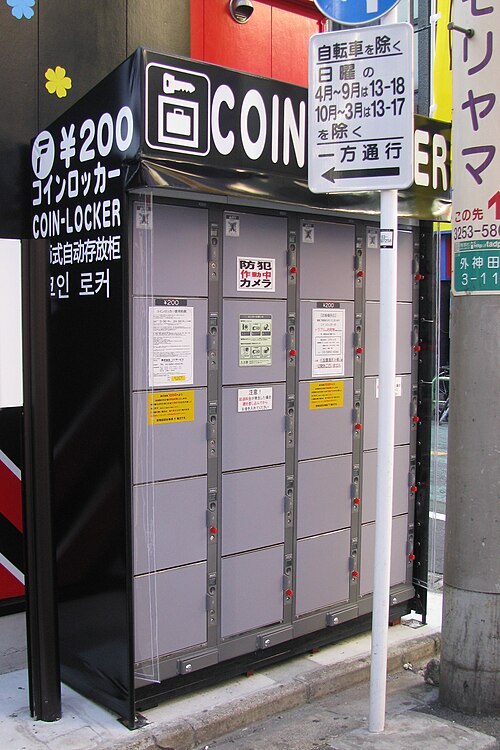
The photographs also widen the picture beyond platforms. At the museum, storage sits alongside umbrella stands; in the Akihabara image, a bank of lockers faces the street. Each offers a different place to put something down. Neither photograph should be read as a current map of available facilities.
There is a trade-off. The bag stays in one place, so your plans must eventually lead back to it. A locker near the first exit you see may be less useful than one near the exit you expect to use later. Convenience depends on the return journey as much as the drop-off.
Four checks before you walk away
The instructions on the actual locker matter more than any general guide. Four questions are especially useful:
- Which side of the ticket gates? JR East’s Chiba Station guide documents lockers both inside and outside the paid area. It notes that people using an inside-gate locker without taking a train need an admission ticket. Check the access rules for your own station.3
- When can you collect the bag? The same Chiba guide gives different opening hours for different banks of lockers. Being inside a railway station does not automatically mean round-the-clock access. Read the collection hours before planning a late return.3
- When does another charge begin? A daily fee need not buy a rolling 24 hours. Multi-Ecube’s published terms use a 2 a.m. boundary for counting an additional day. Check the current rule on your locker rather than assuming the clock starts and ends with your arrival.4
- Can you find and reopen this exact door? Keep the required key, card or receipt. As a practical habit, record the locker number and nearby exit or landmark; a station name alone may not be enough to guide you back.
Check the compartment dimensions and permitted contents too. A bag should fit without forcing the door. Keep items you will need during the day with you, and follow the operator’s restrictions on valuables and other belongings.
When the locker becomes a collection point
The newer systems suggest another role for station storage. JR East Smart Logistics describes Multi-Ecube as offering four functions: reservation, storage, receipt and dispatch. At participating locations, a locker may be used to receive eligible parcels or purchases, or to send luggage onward through a delivery service.2
Those services have their own locations and conditions; they are not available at every ordinary coin locker. Still, the direction is revealing. Instead of only holding something until its owner returns, a locker can connect a journey with a collection or a delivery.
For an afternoon out, the simpler function may be enough. Work out where you will return, check the collection time, and decide whether putting the bag down is worth the fee. The reward can be very concrete: enough freedom to visit the bookstore before meeting your friend.
Keep exploring everyday Japan
Sources & further reading
Sources checked October 20, 2026. Fees, payment methods, locations and service conditions can change; consult the operator and the instructions on the locker you use.
- Alpha Locker — History of the locker business (Japanese). First installation in Japan and the development of electronic and IC-card systems.
- JR East Smart Logistics — About Multi-Ecube. Cashless payment, reservations and participating collection and delivery services.
- JRE Media / JR East — Chiba Station locker locations and use (Japanese; updated October 20, 2025, describing facilities as of August 2025). An example of differences in gate access and operating hours.
- JR East Smart Logistics — Multi-Ecube locker terms issued November 10, 2024 (Japanese), and the revised terms announced for October 31, 2026. Billing-day boundaries, unlocking information and restrictions. Check the terms applying on your date of use.
The everyday examples in this article are illustrative. Photograph dates, creators and reuse permissions are given with each image.



Comments