Culture & Traditions · Real Life in Japan
Maneki Neko: Why Japan’s Lucky Cats Raise One Paw
From a shop doorway to a temple’s gathering of white cats, follow the raised paw through stories, wishes and the work of pottery towns.
By Maki Kakudate · 6 minute read
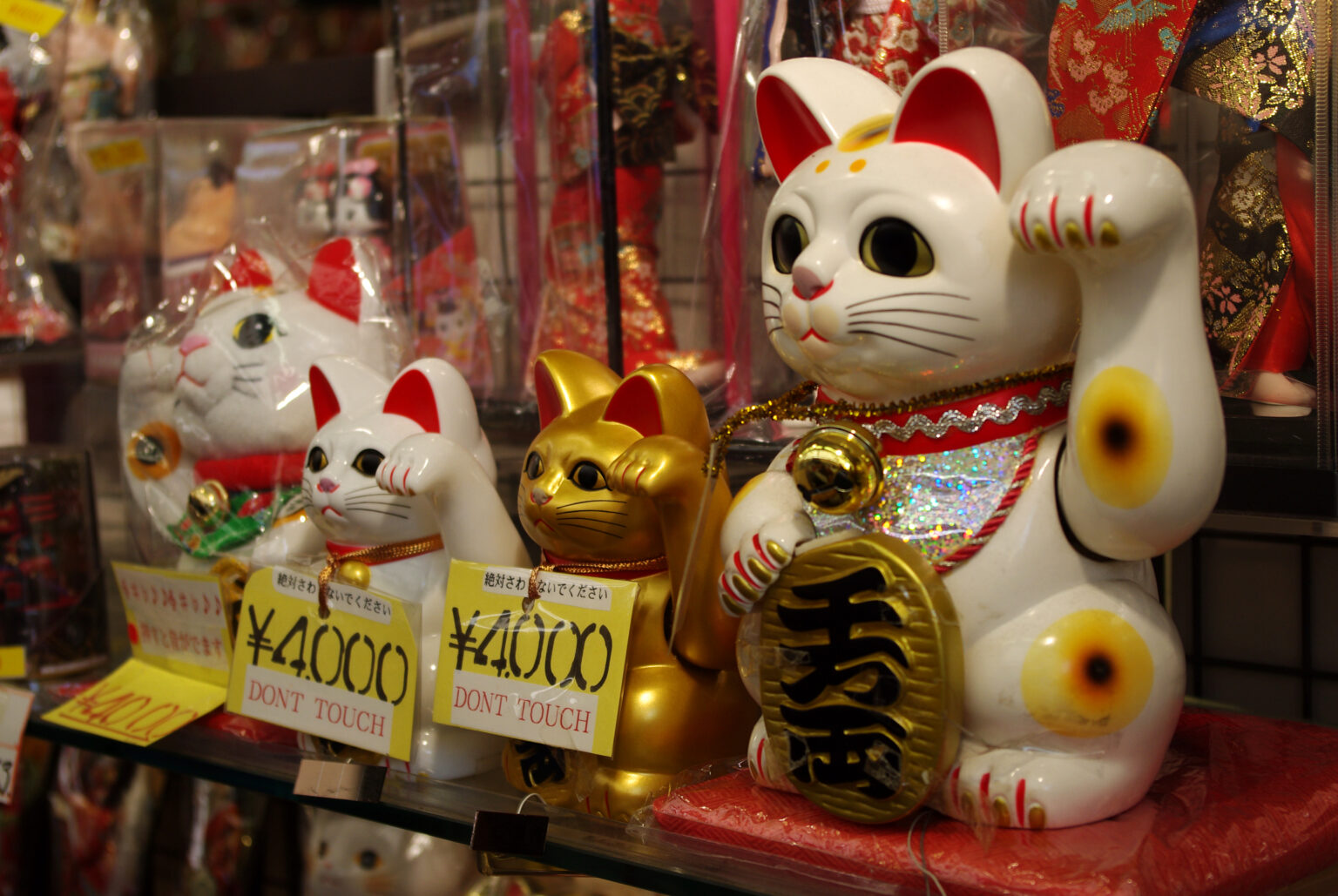
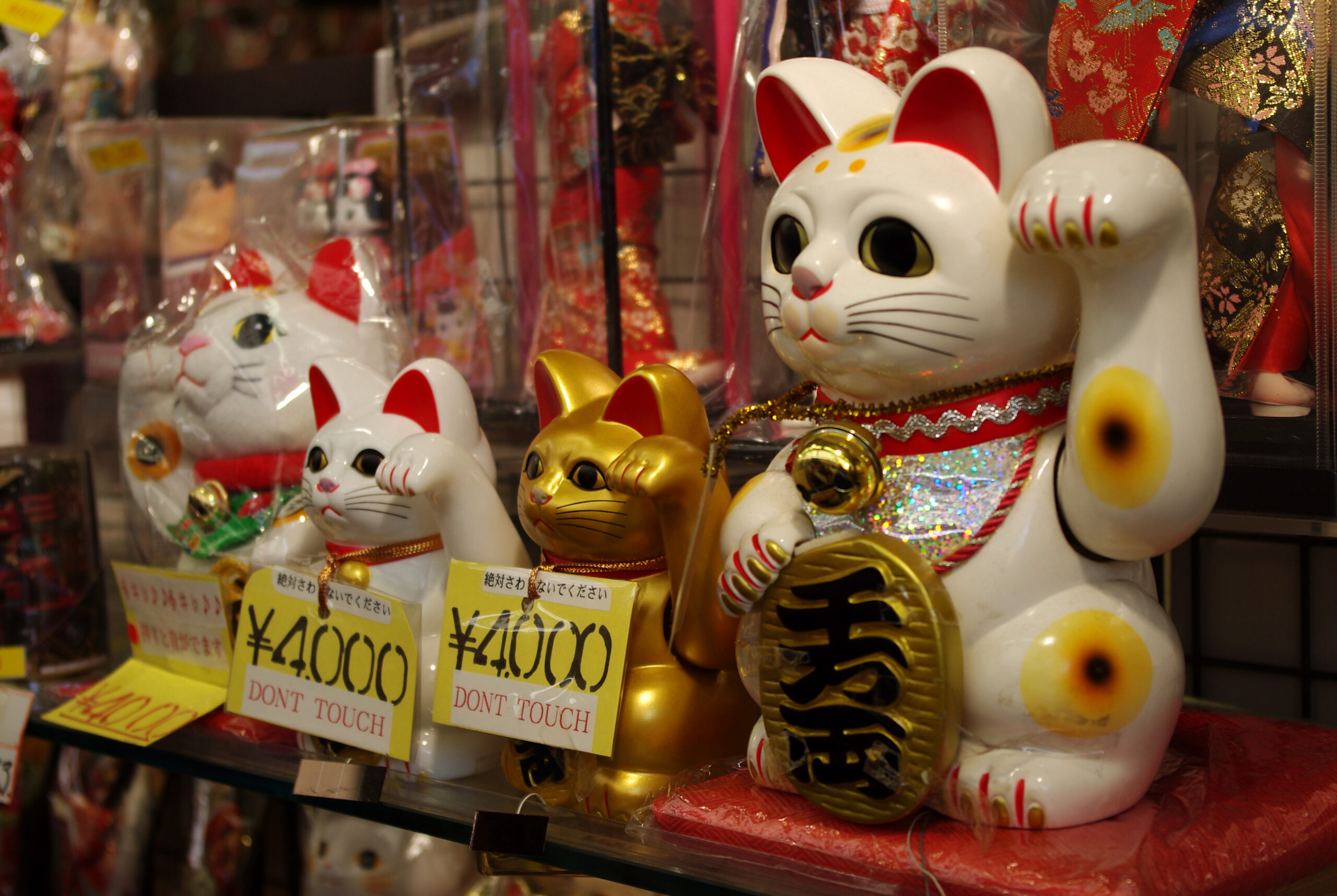
The largest cat in the Asakusa shop display wears a red bib and holds an oversized gold-colored coin. One paw rests beside its ear. Even with price labels in front, the cats seem to be addressing someone beyond the display. That gesture is the key to maneki neko (招き猫), Japan’s beckoning cat.
Often called a “lucky cat” in English, the figure is familiar at shops and restaurants, where it expresses a wish for good business. Look more closely, though, and its raised paw leads to temple stories, pottery workshops and several different ideas about what good fortune means.1
A small invitation to come closer
The cat’s gesture follows a Japanese way of beckoning: holding a hand with the palm facing down and moving the fingers. Read the paw as an invitation to approach. The familiar upright pose gives that passing movement a permanent form.2
A common explanation assigns a different wish to each paw. These are the cat’s own right and left, which appear reversed when you face it.3
| Raised paw | What it is said to invite |
|---|---|
| Right paw | Money and financial good fortune |
| Left paw | People, including customers |
That is a useful starting point. A particular temple or maker may give its cats a more specific meaning.
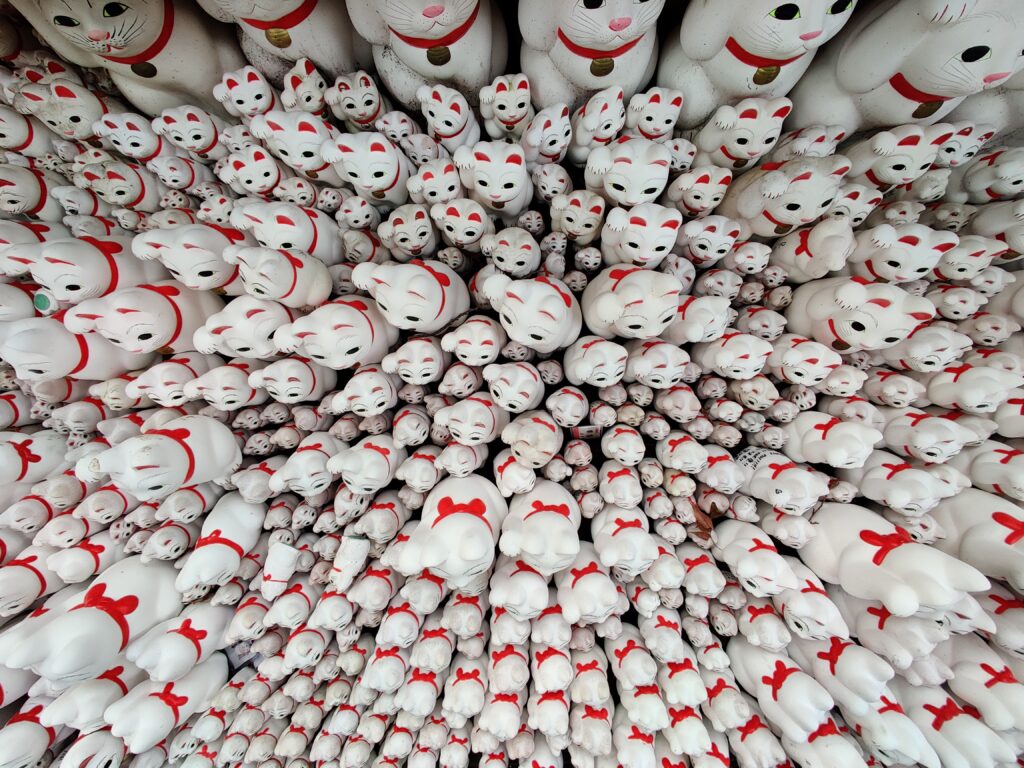
Compare the opening photograph with the cats at Gōtokuji below. The large shop-display cat raises its own left paw; the temple cats raise their right. Once you notice that difference, the figurines become easier to read individually, even when they share white bodies and red collars.
The temple cat that invites connections
At Gōtokuji in Tokyo, the temple’s white cat raises its right paw and carries no koban, the oval coin held by many shop-display cats. Gōtokuji explains that its cat invites people and the connections between them. Making something of those encounters depends on the person who receives them.4
The temple’s legend tells of the lord Ii Naotaka, returning from falconry, being beckoned inside by a cat. A thunderstorm began while he was there. Grateful for the shelter and his conversation with the abbot, he later supported the temple.4
Today, cats of many sizes gather in its offering area. The temple says many people bring cats back after their wishes come true, although returning one is not a fixed requirement. The gathering can be understood as an accumulation of gratitude, with each figure standing for a different person’s story.4
Several stories, an uncertain beginning
Gōtokuji’s account belongs to a wider collection of origin stories. The Museum of Kyoto explains that the precise emergence of a cat figurine with one paw raised remains unclear. It points to a documented craze for marushime-neko in 1852, while carefully avoiding the claim that these were necessarily the original beckoning cats.5
There is a concrete glimpse of that world in an 1852 work by Utagawa Hiroshige held by the National Museum of Japanese History. Its catalogue identifies a scene showing a man handling beckoning cats beneath a marked shop curtain. The figures were already part of a recognizable commercial scene.6
Giving a wish a color
Color adds another layer of interpretation. The Japan Maneki Neko Club associates white with general good fortune and household safety, gold with financial luck, black with warding off misfortune, and pink with love. These colors express wishes; they are a vocabulary people can use when choosing a cat.3
Even a color guide reflects who is explaining it. Aichi’s tourism guide associates red with protection from evil, while the club connects it with health and longevity. A helpful question in a shop is therefore what this particular cat is meant to invite.38
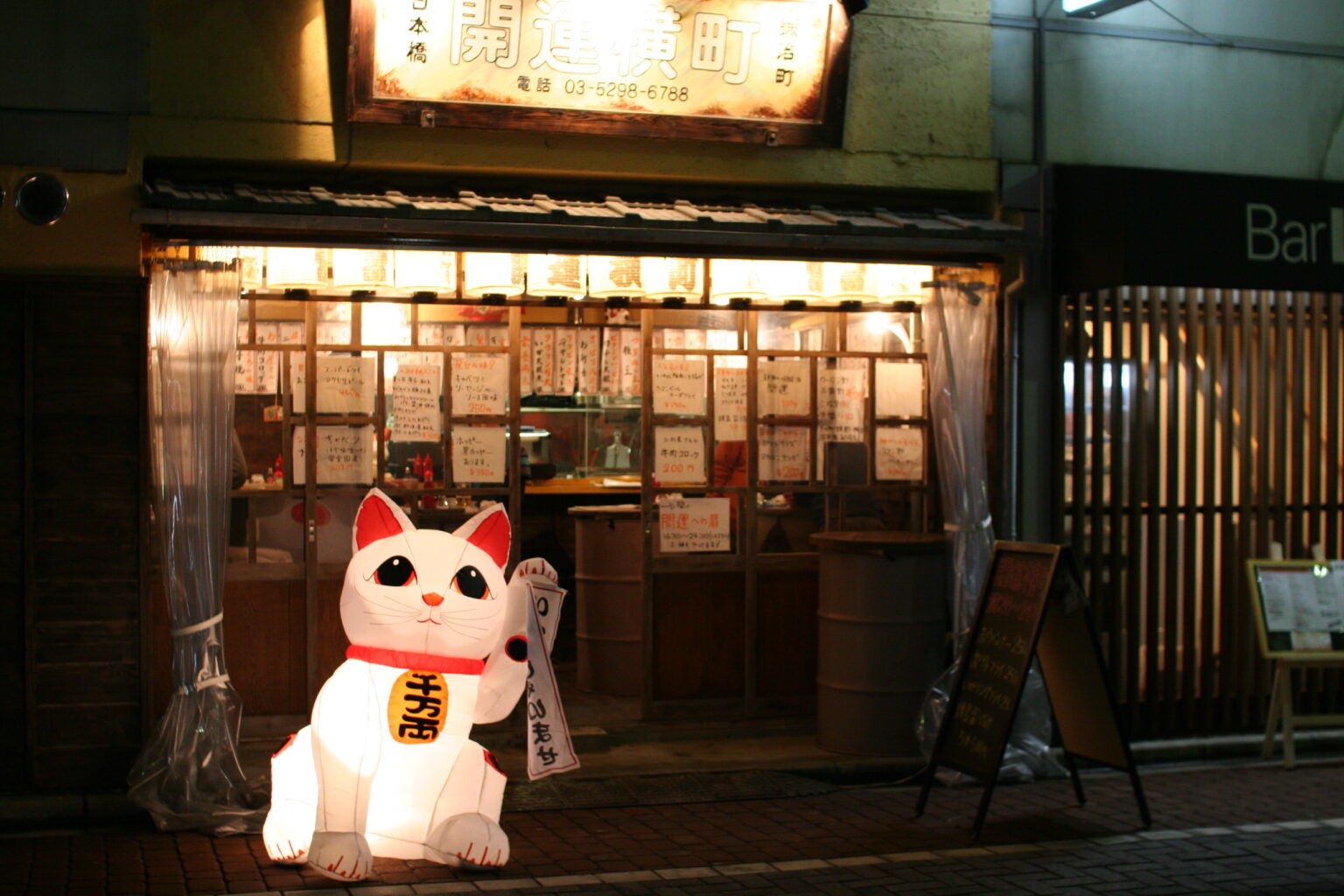
The club also says there is no fixed rule for displaying one. A cat at a shop entrance takes on meaning from its setting: beside a menu and a welcoming light, the raised paw makes the invitation visible before anyone speaks.3
Clay, molds and the maker’s hand
The familiar silhouette can make these cats seem interchangeable. Looking at how one maker works reveals more decisions than the finished outline suggests.
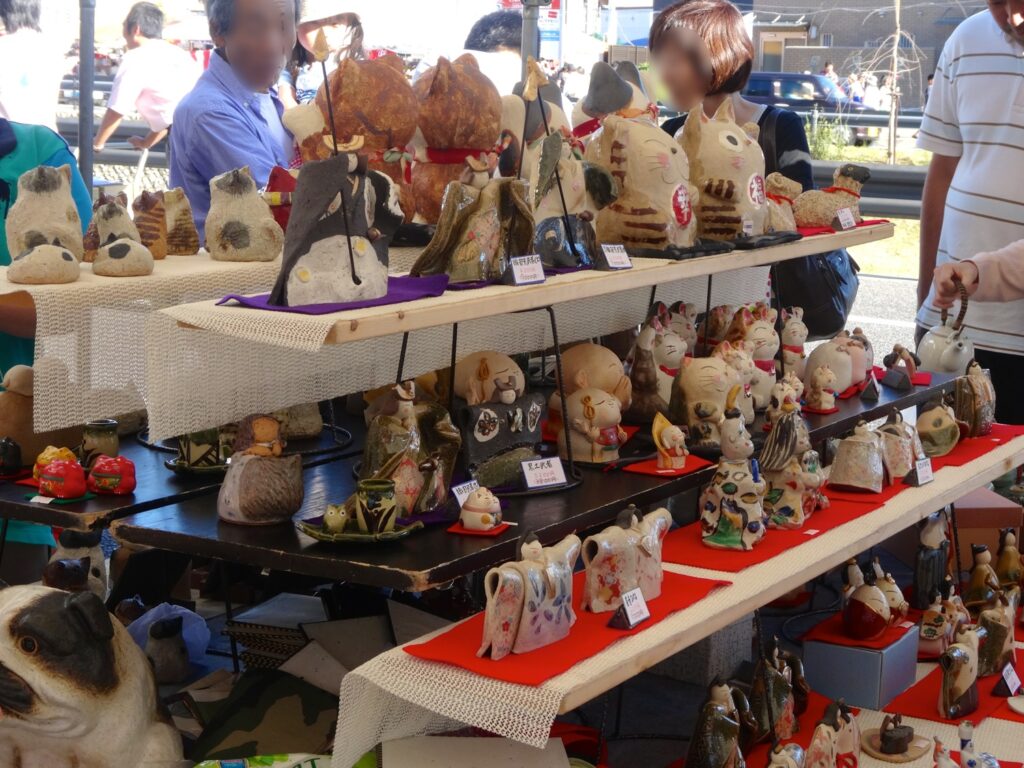
At Chugai Toen in Seto, Aichi Prefecture, the company’s Suhara workshop uses plaster molds. Liquid clay is poured in, the excess is drained, and the formed piece is removed. Parts are attached, surfaces are smoothed, and the figure dries slowly. Painting, glazing and firing then build up its finished appearance.7
The company describes handwork throughout this process. Some decoration goes beneath the glaze; other colors and details are added after firing and fired again. A mold establishes the form, while hands still shape the finish. The next time you look at a ceramic cat, follow the whiskers, the edge of the bib and the painted curve around an eye.7
Two pottery towns, different faces
Seto and Tokoname, both in Aichi, offer useful comparisons. Aichi’s official tourism guide describes traditional Seto-style porcelain cats as slender, with flowing lines and delicate details such as frilled bibs. Tokoname-style cats have stockier bodies, round faces, large ears and prominent eyes. These are regional tendencies, with room for individual designs.8
Tokoname began producing beckoning-cat figures in the late 1930s, according to the Japan Tourism Agency’s account. That history helps explain why a seemingly timeless symbol also belongs to the changing work of a pottery town.2
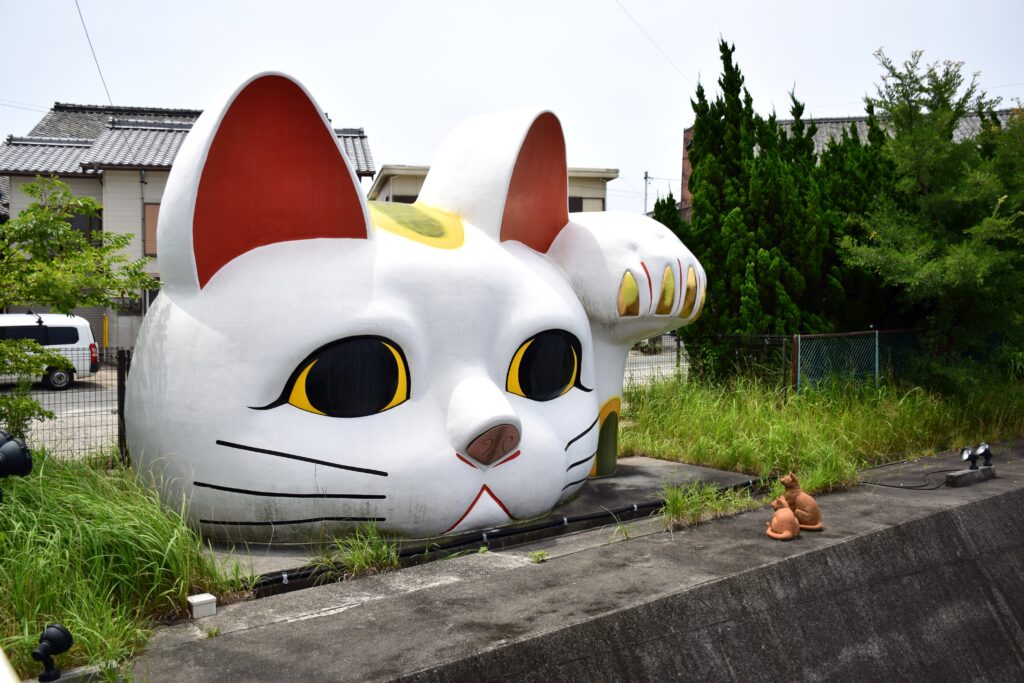
The connection becomes wonderfully oversized at Tokonyan, the enormous cat head and raised paw above an embankment on the town’s Lucky Cat Street. Created in 2008, it turns a figure associated with welcoming customers into part of the town’s welcome to visitors.9
Finding the cat you want to live with
Seto’s Maneki Neko Museum shows how broad this family is. Its collection includes regional clay figures and papier-mâché toys, alongside cats grouped by pottery-producing area. Materials, expressions and decorations change while the beckoning idea remains recognizable.10
When choosing one, start with what catches your attention. Look at the paw, ask about the maker, and find out how that particular cat’s meaning is explained. A shopkeeper’s wish for another customer and a temple visitor’s gratitude give the same small gesture different emotional weight. On a shelf at home, your cat can carry a wish of your own.
Continue exploring
More from everyday Japan
Sources & further reading
Sources checked on October 19, 2026. Temple accounts, museum records, public cultural resources and a maker’s own description support the article’s history and interpretations.
- Web Japan, Ministry of Foreign Affairs — Lucky Cats — Maneki-neko. The familiar ornament and its place in shops and restaurants.
- Japan Tourism Agency / Tokoname Tourism — Maneki Neko (Lucky Cats). Japanese beckoning gestures and the history of Tokoname production.
- Japan Maneki Neko Club — Questions and answers about maneki neko. Common paw and color interpretations, and display practices. Japanese.
- Gōtokuji — The origin of the temple’s shōfuku neko. The temple’s own legend and interpretation of its cat. Japanese.
- The Museum of Kyoto — いつだって猫展 — 2017 cat exhibition. The section on beckoning cats distinguishes origin stories from nineteenth-century records. Japanese.
- National Museum of Japanese History — 浄るり町繁花の図 — collection record F-320-832. An 1852 work by Utagawa Hiroshige depicting marushime-neko. Japanese catalogue description.
- Chugai Toen — About Chugai Toen. The Seto maker’s account of casting, finishing, painting and firing in its workshop. Japanese.
- Aichi Prefecture / Aichi Now — Visit the beckoning-cat pottery towns of Tokoname and Seto. Regional forms and color interpretations. Japanese.
- Japan Tourism Agency / Tokoname Tourism — Tokonyan and Lucky Cat Street. The giant cat landmark and its creation in 2008.
- Maneki Neko Museum, Seto — Permanent exhibition. The museum’s regional folk toys, materials and pottery collections. Japanese.
Photograph credits, original titles and reuse licenses appear with each image. Photograph dates are given in the captions.




Comments