Kiyomizu-dera in Kyoto: The Wooden Stage Above the City
More than a famous viewpoint, Kiyomizu-dera is a story of timber engineering, compassionate worship and pure spring water. Discover the details behind one of Kyoto’s most unforgettable walks.
8 MIN READ
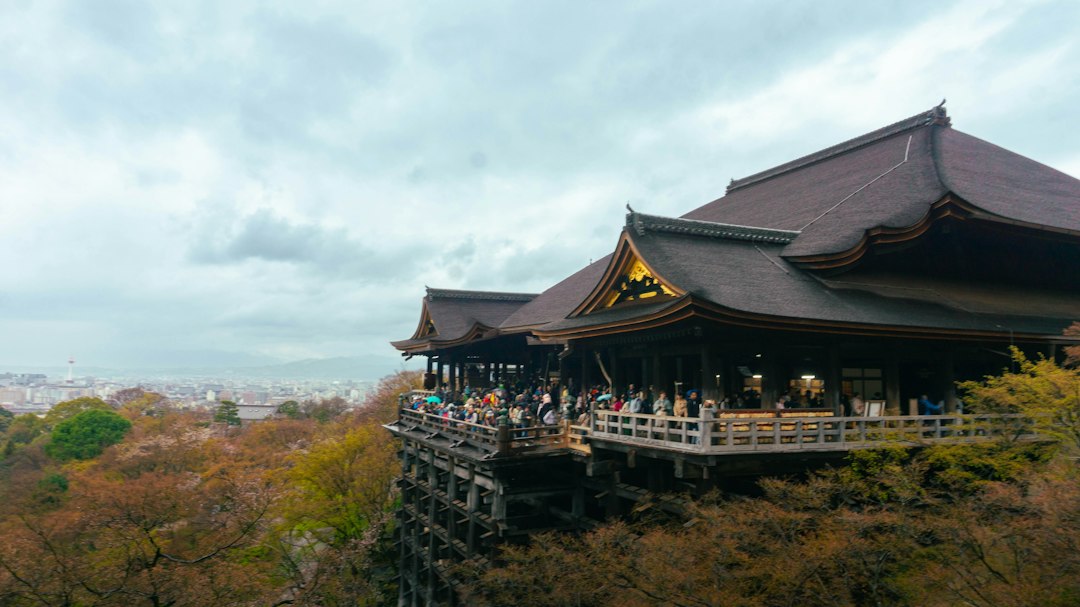
Photo: Michael Stevanus Hartono / Unsplash.
The city stretches away below the wooden railing. Behind you are heavy timber beams and the dark sweep of the temple roof; in front of you, trees spill down the mountainside towards Kyoto’s streets. It feels like standing in the middle of a landscape rather than simply looking at one.
This is Kiyomizu-dera, the famous Buddhist temple on the slopes of Mount Otowa in eastern Kyoto. Its hillside stage is one of Japan’s best-known architectural sights, but the view is only the beginning. The structure beneath your feet, the waterfall that gave the temple its name, and the old lanes leading uphill all belong to a story more than twelve centuries old.1
The wooden stage is part of the main hall
The broad platform called Kiyomizu no Butai projects from the temple’s main hall over a steep slope. It is not a separate viewing tower. Rather, it extends the space of a Buddhist place of worship into the landscape, allowing visitors to look out over Kyoto and the wooded hills.2
From a distance, the stage can look almost precarious. Come closer and notice that it is supported by a deliberately composed forest of timber rather than a single wall. The traditional method is known as kake-zukuri, or a framework built to extend over sloping ground.
The stage rises approximately 13 metres above the hillside. The temple identifies 18 main zelkova pillars in its stage structure, connected by large horizontal timbers. The joints of this supporting framework are put together without nails. That is a remarkable fact about the stage’s framework—not a claim that every part of the temple contains no metal.1
Some visitors come for a photograph of the famous balcony. The more interesting detail may be below it: the way the carpenters made a tall, interlocking wooden system stable enough to serve a living temple on difficult terrain.
A temple founded in 778, rebuilt across the centuries
Kiyomizu-dera traces its beginnings to 778. In the temple’s founding tradition, a Buddhist monk named Kenshin was guided towards a pure spring on Mount Otowa. He later worked with the warrior Sakanoue no Tamuramaro to establish a place of worship associated with Kannon, the bodhisattva of compassion.3
These details are preserved as a religious founding narrative. What is firmly visible in the site’s history is the extraordinary continuity of worship through repeated loss and rebuilding. Fires destroyed temple structures many times. Much of the architecture standing today, including the present main hall and stage, was reconstructed in 1633.3
The temple is also part of the UNESCO World Heritage property Historic Monuments of Ancient Kyoto, inscribed in 1994. The listing recognises a group of historic religious sites and Nijo Castle, whose architecture and gardens illustrate the development of Japanese culture.4
What does “jump off the stage” mean?
Japanese has a striking expression: Kiyomizu no butai kara tobioriru, literally “to jump from the stage of Kiyomizu.” It means making a bold decision or taking a major risk—something like “taking the plunge” in English.5
This is an idiom, not an activity to attempt. The height of the stage made it a powerful image of the courage required for a difficult choice. Today the expression still connects a famous Kyoto landmark with an everyday human feeling: deciding to do something despite uncertainty.
Looking over the rail, it becomes easy to understand why this particular structure gave the language such a memorable metaphor.
The main hall is a place of worship
The principal sacred image at Kiyomizu-dera is an Eleven-headed, Thousand-armed Kannon, enshrined in the inner area of the main hall. Kannon is associated with compassion for suffering beings, and the temple has long been a place where people come to pray as well as to admire the landscape.2
You do not need to know every Buddhist custom to visit respectfully. Keep your voice quiet near worshippers, give people time and space to pray, and follow any signs restricting photography. There is nothing wrong with enjoying the view, but it helps to remember that the buildings are still used for religious life.
Look back from Okuno-in
After visiting the main hall, continue along the temple route towards Okuno-in Hall. This smaller hall has its own projecting platform and is one of the best-known places to look back towards the main stage.2
It is a useful change of perspective. From the stage, the city and hills dominate the view. From farther along the route, the entire main hall appears as a constructed object placed among trees. You can see the large roof, the overhanging platform and the supports beneath it at once.
Autumn colours can make the scene especially dramatic, while summer greenery gives it a softer, continuous backdrop. The design, rather than any particular season, is what makes this vantage point worth visiting.
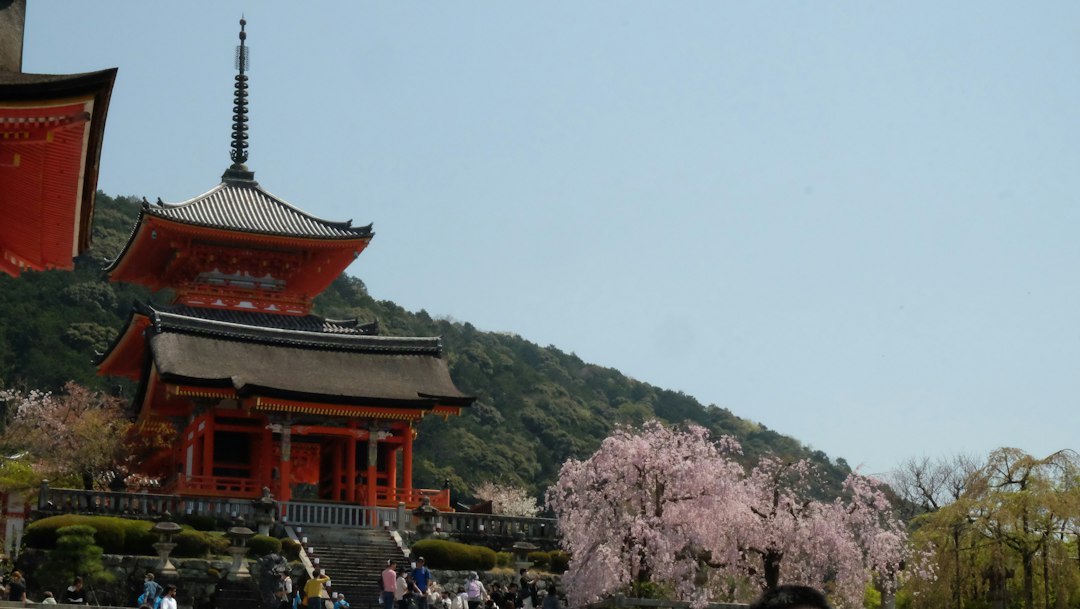
Photo: erika m / Unsplash.
Otowa Waterfall: the origin of the name
Near the lower part of the grounds is Otowa no Taki, or Otowa Waterfall. The name Kiyomizu means “pure water,” a reference to the spring that flows here.2
The waterfall is divided into three streams. Visitors traditionally collect a little water with long-handled cups while praying for purification and their wishes. The temple describes the water as sacred and links it to the purification of the senses. You may hear popular stories that give each stream a different benefit, but there is no need to treat them as a guaranteed formula for health, love or academic success.6
If the area is busy, observe the ritual and join only if there is room. Follow current on-site directions for the cups and queues. The gentle sound of running water gives a very different rhythm from the busy platform high above.
A red gate and a pagoda mark the approach
Before reaching the main hall, visitors pass the striking Nio-mon Gate, one of the first vivid sights at the temple. The present gate was rebuilt around 1500, following the destruction of an earlier structure in a fifteenth-century conflict, and it has undergone modern conservation work.2
The pagoda and other temple buildings introduce splashes of vermilion against the mountain landscape. Their contrast with the unpainted timber of the main hall makes the complex feel like a sequence of different spaces, rather than a single monument.
There is a pleasing order to this walk: the bustle of the approach, the colour of the gates, the solemn atmosphere of the main hall, the broad view from the stage, and finally the quieter water at the foot of the hill.
Sannenzaka and Ninenzaka: the streets that lead uphill
The journey to Kiyomizu-dera begins well before the temple gate. The old sloping streets known as Sannenzaka and Ninenzaka are lined with wooden shopfronts, teahouses, small restaurants and places selling traditional crafts. Their stone-paved steps create one of Kyoto’s most recognisable streetscapes.7
Look for pottery associated with Kiyomizu-yaki, one of Kyoto’s best-known ceramic traditions. Pause to notice the rooflines, the wooden latticework and the way the lanes bend around changes in level. This is a historic townscape shaped by centuries of visitors coming to worship, not simply a decorative backdrop for photographs.
The area remains a neighbourhood where people live and work. Kyoto’s official visitor guidance asks travellers not to block narrow streets, use tripods where prohibited or photograph people without consideration. There is no need to turn a walk into a competition to capture an empty street.8
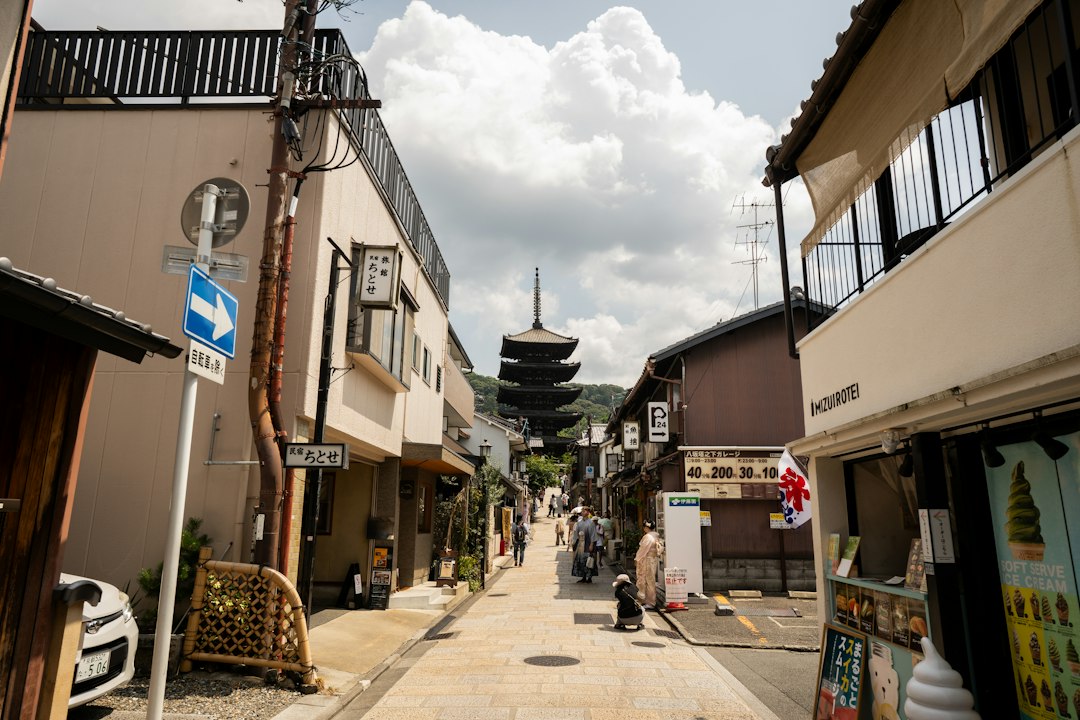
Photo: Emanuele Ricciardi / Unsplash.
A relaxed route for a first visit
Allow time both for the main temple and for the surrounding district. Rather than trying to photograph everything, follow a route that reveals how the hillside, buildings and old streets connect.
- Approach through Higashiyama. If you enjoy walking, Kyoto’s official guide recommends a scenic route from Higashiyama Station via Maruyama Park, Ninenzaka and Sannenzaka, taking around 40–45 minutes without long stops.7
- Enter by Nio-mon Gate. Observe the vermilion entrance, the changes in level and the way the complex is arranged on the slope.
- Visit the main hall and stage. Look at the interlocking timber supports and take in the view while leaving space for worshippers and other visitors.
- Continue to Okuno-in. Look back towards the main stage to understand its shape and the remarkable timber framework beneath it.
- Descend towards Otowa Waterfall. Learn about the spring that gave the temple its name, then make your way back through the old streets.
Allow two to three hours for the temple and a leisurely walk through the surrounding streets. You may want longer if you intend to browse shops, have lunch or explore other nearby temples.
Opening hours and the autumn night view
Kiyomizu-dera opens at 6:00 a.m. year-round. Its closing time varies by season. As of November 2026, admission is ¥500 for adults and ¥200 for primary and junior high school students. The temple’s 2026 autumn special night viewing is scheduled for November 21–30, with closing extended to 9:30 p.m. and last entry at 9:00 p.m.9
Autumn colours and evening illumination can be spectacular, but the busiest hours can also make the approach slow. Check the temple’s latest calendar and Kyoto’s congestion forecast before travelling. If you prefer a calmer visit, early morning is often a better choice than arriving at the peak of the afternoon rush.10
Questions before you go
How high is Kiyomizu-dera’s famous stage?
The wooden stage rises approximately 13 metres above the hillside, roughly comparable with a four-storey building. Its supporting framework includes 18 major zelkova pillars.1
Was the entire temple really built without nails?
No. The famous “without nails” description applies to the joinery of the stage’s main support framework. It should not be extended to every building or fitting in the temple complex.
Can I visit Kiyomizu-dera without booking?
Ordinary temple visits generally do not require advance reservations. The grounds open at 6:00 a.m., and admission is purchased on arrival. Always confirm special events, opening hours and any changes before travelling.
How do I get there from Kyoto Station?
You can use public transport towards the Higashiyama area, then walk up the hill. Kyoto’s official guide provides routes designed to avoid the most congested bus services. Alternatively, Kiyomizu-Gojo Station on the Keihan Railway is roughly a 25-minute uphill walk from the temple.11
Is the walk accessible for all visitors?
The historic approach streets have slopes and steps. The temple provides information on accessible routes to its grounds. If mobility is a concern, consult the official access and wheelchair map before choosing your route.
A place where architecture meets the landscape
It is easy to remember Kiyomizu-dera as a single photograph: a broad wooden platform above autumn trees. But its deeper beauty appears when you connect the scenes—the old street rising through the neighbourhood, the gates on the slope, the beams under the stage and the clear water below.
The temple has stood in different forms for over a thousand years, yet it has never been separate from the mountain supporting it. To walk here is to see architecture working with the land, and a place of worship remaining part of Kyoto’s everyday life.
Sources and further reading
- Kiyomizu-dera Temple: Official history and main hall — wooden stage, structure, founding and rebuilding.
- Kiyomizu-dera Temple: Official grounds guide — Nio-mon, Main Hall, Okuno-in and waterfall.
- Kiyomizu-dera Temple: Temple origins — founding tradition and the 1633 reconstruction.
- UNESCO World Heritage Centre: Historic Monuments of Ancient Kyoto — inscription year (1994) and heritage significance.
- Kyoto City Official Travel Guide: Kiyomizu-dera Temple — stage and Japanese idiom.
- Kiyomizu-dera Temple: Otowa Waterfall — pure water and ritual use.
- Kyoto City Official Travel Guide: Higashiyama walking routes — Ninenzaka, Sannenzaka and access.
- Kyoto City Official Travel Guide: Responsible Travel — considerate photography and street etiquette.
- Kiyomizu-dera Temple: 2026 hours and 2026 special events; Japan Guide: Admission. Checked November 2026.
- Kyoto City: Travel Congestion Forecast — visitor planning.
- Kyoto City Official Travel Guide: Comfortable access to Higashiyama — transport and walking routes.
Opening hours, fees and special events may change. Consult the temple’s official website when planning a visit.



Comments