Real Life in Japan · 12 minute read
More Than a Konbini: The Store That Keeps Everyday Japan Running
Behind Japan’s extraordinary convenience lies a story of changing lives, tireless workers, and a society that never quite stops.
LAYERS OF JAPAN
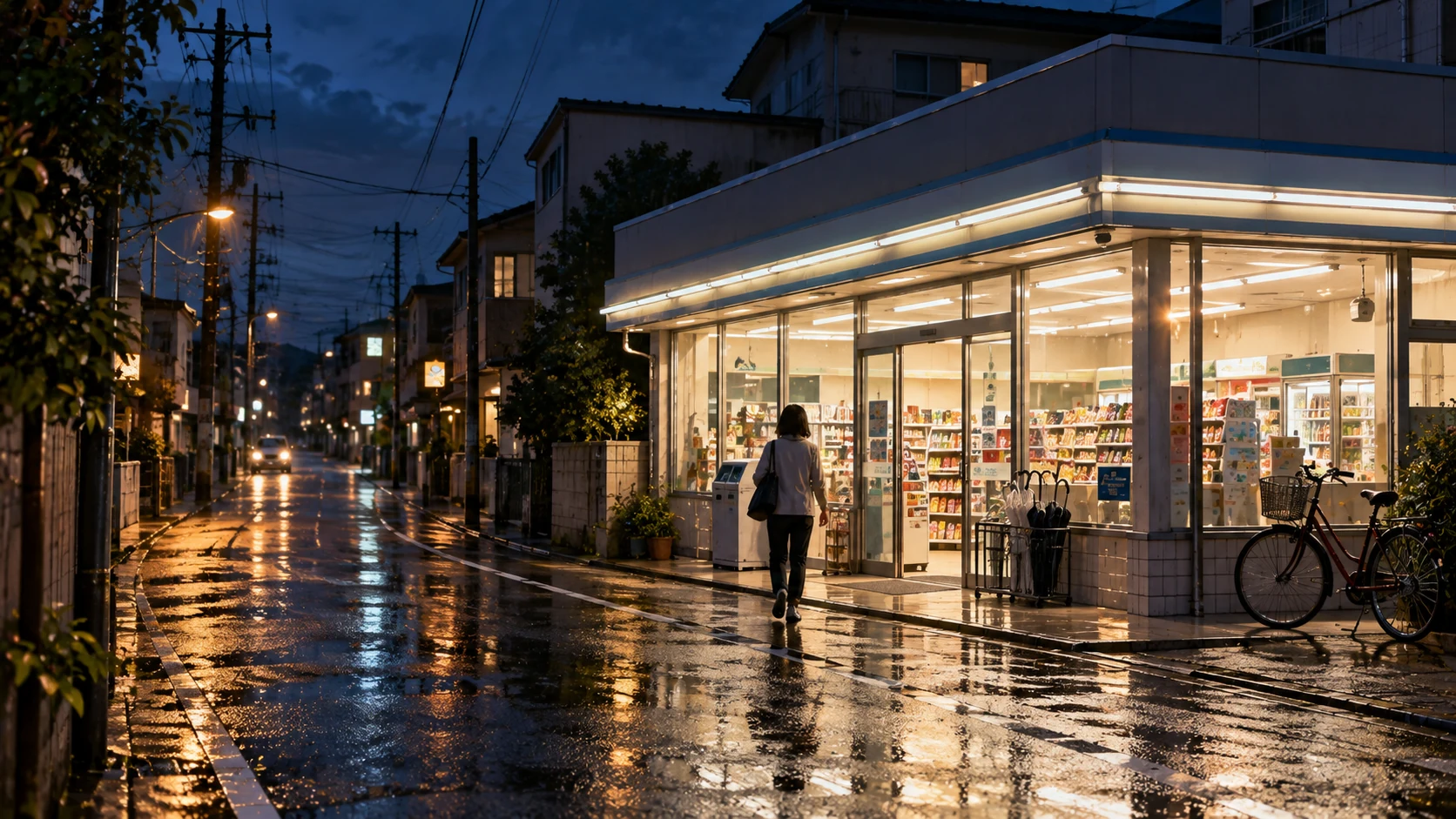
It is nearly eleven at night. Rain has just stopped in a quiet Japanese neighborhood, and the pavement reflects the lights from a small shop on the corner.
Someone steps inside on the way home from work. They need dinner, perhaps a drink, and a place to collect a package that arrived while they were away. The shelves are bright, the floor is clean, and the familiar chime at the door makes the visit feel almost effortless.
In the morning, the same shop might serve a student looking for breakfast, someone paying a bill, or an older resident buying a few groceries. By the afternoon, another customer may be printing a document or sending a parcel.
This is the konbini: Japan’s convenience store.
Visitors often love the food, the neatly arranged shelves, and the sense that nearly everything can be accomplished in one small space. But for people who live in Japan, the deeper story is not simply that the store is convenient.
It is that the store has become woven into the structure of ordinary life.
Convenience can look effortless from the customer’s side of the counter. Behind it is a complicated system of people, schedules, deliveries, and decisions.
1. A Small Store with an Enormous Role
Japan’s convenience stores are everywhere without being quite the same everywhere. You find them beside railway stations, between apartment buildings, along highways, near offices, and in neighborhoods that become very quiet after dark.
According to figures compiled by the Japan Franchise Association, the chains covered by its statistics operated approximately 56,000 stores at the end of 2025, with annual store sales totaling more than ¥12 trillion. Those figures describe the association’s reporting coverage and period; they are not a count of every independent small retailer in Japan.
The numbers help explain the scale, but they cannot explain how personal the stores can feel.
A konbini may be the place where someone buys breakfast every weekday, picks up a replacement phone charger in an emergency, or stops for a cold drink on a humid summer evening. The store becomes part of the route between home and work, or the space between one appointment and the next.
Yet no two customers need it for exactly the same reason.
That flexibility is one of the great achievements of the Japanese konbini. It is also the beginning of a difficult question: how much responsibility can one small store reasonably carry?
2. The Meal You Can Take Home in Five Minutes
For many overseas visitors, food is the first attraction.
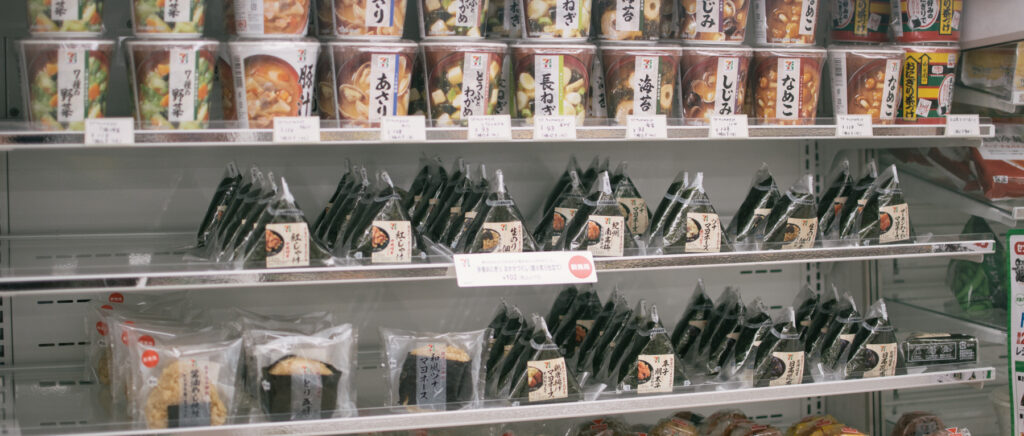
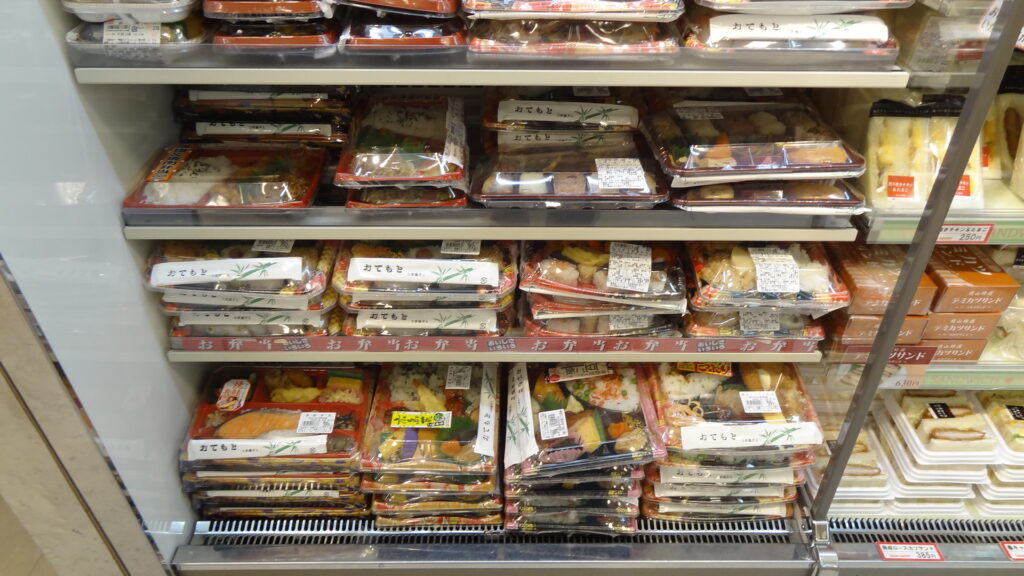
Rows of onigiri—rice balls wrapped or packaged in ways that keep the seaweed crisp—sit beside sandwiches, noodles, salads, prepared side dishes, desserts, and neatly arranged bento lunches. Hot snacks may be available at the counter. Seasonal products come and go.
The selection changes by chain, neighborhood, and time of day, and not every store carries the same range. Still, the attention given to convenience-store food is unmistakable.
For someone living alone, a ready-made meal can mean there is no need to cook after a late shift. For an office worker, an onigiri and a cup of tea can fit into a short lunch break. For a family managing a busy evening, a prepared side dish may make dinner easier.
It would be misleading, however, to say that Japanese people have abandoned home cooking or that a convenience-store dinner is necessarily a lonely one. People use these shops in many ways, alongside supermarkets, markets, restaurants, and food prepared at home.
There are trade-offs, too: price, nutrition, packaging, portion size, and the simple pleasure of cooking all matter. Konbini food solves certain problems; it does not replace every other kind of meal.
But it has changed the range of choices available on an ordinary Tuesday night.
3. The Shop That Also Acts Like an Office
Now imagine needing to do something other than eat.
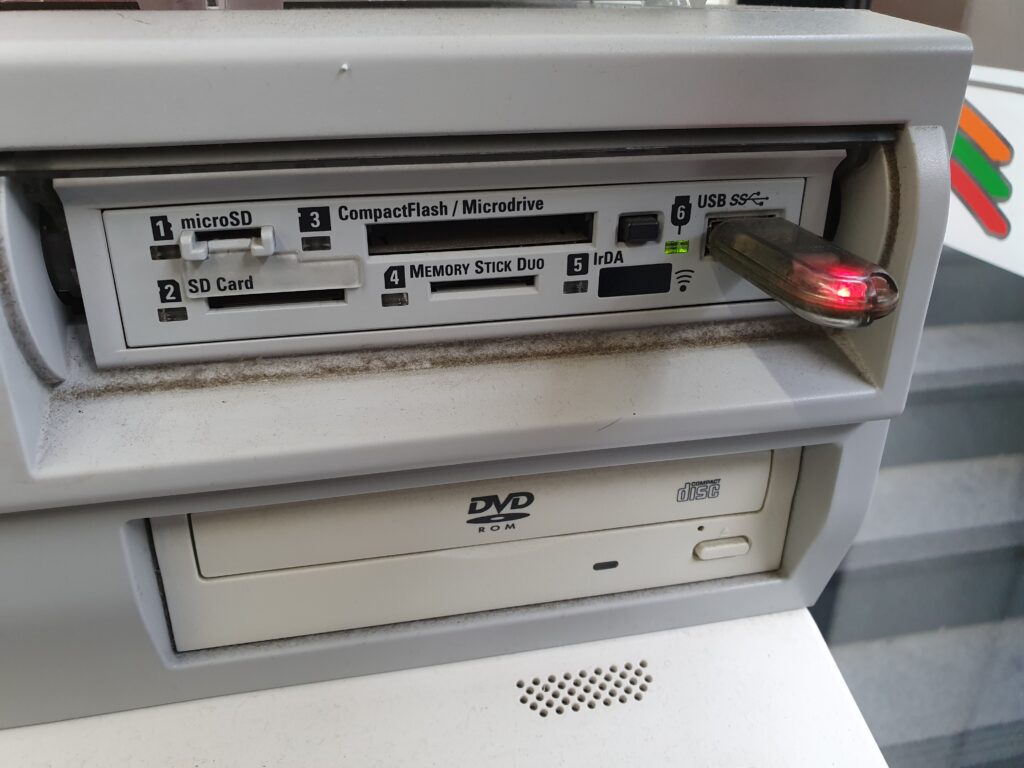
In many Japanese convenience stores, customers can use an ATM, pay certain bills, send or collect parcels, print photographs or documents, buy event tickets, or complete other everyday errands. Selected stores and municipalities also support the printing of some official certificates through multifunction machines.
The details vary by chain, location, payment provider, and participating municipality. A service available in one shop cannot automatically be assumed to exist in every shop.
Still, the overall effect is remarkable.
A konbini is part food retailer, part logistics counter, part payment point, and part access point to digital services. It allows customers to complete small tasks outside the opening hours of more traditional offices.
That flexibility is particularly useful for people whose working hours do not match a typical nine-to-five schedule.
What looks like one small retail store is connected to banks, delivery networks, service companies, and administrative systems.
The customer sees a counter. Behind it is an entire network.
4. The People Behind the Counter
The store’s ease of use depends on work that is not always visible.
A shift may involve checkout, restocking, receiving deliveries, preparing hot food, answering questions about a machine, managing parcels, cleaning, monitoring expiry dates, and responding to unexpected problems.
None of this means every convenience-store job is miserable. For some workers, flexible shifts, local access, and familiarity with customers are real advantages. Some shop owners take considerable pride in running a dependable neighborhood business.
But the number of different tasks can become burdensome, especially when staffing is thin.
Japan’s Ministry of Economy, Trade and Industry (METI) examined the relationship between franchise headquarters and convenience-store owners during its 2019–2020 review of the industry. Its surveys documented concerns about labor shortages, long hours, the burden of multiple duties, and working conditions associated with late-night shifts. Those findings are historical evidence of the issues under discussion—not a survey of every konbini worker in 2026.
The underlying tension remains worth asking about: a store that is useful to everyone may place intense demands on the people expected to operate it.
The lights may be on around the clock. No individual worker can be expected to work around the clock.
5. Why “Open 24 Hours” Is More Complicated Than It Looks
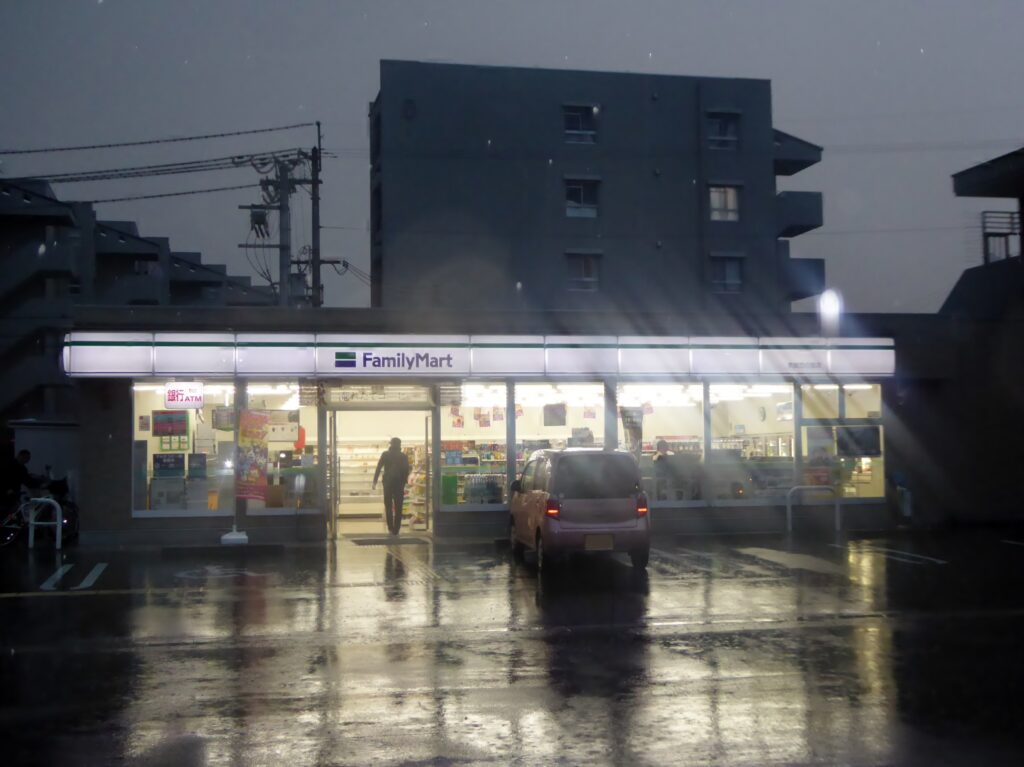
The image of a bright store at two in the morning has become part of the konbini’s appeal.
Someone can buy toiletries, a drink, or a meal after other shops have closed. A late shift or an unexpectedly long journey becomes easier to manage.
Yet not every Japanese convenience store is open twenty-four hours, and opening arrangements can differ by location or change over time.
For a franchise owner, operating late into the night can mean balancing customer expectations, staffing availability, security, costs, and the terms of a franchise agreement. The problem is not solved simply by telling one more employee to stay later.
Japan’s public debate about convenience-store operations has included questions about shorter hours, the relationship between headquarters and franchisees, and whether a service should be maintained in the same form everywhere.
A busy city-center store and a quiet rural location may face very different conditions.
The right question may not be whether convenience is good or bad. It may be what kind of convenience is sustainable for the people who provide it.
6. The Invisible Journey of an Onigiri
Pick up an onigiri from a refrigerator and its journey seems to begin at the shelf.
In reality, many decisions came first: forecasting demand, sourcing ingredients, producing the item, packaging it, transporting it under appropriate conditions, delivering it, and placing it where customers can find it.
Modern convenience-store systems depend on coordination among manufacturers, distribution centers, drivers, store employees, and operators. Freshness has a time limit. A prediction that is too low can mean empty shelves; a prediction that is too high can leave food unsold.
This is one reason the polished appearance of a konbini should not be confused with simplicity.
The tidy refrigerator is the visible end of a complicated supply chain.
That supply chain creates jobs and useful services, but it also consumes energy, transport capacity, packaging, and human effort. A well-stocked shelf is an achievement; it also has an environmental and social cost.
7. When Freshness Becomes Waste
The availability of ready-to-eat food is one of the konbini’s defining strengths. It also creates a challenge: food has a limited time in which it can be sold.
Unsold products are not all handled identically, and it would be wrong to imagine that every item is automatically thrown away. Stores and chains use different processes, including improvements in shelf life, ordering, price reductions, and other food-loss measures.
One public campaign is temaedori—encouraging people who will eat an item soon to choose a product from the front of the shelf, where it may have an earlier date. In October 2026, Japan’s environment and consumer agencies again promoted this approach with convenience-store and other retail associations.
Seven-Eleven Japan has also described markdown initiatives for selected fresh foods approaching the end of their selling period.
These are meaningful attempts to address a real conflict. Customers want freshness and choice. Businesses want to avoid disappointing them. But producing and stocking more than will be purchased can create waste.
The best solution is unlikely to be one slogan or one technology. It requires changes in how food is made, ordered, priced, selected, and valued.
8. The Konbini and the Aging Neighborhood
A convenience store may be useful to a young office worker, but its role can be different for an older resident.
For someone who no longer drives, a nearby place to buy food and daily essentials can make an important difference. Yet the presence of a konbini does not automatically solve transportation, affordability, or access problems. Some communities have no nearby store at all.
Companies have been experimenting with new models in response.
Lawson, for example, describes mobile sales services serving certain care facilities and areas where shopping is difficult. In August 2026, it announced a model called “with LAWSON,” beginning with a shop in Ishinomaki, Miyagi Prefecture, that builds on an existing local business rather than requiring a conventional full-size convenience-store site.
The project is one specific example, not proof that rural shopping problems have been solved. Still, it suggests a new direction: a convenience store can sometimes work with an established community shop rather than simply replacing it.
That is a particularly interesting development when considered alongside the changing future of Japan’s traditional shopping streets.
9. Convenience Stores and the Shops That Came Before
In many neighborhoods, a konbini stands not far from a supermarket, a family-run shop, or a shōtengai shopping street.
The relationship is often described as competition. Chain stores can offer long opening hours, standardized services, and purchasing systems that small businesses may struggle to match.
But commerce is more complicated than a simple story in which one kind of shop defeats another.
Some residents want the efficiency of a konbini and the personal relationships of a neighborhood greengrocer. Different stores serve different budgets, habits, and needs. In some places, a convenience-store brand may partner with an existing business, as the new Lawson model illustrates.
A district with only one kind of retailer may be less useful than one with a healthy mixture of choices.
The future of everyday shopping in Japan is therefore not necessarily a contest between tradition and modernity. It may be about finding combinations that genuinely support the people living there.
10. What Visitors See—and What Residents Know
For a traveler, a Japanese convenience store can feel extraordinary. You enter a clean, brightly lit space and find a surprisingly wide range of food and useful services.
For a resident, the feeling is often less dramatic.
The konbini is where you stop because you forgot milk. Where you pick up a parcel after work. Where you buy something small for a friend. Where you stand for a moment beneath the awning when the rain becomes too heavy.
It is easy to overlook these ordinary acts precisely because the store makes them so easy.
But if we look a little closer, the konbini becomes a window into larger questions about Japan: demanding work schedules, households that need flexible meals, an aging population, changing town centers, food waste, and the tension between consumer convenience and sustainable working conditions.
The shop is not separate from society. It reflects the society around it.
11. The Light That Someone Keeps On
Return to the shop on the rainy street.
A customer leaves with a small bag. A delivery vehicle may arrive later. An employee straightens a shelf and prepares for the next person. Outside, the road is quiet again.
The store is still glowing.
For the person passing through, that light may mean relief: dinner is possible, an errand can be finished, a problem can be solved before tomorrow.
For the people operating the store, it represents planning, work, and responsibility.
Both perspectives deserve to be seen.
The story of Japan’s konbini is not just that it makes everyday life astonishingly convenient. It is also that convenience has become something many people expect without thinking about what it requires.
Convenience is never truly effortless. Someone, somewhere, is always making it possible.
And perhaps the future of the konbini will depend on learning how to care not only for the customers who walk through its doors, but also for the people who keep those doors open.