Dogs & Life Together · 11 minute read
Why Are Dogs Riding in Strollers in Japan?
What Japan’s pet carts reveal about aging dogs, city life, and the changing meaning of companionship.
LAYERS OF JAPAN
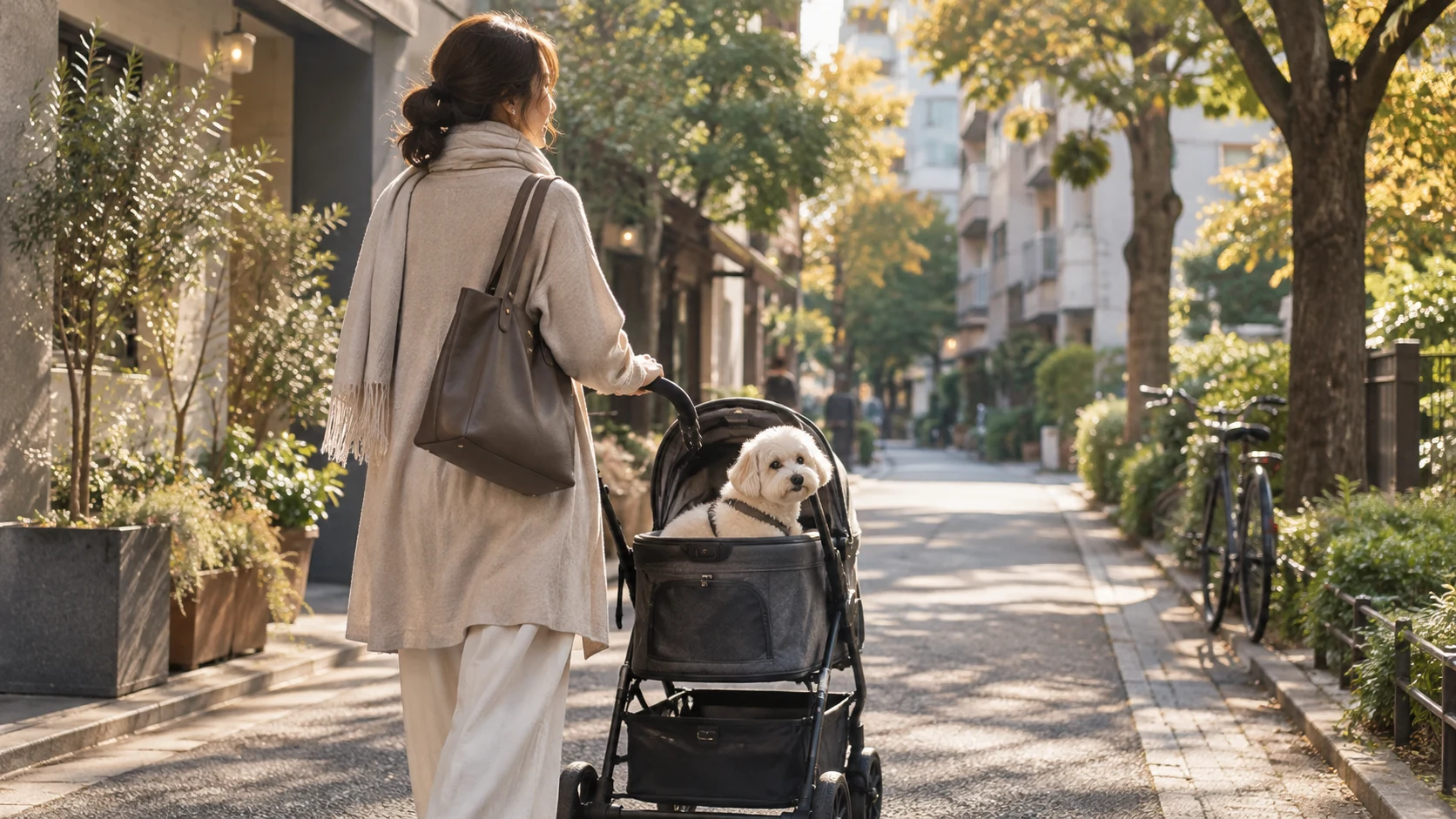
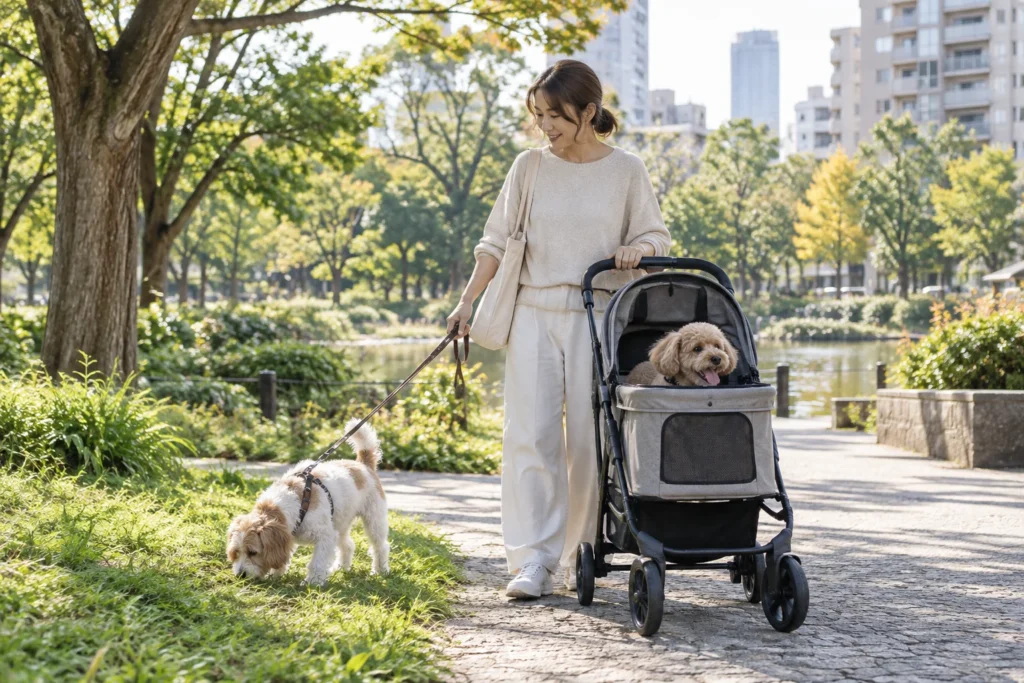
Imagine a quiet Saturday morning in Tokyo. A woman walks along a tree-lined street, past apartment entrances, bicycles and small cafés. Ahead of her is a stroller. But when you look inside, you see a white, fluffy dog, watching the neighborhood go by.
For someone visiting Japan for the first time, the sight may be unexpected. Why is a dog riding instead of walking? Is the stroller a fashion statement? Is it a sign that Japanese people treat their pets like children?
The answer is more interesting than any of those assumptions.
A dog stroller—often called a petto kāto in Japanese—can be a practical tool, a way to care for an aging companion, and sometimes simply a way to make an outing easier for everyone involved. It also reveals the compromises that come with sharing crowded cities, public spaces and everyday routines with animals.
The dog in the stroller may look like a small luxury. The story behind it is often about something much more ordinary: how to keep going places together.
1. The Scene That Makes Visitors Look Twice
You might notice dog strollers near parks, in residential neighborhoods or outside businesses that welcome pets. Some look almost like baby strollers, with padded interiors, sunshades and mesh covers. Others have removable carriers or room for more than one animal.
But it would be a mistake to assume that every Japanese dog rides in one—or that every dog in a stroller is healthy, spoiled or unhappy.
The practice is visible, especially among people who already enjoy taking their dogs on outings. That is different from knowing how common it is in the population as a whole.
In April 2025, the Japanese pet-outing service Wan!Pass surveyed 2,577 of its registered users. Among those respondents, 56% said they currently used pet strollers. The company also reported higher use among respondents with multiple pets and some regional differences.
There is an important limitation: the survey questioned users of a service specifically designed for people who go out with pets. They are not a random sample of all dog owners in Japan. The figure tells us something about an engaged pet-owning community—not that more than half of all Japanese dog owners necessarily use strollers.
Still, the responses point to several real needs, many of which are easy to miss from a photograph.
2. When the Dog Gets Older but Life Goes On
One of the strongest reasons to use a stroller is age.
An older dog may still love the familiar route to the park: the scent of trees after rain, the noises near a café, the sight of a favorite person coming around the corner. Yet arthritis, heart problems, weakness or other health conditions may limit how far the dog can comfortably walk.
A stroller can make it possible to travel farther without asking the animal to push through pain or fatigue.
Veterinary guidance stresses, however, that movement still matters. The Saitama Veterinary Medical Association recommends gentle, age-appropriate activity for older dogs rather than unnecessary inactivity. The American Kennel Club likewise notes that a stroller can provide sensory stimulation, but should not replace safe exercise or opportunities to explore when a dog can still walk.
The most thoughtful outings can combine the two.
A dog may walk for a short distance, sniff around at its own pace, and ride when it becomes tired. A companion that cannot manage a long route may still have a chance to experience the outside world.
This is not the dog being turned into a doll. At its best, it is the dog’s changing abilities being taken seriously.
3. Two Dogs, Two Different Speeds
A stroller can also solve a problem that has nothing to do with old age: not every dog wants or needs the same walk.
Imagine a household with two dogs. One is energetic and happy to keep exploring. The other tires sooner, moves slowly or is recovering from an injury. If both are expected to travel the same distance on foot, one of them may struggle.
A stroller can allow an owner to adjust the outing to each animal.
Japanese veterinary guidance published by a pet-cart maker gives a similar example: ride one way, walk the other, or use the cart to accommodate different levels of stamina in a multi-dog household.
For many people, that flexibility is the appeal. The stroller is not always replacing a walk; sometimes it makes a different kind of walk possible.
But the decision should still begin with the dog’s comfort, temperament and veterinary needs—not merely the owner’s itinerary.
4. The City Is Not Built Only for Dogs
Japan’s cities contain many places where people and dogs share limited space: narrow sidewalks, busy intersections, crowded station approaches, bicycles, apartment corridors and small commercial streets.
Carrying a small dog through a crowded area can be tiring. Allowing it to walk through dense foot traffic can also be stressful or unsafe, depending on the dog’s size and temperament. A stroller can sometimes provide a more controlled way to move between quieter walking spots.
It may also make outings easier for an owner who has trouble carrying a dog for long distances.
But having a dog in a stroller does not automatically create permission to enter every shop, restaurant or public facility. Rules are decided by individual businesses, building managers and transport operators. Some places welcome dogs only in certain areas, or only in a closed carrier. Others do not admit pet dogs at all.
A stroller is one possible tool for sharing a public space. It is not a universal pass.
5. Summer Heat Changes the Meaning of a Walk
In the Japanese summer, even a short walk can require planning.
The Ministry of the Environment warns that dogs are vulnerable to heatstroke and that their bodies are close to the ground, where heat from pavement can be intense. Its public guidance recommends avoiding daytime walks during hot weather and choosing cooler hours.
It can be tempting to think that putting a dog in a stroller solves the problem. It does not.
A stroller can protect paws from some hot surfaces, but the enclosed space may also trap warm air. Poor ventilation, direct sunlight or a hot canopy can create additional danger. Shade, airflow, water, timing and attention to the dog’s breathing are essential.
In very hot conditions, the responsible choice may be to stay in a safe, cool place rather than go out at all.
The goal is not to keep a dog visible in every season. It is to keep the dog comfortable and safe.

6. A Stroller Does Not Mean a Train Ticket
This is an especially important difference for visitors to Japan.
Seeing someone push a dog stroller on a street does not mean that the stroller can be rolled, open and occupied, onto any train.
JR East’s published pet-transport rules require eligible small pets to be fully enclosed in an animal carrier, with the length, width and height adding up to no more than 120 centimeters and a combined animal-and-case weight of no more than 10 kilograms. A small paid baggage ticket is required. Carrying a pet openly, on a leash or in an oversized stroller is not permitted under those rules.
Tokyo Metropolitan buses have their own requirements. Their published guidance permits small pets in fully closed cases under specified conditions; for a detachable pet stroller, the carrying case must be separated and the wheeled frame folded before boarding. A non-folding pet stroller does not qualify merely because it is designed for animals.
Different rail companies and buses have different rules, and assistance dogs are treated differently from ordinary pets.
For anyone planning to travel with an animal, the message is simple: check the exact operator’s current policy before setting out. Do not assume that a cart allowed on a sidewalk will be accepted on public transport.
7. Dogs Are Companions, but Other People Share the Street
A stroller may also express something about how many households see their animals: not merely as pets kept at home, but as companions who participate in ordinary routines.
A dog may accompany its owner to a park, a pet-friendly terrace or an outing planned around the animal’s needs. Some owners enjoy arranging their days so that the dog does not always have to stay behind.
Tokyo’s public animal-welfare guidance acknowledges the importance of dogs as companions while also reminding owners of their responsibilities toward neighbors. Barking, waste, uncontrolled movement and respect for shared spaces matter, whether a dog is walking or riding.
Not everyone likes dogs. Some people are afraid of them; others have allergies or simply want distance. A stroller does not erase those needs.
Responsible owners keep passageways clear, prevent animals from jumping out, follow leash and facility rules, and avoid expecting everyone else to make room.
There is a quiet form of consideration here: caring for an animal while also respecting people who did not choose to be part of the outing.
8. What About the Dog’s Own Choices?
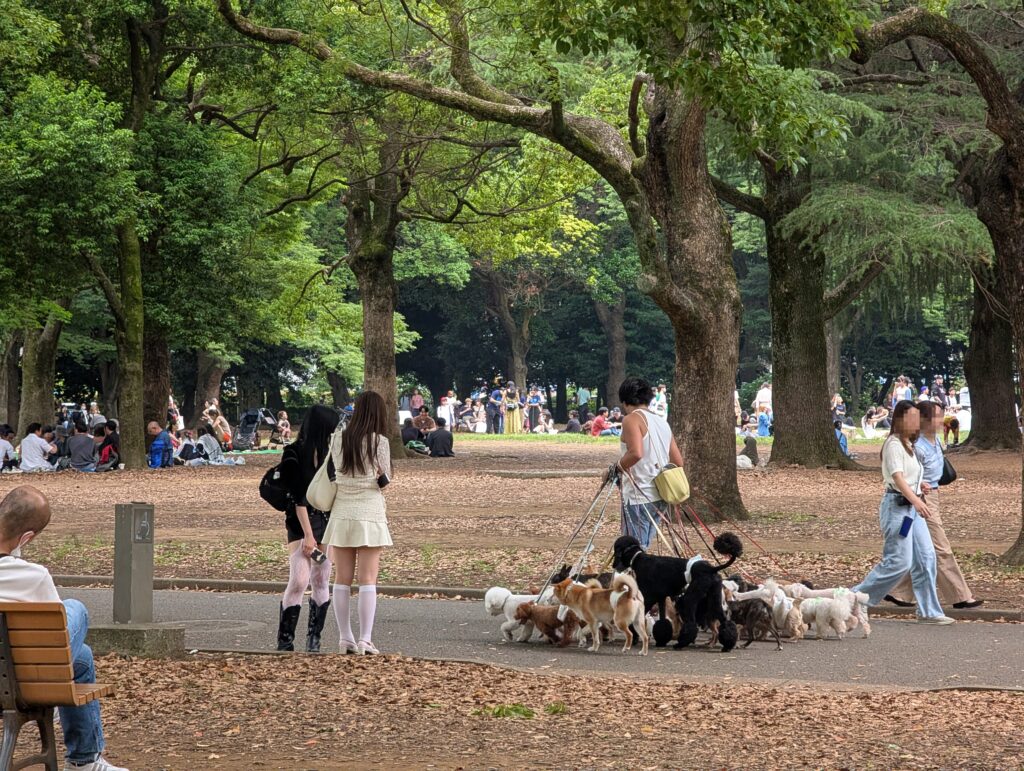
A stroller can be helpful, but it should not become a substitute for asking a more fundamental question: what does the dog want and need?
Dogs experience the world through smell, movement and exploration. For a healthy, mobile dog, stopping to investigate a tree or choosing a slow pace is part of the value of a walk. A trip in a cart may offer sights and sounds, but it cannot reproduce every part of that experience.
Some dogs settle happily in strollers. Others may find the movement, sounds or confinement distressing. The same arrangement is not right for every animal.
A careful owner looks for signs of discomfort, offers breaks when appropriate, secures the dog safely and never leaves it unattended in conditions where it could overheat or escape. For dogs with medical limitations, a veterinarian can help determine a suitable balance of assisted outings and physical activity.
The question is not whether a stroller is fashionable. The question is whether the dog is better off because of it.
9. A Small Picture of a Bigger Change
Japan is often described through its visible contrasts: an old shrine beside a modern office tower, a quiet residential street just beyond a crowded station.
The pet stroller offers another small contrast.
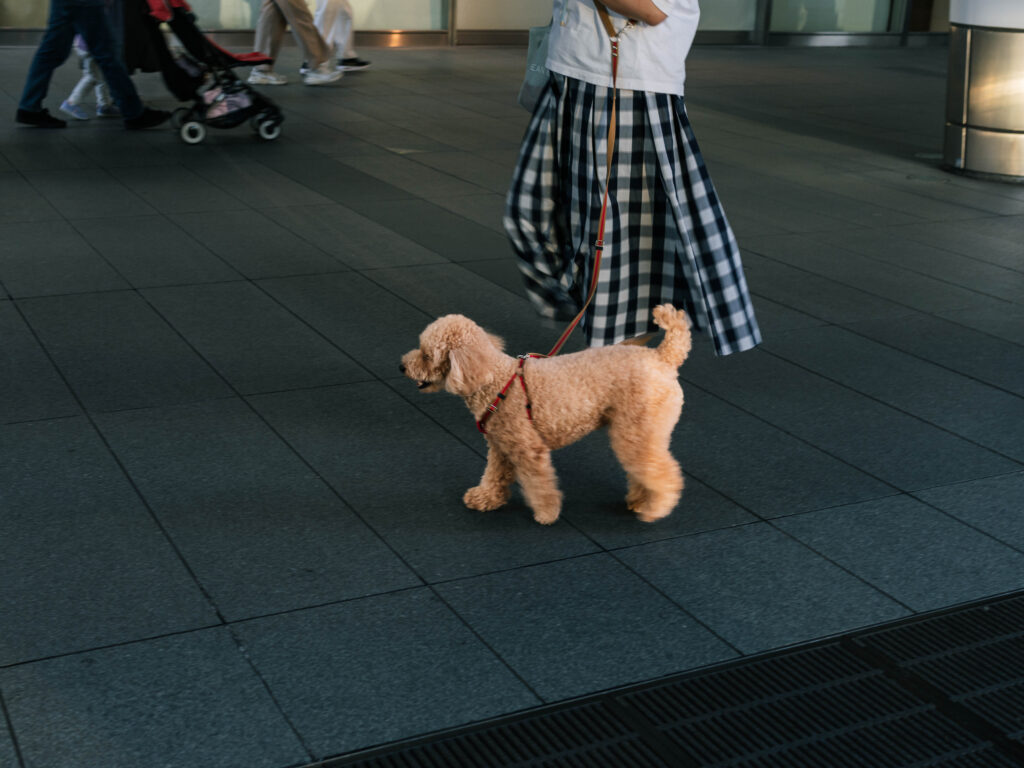
It can look like a piece of fashionable urban equipment. Yet for one family it is a practical way to carry two dogs with different energy levels. For another, it is the device that allows an aging companion to see the neighborhood once more. For someone else, it is a useful but occasional addition to an ordinary walking routine.
There is no single reason, and no single Japanese attitude toward animals, behind every stroller.
What the carts reveal is less a national obsession with pampering than a series of choices about care, mobility and belonging. Those choices are shaped by the lives of dogs and people together, in places not designed exclusively for either of them.
The most revealing details are not always the glamorous ones. They are the small adjustments people make when the needs of someone they love change—even when that someone has four legs.
10. Keeping the Walk Alive
Return to the neighborhood street.
A white dog rides quietly through a patch of late-afternoon sunlight. A few minutes later, perhaps the stroller stops beside a tree. The dog steps onto the ground, takes its time, and follows a scent that its human companion cannot detect.
The outing continues at two different speeds.
That imagined moment captures the best argument for a pet stroller. It is not about making a dog behave like a child, and it is not about replacing the ordinary freedom of a walk.
It is about finding a way for companionship to continue as bodies, cities and daily lives change.
The most caring walk is not always the longest one. Sometimes it is the one that lets everyone come along—and still gives the dog room to be a dog.