Dogs & Life Together · Everyday Japan
Guide Dogs in Japan: The Partnership Behind the Harness
The person chooses the route. The dog helps read the path. A closer look at a working partnership—and how to give it room.
5 MIN READ · DOGS & LIFE TOGETHER
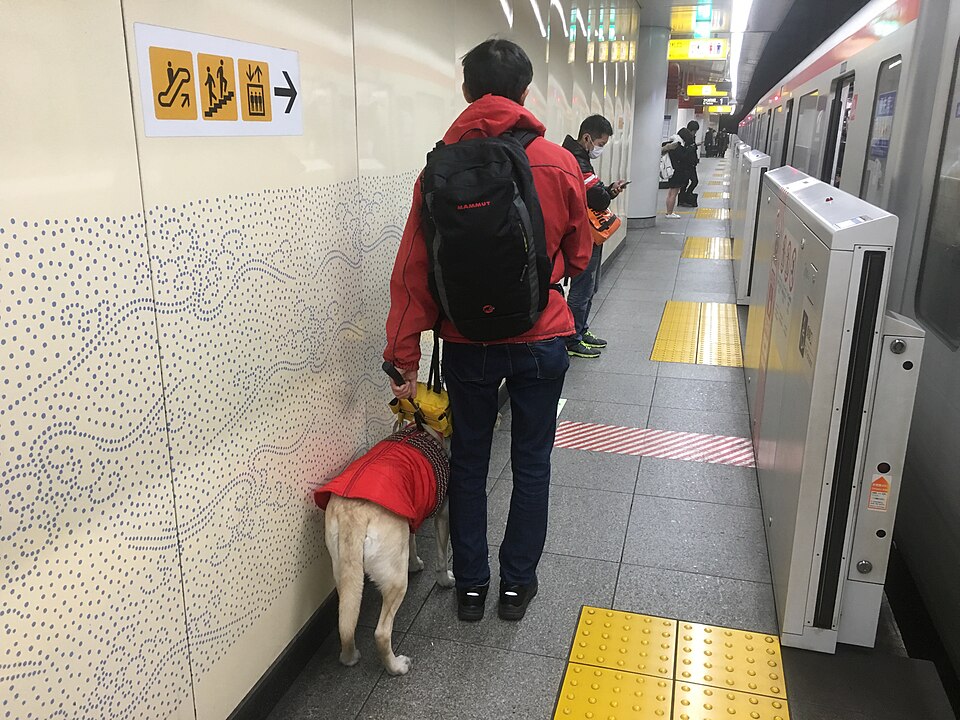
Photo: Nesnad / Wikimedia Commons / CC BY 4.0. Resized to 960 pixels wide; original composition retained.
A guide dog can be standing still and still be working.
At a Japanese station, a bright coat may catch your eye. The harness is the important detail: Japan’s national federation of guide dog training institutions asks people to treat a harnessed dog as working, even during a pause.[2]
Looking beyond the dog’s appearance reveals a more interesting story: two partners sharing information, making decisions and moving through an ordinary day.
Who knows the way?
Japan’s guide dogs, called mōdōken (盲導犬), support people who are blind or have low vision. The Japan Guide Dog Association describes three central tasks: stopping at corners, indicating changes in level, and avoiding obstacles.[1]
The person knows the route and gives directions. Through the handle of the harness, they feel the dog’s movements and use that information to navigate.[1]
A traffic signal shows why the partnership matters. Guide dogs do not judge the light’s color; the person draws on information such as traffic sounds and audible signals to decide when to proceed. Someone nearby can help by clearly saying what color the pedestrian light is.[1]
Understanding the journey means paying attention to the person’s decisions as well as the dog’s skills.
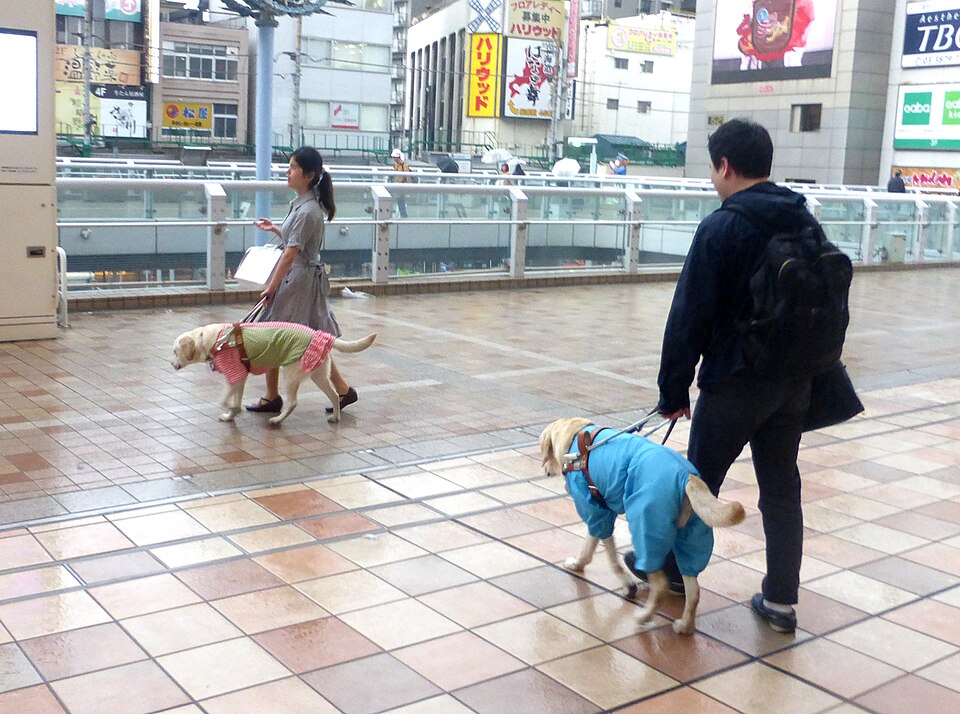
Photo: Nesnad / Wikimedia Commons / CC BY-SA 4.0. Resized to 960 pixels wide; original composition retained.
A small amount of space helps
The federation’s advice is practical: avoid touching the dog or harness, calling to the dog or trying to catch its attention. Do not offer food, and keep your own pet from approaching to greet it. Ask the handler before taking photographs or video.[2]
If someone appears to need assistance, speak to the person first. A simple “Would you like any help?” gives them the choice. Wait for their answer and follow their directions. There is no need to turn every encounter into an intervention.[2]
You can appreciate the partnership without interrupting it. A quiet passage past a working dog is often all the encounter needs.
Training belongs to both partners
The Japan Guide Dog Association describes an approach built around praise and communication, adapted to each dog. Trainers assess individual temperament and suitability; not every dog follows the same path into guiding work.[3]
Learning takes place in real streets as well as at training centers. Avoiding an obstacle includes allowing for the person’s body: something at human face height can matter even when the dog could pass underneath it. Training also prepares dogs for transport and everyday urban conditions.[3]
Once matched, a person and dog train together, including on routes used for shopping or commuting. The association describes certification after this joint training is completed. A trained dog becomes part of a particular person’s life through practice together.[3]
Access is part of independence
Japan’s assistance-dog framework includes guide dogs, hearing dogs and mobility service dogs. The Ministry of Health, Labour and Welfare explains that public facilities and transport, along with businesses such as shops, hotels and restaurants, have a duty to accept people accompanied by qualifying assistance dogs.[4]
This is an accessibility provision. Seeing a guide dog inside a restaurant does not tell you whether that restaurant accepts pets. The ministry also explains that the hojoken assistance-dog mark promotes understanding of the law; it is not simply a badge for selected dog-welcoming shops.[4]
The practical point for another customer is straightforward: a person entering with their guide dog is there to use the same service as anyone else.
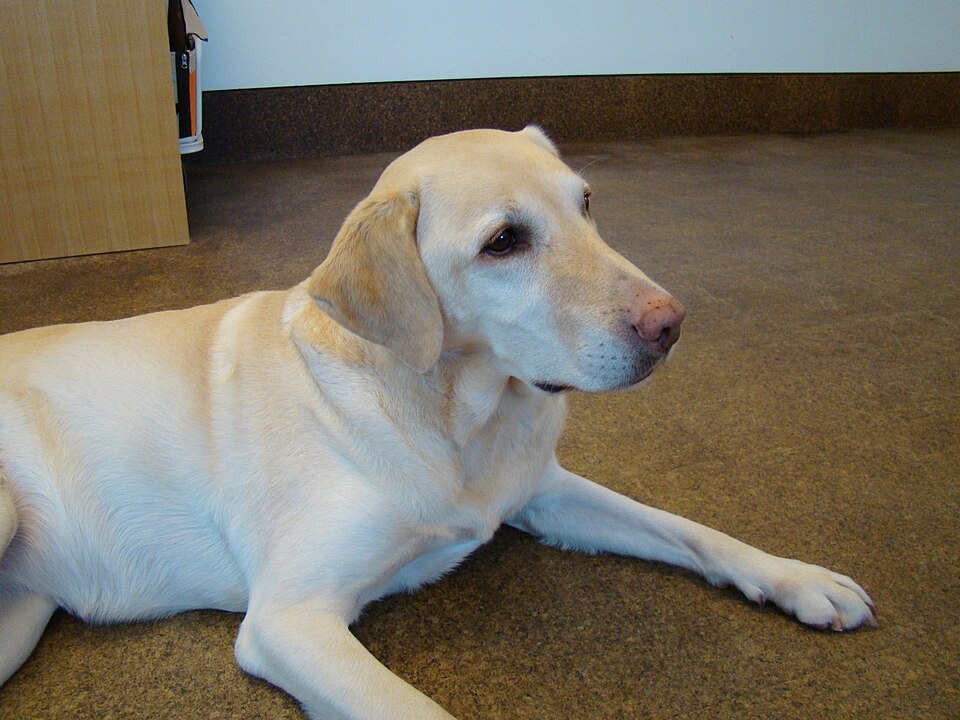
Photo: しんかわな / Wikimedia Commons / CC BY 3.0. Resized to 960 pixels wide; original composition retained.
A life after the harness
The working years are only part of a guide dog’s life. The Japan Guide Dog Association describes retirement at around ten years old. In its retired-dog volunteer program, families welcome dogs into their homes and provide everyday and medical care for the rest of their lives.[5]
Matching takes account of the dog’s personality, circumstances and health, alongside the household environment. It is a commitment to the individual animal, continuing after its guiding work has ended.[5]
The photograph above offers a quieter view of that later chapter. Remembering it alongside the station scene makes room for both sides of the story: a working partnership and a dog with a whole life beyond the journey we happen to see.
Visiting Japan with your own guide dog?
Check the Japan Guide Dog Association’s English guidance well before travel. It explains temporary certification for eligible overseas guide dog users and asks applicants to work through their training organization. Foreign certification should not be assumed to transfer automatically. Animal import and quarantine procedures are a separate part of preparation.[6]
Sources & further reading
- Japan Guide Dog Association — What guide dogs do (Japanese)
- National Federation of All Japan Guide Dog Training Institutions — When you meet a guide dog (Japanese)
- Japan Guide Dog Association — Training and matching (Japanese)
- Ministry of Health, Labour and Welfare — Assistance dogs and the hojoken mark (Japanese)
- Japan Guide Dog Association — Retired-dog volunteers (Japanese)
- Japan Guide Dog Association — Visiting Japan with a guide dog
Training and retirement details describe the Japan Guide Dog Association’s own programs. The photographs are archival images, with individual credits and licenses above.






Comments