Anime & Fandom · 12 minute read
Anime vs. Reality: What Japanese School Life Is Really Like
Cherry blossoms, school festivals, and teenage dreams—and the pressures behind them.
LAYERS OF JAPAN
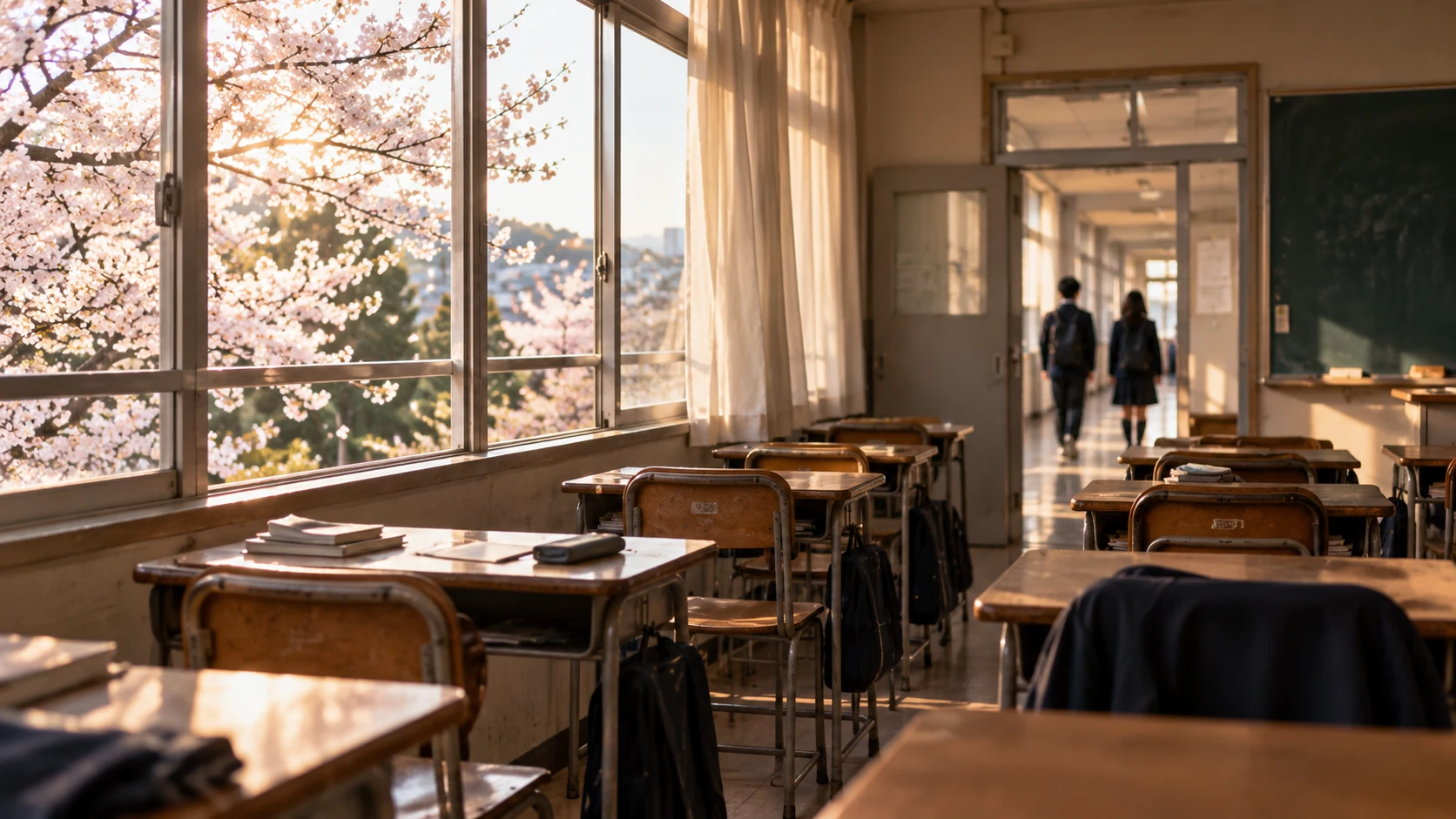
It is April. Cherry blossoms drift past an open classroom window. A student in uniform hurries down the hallway, late for homeroom. Somewhere, a school bell rings. Later, there will be a club meeting, an awkward conversation, perhaps a confession of love as the sky turns orange.
If you have watched Japanese school anime, you probably know this world.
You may even feel nostalgic for a school you have never attended.
The surprising thing is that much of this scenery is real. Japan really does begin its school year in spring. Many students wear uniforms. Cultural festivals, sports days, after-school clubs, student councils, and class cleaning are familiar parts of school life. The everyday details that anime loves are not simply invented.
But the camera rarely stays long enough to show an entire ordinary week.
It does not always show the commuter train before sunrise, the exam preparation after dinner, the uncertainty of choosing a future, or the student who struggles to feel at home in the classroom.
Anime can capture the feeling of youth beautifully. Real life contains that beauty—and much more besides.
1. The School World Anime Gets Right
A Japanese school anime may open with students changing into indoor shoes, gathering for homeroom, listening to announcements, or preparing for a school event. Many of those details are recognizable in real schools, though daily routines vary by school and age group.
Japan’s academic year generally starts in April and ends in March. Spring blossoms have therefore become a natural visual shorthand for beginnings: a new classroom, new classmates, a new teacher, and the uneasy excitement of entering a different stage of life.
Uniforms are common in junior high and high school, but they are not universal. Some schools have considerable freedom over clothing; others specify details of jackets, shoes, hairstyles, or accessories. Likewise, not every school offers the same events or follows the same schedule.
Students may help clean classrooms and shared spaces. They may participate in committees, sports days, artistic presentations, and other collective activities. These are not merely picturesque customs; they are connected to the educational emphasis on participation, cooperation, and responsibility.
What anime changes is often the rhythm.
A school year contains many quiet days: ordinary lessons, homework, a missed train, a rushed lunch, a conversation that does not become a romance. Animation can compress those months into the scenes that mean the most to a story.
The setting may be accurate. The emotional intensity is carefully selected.
2. The Rooftop: Japan’s Most Famous Imaginary Lunch Spot
One of the classic images of school anime is a rooftop open to the sky.
Two students sit beside a fence eating lunch. A character goes there to be alone. Someone finally confesses a secret that would be impossible to say in class.
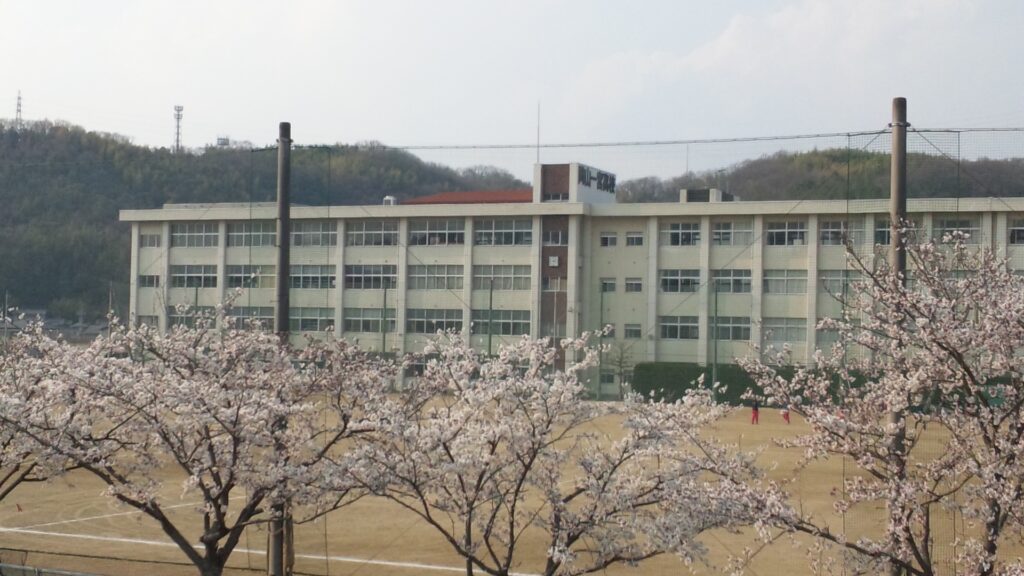
Real Japanese school rooftops are not generally public lounges for students. Access is frequently restricted for safety and management reasons, although actual rules vary. A locked door is much less useful to a romantic screenplay than a sunset overlooking the city.
That is precisely why the rooftop works so well in fiction.
It gives teenagers a place outside the ordinary social order, high above the routines of the school day. It feels private without being far away. For a few minutes, the characters can imagine freedom.
Anime is not necessarily trying to mislead anyone about Japanese school architecture. It is using a real-looking place to express a feeling.
Sometimes the most unrealistic location is the one that tells the emotional truth most clearly.
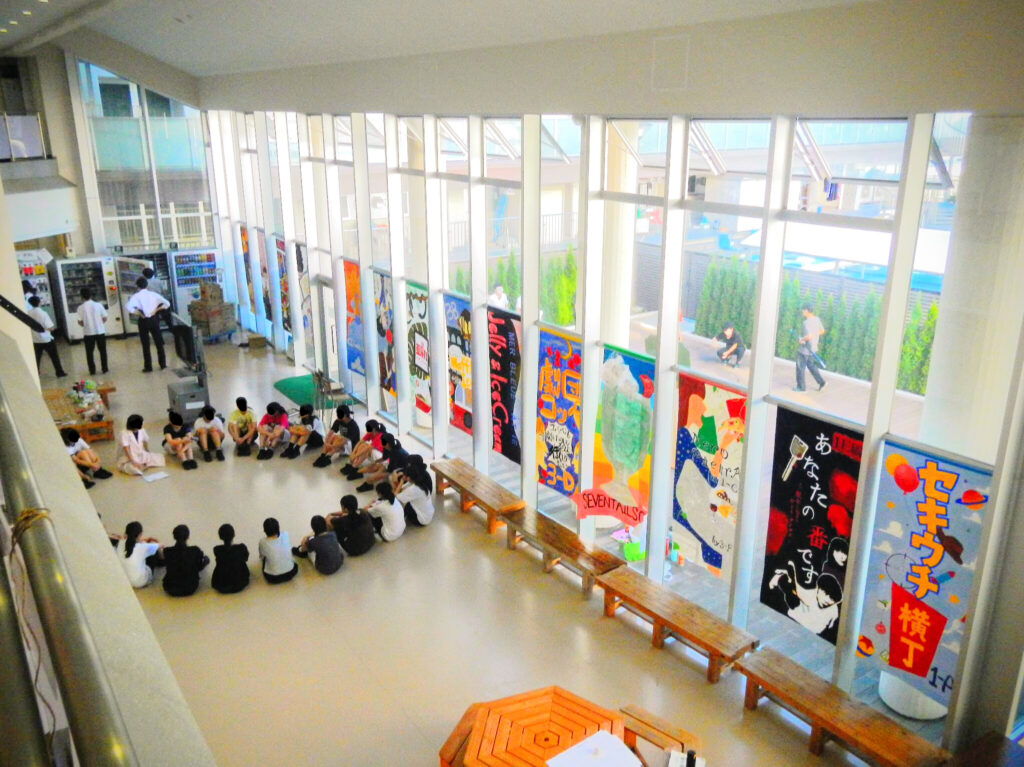
3. The Cultural Festival Is Real—and It Takes Work
The bunkasai, or school cultural festival, is one of the most appealing scenes in Japanese youth fiction.
In anime, a classroom may become a café, a club may perform before a cheering audience, and months of secret feelings may finally surface amid handmade decorations.
Actual cultural festivals are also important events in many Japanese schools. Students may help prepare displays, performances, exhibitions, class projects, and activities for visitors, depending on school policies. Japan’s national high-school curriculum recognizes cultural events among the forms of special school activity.
Yet the days before a festival can be less glamorous than the finished result.
There are materials to buy, tasks to divide, performances to practice, arguments to resolve, and posters to finish. Some students love organizing. Others find teamwork stressful. A shy student may enjoy helping behind the scenes but dread the attention of an audience.
The festival can bring classmates together, but it can also expose differences in motivation and confidence.
That combination—excitement and responsibility—is more interesting than the fantasy alone.
What looks like a perfect day on screen is often built from many ordinary, imperfect afternoons.
4. After School: Friendship, Skill, and the Weight of Commitment
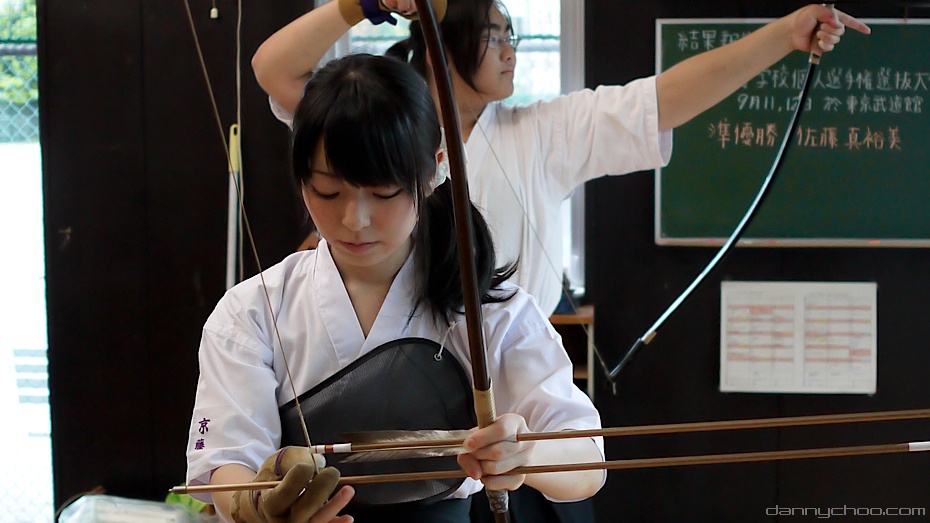
Sports and cultural clubs are another familiar setting in school anime. There may be volleyball, baseball, basketball, archery, music, theater, calligraphy, or countless other activities.
At their best, clubs give teenagers a place to develop skills, build friendships across year groups, and find a sense of purpose beyond the classroom. A student who feels quiet during lessons may feel confident with a musical instrument or on a sports court.
They also introduce the relationship between senpai and kōhai—senior and junior members—which can involve guidance, tradition, and obligations. These relationships are not automatically harsh, nor are they always effortless. Their character depends on the group and the people involved.
Some clubs practice intensively. Others meet occasionally or place more emphasis on enjoyment. Students may choose not to join, and not every school offers the same opportunities.
In demanding settings, practice can compete with rest, homework, part-time work, and family time. A teenager may want to be loyal to teammates while also wishing for an evening free.
Anime often finds drama in this commitment because the emotions are genuine: the joy of improving, the disappointment of losing, and the difficulty of letting other people down.
But everyday life requires limits as well as passion.
5. Uniforms, School Rules, and the Freedom to Be Different
For many viewers overseas, the Japanese school uniform is one of the strongest symbols of anime. But a uniform is not only an aesthetic choice. It is also part of a system of school rules and expectations.
Rules may concern appearance, punctuality, behavior, personal items, and how students represent their school. Some have historically been criticized for controlling matters that seemed unrelated to learning, including hairstyles and clothing details.
Those practices are changing in parts of Japan.
In Kobe, for example, the city has publicly tracked reviews of school rules, including the disappearance of several formerly widespread restrictions at municipal schools. Elsewhere, schools have invited students to participate more actively in discussions about what rules are reasonable.
The broader question is familiar far beyond Japan: how can a school create order without demanding unnecessary sameness?
The student with a different hairstyle, family background, identity, opinion, or way of learning does not become less deserving of respect because the group prefers uniformity.
Anime sometimes romanticizes the neatness of a school ensemble. Real life asks who feels comfortable inside it—and who does not.
6. The Exam Calendar That Changes Everything
School anime often lingers on the final bell, the classroom after sunset, or the walk home with friends. For many real students, those hours are also shaped by preparation for the next stage of education.
Entrance examinations are significant at several transitions in Japan, including admission to many upper-secondary schools and universities. Some students attend juku, or supplementary education programs, to strengthen their preparation. Others study at home, receive school-based support, or pursue different routes.
A student’s future is not determined by one identical national path. Academic high schools, technical and vocational courses, part-time and correspondence programs, university, professional education, and employment offer different possibilities.
But decisions can still feel enormous when you are only sixteen or seventeen.
A teenager may be deciding not only what to study but where to live, how much money their family can afford, whether they can meet expectations, and who they want to become.
The atmosphere of exam season is difficult to capture in a single beautiful frame: the repeated practice tests, the late-night desk lamp, and the fear that everyone else seems more prepared.
In anime, the future often arrives as a dramatic revelation. In real life, it may arrive as an application form and a deadline.
7. When Belonging Becomes Pressure
A class can be a place of warmth. It can also be a place where fitting in feels necessary for survival.
Friendship groups, inside jokes, class duties, club hierarchies, and everyday expectations can help students feel connected. Yet they can also make it hard to disagree or ask for space.
The Japanese expression kūki o yomu—to read the air—describes the skill of sensing what a situation expects. It can encourage thoughtfulness. It can also leave someone worried about speaking too plainly, saying no, or revealing that they feel different.
There is no single personality shared by all Japanese teenagers, and pressures to conform exist in schools around the world. Still, understanding these unspoken expectations can help overseas readers see why an ordinary classroom scene may carry such complicated emotions.
A student can have friends and still feel lonely. They can attend every day and still be anxious. They can be surrounded by people yet unsure whether anyone would understand them if they spoke honestly.
The outside of a school day does not always reveal the inside.
8. The Students Missing from the Picture
It would be unfair to describe real Japanese school life without acknowledging students for whom attending school is difficult.
Japan’s Ministry of Education reported that in the 2024 school year, approximately 68,000 upper-secondary students were counted as experiencing prolonged nonattendance under its survey definition. Separately, the total for elementary and lower-secondary schools reached approximately 354,000. These figures refer to different educational levels and should not be added casually to make a claim about high school alone.
The same survey identified approximately 769,000 recognized bullying cases across elementary, lower-secondary, upper-secondary, and special-needs schools combined. The measure counts recognized incidents, not 769,000 different victims, and it is not a high-school-only figure.
The reasons students struggle with attendance are diverse. Experiences of bullying, health difficulties, anxiety, family circumstances, learning needs, and problems with school fit cannot be reduced to a single story.
Nor should students who learn outside conventional classrooms be treated as having failed. Japan’s educational responses increasingly involve consultation, alternative support, and attempts to provide pathways suited to different needs.
These figures do not make Japanese schools uniquely troubled, and they cannot tell us what every student experiences.
They do, however, remind us that a beautiful image of youth is not a complete picture of youth.
A responsible story makes room for the students who are not standing in the cheerful classroom photograph.
9. There Is No Single Japanese High School Experience
A school in central Tokyo may feel quite different from one in a small mountain town. A public academic high school can differ from a private arts-focused school, a technical program, or a correspondence school. Rules, resources, class sizes, commuting patterns, and club opportunities vary.
Students’ lives also vary.
Some spend long evenings at practice. Some care for relatives. Some work part-time where permitted. Some travel a long way to school. Some find friendship quickly. Some do not. Some are eager to enter university; others have entirely different ambitions.
That diversity is often missing when Japanese school life is reduced to a single uniform, a single kind of classroom, or a single cherry-blossom scene.
It is worth remembering, too, that anime itself is not one story. Many animated works explore isolation, family pressure, bullying, economic uncertainty, disability, or the pain of growing up with considerable sensitivity.
The best school stories are not valuable because they resemble documentaries.
They are valuable because they can help viewers recognize feelings—joy, embarrassment, courage, loneliness—that cross national borders.
10. The Ordinary Moments That Last
Picture the classroom after the last lesson.
The desks are slightly out of place. Afternoon light stretches across the floor. Someone has forgotten a notebook. Voices fade along the corridor, and the room becomes quiet again.
There may have been no confession, no championship, no dramatic turning point that day.
Perhaps a student finally understood a difficult problem. Perhaps two friends laughed about something no one else would find funny. Perhaps someone who had been afraid to speak raised a hand for the first time.
These moments rarely become the climax of a television series.
But they can remain with a person for years.
That is what school anime sometimes understands exceptionally well: ordinary youth feels ordinary only while it is happening. Later, the small moments may become the ones we remember most clearly.
The Japan of school anime is not entirely fictional. Its blossoms, corridors, festivals, and clubs are connected to real places and experiences.
But no single animation can contain every student’s life.
Beyond the beautiful frames are real teenagers making mistakes, finding friends, facing expectations, and learning that growing up does not follow a perfect script.
Anime captures the beauty of youth. Real life reminds us how much courage it takes to grow up.