Japanese Fandom · Small Discoveries
Japan’s Capsule Toys: Small Objects, Big Curiosity
A favourite character, a tiny café dish, an everyday object seen afresh: what makes a small toy worth stopping to look at?
ANIME & FANDOM · 5 MIN READ
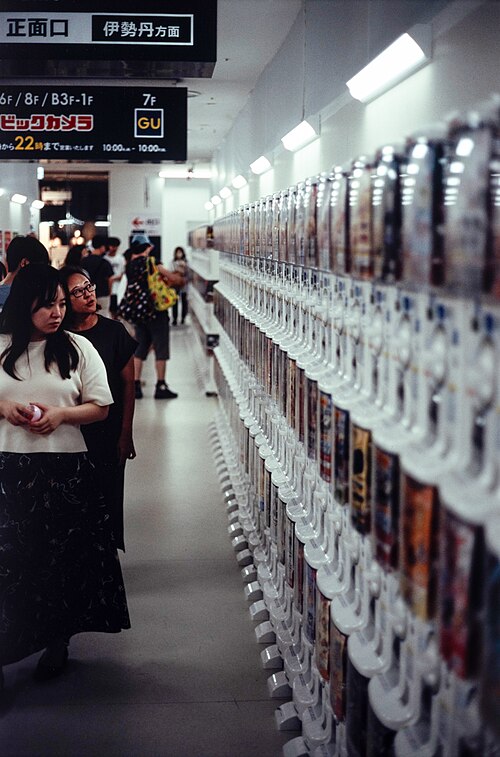
Photo: Itsmejames, via Wikimedia Commons · CC BY 4.0. Reduced resolution; full composition retained. This photograph remains under CC BY 4.0.
Sometimes the pleasure begins before the handle turns.
A long row of capsule toy machines is also a row of possibilities. You can move from one display to the next, pause at a familiar character, and then notice something whose appeal is harder to explain. Perhaps it is a tiny version of an ordinary thing you had never thought of collecting.
That moment of recognition offers one way into Japan’s capsule toy culture. Alongside the surprise of what comes out, there is the curiosity of looking closely: who thought to make this, and which details did they decide to keep?
A small format with many kinds of appeal
Capsule toys are sold through vending machines, often with several variations pictured on a display. You may hear them called gachapon or gashapon; Gashapon is Bandai’s registered brand. Other manufacturers also make capsule toys, including the café miniatures explored below.
| What draws you in | What to look for |
|---|---|
| Recognition | A character or object connected to something you already enjoy. |
| Detail | A familiar shape, colour or decoration reproduced at an unexpected scale. |
| Association | A little reminder of a place, a meal or an interest you would like to explore. |
These are ways of looking, rather than explanations for every buyer. The same miniature can feel nostalgic to one person and completely new to another.
The surprise has to be designed
In Bandai Namco’s 2024 integrated report, product developer Ran Matsumoto described the challenge of creating something that feels interesting when opened. Her team considers new materials, formats and ideas, alongside established character series.
One concrete example is CAPCHARA, a line dispensed without a separate conventional capsule. Matsumoto explained that these products can have irregular shapes, requiring careful testing to make sure the machine can release them properly.
It is a useful glimpse of the work behind a brief purchase. A designer’s idea has to become an object that can travel through a machine and arrive in someone’s hands. The account comes from the manufacturer’s own report, and describes its development approach rather than an independent study of buyers.
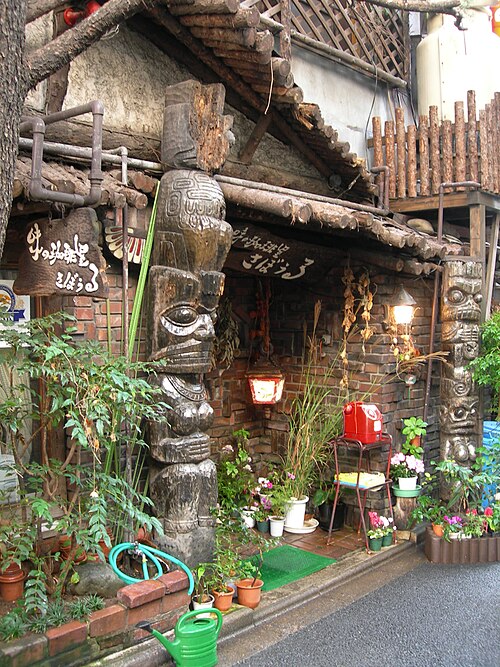
Photo: Ogiyoshisan, via Wikimedia Commons · CC BY-SA 3.0. Reduced resolution; full composition retained. This photograph remains under CC BY-SA 3.0.
A café you can hold in your hand
KenElephant’s Jun Kissa Miniature Collection gives that small format a particular setting: real Japanese coffee shops. Its first collection included Sabouru’s cream soda in Tokyo’s Jinbocho district and Takase’s pudding à la mode in Ikebukuro, under the supervision of café writer Rina Namba.
In the Kansai collection, the subjects included Soirée’s colourful jelly punch in Kyoto and American’s pancakes in Osaka. The manufacturer describes reproducing cup illustrations with printing and using paint to imitate the gloss of real crockery. Small paper napkins carry the cafés’ logos.
Those details can give a miniature its personality. A dish has a particular arrangement; a cup belongs to a particular café. Shrinking it makes those decisions newly noticeable.
From a miniature back to the real place
In a 2021 Time Out Tokyo interview, KenElephant’s spokesperson explained how the café series took shape. The team asked Namba to suggest shops for familiar dishes, then considered which menus could be modelled effectively and would look appealing in miniature.
The spokesperson also said they had heard of customers taking their miniatures to the cafés represented. That is the company’s account, rather than a measured visitor survey, but it suggests a pleasing reversal: a toy can become a reason to seek out its full-sized counterpart.
A shopkeeper offered another perspective. Speaking to Namba Keizai Shimbun in 2021, Arabiya Coffee’s owner welcomed the miniature version of the Osaka café’s coffee. He praised its detail and hoped it might encourage people who had not previously been interested in coffee to visit.
For him, the tiny cup carried the possibility of a new encounter. For a visitor, it might later hold the memory of an actual table, a conversation or an afternoon in the neighbourhood.
These collections are examples of the idea, not a promise of what will be stocked in a particular machine. Check current product and shop information if you are looking for a specific release.
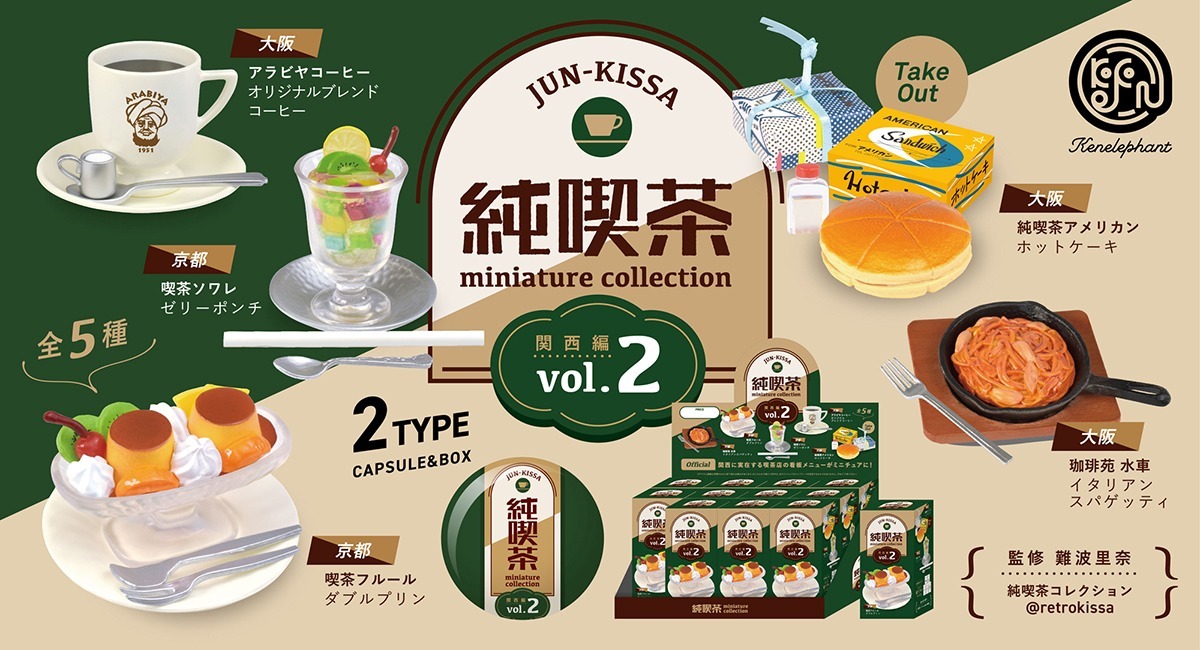
Image: KenElephant, from its official 2021 press release, via valuepress. Press-material terms. Rights remain with the respective owners. Unaltered official image; displayed at a reduced width.
The handle is part of the experience
Bandai’s 2021 interview with machine developer Tatsushi Igarashi describes changes in machine design and payment options. Alongside those developments, he wanted to preserve the familiar scene of children using their pocket money to turn a machine.
Even Bandai’s cashless Smart Gashapon keeps a physical turn in its published sequence: select a product on the screen, pay with a supported method, then turn the handle. Accepted payment methods vary by installation.
That small action gives the purchase a rhythm: look, choose, turn, collect. It is worth noticing even if you decide that browsing is enough.
Enjoy one discovery at your own pace
- Read the display first. Check the price, the collection, the size of the item and the machine’s payment instructions. A picture of a full series does not mean one turn buys every item.
- Leave room for an unexpected result. Random assortments can include duplicates. For example, KenElephant’s café-sweets collection explicitly says the contents cannot be selected and may repeat. Another purchase is not a guarantee of your preferred design.
- Choose a comfortable limit. Decide what you would enjoy spending before you begin. One object you like can be enough.
- Keep the small story. Save the leaflet if it identifies the shop or design. If you take a miniature out for a photograph, ask where necessary and keep shared tables and paths clear.
You could put a tiny cup beside a notebook, photograph it with something ordinary for scale, or simply look up the café that inspired it. The object offers a starting point; what you do with it can make the experience personal.
For an overseas reader, this is an approachable way to notice everyday Japan. Start with one small thing that catches your eye, then follow the detail that made you pause.
Sources & image credits
- Bandai Namco: Ran Matsumoto’s development account — published in the company’s 2024 integrated report.
- KenElephant: Jun Kissa Miniature Collection vol. 1, vol. 2 and café-sweets collection — subjects, design details and random-assortment information.
- Time Out Tokyo, Aya Hasegawa: interview with KenElephant’s spokesperson — selection of cafés and reported customer visits.
- Namba Keizai Shimbun: report on miniature café menus — Arabiya Coffee’s owner, paraphrased from Japanese.
- Bandai: Tatsushi Igarashi interview and Smart Gashapon guide — machines, payment and the handle-turning sequence.
This article draws on published interviews and manufacturer materials; it does not claim interviews or on-site reporting by LAYERS OF JAPAN. The first two photographs show real places. The third image is KenElephant’s official promotional image for the miniature collection discussed. Source and licence information appears with each photograph.





Comments