Growing Up in Japan · 9 minute read
Would You Let a Six-Year-Old Walk Home Alone? Japan’s School Commute and the Fear Behind It
To some overseas visitors, Japanese children walking to school without their parents are a symbol of independence. To a worried parent, the same scene can raise a very different question: what happens when nobody is watching?
LAYERS OF JAPAN
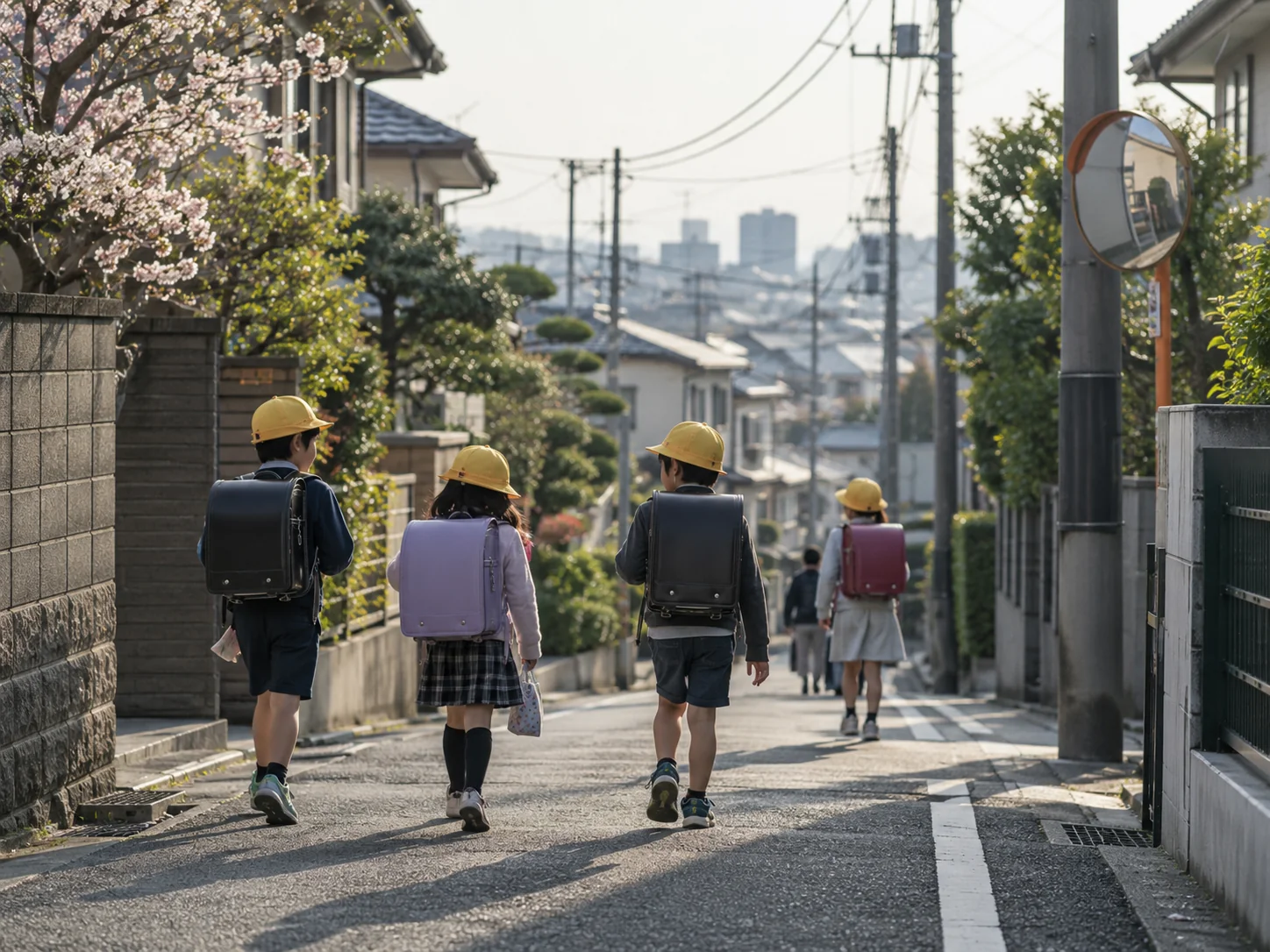
In a quiet Japanese neighborhood, a small child walks down the road with a bright yellow hat and a backpack almost as large as their back.
Perhaps two classmates are alongside them. Perhaps an older student is leading a group. Or perhaps, for the final stretch home, the child is alone.
There is something moving about this ordinary sight. A child knows the way. The familiar school route has become part of a world they can navigate without a parent’s hand.
But imagine watching that child turn a corner and disappear from view.
A parent might think of speeding cars. Of a stranger stopping to ask a question. Of a quiet road where no one would hear a call for help.
Japan’s independent school commute is often admired from a distance. Its risks feel different when the child is yours.
The Picture of Childhood Independence
In many parts of Japan, children begin elementary school at around six years old and may walk to school without a parent accompanying them for the entire journey.
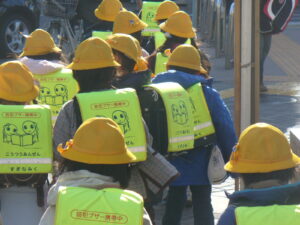
The custom is not universal. Some pupils walk in an organized shūdan tōkō group, often with older children helping younger ones. Others walk with a friend, ride a school bus, use public transport or are accompanied by an adult. Arrangements depend on the school, the route and the family’s circumstances.
From the outside, however, the image is striking: young children in yellow hats, carrying randoseru backpacks, moving through residential streets on a weekday morning.
The practice is sometimes presented internationally as proof of Japan’s safety and the maturity expected of its children.
There is truth in the idea that a familiar route can foster confidence. Learning where to cross, how to ask for help and how to travel with classmates can be part of growing up.
But a beautiful image does not tell us whether a particular road is safe.
A Different Conversation in Vancouver
Imagine describing that walk to a parent in Vancouver, Canada.
The response might not be admiration. It might be alarm: isn’t a young child supposed to be supervised?
British Columbia treats adequate supervision as an important child-protection issue. Legal Aid BC explains that the province does not specify one age at which every child may be left alone, and notes a court case in which leaving an eight-year-old home alone was considered inappropriate. Canada’s Criminal Code also makes it an offence to unlawfully abandon or expose a child under ten when their life is endangered or likely to be endangered, or their health is permanently harmed or likely to suffer permanent harm.
But this is not the same as saying that a child walking outdoors without an adult is automatically a crime in Vancouver.
A Vancouver case illustrates how complicated the question can be. In 2017, child-protection authorities challenged a father’s decision to let four of his children, then aged seven to ten, take public transit without an adult. In 2020, British Columbia’s Court of Appeal ruled that the ministry had exceeded its authority in imposing that supervision requirement in the circumstances of the case.
Today, Metro Vancouver’s transit operator, TransLink, explicitly allows children aged twelve and under to ride buses without a fare-paying adult, while leaving parents and guardians responsible for deciding whether a child can safely travel unaccompanied.
Vancouver also supports an adult-led Walking School Bus program, in which groups of children walk together with designated leaders.
The contrast with Japan, then, is not that one country permits freedom and another simply criminalizes it. It is about differing expectations of supervision, differing routes and differing judgments about what makes independence responsible.
The question is not only Can a child do this? It is also Who has made it safe enough for the child to try?
The Most Frightening Part May Be the Last Five Minutes
A group of children can make the morning walk feel lively and secure. But groups do not always remain together until everyone reaches their front door.
Children peel away at intersections. School years may finish at different times. After-school activities change schedules. A child who started the journey with friends may find themselves alone on the final road home.
And not all streets offer the same protection.
A neighborhood full of open shops and pedestrians provides opportunities for someone to notice a problem. A road beside fields, an isolated footpath, a wooded corner or a stretch lined by high walls may have very few witnesses.
This is one reason the discussion becomes particularly difficult in rural and depopulating areas. A route may be familiar, but the distance can be long and the number of people available to help can be small.
That does not establish that children in rural Japan face a higher overall rate of crime than children in cities. Such a comparison would require reliable location-specific data.
It does mean that an empty street can create a different kind of vulnerability, especially for a young child who needs immediate help.
When the Fear Became Reality
The concern is not purely hypothetical.
In December 2005, a seven-year-old girl disappeared while returning home from school in the former city of Imaichi, now part of Nikko in Tochigi Prefecture. Reports describe how she separated from friends along a lightly traveled route. She was abducted and killed. The case left a lasting mark on discussions of school-route safety. Twenty years later, it was still being examined by Japanese journalists.
In May 2018, an elementary school girl was abducted and killed on her way home in Niigata City. Reporting on the case drew attention to places that are easy to enter but difficult for other people to observe.
These were distinct tragedies, in different settings. One occurred in an area with relatively little passing traffic; the other was in a city. Neither should be used to suggest that all Japanese streets are dangerous or that abductions are an everyday occurrence.
But neither should they disappear beneath comforting stories about how safely Japanese children travel.
A serious danger does not have to be common to deserve serious prevention.
For families who have heard about these cases, the last few minutes before a child returns home can feel unbearably long.
More Than Crime: The Road Itself
Fear of an unknown person is only one part of the calculation.
Traffic is a practical, everyday concern. Residential lanes may be narrow. Visibility at intersections may be poor. Drivers may not expect a small pedestrian to step out from behind a parked car. Snow, heavy rain or an early winter sunset can make a familiar journey harder.
Japan’s Ministry of Education does not treat this as a problem already solved by the existence of a designated school route. It calls for continuing checks and coordination among schools, police, road authorities and local communities.
The ministry has also recognized that population decline, school closures and longer journeys are changing how children travel. Its 2025 guidance reported that, as of the 2023 school year, 18.2% of public elementary schools had introduced school buses for pupils’ commutes.
Such arrangements are reminders that walking is not always the safest—or the most practical—option.
The right way to reach school should depend on the child and the place, not on a romantic picture of how Japanese childhood is supposed to look.
Who Is Actually Watching?
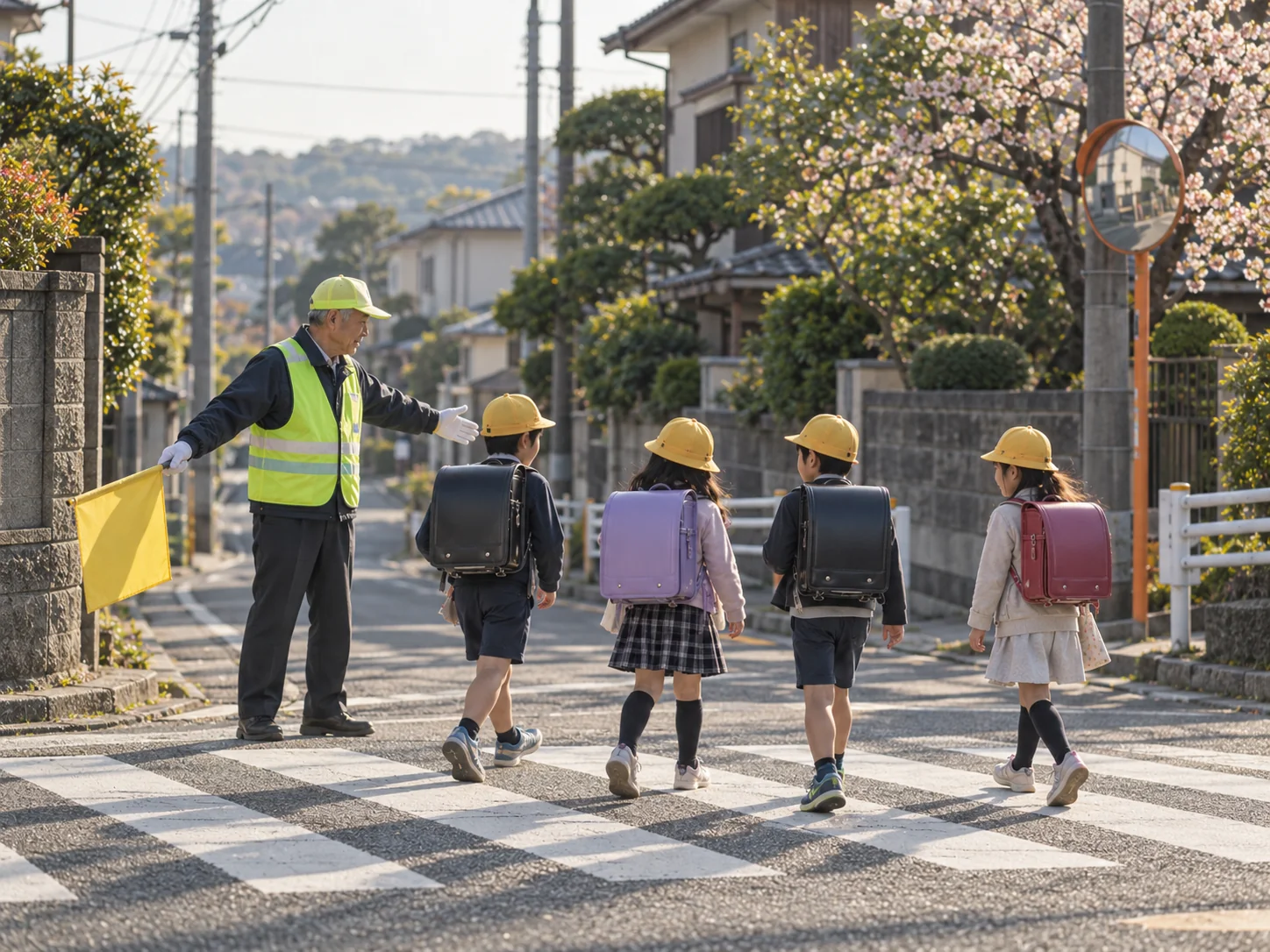
In many Japanese neighborhoods, local volunteers stand near school crossings, sometimes holding small flags. Parents help with safety patrols. Children may be taught which routes to use and where to seek help.
These efforts matter enormously.
But they also require people, time and continuity.
Japan’s education ministry has warned that population decline and an aging society are contributing to shortages of people able to watch over children on their commutes.
What happens when the volunteer who has stood at the crossing for years can no longer come? What happens when a small school closes and a child must travel farther? What happens when an afternoon activity ends after the usual supervision has finished?
These are questions for schools, municipalities and communities, not burdens that should fall solely on six-year-olds or their parents.
A GPS tracker may help a family know where a child is. It cannot stop a speeding vehicle. Teaching a child to shout for help can be useful, but it cannot substitute for a safe crossing or an adult close enough to respond.
Independence works best when protection is built into the environment, not merely expected of the child.
The Parent’s Fear Is Part of the Story
There is a difference between a child feeling proud to walk independently and a parent feeling confident that the journey is safe.
Both feelings can exist in the same family. A parent may want a child to grow capable, make decisions and enjoy a little freedom—while still checking the clock every afternoon.
Some parents decide that an independent walk is suitable. Others accompany their children, arrange a group, choose a bus or change the route. A child’s age, temperament, disability, health, distance from school and local traffic all matter.
There is no reason to turn any one of these choices into a test of good parenting.
And there is no reason to assume that a six-year-old should carry the responsibility for compensating for an unsafe road or a lack of adults.
A More Difficult—and More Honest—Picture of Japan
The small figure with the yellow hat is still beautiful to watch.
The backpack still represents growing up. The familiar route can still bring pride, friendship and a sense of belonging.
But behind the scene are invisible decisions: which crossings are safe, who volunteers, which streets are deserted, when children separate from the group and what adults will do if something goes wrong.
For an international reader, perhaps the most interesting question is not why Japanese parents are willing to let young children walk without them.
It is whether the freedom celebrated in that image is being supported by enough people—and whether that support can survive as Japan’s neighborhoods change.
A child should be free to grow more independent. That does not mean being left alone with risks adults could have prevented.
This is the tension behind an ordinary school-day scene in Japan: the pride of a small step forward, and the fear that comes from knowing just how much is at stake.