Tokyo Tower: A Familiar Shape in a Changing City
A tower built for broadcasting became part of Tokyo’s identity. Look up from the park, look out across the city, and stay long enough to see the lights.
6 MIN READ
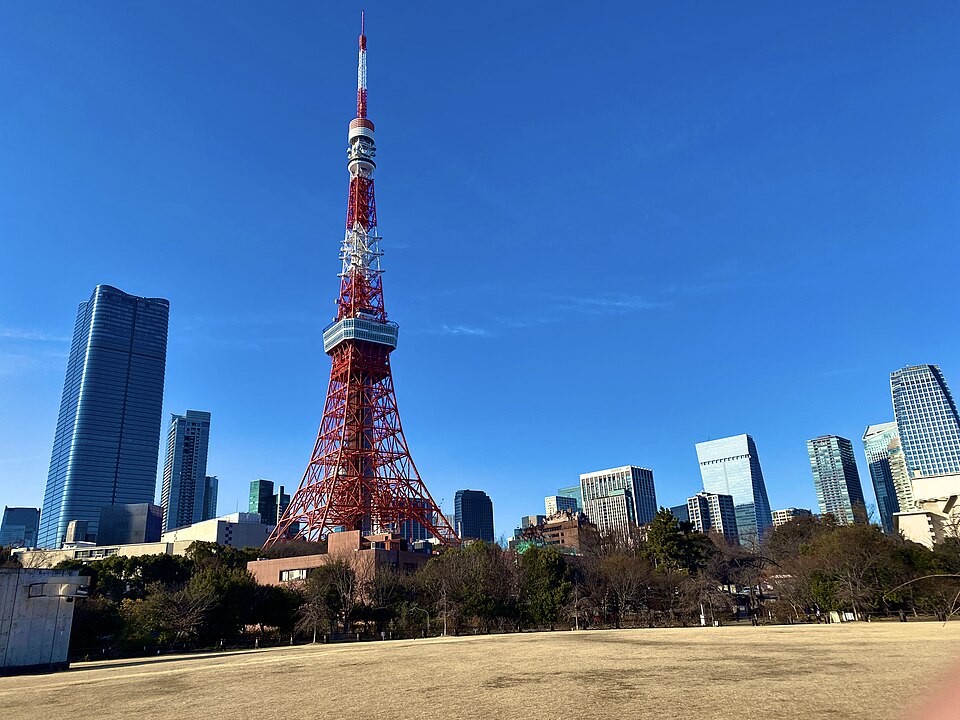
Photo: Qian2007 / Wikimedia Commons · CC BY-SA 4.0. Resized; original composition retained.
From the lawn at Shiba Park, Tokyo Tower has room around it. Its legs spread above the trees, its steelwork narrows towards the sky, and office buildings gather at the edges of the view. It is a good place to begin: with the whole shape in front of you.
Later, from an observation deck, the direction of your attention changes. The tower becomes the place you are standing, and Tokyo spreads into hundreds of smaller things: a road curving between buildings, a patch of trees, the windows of an apartment block. A visit can hold both experiences.
What a tower meant in 1958
Tokyo Tower opened in 1958 as a broadcasting tower. At 333 metres, its steel structure rose above the capital during Japan’s postwar recovery. The Agency for Cultural Affairs describes it as a symbol of that recovery and of the country’s period of rapid economic growth. It was registered as a tangible cultural property in 2013.12
That background gives the familiar outline more weight. A structure built to carry broadcasts also became a way to picture the city’s future. Today, looking at its open steel frame among the surrounding buildings lets you see a moment of that ambition still standing in the contemporary city.
Try looking at the first photograph again with 1958 in mind. The tower and the buildings around it do not belong to a single moment. The pleasure is in seeing them share the same skyline.
Three heights, two observation decks
The numbers are easy to mix up. 333 metres is the tower’s overall height. Visitors look out from the Main Deck at 150 metres and the Top Deck at 250 metres.13
The Main Deck is a straightforward place to start if you want time to study the city. The Top Deck Tour includes both observation levels and takes you higher. Choose according to the experience you want, then check the operator’s current ticket options and availability.3
GO TOKYO also highlights the Main Deck’s glass floor panels, known as Skywalk Windows, through which you can look towards the ground below.4 They offer a very different sensation from looking across the horizon. You can decide how close you want to get.
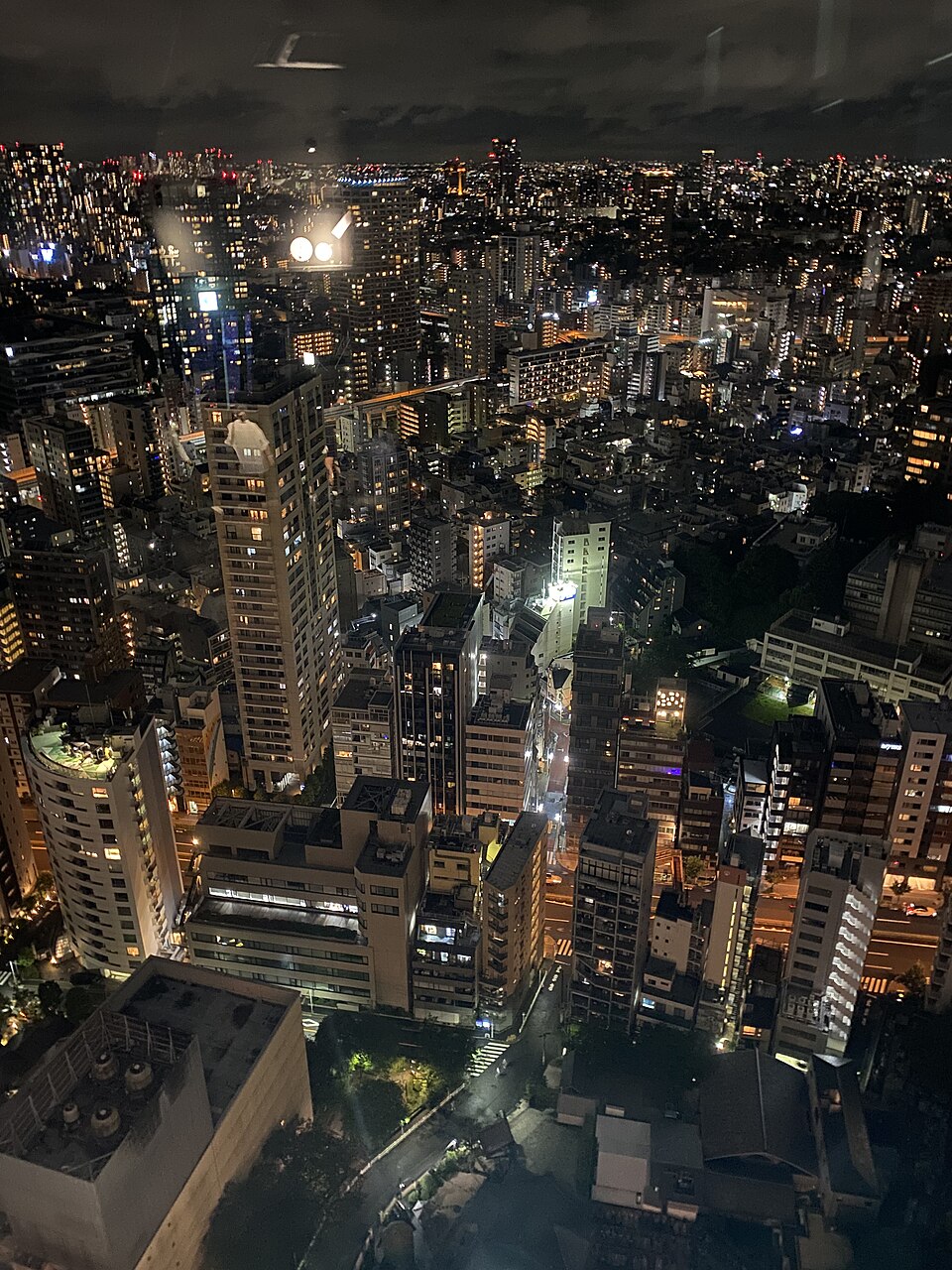
Photo: Immanuelle / Wikimedia Commons · CC BY-SA 4.0. Resized; original composition retained.
Give the view a small task
A big city panorama can be difficult to take in all at once. Start by finding the streets you approached along. Trace one road until it disappears behind a building, then look for it again. Find a green space and compare its outline with the blocks beside it.
In daylight, this can feel like reading a map at an unfamiliar angle. After dark, illuminated roads and windows draw a different map. The photograph above shows that change of emphasis: individual buildings remain visible, but points and lines of light begin to connect them.
On a clear day, Mount Fuji may be visible in the distance, according to GO TOKYO.4 Treat it as a possibility. The streets immediately below offer plenty to notice even when the distant view disappears into haze.
The walk beneath the tower
Keep some time for the neighbourhood. Shiba Park and Zojoji Temple are close to Tokyo Tower, and Japan’s national tourism organisation suggests combining them with a visit.5 Walking between them changes the scale of the afternoon: from skyline to paths, gates and trees.
Zojoji is a working Buddhist temple. Its official history records its move to this site in 1598 and its subsequent role as the Tokugawa family temple. It also explains the destruction of major buildings during the Second World War and their later reconstruction.6
That history makes the familiar pairing of temple and tower more interesting. What looks like an easy image of “old and new Japan” contains rebuilding and change on both sides. Pause to notice the temple itself, follow posted directions and leave room for worshippers.
Back at the tower, Foot Town—the building at its base—contains shops and places to eat.5 It can be a useful break between walking and going up, especially if your visit stretches into the evening.
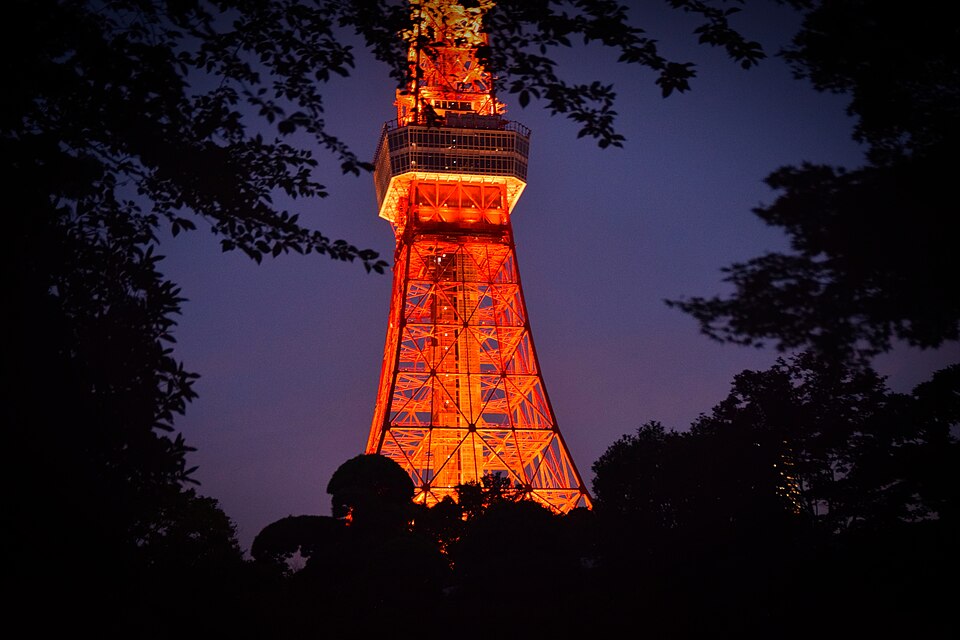
Photo: Raita Futo / Wikimedia Commons · CC BY 2.0. Resized; original composition retained.
Stay for a different kind of light
By night, the steelwork becomes a pattern of light. In the photograph above, dark leaves partly frame the tower, and the warm illumination picks out the braces and platforms. A closer view like this can be as memorable as fitting the entire structure into the frame.
The operator describes two lighting systems: the familiar Landmark Light and the colour-changing Infinity Diamond Veil. The Landmark Light has seasonal versions, while special programmes can give the tower another appearance. Consult the official lighting calendar if a particular display matters to your visit; the schedule can change.7
Choose a permitted place to stop where you can look comfortably without obstructing a pavement or entrance. Then lower the camera for a moment. Notice how the tower sits behind the branches, rooftops or traffic around you. That foreground is part of your view of Tokyo, too.
A simple way to plan a first visit
Pick the station that makes sense for your journey. The tower’s official access guide gives these approximate walks from the listed exits:8
| Station | Line and exit | Walk |
|---|---|---|
| Akabanebashi | Toei Oedo Line · Akabanebashi Exit | About 5 min |
| Kamiyacho | Tokyo Metro Hibiya Line · Exit 1 | About 7 min |
| Onarimon | Toei Mita Line · Exit A1 | About 6 min |
One relaxed plan is to walk through the neighbourhood in daylight, visit an observation deck, and look back at the tower after dark. If you include Zojoji, check the temple’s visiting information separately; an evening tower visit does not mean every nearby building will still be open.
Before setting out, check the official ticket site for admission, operating hours and any service notices. Allow extra time for the walk and for stopping along the way.
When you leave, look back once from farther down the street. The tower will have changed size again. By then, its familiar outline may be attached to something more personal: a route you walked, a view you studied, or the moment the lights came on.
Sources & further reading
- All-Japan Towers Federation: Tokyo Tower — broadcasting purpose, completion and height.
- Agency for Cultural Affairs: Tokyo Tower (Japanese) — cultural-property registration and its place in postwar history.
- Tokyo Tower: official ticket information — observation levels, tours and current visitor information.
- GO TOKYO: Tokyo Tower — observation experiences and visibility of Mount Fuji.
- Japan National Tourism Organization: Tokyo Tower — nearby places and Foot Town.
- Zojoji Temple: official history and precinct guide — the temple’s history and continued religious use.
- Tokyo Tower: lighting calendar and systems (Japanese) — seasonal lighting and programme changes.
- Tokyo Tower: official access guide — stations, exits and approximate walking times.
Photographs show views from 2020–2024; the skyline and lighting may differ on your visit. Image credits and licences appear beneath each photograph. All three images have been resized without additional cropping.



Comments