Real Life in Japan
Japan’s Shinkansen: Enjoying the Journey Between Cities
A window seat, a station lunchbox and time to watch Japan pass by. A closer look at the pleasures of the bullet train.
7 MIN READ
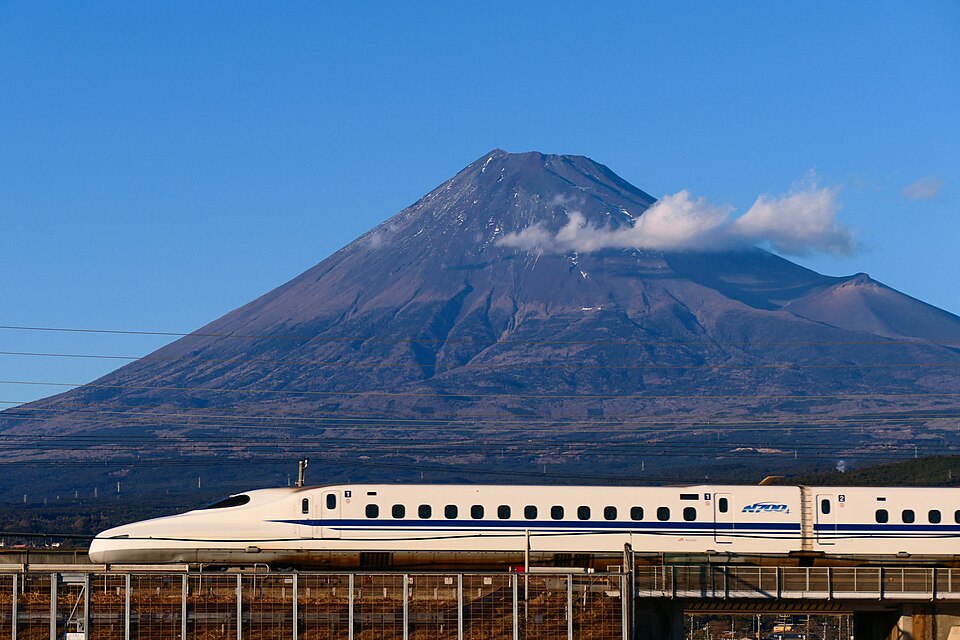
Photo: MaedaAkihiko / Wikimedia Commons / CC BY-SA 4.0. Resized; original composition retained.
You have found your seat, put your bag away and checked that this is the right train. For a little while, there is nothing else to arrange. Your next destination can wait beyond the window.
A Shinkansen journey offers that welcome pause. You can open a book, unpack a lunchbox or watch the scenery change. The train may be moving quickly, but your part of the journey can feel unhurried.
Japan’s bullet trains are easy to admire from the platform. Spending time inside one reveals a more personal pleasure: the chance to settle into the space between two places.
A familiar symbol with a long working life
The Tokaido Shinkansen opened on 1 October 1964. JR Central’s account of its 60th anniversary describes six decades of work on the technology and services that keep the line running.1 Behind the recognisable train is an everyday transport system with a much longer history than a first-time visitor’s photograph might suggest.
That is an interesting way to look at it. A train that feels like a special attraction to you may be part of somebody else’s ordinary journey. There is room for both experiences in the same carriage.
Let yourself enjoy the occasion without feeling obliged to turn every minute into an activity. A drink, a comfortable seat and a view can be quite enough.
“Shinkansen” is a network, not one route
Different Shinkansen lines serve different parts of Japan. The Tokaido line connects Tokyo, Nagoya, Kyoto and Shin-Osaka; other lines carry the journey north, west and south. JNTO’s overview is a useful starting point for understanding the network.2
| Line | Selected places it connects |
|---|---|
| Tokaido | Tokyo, Nagoya, Kyoto and Shin-Osaka |
| Tohoku | Tokyo, Sendai, Morioka and Shin-Aomori |
| Hokuriku | Tokyo, Nagano, Kanazawa and Tsuruga |
These are line overviews, not the stopping pattern of every train. On the Tokaido line, names such as Nozomi, Hikari and Kodama identify services with different stops. Nozomi stops at fewer stations than the other two.2 Begin with the place you want to reach, then choose a service that actually stops there.
Make the first few minutes easy
Give yourself enough time to find the Shinkansen area and read the departure board. JR Central’s Tokaido guide explains that the displays alternate between Japanese and English and show the service, departure time, destination and platform.3 Match those details to your booking before joining a queue.
Think of the boarding process as a short sequence: the right station, the right train, the right car, then your seat. You do not need to solve everything at once. If something does not match, show your booking to station staff.
Many Shinkansen services offer both reserved and non-reserved seating, while some are entirely reserved.2 For a first journey, a reserved seat is a straightforward choice: you know where you are going to sit before you board.
Keep your booking information easy to reach and follow the boarding instructions for your ticket. JR Central’s guide covers both paper tickets and digital arrangements.3
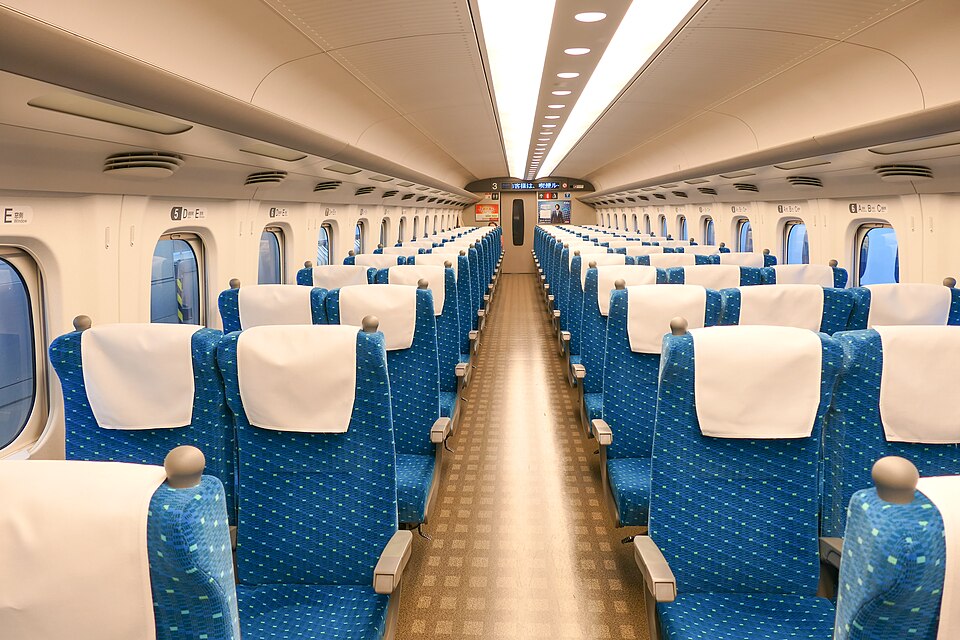
Photo: MaedaAkihiko / Wikimedia Commons / CC BY-SA 4.0. Resized; original composition retained.
Look out of the window—even between the landmarks
Mount Fuji is one of the sights you may hope to see on the Tokaido route. JR Central advises choosing the right-hand side when travelling from Tokyo towards Kyoto or Osaka. In an ordinary car, the window seat on that side is E; in a Green Car, it is D. Clear weather matters, so the view is a possibility rather than a promise.4
If the mountain stays behind cloud, you still have a window. Look for the smaller changes: the spacing of buildings, the colours of roofs, the sudden opening of a view. You do not have to identify every town to enjoy noticing it.
Try leaving the camera on your lap for part of the journey. Choose something to follow—a river, the edge of a neighbourhood, the shape of distant hills—until it disappears. It is a different way of seeing from standing at a viewpoint: the scene arrives, changes and moves on.
Let lunch become part of the trip
An ekiben is a station lunchbox, and choosing one can be a small excursion of its own. JNTO describes a food culture built around regional dishes, varied packaging and meals made to accompany railway journeys. Large stations may offer boxes from several regions, so buying one in Tokyo does not necessarily mean its story begins there.5
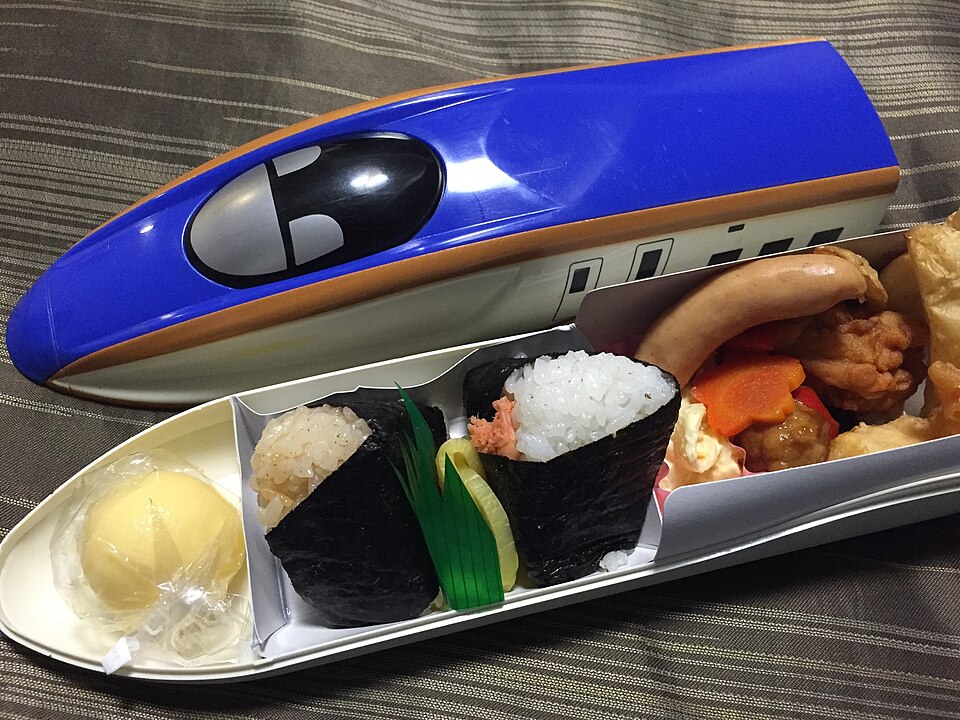
Photo: masataka muto / Wikimedia Commons / CC BY-SA 2.0. Resized; original composition retained.
Take a little time at the shop. Look at the photographs, read what you can of the description and choose something you actually want to eat. A modest box that appeals to you is a better travelling companion than a famous one bought only for its name.
When you open it, notice the arrangement as well as the main dish. Which part will you try first? What would you leave until last? Lunch gives the journey its own beginning, middle and end.
Eating and drinking are allowed on the Tokaido Shinkansen, and seats have fold-down tables. Buy refreshments before boarding: JR Central states that food and drink sales are not available in Standard Class.3 A little preparation lets you settle in without waiting for a trolley.
Share the carriage comfortably
The easiest way to approach train manners is to think about the people nearby. JR Central asks passengers to avoid voice calls and audible videos at their seats, and to use the deck area between cars if a call is necessary.3 Headphones and a quiet voice help keep a shared space comfortable.
Before reclining, look behind you and move the seat gently. Keep your belongings within your space, and gather food wrappers when you finish. These small actions make the journey easier for you as well as for the next person.
Large luggage needs a little more planning. On the Tokaido, Sanyo and Kyushu Shinkansen, an ordinary suitcase measuring more than 160 cm and up to 250 cm in combined length, width and height requires a reservation for a seat with an oversized baggage area. JR Central lists separate provisions for items such as strollers and sports equipment.6 Check the operator’s current instructions before booking with a large bag.
Choose a journey that gives you time to arrive
A fast train makes it tempting to fit another city into the day. Before adding one, think about what you would like to do when you get there. Would you have time to walk around, sit down for a meal and enjoy the place without watching the clock?
One well-chosen train journey can be more satisfying than a day spent transferring between several. Pick a departure that leaves room for breakfast, or an arrival that gives you time to find your hotel calmly.
And on the train itself, leave a little space in your plans. You might remember an unexpected view, the lunchbox you chose or simply the relief of sitting down. Those are parts of a visit to Japan, too.
Sources & further reading
- JR Central: Annual Report 2024, Tokaido Shinkansen — opening date and the line’s 60th anniversary.
- Japan National Tourism Organization: Shinkansen — routes, service names and seat types.
- JR Central: Shinkansen guide — boarding, food and drink, and phone etiquette on the Tokaido Shinkansen.
- JR Central: a Tokaido Shinkansen journey from Tokyo — the Mount Fuji side and window-seat letters.
- Japan National Tourism Organization: local ekiben culture — regional food and station lunchboxes.
- JR Central: luggage information — sizes, reservations and special items.
The practical examples focus on the Tokaido Shinkansen; arrangements vary by line, service and ticket. Check your operator’s current information when booking. Photographs show the dated examples identified in their captions, not a guarantee of a particular train interior, meal or view. Images have been resized to 960 pixels wide without cropping and retain the licences linked below them.



Comments