Irori: The Hearth That Held a Japanese Home Together
A kettle, a bed of ash and a place to sit: Japan’s traditional hearth connected cooking, conversation and the house above it.
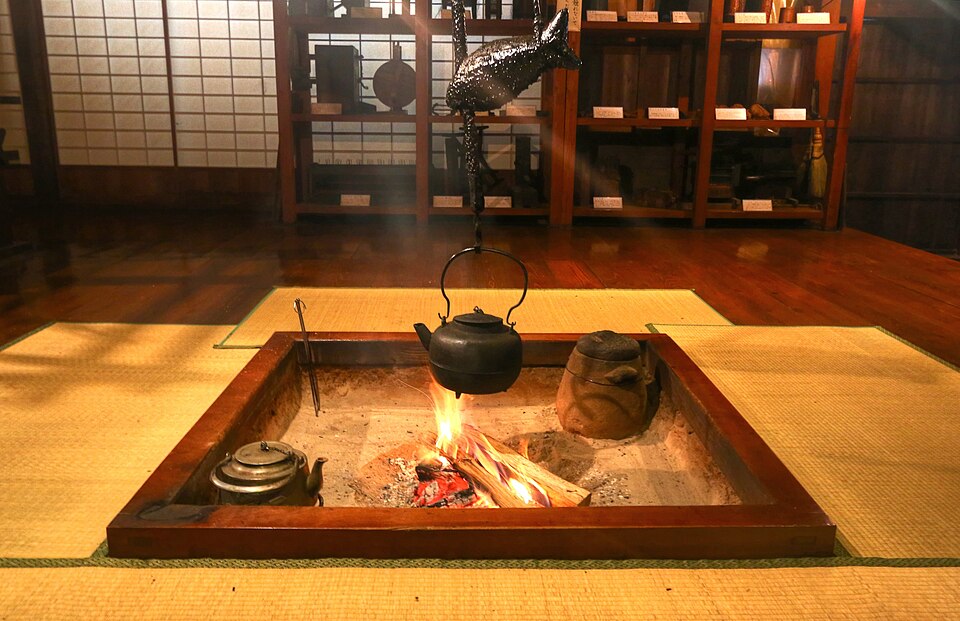
くろふね (Jranar) / Wikimedia Commons, CC BY-SA 4.0. Resized to 960 pixels wide; composition unchanged. This photograph remains under CC BY-SA 4.0.
In the photograph above, the kettle is easy to spot. Follow its handle upward and there is another detail: a fish-shaped piece in the hanging assembly. Below, a small fire burns in a broad bed of ash. Around it, the room offers places to sit.
This is an irori, a traditional Japanese open hearth built into the floor. It supplied warmth and light, and often a place to prepare food.1 Looking closely at one can tell you about much more than how a kettle was heated.
A fire at the level of daily life
An irori commonly takes a square shape, edged in timber or stone. Some were made directly in the ground; others were built into raised wooden floors. Pots could stand on supports or hang above the heat.1
That low position is worth noticing. In these photographs, the fire, floor and seating belong to the same scene. You can trace a short journey from the kettle to the people who might gather around it, without imagining a separate kitchen behind a door.
Start with the shape of the room, then look at the tools. The timber frame defines where the hearth begins; the suspension above it turns the empty air into useful working space.
The hanging kettle has an adjustable answer
The suspended fitting is called a jizaikagi. It lets a pot or kettle hang at different heights over the fire. Raising or lowering the vessel changes its distance from the heat—an everyday cooking adjustment made through the hanging mechanism.2
Designs vary. The architectural dictionary JAANUS describes a component called a saru, whose angle helps hold or release the mechanism. It could be shaped like a fish, a fan or a mallet associated with the deity Daikokuten. A practical fitting could also give the room a distinctive carved detail.2
A hanging kettle is not essential to every irori. An iron support called a gotoku can stand in the ash and carry a kettle instead.3 When you see a hearth without a hook, look down for the support before assuming something is missing.
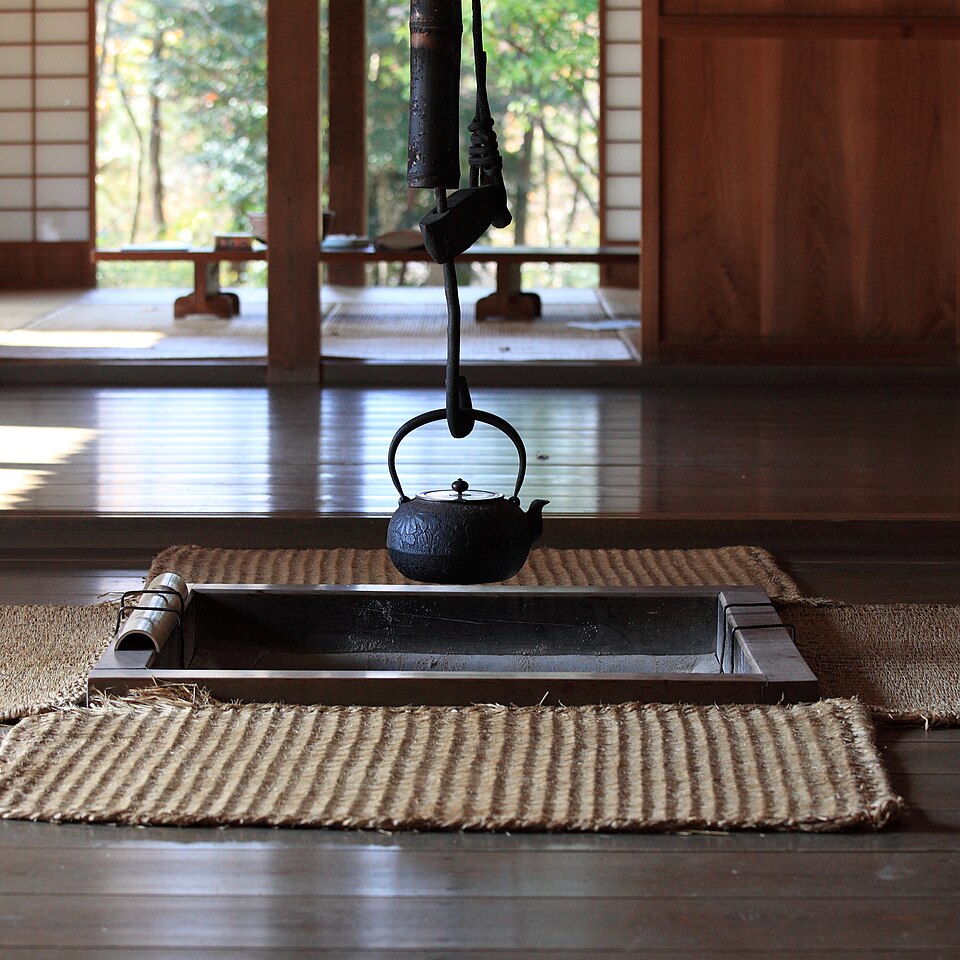
TANAKA Juuyoh (田中十洋) / Wikimedia Commons, CC BY 2.0. Resized to 960 pixels wide; composition unchanged.
Where you sat could mean something
The hearth also organized relationships. In traditional minka houses, seating around it could follow a household hierarchy. JAANUS records the yokoza, overlooking the earthen-floor entrance area, as the household head’s place. Other positions were associated with the wife, visitors, the eldest son or junior members; names varied by locality.1
That history adds a question to the cozy photograph: who would have sat where? A shared source of warmth could also make rank visible. These are historical arrangements to ask about, rather than seating rules to impose on a present-day family or inn.
The fire worked on the house above it
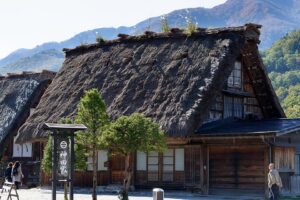
In Shirakawa-go’s gassho-style houses, heat and smoke rose through the lattice ceiling into the attic. The Japan Tourism Agency explains that soot helped protect the timber from moisture and pests, while rising heat helped keep the thatch dry.4
The attic was also a workplace. When silkworms were raised there, the steadier warmth from below mattered to that activity. The hearth connected the living floor with work taking place overhead.4
Miyama’s local tourism organization describes a related connection between hearth smoke and the care of thatched roofs.5 Looking up from the fire therefore changes the story: the roof and the room were parts of a house that worked together.
This describes particular traditional buildings. It is not a recipe for adding an open fire to a modern room.
Keeping a hearth alive takes people
At Nihon Minkaen, Kawasaki’s open-air house museum, the Robata no Kai volunteers tend fires and welcome visitors into selected houses. The museum describes hearth burning as part of keeping the buildings dry and smoking the thatch, as well as giving the interiors a sense of inhabited life.6
The group’s work also includes finding firewood, maintaining grounds and replacing shoji paper. Seen this way, the glowing hearth is one visible part of a much larger routine of care.6
If a volunteer is available, ask about the hearth in that particular house. How was a pot supported? Which side faced the entrance? Such small questions make the building easier to read.
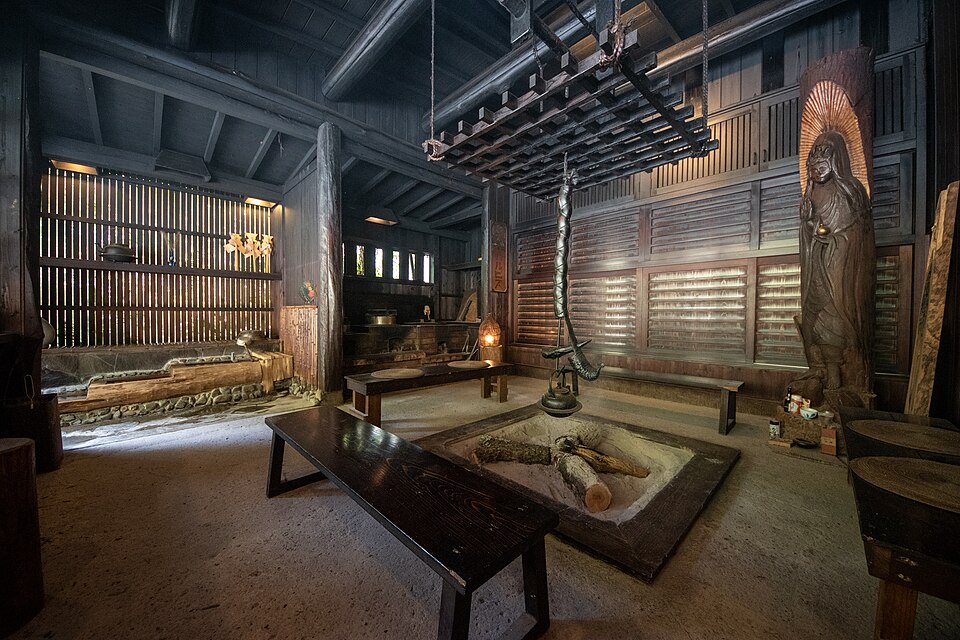
JosephCoston / Wikimedia Commons, CC BY-SA 4.0. Resized to 960 pixels wide; composition unchanged. This photograph remains under CC BY-SA 4.0.
Meeting an irori today
A museum visit is one setting; a meal or stay can be another. Japan’s national tourism organization describes gathering around irori in thatched houses at Ouchi-juku, the historic post town in Fukushima, to enjoy local dishes.8 The Kagoshima ryokan photograph above shows a different arrangement, with wooden benches beside the hearth.
Check what the specific venue offers before going. A hearth may be on display without a fire, and a photograph does not guarantee a cooking experience. Nihon Minkaen, for example, lists seasonal pauses and other interruptions to its hearth-side activities.7
Follow the host’s guidance about seating, shoes and photography, and leave the fire and hanging equipment to the people tending them. The museum also notes that smoke can leave a smell on clothing.7
Take a moment to look from the ash to the kettle, then from the kettle to the beams. What first looks like a picturesque corner begins to reveal a whole set of connections: food, warmth, the people in the room and the work of caring for their home.
Sources & further reading
- JAANUS — Irori: Hearth forms, household uses and historical seating arrangements.
- JAANUS — Jizaikagi: Adjustable pothooks, their function and decorative forms.
- Japan Search — Gotoku: A museum-object description of a support used in hearth ash (Japanese).
- Japan Tourism Agency — Irori Fireplaces: The relationship between the hearth, timber, thatch and attic work in Shirakawa-go.
- Kyoto Miyama — Miyama’s culture of thatch: Local connections between hearth smoke and thatched roofs.
- Nihon Minkaen — Robata no Kai volunteers: Hearth tending, house preservation and visitor interpretation (Japanese).
- Nihon Minkaen — Visitor information: Current opening information, pauses in hearth activities and visitor rules (Japanese).
- Japan National Tourism Organization — Traditional towns and heritage stays: Ouchi-juku’s thatched houses and hearth-side dining.
Individual photo credits and licenses appear beneath each image. The first and third photographs retain their CC BY-SA 4.0 licenses.





Comments