Dogs & Life Together
Why Do Dogs Wear Clothes in Japan?
Rainwear, little shirts, seasonal patterns and matching outfits: a closer look at the choices behind a dog’s wardrobe.
DOGS & LIFE TOGETHER · 5 MIN READ
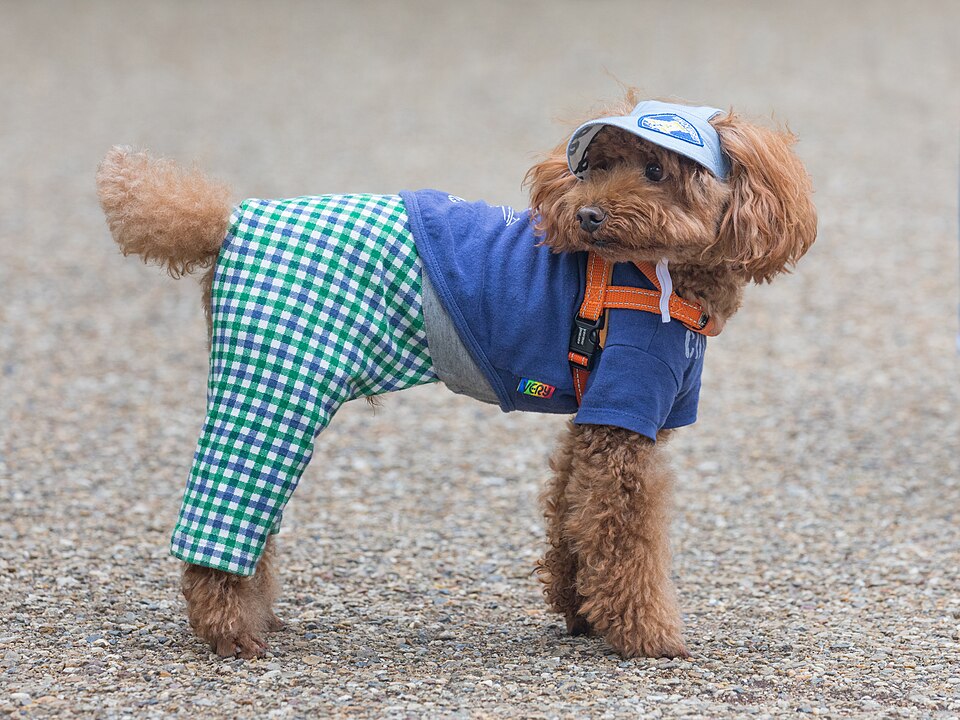
Photo: Basile Morin / Wikimedia Commons · CC BY-SA 4.0. Reduced resolution; full composition retained. Photograph remains under this license.
A navy shirt, green checked trousers and a pale blue cap. In the photograph above, a toy poodle in Tokyo’s Ueno Park wears an outfit assembled with the detail of a very small human wardrobe.
The clothes catch the eye first. Look again and there is an orange harness over the shirt: the dog is also equipped for an ordinary outing.
Dog clothing in Japan can serve several purposes. Some garments are made for particular weather; others express a person’s taste, echo the season or coordinate with an owner’s outfit. A photograph alone cannot tell us which reason mattered most to the person who chose it. Looking at the clothes, the shops and the dog’s needs separately gives a fuller picture.
A garment for a particular walk
Begin with the practical side. Japanese specialist ALPHAICON sells rainwear with features including waterproof material, wind protection and reflective details. Its Rain Dog Guard product page describes clothing designed around outdoor conditions.1 That is a different design brief from a decorative shirt selected for its print.
Warmth is another possible reason. The animal-welfare charity Blue Cross notes that some short-coated dogs may need a coat in cold weather, while thick-coated dogs often have more natural protection. Individual dogs differ, and age can also affect how they cope with the cold.2
These are general care considerations, not something unique to Japan. They help explain why two dogs on the same street may be dressed differently. The weather, the individual animal and the purpose of the garment all matter. A wardrobe does not need to be large to have a practical role.
Familiar clothes, on a smaller scale
Then there is the visual pleasure of miniature clothing. The Osaka shop display below contains rows of little shirts, recognizable graphic references and bright color combinations. Seen together, they resemble a compact rack of casual clothes.
The scale is part of their appeal. A print that would be ordinary on a person’s T-shirt becomes something to look at twice when it appears on a garment made for four legs. The familiar shape becomes surprising at this size.
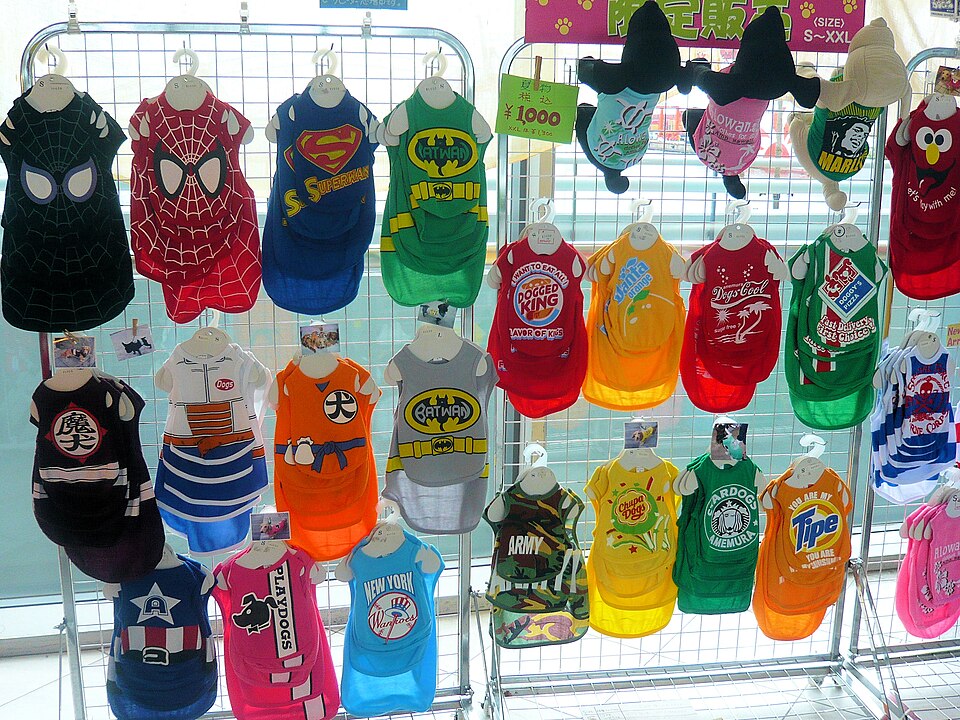
Photo: Stéfan / Wikimedia Commons · CC BY-SA 2.0. Reduced resolution; full composition retained. Photograph remains under this license.
The display is archival, but current Japanese retailers still offer different approaches to dog clothing. DOG DEPT’s categories include shirts, knitwear, outerwear and rainwear, alongside clothes for people.3 That range helps explain why “dog clothes” is too broad a label to tell you what any one item is meant to do.
For an overseas visitor, the details can be more revealing than the novelty: the position of a fastening, the opening around the legs, or the way a pattern continues from one part of the garment to another. A tiny outfit is still an object someone has had to design.
Matching clothes make the connection visible
DOG DEPT explicitly offers pair look collections, with coordinated items for dogs and their owners.3 A shared check, color or graphic can connect the two outfits without making the garments identical.
One way to read this design choice is as a small expression of companionship. The person and dog appear as part of the same outing, linked by a detail that other people may only notice after a second glance.
Seasonal clothing offers another example. Pet Paradise’s summer collection includes dog versions of yukata, with floral patterns and decorative sashes, as well as festival-style garments.4 The floral print and sash carry the seasonal reference, even when the shape has been adapted for a dog. It is a small example of a retailer bringing familiar clothing traditions into a different part of family life.
The outfit travels into everyday life
The photograph below, taken in Tokyo’s Ebisu neighborhood, brings the subject out of the shop. Several dogs sit in strollers while people photograph them outside a café. You can see clothes, bags, phones and the small arrangements that make up an outing.
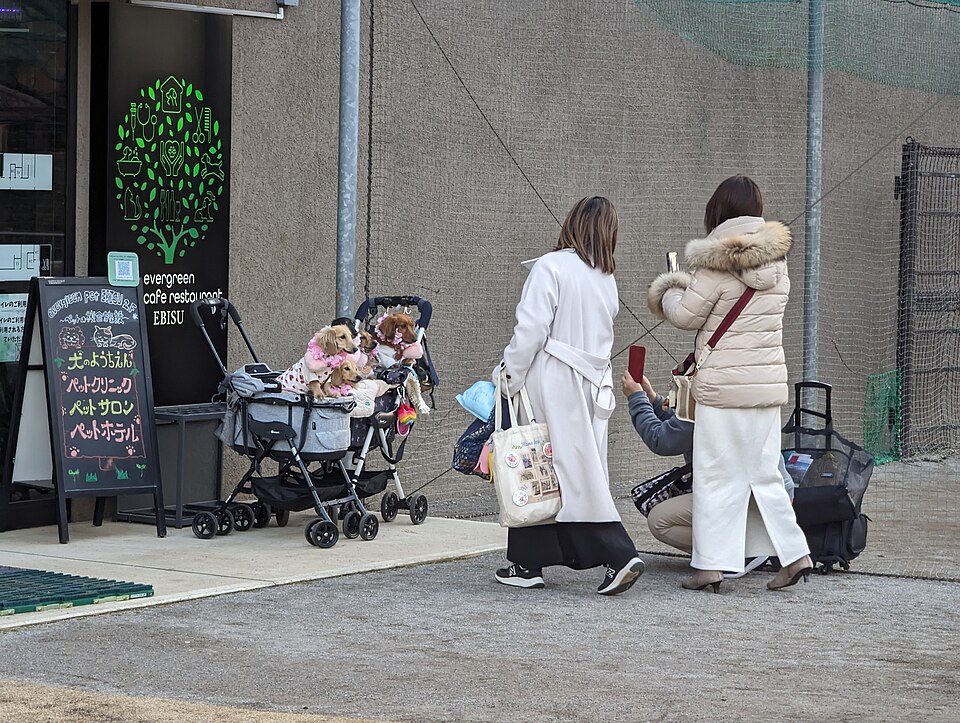
Photo: Syced / Wikimedia Commons · CC0 1.0. Reduced resolution; full composition retained.
Look at the surrounding details: bags hang from handles, a phone is raised, and someone crouches down for a photograph. The dogs’ outfits sit within the same everyday world as the human coats and café entrance. The picture gives us a close view of one small social moment.
Our story about dogs riding in strollers looks at another object in that scene. Together, these details invite a closer view of how some owners arrange life with their dogs, from getting ready at home to spending time outside.
The dog’s comfort comes first
The dog experiences fabric, fastenings and movement, rather than the meaning a person gives a matching pattern. That is an essential part of the story.
Dogs Trust recommends introducing a coat gradually and positively. If a dog is uncomfortable or moves away, its guidance is to remove the garment and return to an easier step another time.5 Blue Cross also warns that elaborate costumes can restrict natural movement and make a dog’s body language harder for people and other dogs to read.6
A size label is only a starting point. For example, DOG DEPT’s garment chart lists back length and chest circumference, alongside reference weights and breeds.7 The useful question is how the actual garment fits the actual dog. A familiar breed name on a chart cannot show you that on its own.
For visitors, appreciation can stay simple: enjoy the colors and small design details, ask before photographing an owner’s dog, and give the animal space. There is no need to turn a passing encounter into a performance.
Return to that small outfit in Ueno Park. The checks and cap make it memorable; the orange harness places it within an ordinary outing. The details of the garment and the needs of the animal belong in the same picture.
Sources & further reading
- ALPHAICON — Rain Dog Guard: product description
- Blue Cross — Dogs in winter: individual needs and coats
- DOG DEPT — matching clothing for people and dogs
- Onward Holdings / Creative Yoko — Pet Paradise seasonal yukata collection
- Dogs Trust — introducing a coat gradually
- Blue Cross — dog costumes, movement and communication
- DOG DEPT — an example of a garment size chart
Brand materials document examples of Japanese dog clothing; they are not endorsements or a shopping ranking. The photographs are archival, and none is presented as a photograph of the named brands’ current products. Photo credits and reuse terms appear beneath each image.



Comments