Food & Everyday Tables
Ramen in Japan: Finding Your Favourite Bowl
A first spoonful, a different noodle, an extra serving: how a familiar Japanese meal becomes a matter of personal taste.
7 MIN READ
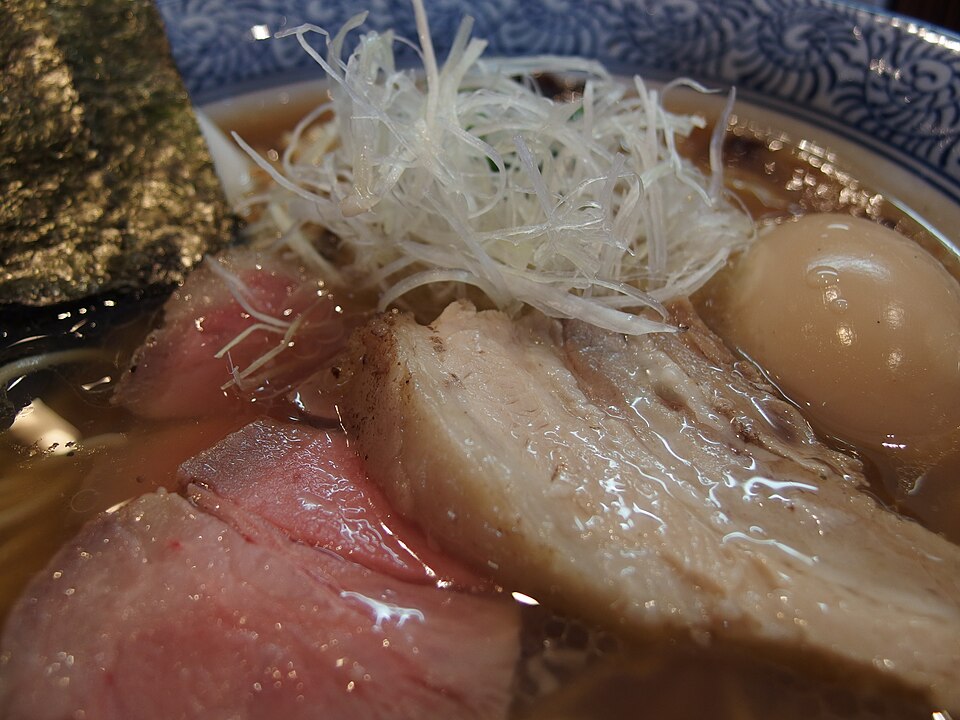
Photo: Guilhem Vellut / Wikimedia Commons / CC BY 2.0. Resized; original composition retained.
Imagine sitting down for ramen without a list of places you are supposed to love. A bowl arrives. Before you reach for the pepper, taste the soup. What would make you want another spoonful?
That question is a useful starting point in Japan, where one familiar name covers many kinds of meal. A soy-sauce-seasoned bowl in Tokyo, miso ramen in Sapporo and a pork-bone soup in Fukuoka offer different things to notice. You can learn the names as you go. The more interesting discovery is which combination you want to eat again.
Four names that help you read a menu
Shoyu, shio, miso and tonkotsu are useful words to recognise. They describe different parts of the soup, however. The first three refer to its main seasoning; tonkotsu refers to a pork-bone stock. A government interview with food scientist Muneaki Yonemitsu explains this distinction through tare, the concentrated seasoning, and dashi, the stock it flavours.1
| Menu name | What the name tells you |
|---|---|
| Shoyu | Soy sauce is central to the seasoning. |
| Shio | Salt is central to the seasoning. |
| Miso | Miso paste is central to the seasoning. |
| Tonkotsu | The stock is made with pork bones. |
This is why a description such as tonkotsu shoyu makes sense: it gives you information about both the stock and its seasoning. It also means that “miso” or “shio” alone cannot tell you whether a bowl contains pork, chicken or seafood. If ingredients matter to you, check the complete dish with the restaurant.
The photograph above shows a shoyu ramen photographed in Tokyo in 2014. Its sliced meat, egg, nori and fine strips of white onion provide a close view of one particular bowl. It is an example to look at, rather than a promise of what every shoyu order will contain.
How ramen became part of everyday Japan
Ramen has roots in Chinese noodle cooking. The Shin-Yokohama Ramen Museum traces its development through the opening of Japan’s ports, Chinese restaurants and the growing popularity of noodle shops. Its chronology records the opening of Asakusa’s Rairaiken in 1910 as an important moment in bringing ramen to a wider audience.2
The museum also describes the spread of ramen stalls after the Second World War and the launch of instant ramen in 1958. Those are separate stages in a longer story: restaurant ramen was already established before packets and cups made the name familiar in kitchens around the world.2
This history makes a useful companion to a meal. A bowl can be quick to eat while carrying the work of many cooks, businesses and communities that changed it over time.
In Sapporo, pay attention to the noodles
Sapporo’s official tourism guide identifies the city with miso ramen and draws attention to its medium-thick, wavy noodles. Their shape and texture are an important part of how the noodles and soup work together.3 On a first visit, it is worth noticing the chew as carefully as the flavour of the broth.
Another official Sapporo guide describes a preparation in which pork, garlic and vegetables cook in a wok before the broth is added. It also presents butter and corn as familiar options.4 Individual shops make their own choices, so the city’s reputation gives you a starting point rather than a fixed recipe.
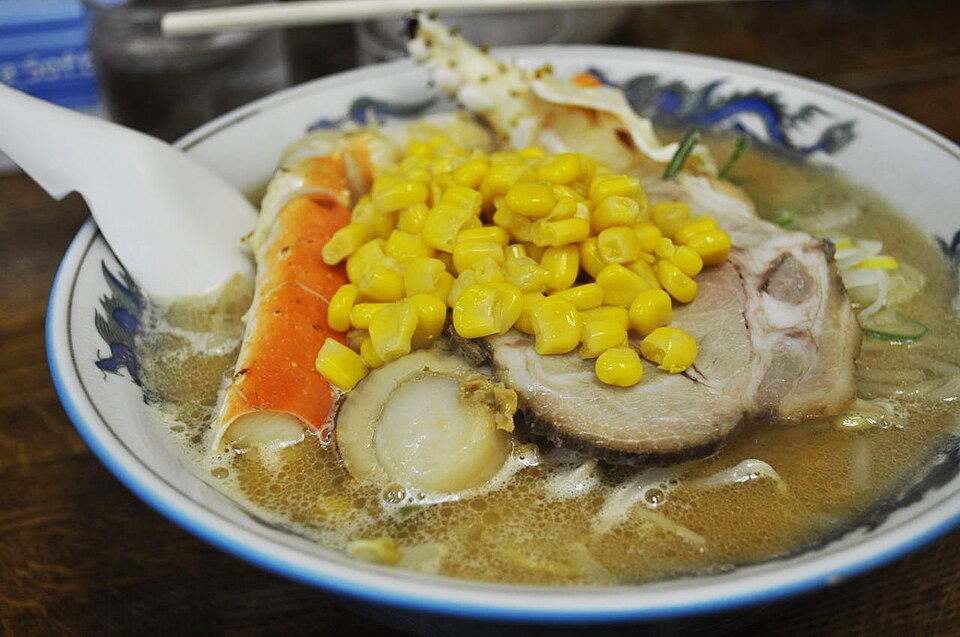
Photo: Schellack / Wikimedia Commons / CC BY 3.0. Resized; original composition retained.
The Sapporo photograph brings that variety into view: corn, seafood and sliced pork share the bowl. You might start with the soup, then try a mouthful of noodles, then return to the soup after tasting a topping. The order is yours. Looking for those small changes can make a meal more memorable than trying to decide immediately whether it is “the best.”
In Fukuoka, a second serving changes the rhythm
Hakata ramen is widely associated with thin noodles and cloudy pork-bone soup. Fukuoka Prefecture’s tourism guide also distinguishes the related traditions of Hakata, Nagahama and Kurume, while cautioning that their boundaries are not absolute.5 Treat the regional names as clues to a history, with room for each shop’s approach.
One especially useful word is kaedama: another portion of noodles for the soup already in your bowl. Fukuoka City’s guide describes it as a common local practice.6 If your shop offers it and you are still hungry, keep some broth for the extra noodles.
You may also be asked how firm you want the noodles. Futsu means normal, kata means firm and yawa means soft. The prefectural guide recommends the normal serving as a perfectly good way to learn a shop’s standard.5 There is no need to order the firmest option to prove that you know ramen.
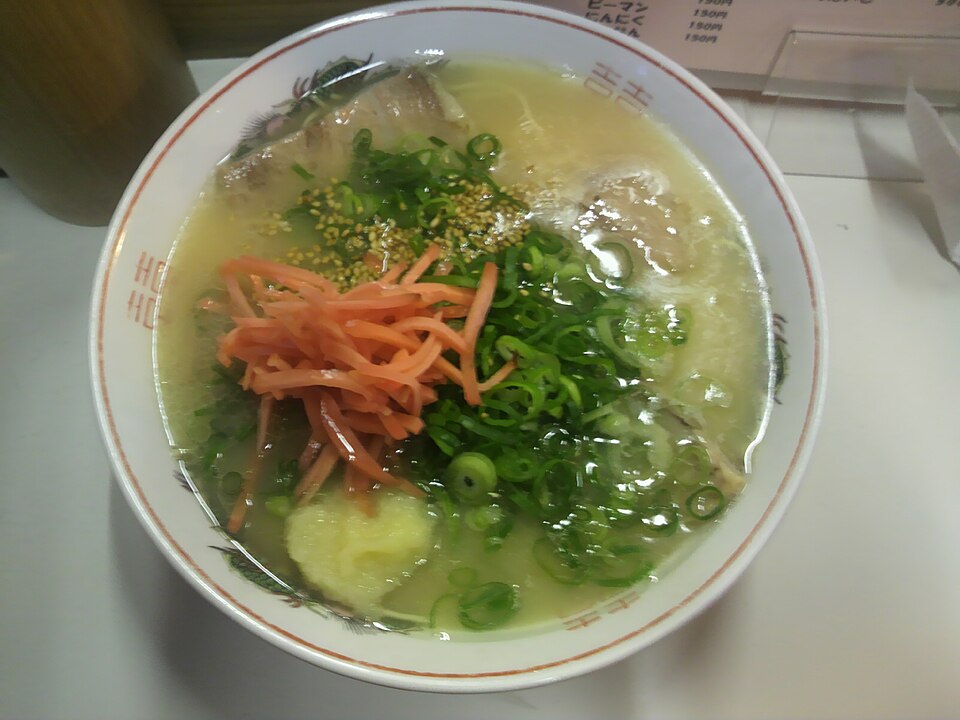
Photo: vigorous_action / Wikimedia Commons / CC BY-SA 3.0. Resized; original composition retained.
The red ginger and green onions in this Hakata–Nagahama bowl make a striking contrast with its pale soup. If condiments are offered separately, try a little at a time. That gives you a chance to discover what each addition does, and whether you prefer the soup as it arrived.
Ordering without turning lunch into a test
A first visit becomes easier when you notice how that particular shop works. Some use a ticket machine; others take orders directly. JNTO describes both arrangements in its ramen guide.7
- Choose while you wait. Read the menu or look at the photographs before your turn. Keep your group together in a queue, and follow staff instructions about tickets and seating.8
- Use the shop’s ordering system. Where tickets are required, choose your meal, pay and give the ticket to the staff. Check the machine’s displayed payment options rather than assuming they are the same everywhere.7
- Start with a manageable choice. The standard or recommended bowl is a useful introduction. You can decide about additional toppings on a later visit, once you know what you enjoy.8
- Eat comfortably and leave room for the next guest. Slurping is acceptable; it is not an obligation. When you finish, avoid lingering at a busy counter with people waiting.8
You do not have to finish every drop of soup. JNTO explicitly notes that leaving broth after eating the noodles and toppings is acceptable.7 Enjoying the meal does not require an empty bowl.
Why one good bowl can lead to another
Ramen lends itself to a small, personal comparison. After a meal, write down just three things: what the soup was like, what you noticed about the noodles, and which topping you would choose again. “I liked the springy noodles” tells you more about your own taste than a borrowed ranking.
On another day, change one thing. Try a different seasoning, a different regional style, or a second shop serving the kind you already liked. Two bowls with the same name may leave quite different impressions. You are building a vocabulary through eating.
If you want to connect that curiosity with the history, the Shin-Yokohama Ramen Museum combines ramen restaurants with an exhibition about the dish. Its dining area recreates a Japanese streetscape from 1958. Check its official information for the current shops and visit details.9
You may eventually remember a bowl by its place in a day: lunch after a long walk, a stop before a train, the meal you wanted when the weather turned cold. Learning the names helps you order. Finding your favourite gives those names something personal to mean.
Sources & further reading
- Highlighting Japan: the science of ramen — an interview with Muneaki Yonemitsu explaining seasoning and stock.
- Shin-Yokohama Ramen Museum: ramen history (Japanese) — Chinese roots, Rairaiken, postwar stalls and instant ramen.
- Welcome to Sapporo: Sapporo’s ramen noodles — miso ramen and the role of medium-thick, wavy noodles.
- Visit Sapporo: ramen — preparation, toppings and variation among shops.
- Visit Fukuoka: Hakata, Nagahama and Kurume ramen — local traditions and ordering noodle firmness.
- Fukuoka City: food guide — Hakata ramen and kaedama.
- Japan National Tourism Organization: ramen guide — ordering and leaving broth.
- Japan National Tourism Organization: how to enjoy ramen — choosing, queuing and counter etiquette.
- Shin-Yokohama Ramen Museum: official visitor information.
These are archival photographs of individual bowls, not current menu photographs or endorsements of particular restaurants. All three have been resized to 960 pixels wide, with their original proportions and composition retained. Each photograph keeps its stated Creative Commons licence; source and licence links appear in its caption.




Comments