Hachiko Beyond Shibuya: The Real Dog Behind the Statue
A familiar meeting point leads back to a living dog, the people around him, and a sculpture that finally brings two companions together.
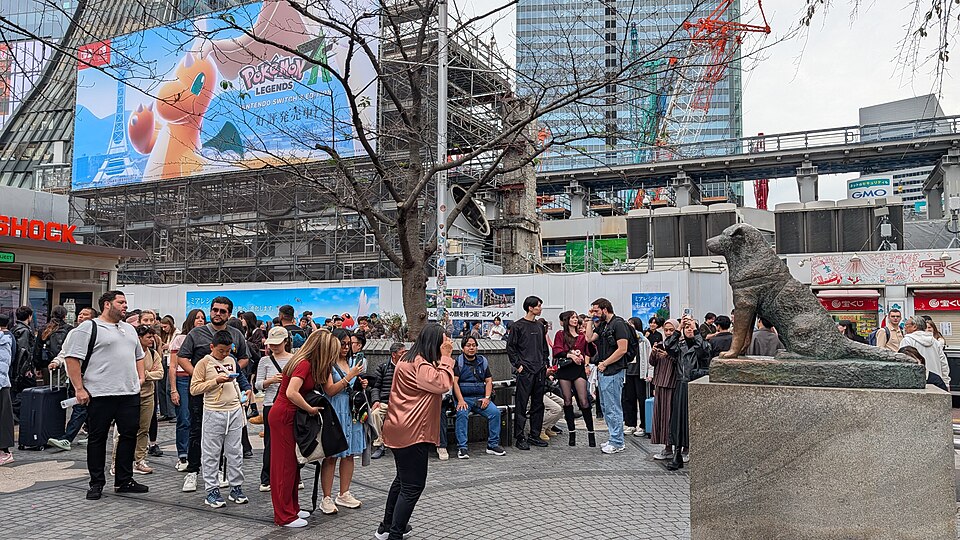
Joli Rumi / Wikimedia Commons, CC BY-SA 4.0. Resized to 960 pixels wide; composition unchanged.
At Shibuya Station, a bronze dog has become a place where people find one another. The name is famous enough to work almost like an address: Hachiko.
The statue stands close to Shibuya Scramble Crossing and is one of the area’s familiar meeting points.[1] But a quick photograph leaves several questions outside the frame. Who was the person Hachiko waited for? Who looked after the dog? And why does another statue, elsewhere in Tokyo, show him in a very different pose?
Following those questions changes the visit. The dog on the pedestal becomes a particular animal with a short shared life, a wider circle of people, and a story that people have continued to reshape.
Before the statue, a dog named Hachi
Hachiko was an Akita dog, born in Odate, Akita Prefecture, in November 1923. He went to live with Professor Hidesaburo Ueno in 1924 and was given the name Hachi. Ueno died suddenly in 1925, so their time together was much shorter than the years for which the dog would later be remembered.[2]
Ueno taught at the institution now known as the University of Tokyo. His work helped establish agricultural civil engineering in Japan, a field concerned with farmland, irrigation and drainage.[3] Remembering his name gives the familiar story a person at its center, rather than an unnamed owner who simply disappears.
A small correction to the railway story
Many retellings describe Ueno taking a train from Shibuya to the university every morning. The university’s own historical discussion complicates that picture.
Researcher Takashi Tamura points out that Ueno’s home was near the agriculture faculty’s former location in Komaba. Ueno normally walked there, and accounts place Hachiko at the university gate as well. Train journeys from Shibuya were associated with other destinations, including an agricultural research station. The image of a daily train commute to campus is therefore misleading.[4]
This does not erase Hachiko’s connection with Shibuya Station. It helps distinguish his life with Ueno from the later story of his visits after Ueno’s death. A memorable story can be moving and still deserve a closer look.
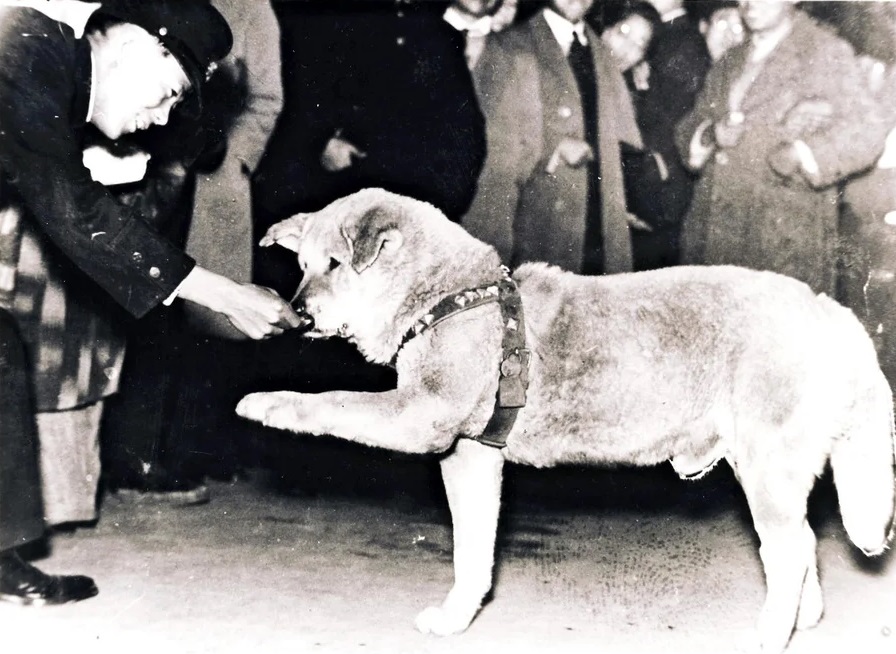
Unknown photographer; source: Yomiuri Shimbun / Shibuya Folk and Literary Shirane Memorial Museum / Wikimedia Commons, Public domain. Original digital file; no changes.
There were other people in his life
Hachiko continued to visit Shibuya Station after Ueno died. A newspaper article published on 4 October 1932 brought him much wider attention; his station visits continued until his death in March 1935.[5]
Yet picturing him as a dog with nobody around him leaves out part of his life. Odate’s HACHI100 account describes several arrangements for his care, including a period with Ueno’s wife and a later home with the Kobayashi family in Yoyogi. Station staff also came to look after him.[2]
The photograph above makes that wider human world visible. There is a hand, a raised paw and a station attendant close to the dog. It is a useful image to hold alongside the solitary bronze figure: Hachiko was also an animal whom people encountered and cared for.
He lived to see the first statue
The first Shibuya statue was unveiled in April 1934, while Hachiko was still alive. He attended the ceremony himself. Sculptor Teru Ando created that earlier figure.[6]
That is an unexpected detail if you imagine the monument as something made only after his death. Hachiko had already become a public figure during his lifetime.
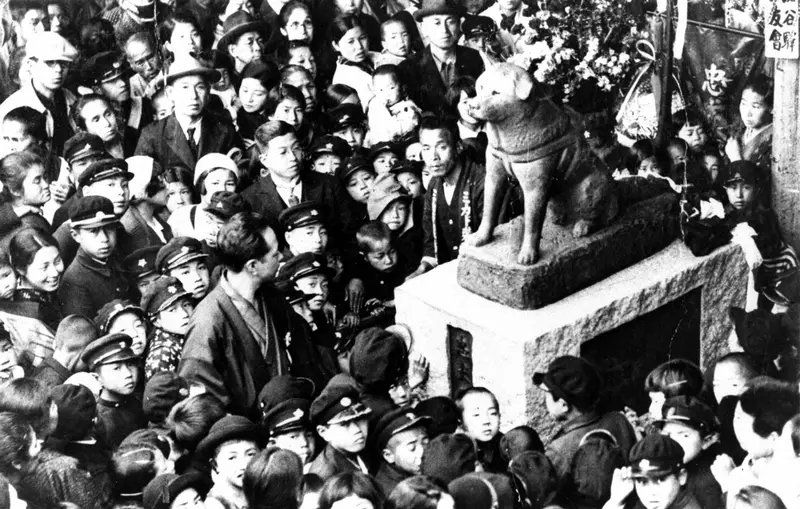
Tokyo Mainichi Shimbun / Wikimedia Commons, Public domain. Original digital file; no changes.
The original statue was removed in 1944 for wartime metal collection. Its replacement was unveiled in 1948, made by Teru Ando’s son, Takeshi Ando.[5][6] The sculpture in today’s travel photographs and the one in the archival photograph above therefore belong to different chapters of the story.
A reunion at the University of Tokyo
Another chapter takes place at the university. A sculpture by Tsutomu Ueda, unveiled on 8 March 2015, brings Professor Ueno and Hachiko together. The date marked 80 years since the dog’s death.[7]
The project grew from an idea proposed by philosopher Masaki Ichinose, who wanted more people to know who Hachiko’s owner had been. Its creators chose a joyful young dog greeting his companion. Donations funded the work; photographs of Akita dogs jumping up to greet a person helped inform the pose.[3]
This is a symbolic reunion. The sculpture offers an ending that history could not provide, and the professor becomes visible beside the dog whose fame outlived them both.
Finding the second statue: The university places it just inside the No-seimon Gate of its Yayoi Campus, on the left as you enter. This is the Yayoi area of the Hongo campus, rather than Komaba, where Ueno once worked.[3] Use the university’s official monument page to see the sculpture and locate it. Follow campus notices when visiting.
One story, several places to look
Shibuya is the place to begin: the public landmark, the station and the stream of people meeting beside it. The university adds the person who is missing from that single-dog portrait.
The story also reaches beyond Tokyo. Odate, Hachiko’s birthplace, opened the Akita Dog Visitor Center in front of Odate Station in 2019. Its building draws on the design of an earlier Shibuya Station, connecting the hometown with the place where Hachiko became famous.[2]
For a first encounter, there is no need to turn the story into a checklist. Pause at the statue, then look at the old photographs. Notice the people standing near the living dog. Learning their part in the story makes the famous act of waiting feel less distant—and the next photograph of Hachiko a little more meaningful.
Sources & further reading
- GO TOKYO — Hachiko Statue and its location
- HACHI100 / Odate City — Hachiko’s life and hometown (Japanese)
- The University of Tokyo — Hachiko and UTokyo, part 1
- The University of Tokyo — the Komaba commute and the familiar story (Japanese)
- Showakan — historical overview and the 1932 newspaper story (Japanese)
- Shibuya City Libraries — Hachiko and the two Shibuya statues (Japanese)
- The University of Tokyo — Professor Ueno and Hachiko monument
Photograph credits, source pages and reuse terms appear below each image. Historical photographs are identified in their captions.




Comments