An onigiri can wear its kelp in two quite different ways. One coating looks like long, delicate ribbons, almost wide enough to wrap around the rice. The other looks like a soft tangle of fine threads. In Tsuruga, a port in Fukui Prefecture, a local kombu processor explains the difference with a simple question: which face of the kelp met the blade?
A ribbon from the face of a single blade of kelp
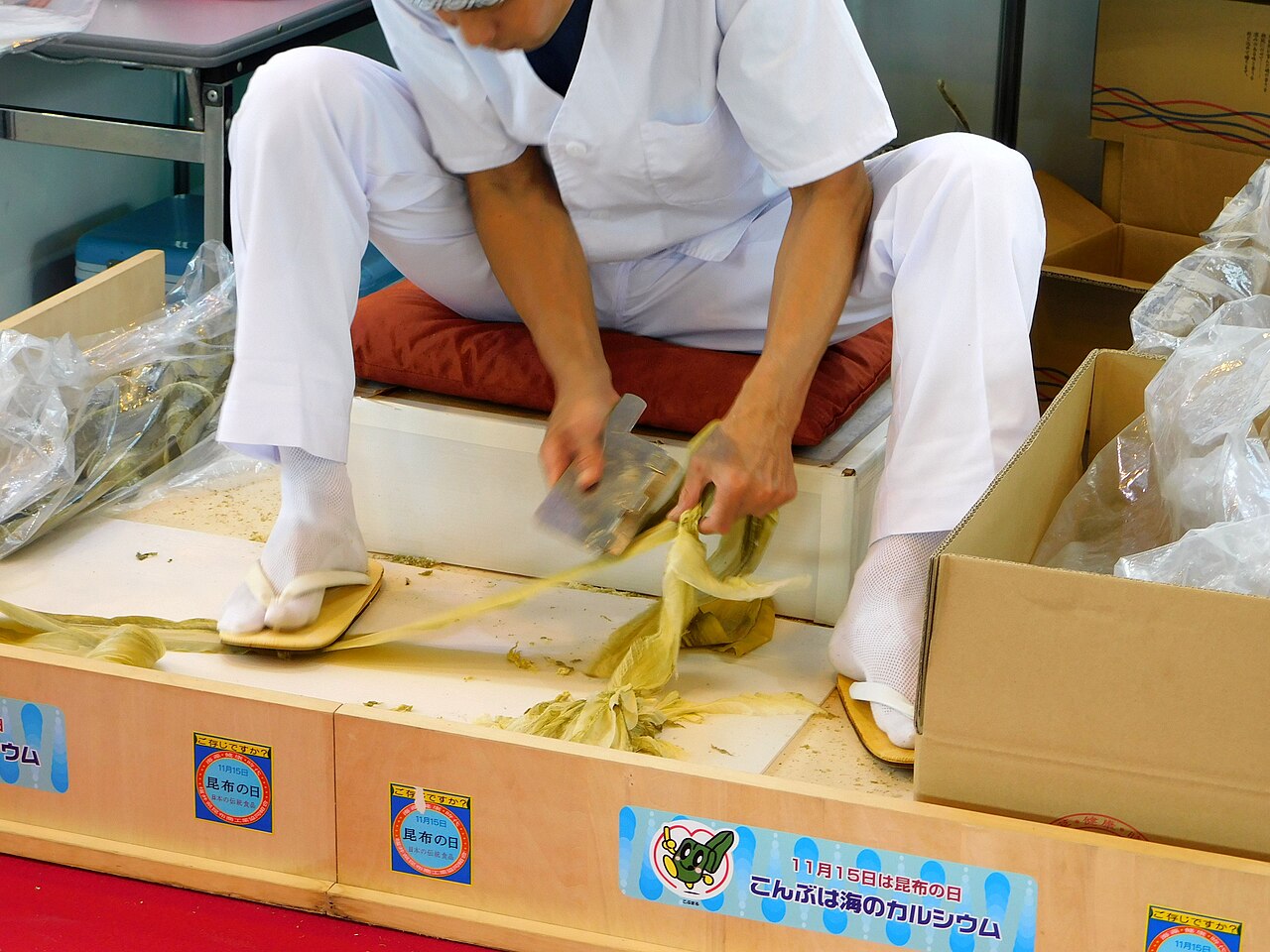
For oboro kombu, dried kelp is softened with vinegar and worked one piece at a time. A craftsperson draws a specialised blade across the broad face, shaving off a thin, continuous layer. Look at the demonstration photograph: the width of the original piece of seaweed gives the ribbon room to spread. The maker selects kelp with few blemishes because a defect can interrupt a long shaving.
Tsuruga Kombu contrasts this with the usual modern method for tororo kombu. Several pieces of kelp are stacked and pressed into a block. A machine shaves across the side of the stack. Each pass catches the edges of many layers, so the result falls into fine, tangled strands. The distinction is chiefly in the cut. Buying two different species of seaweed would not, by itself, account for the two textures.
Why this trade belongs to a port
During the Edo period, Tsuruga was a port of call for the kitamaebune, merchant ships on the Sea of Japan trading routes. Kelp moved through the port as cargo. A town did not have to grow the seaweed outside its harbour to develop the skill of processing it. Shipping gave local makers the raw material; the way they handled it gave shoppers a reason to seek out their work.
Try the comparison at a food shop before buying. Look for おぼろ昆布 and とろろ昆布 on the labels, then tilt the packets so the edges show. One resembles a loose strip of fabric; the other could almost be teased apart like thread. That difference is a tiny, edible record of a workshop decision.
Read next
Sources and photograph
Cover photograph: A demonstration of shaving oboro kombu at a Tsuruga products fair. TR15336300101 · CC BY-SA 4.0


Comments