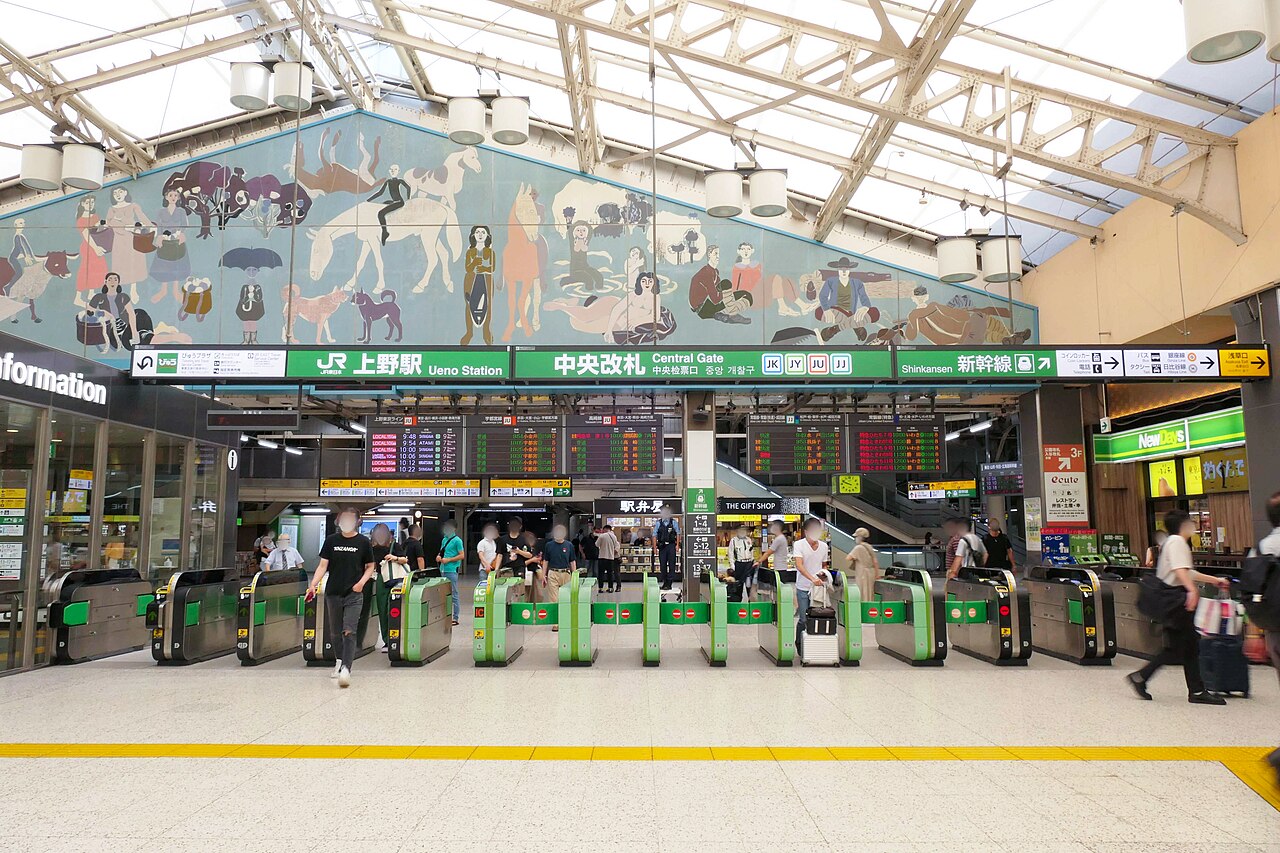
You can take a small pet dog on JR East and Tokyo Metro trains in a suitable enclosed carrier. At Ueno, the signs for the JR Yamanote Line and the Tokyo Metro Ginza Line can both point you toward Shibuya. The line you choose changes what you do at the gate. On JR East, show the carrier to staff and buy a ¥290 baggage ticket. On Tokyo Metro, a small pet that meets its conditions travels free with a fare-paying passenger.
Above: the central ticket gates at JR East’s Ueno Station in 2021. MaedaAkihiko / Wikimedia Commons · CC BY-SA 4.0. Image resized.
Measure the carrier you will actually carry
Use the outside length, width and height of the pet carrier. Add the three measurements, then weigh the dog and carrier together. A case measuring 50 × 35 × 30 cm adds up to 115 cm. If it weighs 2.1 kg and your dog weighs 6.4 kg, the combined weight is 8.5 kg. That combination falls within the size and weight limits below. Check that the dog’s head and body fit comfortably inside with the carrier closed. A carrier sold as “small” can still be too tall once you add its three sides.
| Operator | Carrier and dog | Pet charge |
|---|---|---|
| JR East | Dedicated pet case. Three sides total up to 120 cm. Dog and case together up to 10 kg. | ¥290 per case per ride, in addition to your own fare. |
| Tokyo Metro | Dedicated container. Its Japanese passenger guide gives a three-side total up to 120 cm and a combined weight up to 10 kg. | No extra charge for an eligible pet. |
If you arrive on wheels
Before leaving home, try lifting the carrier off the stroller and folding the frame. JR East specifically allows a detachable case that meets its limits. The frame must be folded and meet the ordinary baggage rules in its own right. A mesh cover over an oversized, one-piece buggy does not make the buggy an eligible carrier. JR East also lists dog slings among the items it does not accept, even when the entire animal fits inside.
Tokyo Metro’s guide describes the pet container. If yours has wheels or a detachable base, check that particular setup with Metro station staff before going through. An operator’s answer about the outward trip may not cover the return trip on a different railway.
What to say at the gate
At a staffed JR East gate, show the closed case and say 「犬を連れています。手回り品きっぷを一枚お願いします」 (Inu o tsurete imasu. Temawarihin kippu o ichimai onegaishimasu.). That means “I’m travelling with a dog. One baggage ticket, please.” Keep the dog inside throughout the journey. If your route involves another operator, write down the line name along with your measurements. “Can I use this carrier on the Ginza Line?” is a much easier question for staff to answer than “Can dogs ride trains in Tokyo?”
If a Tokyo street full of dogs on wheels first made you curious, the companion story looks at why families choose them. Why are dogs riding in strollers in Japan?
Railway guidance
- JR East’s pet and detachable stroller FAQ (Japanese)
- JR illustrated guide to acceptable cases (PDF, Japanese)
- Tokyo Metro passenger guide, small animals section (PDF, Japanese)
- Tokyo Metro conditions of carriage, Article 173 (PDF, Japanese)
- Tokyo Metro Ginza Line station list (English)
Railway guidance checked November 27, 2026. This guide covers pet dogs on these two operators.


Comments