Culture & Traditions
Omikuji in Japan: How to Read, Keep or Tie a Paper Fortune
What do daikichi and kyō mean? A guide to Japanese fortune slips, the advice beneath the luck rating, and the local customs for taking them home.
By Maki Kakudate · 5 minute read
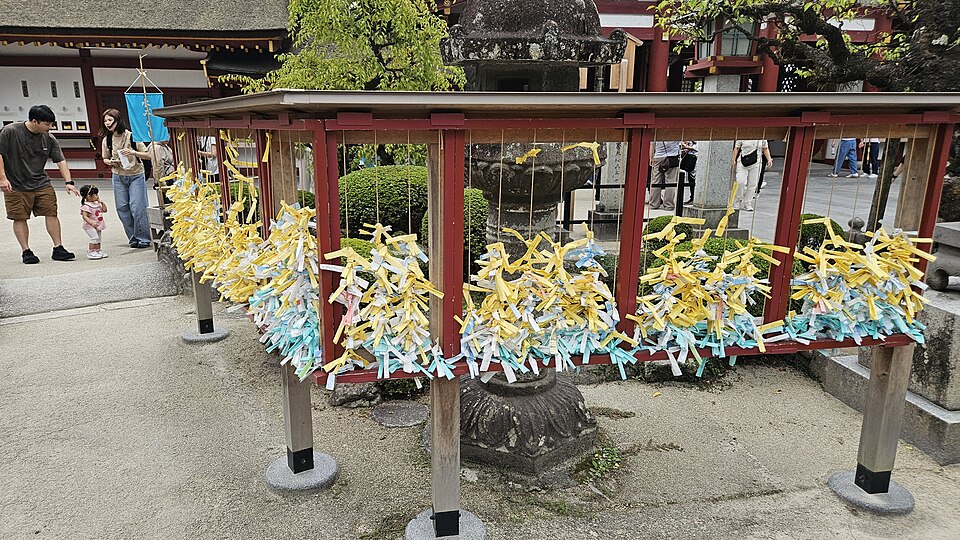
At Tokyo’s Meiji Jingu, the paper you draw does not rank your luck at all. Its omigokoro offers a poem and an explanation instead.1 It is an unexpected starting point for understanding a custom often introduced as a way to find out whether good or bad fortune lies ahead.
Omikuji are paper fortunes received at Japanese shrines and temples. Many combine an overall fortune with separate guidance on matters such as work, study, travel or relationships.2
For a first-time visitor, the large characters at the top can seem like the whole point. Yet there is more to read—and what you do with the paper afterward depends on where you received it.
How do you draw an omikuji?
One familiar method uses a container of thin sticks. You draw a stick, then receive the printed fortune associated with its number or mark. Kokugakuin University’s Encyclopedia of Shinto describes this as one form of a wider practice of drawing lots to seek divine guidance.6
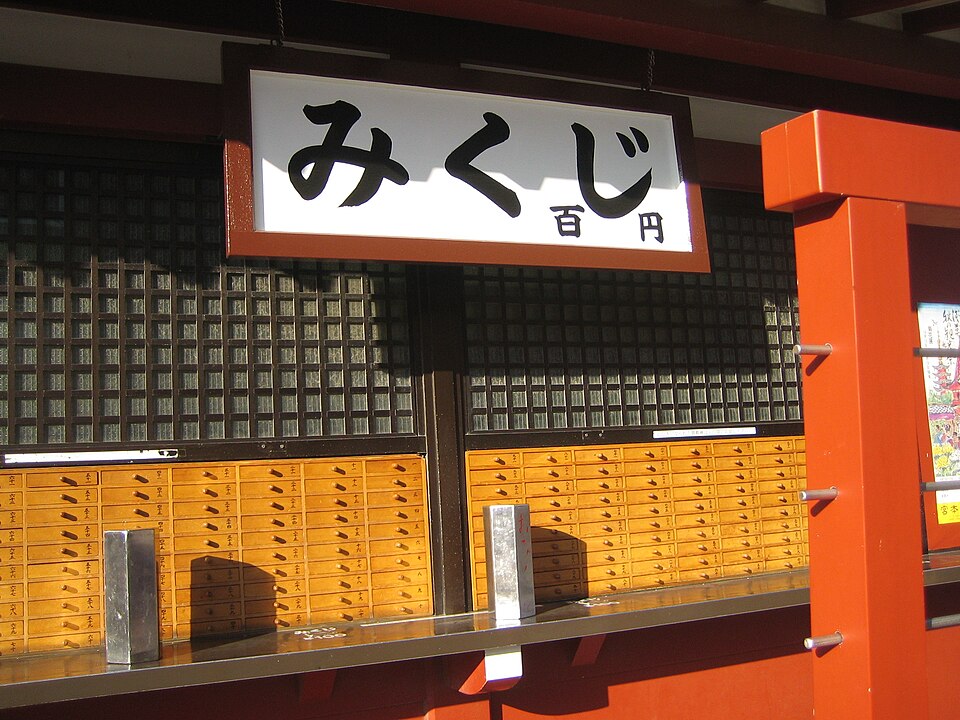
At a self-service counter with numbered drawers, the process usually looks like this. Read the displayed instructions first, since some places hand out the paper for you or use another system.2
- Check the offering amount. Use the amount and payment method shown at that counter.
- Draw as instructed. Where a stick container is used, shake it gently and allow one stick to emerge.
- Match the number. Take the corresponding fortune from its drawer, or show the stick to the attendant if that is the local procedure.
- Return the stick. It belongs to the drawing equipment. Sensoji explicitly reminds visitors to put it back.4
- Step aside to read. Give the next person room to use the counter.
If the number is difficult to read, ask for help before opening drawers at random. The task is to find the paper that matches your draw, rather than choose whichever result looks appealing.
What do daikichi, kichi and kyō mean?
These are common fortune labels. The English wording below is a reading aid, not a single ranking system used throughout Japan. The Association of Shinto Shrines says that both the categories and their order can differ between shrines.3
| Japanese | Reading | Basic meaning |
|---|---|---|
| 大吉 | Daikichi | Great good fortune |
| 吉 | Kichi | Good fortune |
| 中吉 | Chūkichi | Moderate good fortune |
| 小吉 | Shōkichi | Small good fortune |
| 末吉 | Suekichi | Good fortune to come |
| 凶 | Kyō | Bad fortune |
The names are drawn from the categories described by the Association and JNTO’s visitor guide.2, 3 If your slip uses a different label or sequence, look for that shrine or temple’s explanation.
Read the lines beneath the headline
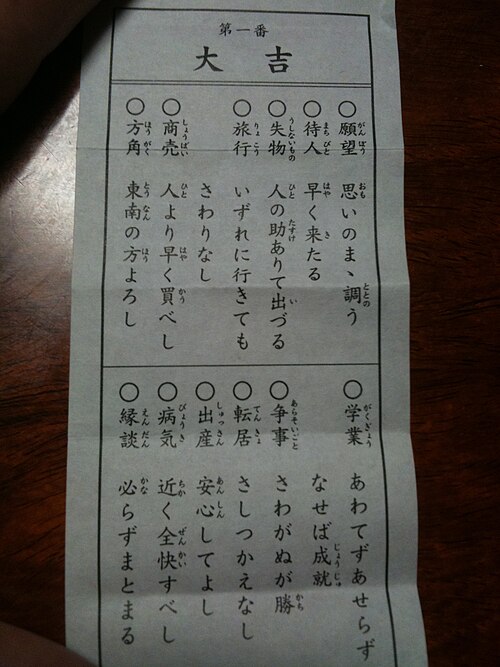
In the photograph below, daikichi appears above separate entries for wishes, a person awaited, lost items, travel and other concerns. It is a useful visual reminder: the headline and the individual entries do different jobs.
The Association of Shinto Shrines emphasizes reading the contents as guidance for everyday conduct, rather than stopping at the fortune classification.3
Try reading the whole slip once, then returning to the part that matters to you. A line about travel may hold your attention during a trip; someone studying for an examination may notice another section first. Those are ways of approaching the text, not rules about which result you must prioritize.
Should you tie an omikuji or take it home?
Both practices exist. The Association of Shinto Shrines says that taking an omikuji home is acceptable, even though tying it at a designated place in the grounds is also customary.3
Local guidance makes the choice clearer. Dazaifu Tenmangu explicitly offers two options: keep the fortune, or fold and tie it in a designated area. Its Japanese fortunes also change color with the seasons.5 The colorful rack in the opening photograph belongs to this shrine.
Sensoji gives more specific advice for a kyō result: seek Kannon’s protection and tie the fortune at the appointed place. The temple encourages those who draw bad fortune to avoid fear and approach daily life with patience and sincerity.4
Before tying the paper
Look for the marked rack or tying area. Do not assume that any tree branch is suitable just because you have seen photographs of fortunes tied to trees elsewhere. If the instructions are unclear, ask a member of staff.
These examples explain why a universal instruction such as “always tie a bad fortune” is incomplete. Start with the practice of the shrine or temple in front of you.
Why does Meiji Jingu have no good-or-bad rating?
Meiji Jingu’s omigokoro draws on poems by Emperor Meiji and Empress Shoken. The shrine selected fifteen from each, making a collection of thirty, and accompanies them with explanations and English translations. It presents these as guidance for conduct rather than predictions of good or bad luck.1
That changes what you look for when unfolding the paper. There is no winning label to find; the attention goes to the poem and its interpretation. It is also a reason to avoid assuming that an experience at one shrine tells you exactly what another will offer.
Can you get an omikuji in English?
Yes, at some places. Dazaifu Tenmangu’s visitor information lists Japanese, English and Chinese fortunes, while Meiji Jingu includes English translations with its omigokoro.5, 1
Ask about language options before drawing. If you receive a Japanese slip, a translation can help you begin, but a poem or an unfamiliar expression may need more explanation than a word-for-word rendering provides.
Before leaving, choose one line you would like to understand better. Whether you keep the paper or tie it where instructed, that question can stay with you after the visit.
Three customs, three ways to take part
Continue with the other objects you may encounter at a shrine or temple counter.
Sources & further reading
Sources checked October 22, 2026. Follow local instructions; drawing methods, language options and the handling of fortunes can vary.
- Meiji Jingu — Omamori and Omigokoro (Japanese). Poems, the thirty selections, English translations and the absence of luck ratings.
- Japan National Tourism Organization — Draw an Omikuji Fortune Slip. Common drawing methods, labels and the subjects covered by fortunes.
- Association of Shinto Shrines — Omikuji (Japanese). Variation in rankings, reading the guidance and taking a slip home.
- Sensoji — Frequently Asked Questions: Omikuji (Japanese). Returning the stick and the temple’s guidance for a bad fortune.
- Dazaifu Tenmangu — Experiences: Fortunes. Languages, seasonal colors, keeping and tying omikuji.
- Suzuki Kentarō / Kokugakuin University — Omikuji, Encyclopedia of Shinto. Drawing lots and the numbered-stick method.
Photo dates and credits appear in the captions. The photographs illustrate the custom and do not establish current prices or availability. Practical suggestions about making room at the counter and reading a slip are editorial guidance.





Comments