Culture & Traditions · Real Life in Japan
Beyond cleanliness: the comfort, rituals, and everyday meaning of Japan’s bathing culture.
LAYERS OF JAPAN · 12 minute read
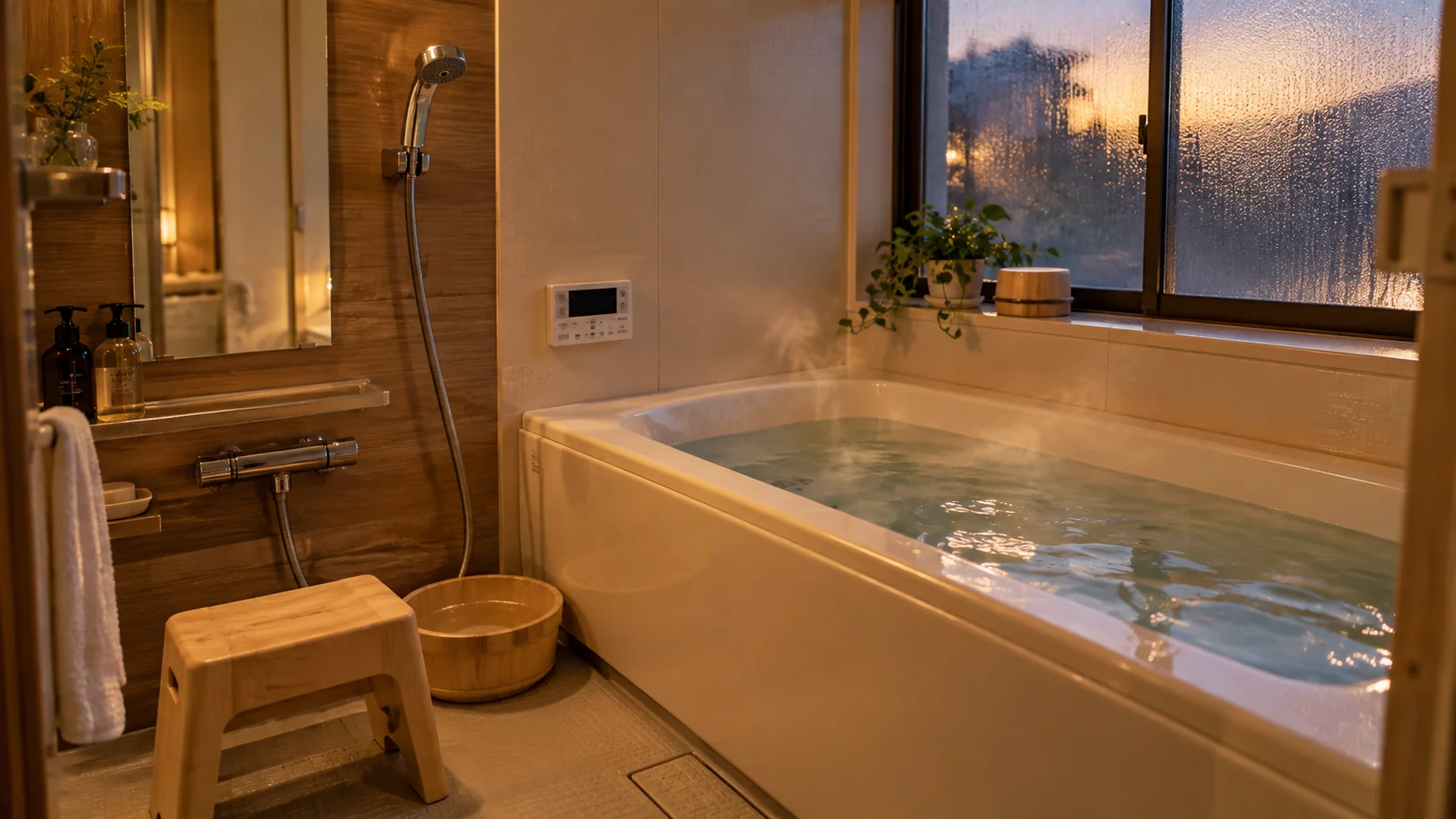
Some evenings in Japan end not with a television show or a cup of tea, but with the sound of water filling a bathtub.
Imagine someone returning home after a long commute. A bag is placed beside the door. Dinner can wait a moment. In the bathroom, steam begins to soften the mirror. There is a short shower, a pause, and then the quiet moment of lowering oneself into warm water.
Nothing spectacular happens.
That may be exactly the point.
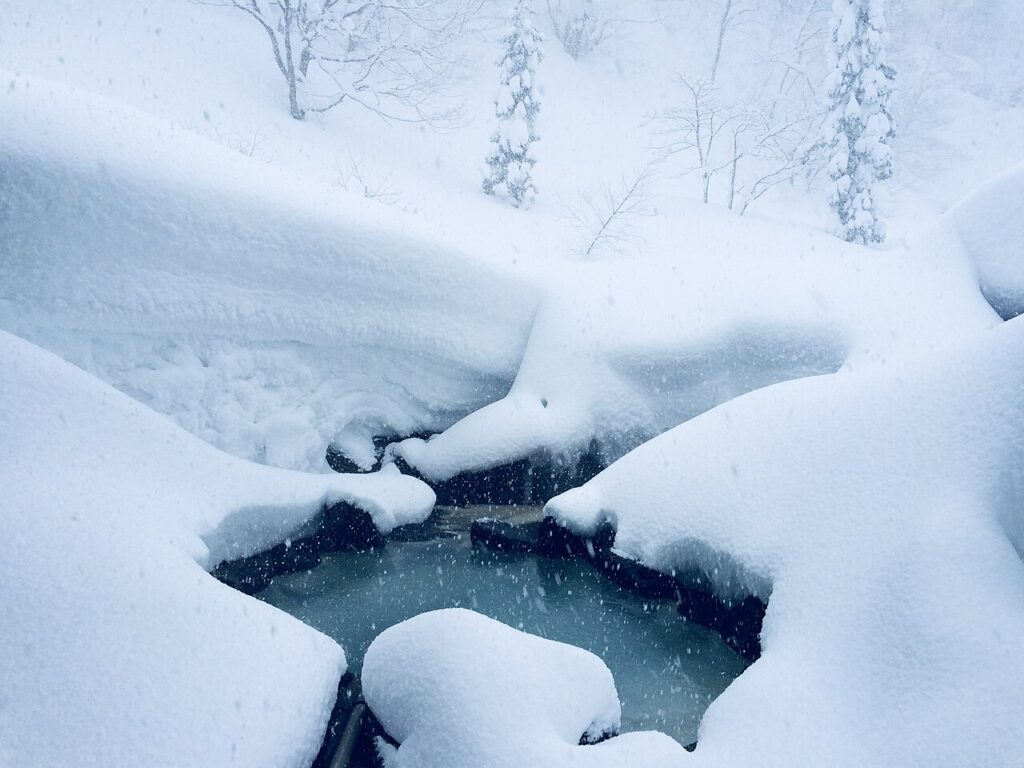
Visitors to Japan often encounter bathing through travel images: an outdoor hot spring surrounded by snow, a traditional inn, or an immaculate bathhouse with Mount Fuji painted across the wall. These places are worth discovering, but they are only one part of the story.
To understand Japanese bathing culture, it helps to begin with the ordinary bath at home.
In many households, a bath is not simply where a person gets clean. Washing and soaking are treated as different activities. Soaking can mark the transition between a demanding day and the private hours that follow.
Yet this is not a ritual every Japanese person follows every evening. Some people prefer a quick shower. Others lack the time, space, money, or physical ability for a long soak. The more interesting story lies in how the bath became such a familiar possibility—and what it asks of the people who maintain it.
1. The Most Surprising Rule: Wash Before You Soak
For someone who has never used a Japanese-style bathroom, the first surprise may be the layout.
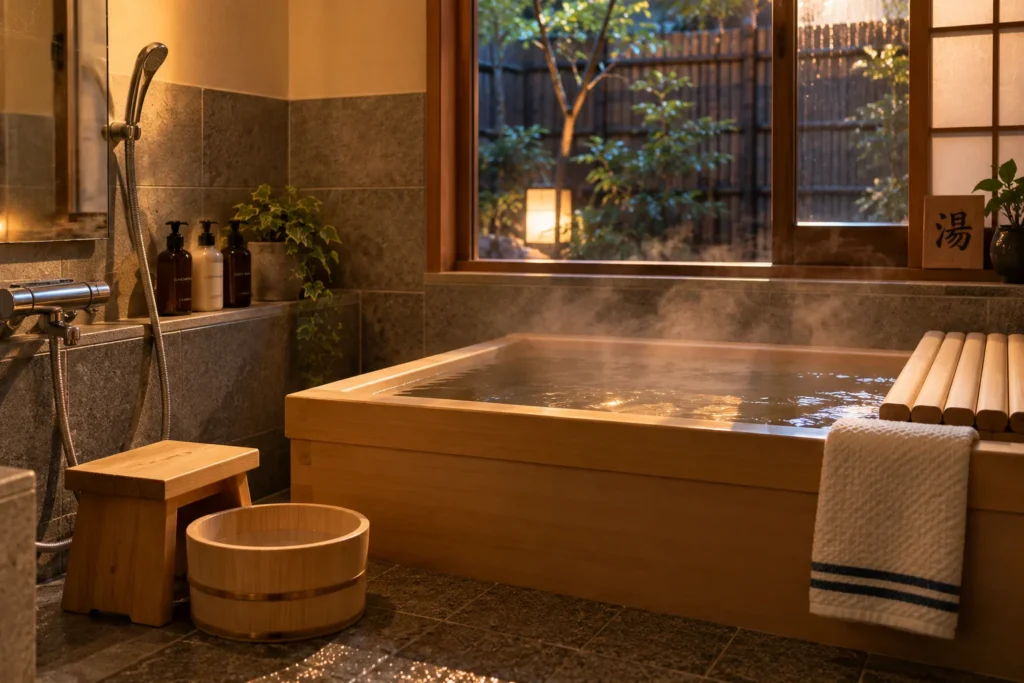
In many Japanese homes, the bathtub sits beside an area designed for washing. A hand-held shower, faucet, small stool, and basin may be located outside the tub itself. The room is often designed so that water can be used in the washing area without damaging the surroundings.
The sequence is important. You rinse and wash outside the tub, remove soap or shampoo, and enter the bath to soak. You do not usually sit in the bath while washing your hair or soaping your body.
Why?
Traditionally, several members of a household may use the same tub of hot water in succession. Keeping soap and dirt out of the soaking water makes that arrangement possible. Families and homes differ, of course, and the bathwater is not always shared. But the distinction between washing and soaking still helps explain the design.
A visitor may think the tub is the entire bathroom. In Japan, the tub is often just the quietest part of a larger washing routine.
2. Why the Bath Belongs to the End of the Day
The image of an evening bath is familiar in Japan: a way to warm up after cold weather, settle down after work, or create a small interval with no immediate demands.
Part of its appeal is physical. Warm water feels different from standing under a shower. Soaking allows the body to remain surrounded by water for a while rather than moving quickly from one task to the next.
But the significance is also emotional.
In daily life, many people move between crowded trains, school, workplaces, errands, and family responsibilities. The bath can provide a rare boundary. Inside a bathroom, the phone is elsewhere, conversations can pause, and there may be nothing useful to accomplish.
That does not mean every bath is a moment of perfect serenity. Someone must clean the tub, pay to heat the water, and sometimes hurry because another person is waiting. The bathroom may be tiny. Children may knock on the door. The day does not disappear simply because a faucet has been turned on.
Still, for people who enjoy soaking, the ritual can be a way of saying: the work of today is nearly over.
3. One Bathtub, More Than One Person
Sharing a bathtub can sound unfamiliar to readers whose idea of a bath involves filling a tub for one person and then draining it.
The Japanese arrangement is often different. A household member washes before entering; the next person may soak in the same water after it has been kept warm or reheated. Modern homes may have controls for filling the tub to a selected temperature and, depending on the equipment, reheating the water.
This does not mean that family members bathe together, nor that everyone uses the same water every day. Both the routine and the equipment vary considerably.
It does mean that a family bath can be an exercise in coordination. Someone decides when to fill it. Someone goes first. Someone remembers to keep it warm. Someone cleans the room afterward.
That invisible household labor belongs to the story just as much as the pleasurable moment of soaking.
4. The Home Bathroom Is Not an Onsen
International visitors often learn about Japanese bathing at an onsen, a natural hot spring. But an ordinary household bathtub, a neighborhood sentō, and an onsen are not interchangeable.
An ofuro is an ordinary Japanese word for a bath or bathing. In everyday conversation, it can refer to the bath at home.
A sentō is a public bathhouse, traditionally serving the daily bathing needs of neighborhood residents. It may use heated ordinary water rather than naturally heated spring water.
An onsen, under Japan’s Hot Springs Act, involves water, vapor, or gas emerging from underground that meets specified temperature or mineral criteria. Water can qualify as onsen if it is at least 25°C at the source, or if it meets one of the law’s qualifying substance thresholds. The word therefore describes the nature of the source, not simply a luxurious bathtub.
A large spa-style facility may be a different kind of public bath, sometimes called a super sentō. A ryokan may offer hot-spring baths or ordinary bathing facilities, depending on the property.
These distinctions matter because a romantic photograph of a mountain hot spring does not tell us what a typical Japanese apartment bathroom looks like.
5. The Sentō: A Bath That Belongs to the Neighborhood
Before private baths became widespread in Japanese homes, public baths played an essential role in everyday hygiene.
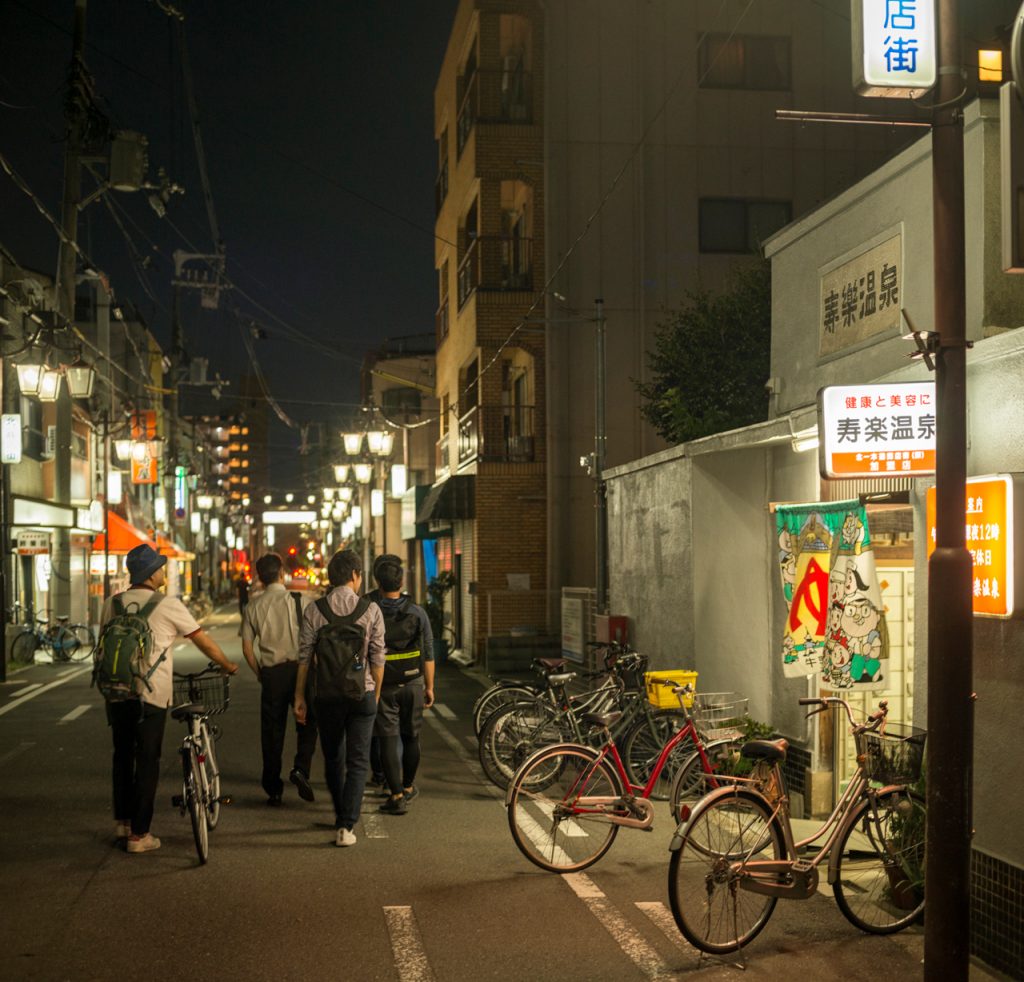
A neighborhood sentō could be a practical destination rather than a special outing. Customers paid an admission fee, removed their shoes, washed, and soaked. A bathhouse also offered something a household bathtub could not always provide: familiar faces and a shared local routine.
One person might visit on the way home from work. Another might come because the spacious bathing area felt better than a small bath at home. Someone else might simply enjoy seeing the same neighbors each week.
Public bathing requires etiquette because the water and space are shared. Visitors wash thoroughly before entering a communal tub, keep towels out of the water, and respect the privacy and comfort of other guests. Photographing strangers in bathing areas is inappropriate. Policies regarding tattoos, children, and particular facilities vary, so checking a bathhouse’s rules before visiting is wise.
The social atmosphere is not always lively. Sometimes a sentō is a place where people exchange a few words and then simply enjoy being quiet together.
6. Why Traditional Public Baths Are Disappearing
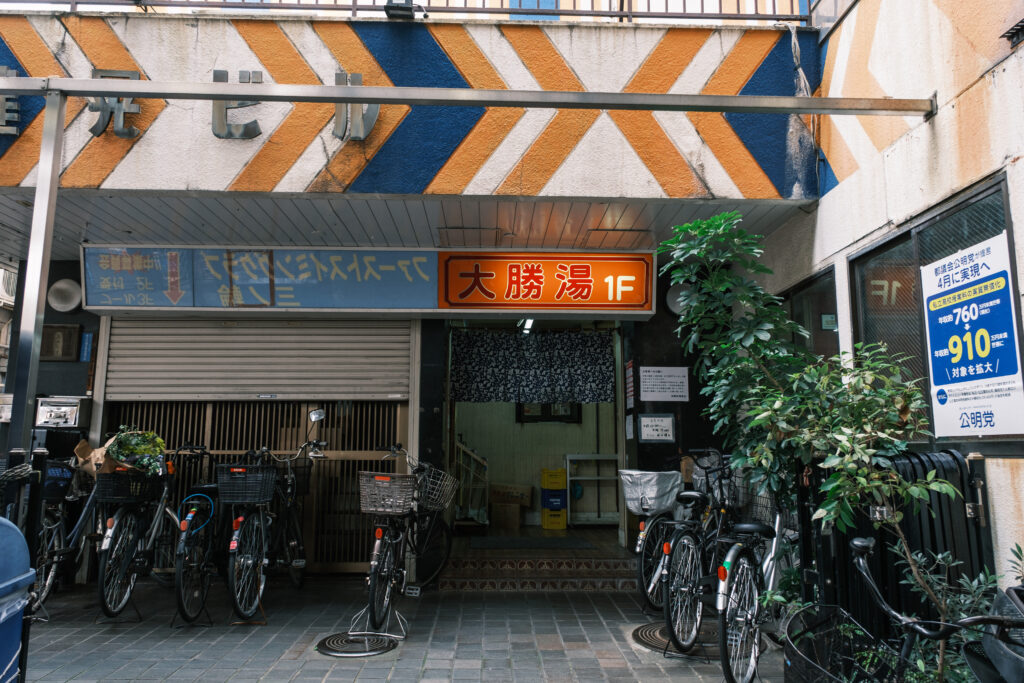
The image of the classic neighborhood bathhouse is much loved, but the number of traditional sentō has fallen sharply.
Japan’s Ministry of Health, Labour and Welfare reported 2,847 general public bath facilities at the end of fiscal 2023, compared with 3,398 at the end of fiscal 2019. This refers to the officially defined category of general public baths, not to every hot spring, sauna, leisure spa, or bathing facility in the country.
The ministry identifies several pressures: the spread of bathrooms in private homes, falling customer numbers, aging proprietors, difficulties finding successors, aging buildings, and rising business costs.
For a longtime customer, a closure may mean losing more than a place to get clean. It can mean losing the warm entrance on a winter evening, the familiar owner at the counter, and the easy chance to recognize people who live nearby.
Some operators and communities are finding new ways to bring visitors into public baths, but adaptation is not easy and not every bathhouse can be saved.
A painted mural or beautiful wooden façade can be restored. The neighborhood habit of showing up, week after week, is harder to manufacture.
7. Warm Water, Shared Space, Unwritten Rules
The rules of a shared bath can seem elaborate until you understand their purpose.
Wash first, because other people will soak in the water. Rinse away soap. Keep long hair out of the tub. Avoid splashing or creating discomfort. Leave the phone and camera outside areas where people expect privacy.
Japan’s tourism authorities explain these customs to international visitors, while also emphasizing that newcomers need not panic about getting every detail perfect. The basic principle is consideration for everyone using the facility.
At home, the ritual may be much more informal. A bath can be a place for listening to music, reading if the environment is safe, or doing absolutely nothing.
Shared spaces and private bathrooms are different settings, but they reveal a related idea: the water should be enjoyed without forgetting the needs of the next person.
8. The Part of Bathing Culture That Is Not Relaxing
It is tempting to describe soaking as an uncomplicated source of wellbeing. That would leave out a serious problem.
Bathing accidents, including accidental drowning in bathtubs, occur in Japan—especially among older adults and during colder months. The Consumer Affairs Agency reported that in 2024, 7,776 people died in the statistical category of accidental drowning or submersion in a bathtub, including falls into a bathtub; 7,363 were aged 65 or older. These are official figures for a defined cause-of-death category, not proof that all such deaths were caused by any single mechanism often labeled “heat shock.”
The agency advises warming the changing room and bathroom before bathing, avoiding very hot water and prolonged soaking, and paying attention to hydration and sudden changes in position. Its published guidance gives 41°C or below and up to about ten minutes of soaking as general safety benchmarks, particularly relevant to preventing accidents among older adults.
The right approach depends on a person’s health and circumstances; people with medical concerns should seek advice appropriate to them.
A treasured habit is still a physical activity with risks. Respecting the culture includes being willing to talk about those risks openly.
9. What Does a Daily Bath Cost?
There is also a quieter cost: water and energy.
Filling a tub requires water. Keeping it warm uses energy. Heating systems, insulation, household size, and bathing habits all influence how much a family spends and consumes.
Some households share the same tub of water among family members; others prefer showers. Some take a bath on cold evenings but skip it in summer. Environmental trade-offs depend on equipment and behavior, so it would be misleading to assume that a bath is automatically more or less sustainable than a shower in every situation.
In May 2026, Japan’s Ministry of Economy, Trade and Industry published a report on policies to improve the efficiency of domestic water-heating equipment and reduce fossil-energy use. That is a reminder that even the most personal daily comfort is connected to energy systems and climate choices.
An evening soak may feel private. The water and heat that make it possible come from a much larger world.
10. Not Every Japanese Person Loves a Bath
The title of this article asks why Japanese people love soaking, but there is no single preference shared by everyone in the country.
Some people genuinely love the bath. Some take only showers, especially when life is busy or the weather is hot. Some live in accommodation with limited facilities. Others find hot water uncomfortable or need to avoid certain types of bathing for health or mobility reasons.
And many cultures outside Japan have rich bathing traditions of their own, from public baths to saunas and hammams. There is nothing uniquely human about finding comfort in warm water.
What is distinctive about the Japanese context is the combination of domestic bathroom design, a long public-bathing history, familiar etiquette around shared water, and the cultural language of ofuro, sentō, and onsen.
Those elements offer different ways to experience something simple: a quiet moment between the busy world and home.
11. Washing Away the Day
Imagine the room again, after the evening rush has ended.
The shower has been turned off. The towel is waiting nearby. Water moves gently against the side of the tub. Outside the window, perhaps the city is still noisy—but from here it feels far away.
Tomorrow will bring more work, messages, errands, and obligations. Nothing about the future has been solved in a bathtub.
Yet for a few minutes, there may be no need to answer anyone, decide anything, or go anywhere.
That is the part of Japanese bathing culture a photograph of a spectacular hot spring cannot fully explain.
The bath is not always a luxury. It may be a small, ordinary way to mark the end of the day.
In Japan, a bath is not always about washing away the dirt. Sometimes, it is about washing away the day.