Imperial Family · 7 minute read
Princess Aiko and the Throne She Cannot Inherit
Japan’s emperor has one daughter. Her growing public role brings an old institution into focus—and raises a question its succession law still leaves unresolved.
LAYERS OF JAPAN · Reviewed October 12, 2026
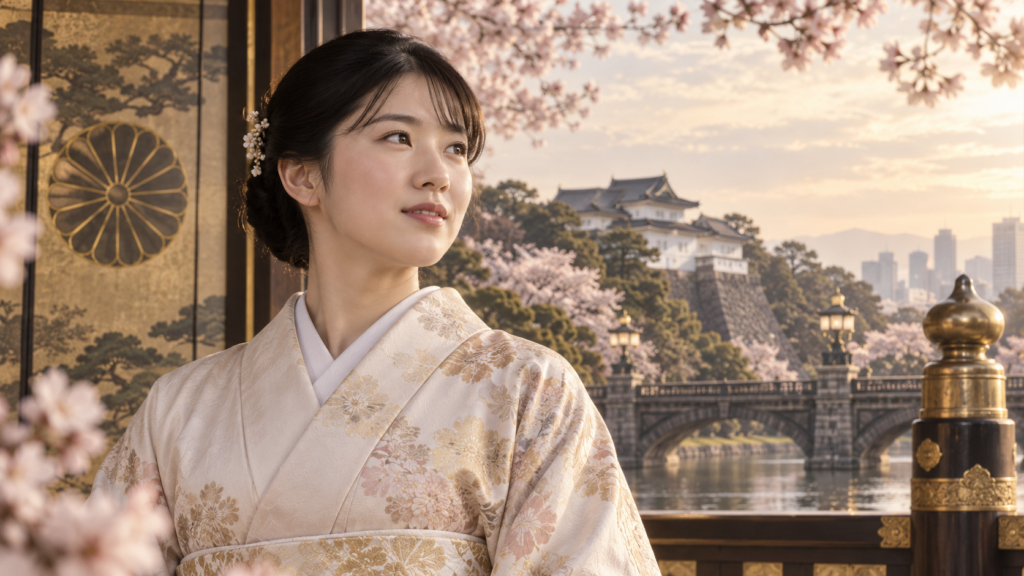
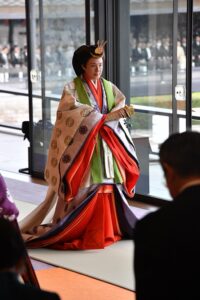
An imperial ceremony can make tradition appear settled: the measured movements, the formal dress, the sense of an institution continuing from one generation to the next. Princess Aiko’s place within that institution reveals a less settled story.
She is the only child of Emperor Naruhito and Empress Masako. She is also a university graduate with a working life and an expanding programme of public duties. Yet the law does not allow her to succeed her father.
Princess Aiko belongs to the imperial male line, but she cannot inherit the throne because she is a woman. Understanding that distinction takes us beyond the familiar images of Japan’s imperial family and into questions of history, public feeling and institutional change.
A princess growing into her public role
Born on December 1, 2001, Princess Aiko studied Japanese language and literature at Gakushuin University. After graduating in March 2024, she began working for the Japanese Red Cross Society in April. Her professional work now sits alongside imperial responsibilities.
The Imperial Household Agency’s record of her activities includes court ceremonies, cultural events and engagements connected with disaster preparedness. In September 2025, she visited Niigata Prefecture, including the former village of Yamakoshi, which was severely affected by the 2004 Chuetsu earthquake, to learn about recovery. In November, she travelled to Laos on her first official overseas visit.
These are concrete parts of her public life. They also invite a more personal response: a reader who has followed her from childhood may experience her growing responsibilities as a familiar person’s coming of age. That is one possible source of attachment, rather than a feeling we can attribute to everyone in Japan.
Why can’t Princess Aiko become emperor?
Article 1 of the Imperial House Law restricts succession to males belonging to the imperial male line. There are two conditions here: the successor must be male, and the imperial ancestry must run through the paternal line.
Aiko’s father is the emperor, so her paternal lineage is not the obstacle. Her sex is. The rule excludes her regardless of her education, public service or popularity; it is not a judgment on her individual capabilities.
The role itself also needs explaining. Under Japan’s Constitution, the emperor serves as the symbol of the state and the unity of the people and has no powers related to government. Article 2 leaves succession to the Imperial House Law passed by the Diet, Japan’s national legislature.
The debate therefore concerns a symbolic and constitutional institution: who may embody its continuity, and how the rules governing it should be decided.
Japan has had female emperors before
Eight women have occupied Japan’s throne across ten reigns. Two reigned twice under different imperial names. They were sovereigns in their own right, not simply the wives of emperors.
Among them was Empress Suiko, whose reign began in 592. The most recent was Empress Go-Sakuramachi, who reigned from 1762 to 1770. Japan’s history therefore offers precedents for a woman holding the throne, even though the present law excludes women.
Those historical sovereigns belonged to the male imperial line. This is why two expressions that can sound almost identical in English describe different questions in Japan.
A female emperor—josei tennō—is a woman who occupies the throne. Female-line succession—jokei succession—means tracing the relevant imperial descent through a woman. A sovereign in that line could be either male or female.
Princess Aiko is herself a woman in the paternal imperial line. Allowing her to reign would require changing the rule excluding women. Whether a future child could inherit through her would raise a further question about how imperial descent is transmitted. The two issues are connected, but they should not be treated as interchangeable.
What public opinion does—and does not—tell us
A Mainichi Shimbun survey conducted on May 23–24, 2026 found that 72% of respondents supported allowing a woman to become emperor, while 10% opposed it. The smartphone-based survey received 1,780 valid responses from adults selected from NTT Docomo’s d Point Club membership.
That result shows substantial support among the respondents for a female emperor. It does not establish the same level of support for Princess Aiko’s accession specifically, or for female-line succession. Those are different questions.
Nor does a headline percentage explain every respondent’s reasoning. Equality, the future size of the imperial family and attachment to a particular public figure are distinct considerations. A person can care about more than one of them, and we should not infer their motives from a single answer.
The emotional question remains understandable: if a daughter can represent the imperial family through public service, why should her sex prevent her from succeeding her father? For someone who regards exclusion on that basis as unfair, the legal distinction can feel painfully distant from the person they see.
What does continuity mean?
The argument for retaining male-line succession begins from a different understanding of inheritance. In that view, the paternal line is a defining feature of the institution itself, rather than an ordinary family rule that can be changed without altering its identity.
A policy choice follows from that position: address the practical problem of a shrinking imperial family while preserving the existing succession principle. Government statements and the 2026 legislation reflect that approach.
The disagreement is therefore partly about what must continue. Is continuity best understood as maintaining a particular lineage rule, or as enabling the institution to endure while its rules adapt? These are competing judgments, and neither public affection nor an appeal to history resolves every part of them.
What the 2026 reforms change
Japan’s Diet passed legislation amending the Imperial House Law and related laws on July 17, 2026. It was promulgated on July 24 as Act No. 66. Its principal provisions are scheduled to take effect on October 24, 2026; at this article’s October 12 review date, that commencement is still ahead.
The reforms allow imperial princesses to retain their status after marrying men outside the imperial family. Under the rule still in force before that commencement, such a marriage means leaving the imperial family. A transitional provision permits princesses who already hold that status when the reform takes effect to choose to leave upon such a marriage.
The legislation also opens a restricted adoption route for certain male-line descendants of former imperial family members to join the imperial family. Admission under this route does not itself place an adopted man in the succession order.
The reforms leave Article 1’s male-only succession rule unchanged. Retaining imperial status and becoming eligible for the throne are separate legal matters. The changes can alter the conditions under which a princess continues her public role without allowing her to become emperor.
For Princess Aiko, that distinction is central. Her place within the working imperial family can develop while the throne remains legally closed to her.
The person behind the question
There is a limit to what this debate can tell us about Aiko herself. Her public duties do not establish a wish to become emperor, and the hopes of her admirers should not be presented as her own.
It is possible to discuss the law seriously while leaving that private space intact. She is a person with a working life and family relationships, as well as a figure onto whom arguments about tradition and gender are projected.
That gap—between what someone represents to others and what we actually know about them—is part of the story. Affection can bring an institution closer to the public, but it does not give us access to the thoughts of the person at its centre.
A question about Japan’s future
Japan is often presented as a place where ancient tradition and modern life coexist effortlessly. The succession debate shows how much work that coexistence can involve.
Princess Aiko can participate in an institution’s present without being eligible to inherit its highest role. Around that fact sit different understandings of fairness, historical continuity and responsibility for future generations.
Whether the succession law changes will depend on decisions made through Japan’s political institutions. For now, her story invites a question that reaches beyond the ceremony:
What does it mean to preserve a tradition while the society around it continues to change?
Continue exploring
Discover the perspective behind this magazine in About LAYERS OF JAPAN, or explore our ten themes of Japanese culture and everyday life.