Watching Sumo: The Moments Before the Match
Salt, raised legs and the pause before the charge: a first-time viewer’s guide to the small details around a sumo bout.
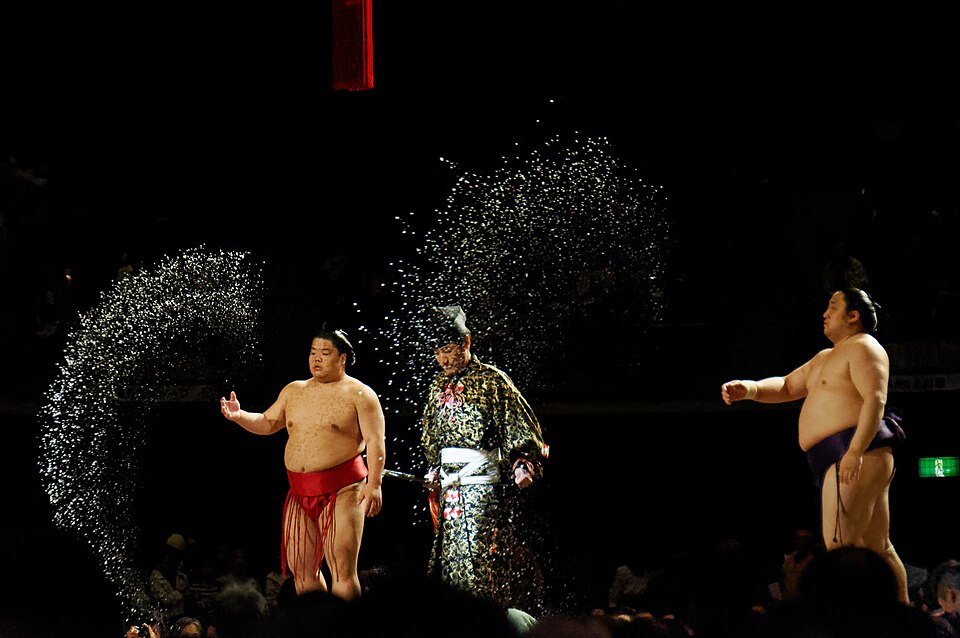
Photo: yoppy, Wikimedia Commons · CC BY 2.0. Resized to 960 pixels wide; original composition retained.
A handful of salt rises into the air. Two wrestlers crouch, face one another, then stand and step away. If you are watching sumo for the first time, it is easy to wonder when the match will begin.
Those moments give you something to follow before the first collision. Start with a few visible details: a lifted leg, the distance between the opponents, a change in posture. You can enjoy the suspense without memorizing every rank or recognizing every wrestler.
The salt gives the ring a different meaning
The Japan Sumo Association explains salt throwing as an act of purification: it cleanses the sacred ring, wards off harmful influences and expresses a prayer for the wrestlers’ safety. Its meaning reaches beyond the striking photograph it creates.2
For a first viewing, try following the entire gesture. Watch the hand reach for the salt, the throw, and the wrestler’s return toward the center. The arc of white grains is brief; the preparation continues after they fall. It is a useful invitation to slow your own attention down.
Salt throwing is associated mainly with the two highest divisions, makuuchi and juryo, with some exceptions in makushita. Do not expect an identical sequence in every bout throughout the day.1
Follow the raised leg all the way down
The familiar movement of lifting one leg to the side and bringing it firmly down is called shiko. It is a fundamental sumo movement and an important part of lower-body training, as the association’s explanation emphasizes.3
Look beyond how high the foot rises. Notice the supporting leg and how the wrestler keeps the upper body controlled. Following that movement gives a first-time viewer a more specific question than simply asking who looks strongest: how does this athlete carry and control his weight?
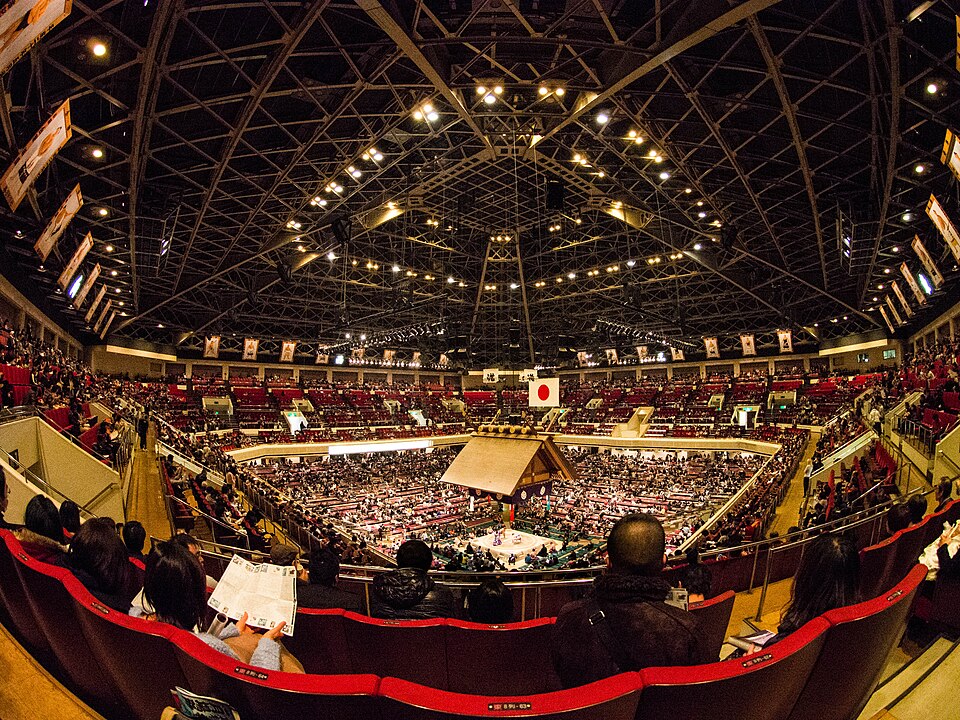
Photo: Gregg Tavares, Wikimedia Commons · CC BY 2.0. Resized to 960 pixels wide; original composition retained.
The face-off may happen more than once
Shikiri is the preparation in which the wrestlers face each other near the center, crouching toward the starting position. They may rise, return to their corners and repeat the sequence. The upper divisions allow more preparation time than the lower ones. The opening charge is called the tachiai; the competitors must coordinate their start. A bout itself can be much shorter than the buildup.1
Try choosing one wrestler for a single bout. Watch his hands, then his shoulders, then the space between the two opponents. You do not have to guess the precise moment they will launch. Simply noticing what changes between one crouch and the next makes the waiting easier to read.
A ring entrance is a separate ceremony
When several wrestlers appear together in ornate ceremonial aprons, you are watching a dohyo-iri, or ring-entering ceremony. The juryo and makuuchi ceremonies introduce the wrestlers and include shared gestures such as a clap and raised hands. They are distinct from the preparation for an individual match.4
A tournament day moves through different divisions. Lower-division bouts begin earlier, while juryo and makuuchi appear later; the official program lists their ring entrances separately from their bouts. A yokozuna ring entrance has its own place in the program when performed. Check the schedule for your chosen day, because opening hours and approximate start times can vary.5
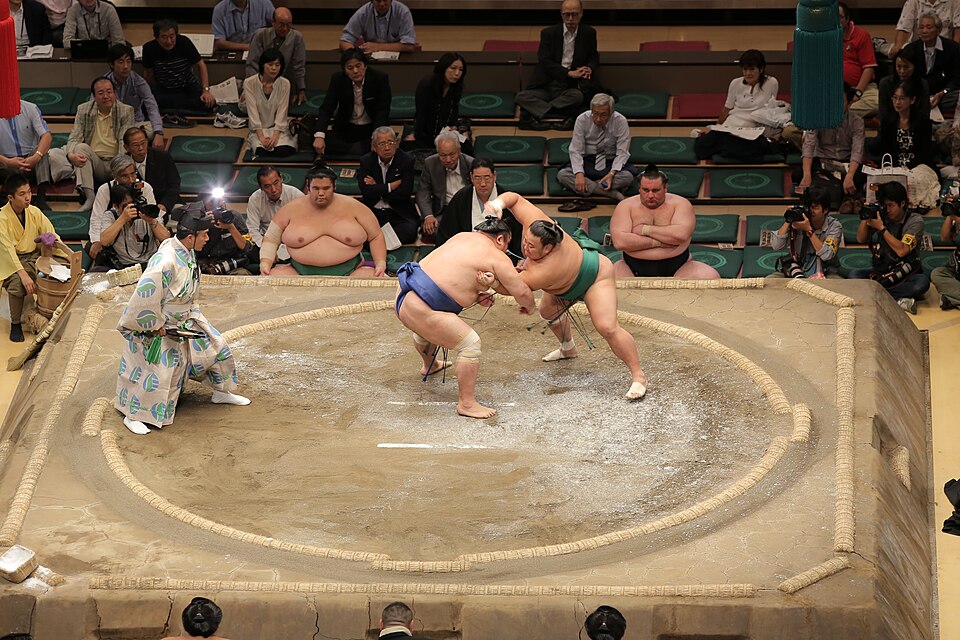
Photo: ElHeineken (Lars Heineken), Wikimedia Commons · CC BY-SA 4.0. Resized to 960 pixels wide; original composition retained. This resized photograph remains available under CC BY-SA 4.0.
When they collide, watch the feet
The basic aim is to make the opponent touch outside the ring, or touch the ground inside it with any part of the body other than the soles of the feet. Size alone does not decide the result: technique, timing and balance matter too.6
That gives you two useful places to look: the wrestlers’ feet and the circular boundary. As they push or grapple, follow who is being moved backward and who changes direction. If the finish happens too quickly to understand, that is a good reason to watch the replay. You can learn the name of the winning technique afterward.
For your first few bouts, resist trying to identify everything at once. One match can be about the start; the next can be about footwork. Small observations add up, and the contest becomes easier to follow without turning the experience into a vocabulary test.
Plan a visit around the sumo you want to see
Begin with the Japan Sumo Association’s official tournament calendar. Grand tournaments take place at specific times and venues, so being in Tokyo does not automatically mean a tournament is on at Kokugikan.7
The association’s English ticket guide explains the difference between box seats where you sit on the floor and conventional chair seating, and links to ticket sales. Consider how you prefer to sit, then check the details for the venue and ticket type you choose. Use the current listing for prices and availability.8
If the ring entrances interest you, look up their approximate times before deciding when to arrive. Leave yourself time to find your seat. Follow the venue’s instructions and keep the view clear for the people around you.
The most rewarding first goal is modest: leave able to recognize one gesture you did not understand before. The next cloud of salt, or the next quiet crouch, will already look a little different.
Sources & further reading
- Japan Sumo Association — SUMO: official English introduction (PDF)
- Japan Sumo Association — The meaning of the salt (Japanese)
- Japan Sumo Association — Shiko explained (Japanese)
- Japan Sumo Association — Ring-entering gestures (Japanese)
- Japan Sumo Association — Tournament-day schedule (Japanese)
- Japan Sumo Association — Sumo basics (Japanese PDF)
- Japan Sumo Association — Grand Tournament Schedule
- Japan Sumo Association — How to Buy
Photographs are archival and show different occasions. They illustrate the setting and gestures, rather than a single tournament day. Photo credits and licenses appear beneath each image.








Comments