Bunraku: Why Three Puppeteers Move One Puppet
The people behind a character are visible. A closer look at their hands—and a closer listen to the voice beside the stage—reveals how the illusion works.
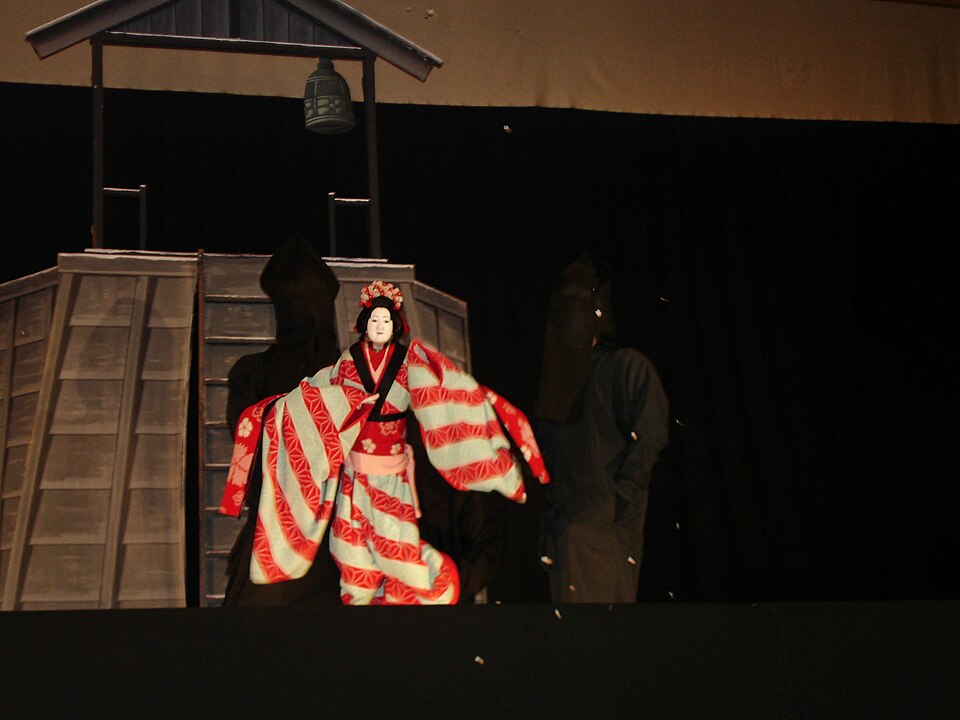
Ivan Fourie / Wikimedia Commons, CC BY 2.0. Resized to 960 pixels wide; composition unchanged.
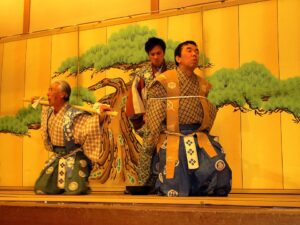
Start with the photograph. The puppet’s pale face and patterned sleeves catch the light. Behind it, you can still make out the people responsible for its movements. Bunraku lets both the character and the work of creating it remain in view.
This Japanese theatre combines puppetry, a narrator’s voice and shamisen music. Its stories can involve love, family separation and painful choices, alongside humour and dance. The puppet is one part of a performance made jointly by several kinds of artist.1
Three people, one connected movement
The characteristic three-person technique divides a puppet’s movements between specialists. Their roles are distinct:2
| Puppeteer | What they control |
|---|---|
| Omo-zukai | The head and right hand, while supporting the body. |
| Hidari-zukai | The left hand. |
| Ashi-zukai | The feet and the movements that create walking. |
The performers coordinate through cues without speaking to one another. That cooperation allows a head turn, a hand movement and a step to belong to the same character.2
Try following just one hand for a few moments. Then widen your attention to the whole figure. It is a simple way to notice the difference between moving a part and giving the character a gesture.
Why the people behind the puppet can be seen
The black clothing has a theatrical meaning. In this stage convention, black signals that a performer should be treated as invisible. A lead puppeteer may also work with an uncovered face, a practice called de-zukai.2
You can notice the operator and still follow the character. There is no need to force yourself to ignore the human hands. Let your attention move between the work being done and the expression that emerges from it.
A walking figure may have no legs
Under the costume, the body can be surprisingly simple: a shoulder board and a bamboo hoop joined by fabric. The elaborate clothing conceals a structure built to be handled and moved.3
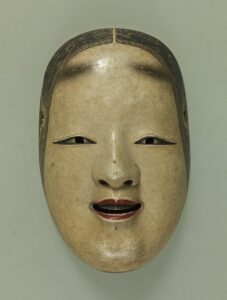
Female-role puppets usually have no legs. Instead, the foot puppeteer works the hem of the robe to suggest the steps beneath it. The audience sees walking, even though the limbs it imagines under the clothing may not exist.3
That is a detail worth watching for. Look at the lower edge of the robe and the rise and fall of the figure. Then look back at the face. The sense of a body comes from how those movements fit together.
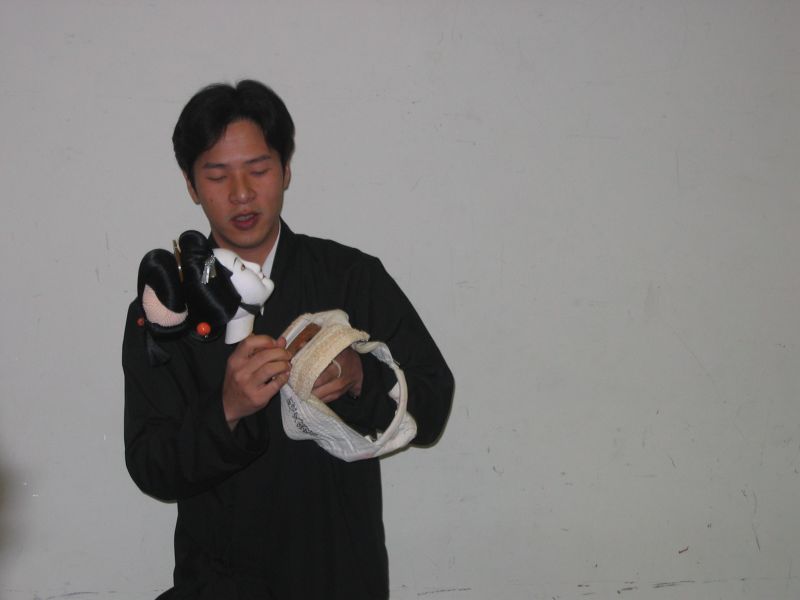
Fabien / Wikimedia Commons, CC BY-SA 2.0. Original 800-pixel-wide file; no changes.
The character’s voice comes from somewhere else
The narrator, known as the tayu, voices the characters as well as describing the scene. Changes in vocal delivery distinguish speakers and convey their feelings. The performance moves between dialogue, narration and passages closer to song.4
A written text sits before the narrator on a bookstand. Before beginning, the narrator raises the book in a gesture of respect for the words and techniques inherited from earlier performers.4
If you do not understand Japanese, a synopsis can help you follow who is speaking and what is at stake. You can also listen for changes in pace and vocal intensity, then look for the movement that accompanies them.
The shamisen helps shape the scene
Beside the narrator, the shamisen player helps lead and support the telling. The instrument can suggest a setting or a change in emotion, giving the drama its own sound and momentum.5
The thick-necked futozao shamisen used in this music has three strings and is played with a large plectrum, or bachi. Its sound can be deep and forceful, but it also allows delicate expression. The attack of the plectrum adds rhythm and punctuation as well as melody.5
For a short stretch, try looking toward the musicians. Notice how a sound begins or ends against a spoken phrase. Then return to the puppet and see what that same moment looks like.
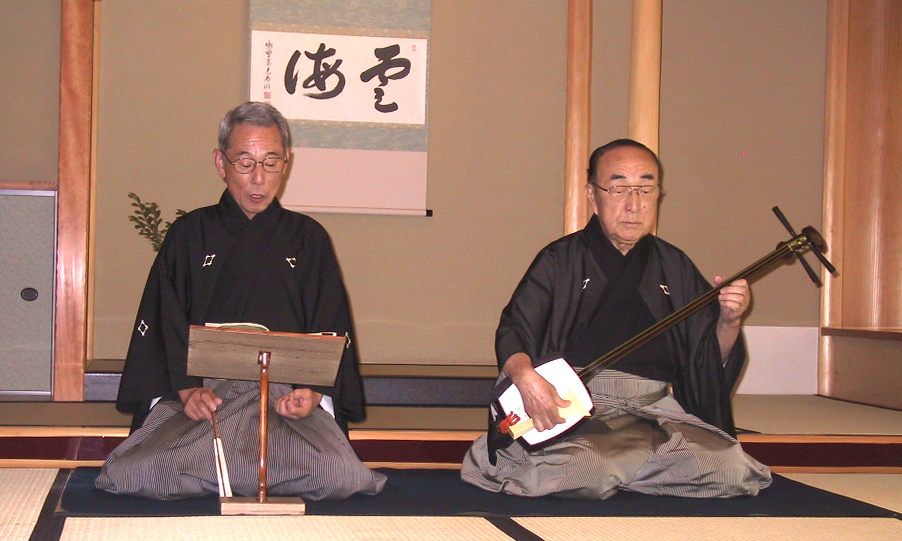
Rdsmith4 / Wikimedia Commons, CC BY-SA 2.5. Original 902-pixel-wide file; no changes.
A theatre shaped in Osaka
The form developed around 1600 as narrative music and puppetry came together. In Osaka, the narrator Takemoto Gidayu opened the Takemoto-za theatre, where plays by Chikamatsu Monzaemon helped shape the tradition.1
That history helps explain why listening matters so much. The drama reaches you through words and music as well as the visible figure. Watching the puppet alone gives you only one way into the scene.
A first encounter: give yourself three things to follow
You do not need to identify every technique at once. Begin with a small set of questions:
- Where is the character looking? Follow the head, then notice how the hands respond.
- What suggests weight or movement? Watch a sleeve, the hem of a robe or a change in posture.
- What do you hear at that moment? Listen to the voice and the shamisen alongside the action.
For an introduction before visiting, the Japan Arts Council’s English-language guide to the performers includes explanations and video material. The National Bunraku Theatre’s official page lists performances in Osaka. Check the specific programme’s running time, language assistance and ticket details when planning a visit.6
There is room to appreciate the craft before following every word of the story. A hand pauses. A voice changes. A figure turns. Knowing how many people contribute to that moment can make it more absorbing to watch.
Sources & further reading
- Japan Arts Council — Introduction to Bunraku. The combined arts, themes and development of the form in Osaka.
- Japan Arts Council — Puppeteer. The three roles, coordination, black costumes and de-zukai.
- Japan Arts Council — Moving a Doll. The body structure, hands and movement of the feet or robe.
- Japan Arts Council — Narrator (Tayu). Vocal styles, characterisation and respect for the libretto.
- Japan Arts Council — Shamisen Player. The musical partnership, instrument and playing techniques.
- Japan Arts Council — Bunraku at the National Bunraku Theatre. Official performance and theatre information.
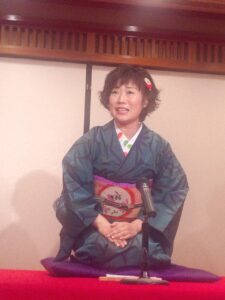
Photo sources, creators and licences appear beneath each image. The third image illustrates a vocalist and shamisen player; no particular bunraku production or venue is identified.






Comments