Culture & Traditions
Ema in Japan: The Wishes Written on Wooden Prayer Plaques
Ema are wooden prayer plaques offered at Japanese shrines and temples. Explore their meaning, the wishes people write and what to know before writing your own.
By Maki Kakudate · 6 minute read
If you had a small wooden plaque and a few lines of space, what would you put into words? A hope for someone you love? An exam you are working toward? Thanks for something that has already happened?
In Japan, an ema offers a place for such a message. These votive plaques are offered at Shinto shrines and Buddhist temples, with words or pictures expressing a prayer, a wish or gratitude. Their religious setting matters: the rack is a place of offerings, even when its colors and shapes first catch a visitor’s eye.12
Writing one involves a decision that looking at a shrine does not. You have to choose what you want to say.
Why the name contains a horse
The word ema means “horse picture.” The Association of Shinto Shrines traces the practice to offerings of living horses to the deities, including prayers for rain or for rain to stop. Horses were understood as the deities’ mounts. Models and pictures came to serve as substitutes.1
The history is wider than a simple change from an animal to a souvenir-sized board. The Japan Tourism Agency’s explanation for Itsukushima Shrine describes clay and wooden figures, painted images, and eventually subjects extending beyond horses. Wealthy donors could present elaborate paintings; smaller, simpler offerings also developed.2
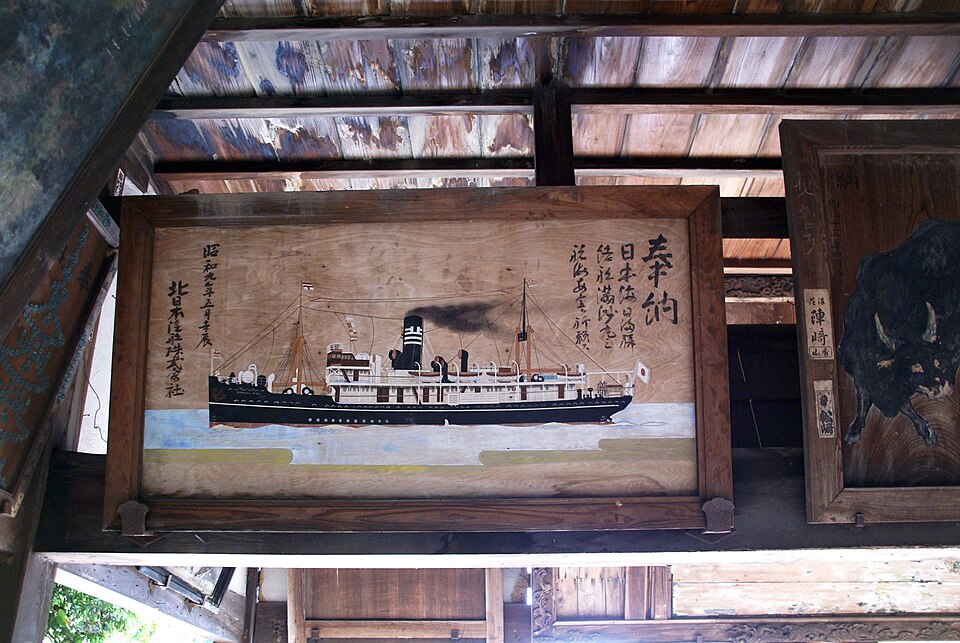
Itsukushima’s collection includes a votive painting dated 1520 depicting bugaku, a court performing art. That is a useful reminder to look up as well as at the small plaques near a writing table. An ema may be an artwork large enough to hang in a hall.2
An exam, a promise, a thank-you
Exam success is one familiar reason to offer an ema. The Association of Shinto Shrines notes the many plaques dedicated during examination season. Dazaifu Tenmangu, associated with learning, explicitly welcomes visitors praying for success in their studies and entrance exams.13
But a request is only one possibility. The official interpretation prepared for Meiji Jingu describes messages of gratitude, commitments to the kami, aspirations and other heartfelt thoughts. The words can concern what someone hopes will happen, what they intend to do, or what they wish to acknowledge.4
Imagine the difference between asking to pass an exam and promising to continue studying. Both can concern the same uncertain future, but they place the writer in a different relationship to it. One asks for help; the other makes an intention explicit. These are illustrative examples, rather than quotations from anyone’s plaque.
It would be too much to read a person’s entire faith from a few handwritten lines. A visitor sees the message, not the years of experience behind it. Nor does a rack of ema tell us what everyone in Japan believes.
The design belongs to the place
There is no single appearance that every ema must share. The Association of Shinto Shrines describes how their imagery expanded to include festivals, zodiac animals, and pictures connected with particular prayers.1
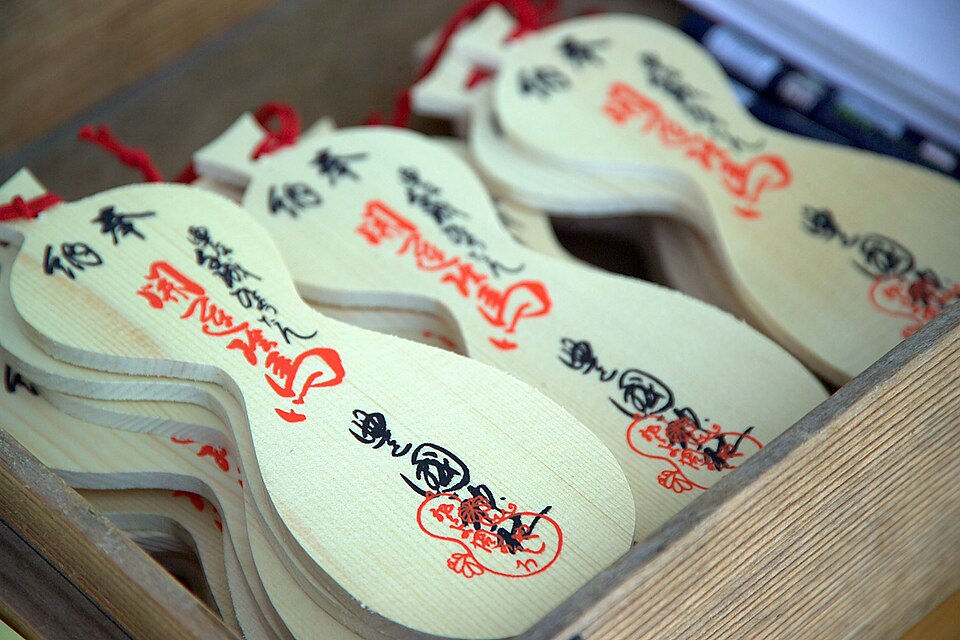
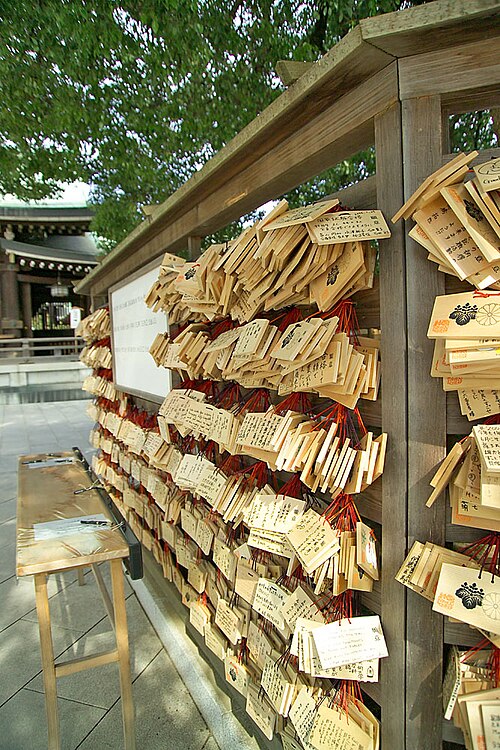
In the opening photograph, the plaques at Kyoto’s Toyokuni Shrine take the shape of a gourd. Their rounded outline is different from the familiar board with a peaked upper edge. The Meiji Jingu photograph farther down shows another arrangement: many small plaques gathered in overlapping rows.
These details are worth noticing before looking at anybody’s handwriting. The picture, outline and way the plaques are displayed help give each setting its character. A large framed painting and a palm-sized plaque can both belong to the history of votive offerings, while asking quite different things of the person who makes or commissions them.
How to write an ema at a shrine or temple
You do not necessarily need Japanese to take part. Dazaifu Tenmangu’s visitor guidance welcomes messages in any language and says ema are available regardless of religious belief. It also allows visitors either to hang their completed plaque in a designated space or take it home. That is the guidance of this particular shrine; follow the practice of the place you visit.5
Before you pick up the pen
- Find the appropriate counter. Ask where ema are available and check the offering amount displayed there.
- Read the local instructions. Follow any guidance about which side to write on, what information to include and where to place the finished plaque.
- Use words you understand. A short message in your own language can express what you mean more clearly than copied Japanese.
- Leave room for others. Share the writing area and avoid moving other people’s offerings to improve a photograph.
There is no need to turn the visit into a test of elaborate phrasing. If you are unsure whether to leave an ema at the shrine or keep it, ask at the counter. The answer can be part of learning how that place understands the offering.
Personal words in a shared space
An ema rack brings private concerns into public view. That makes it an unusual place to stand: you can see that many people have something important to ask or acknowledge, without needing to know their individual stories.
For photography, a considerate approach is to focus on the setting, the illustrated fronts or the overall arrangement. Avoid making another person’s name and intimate message the subject of a close-up you plan to publish. The fact that an offering is visible does not tell you how its writer would feel about it reaching a different audience.
When writing your own, remember that other visitors may be able to read it. Choose what you are comfortable placing in that shared space and ask staff if you need guidance.
After the plaque is left behind
At Meiji Jingu, the official explanation says that priests offer the ema to the kami during the daily mikesai ritual and that the plaques are eventually burned in a ritual fire. Their time on the rack is one stage in the offering’s life.4
That account belongs to Meiji Jingu; the timing and handling of offerings should be checked locally. It also helps explain why a visitor should not expect a small plaque to remain on display indefinitely.
Before writing, you might ask yourself two questions: what do I hope for, and what am I already grateful for? Either can give you something worth saying. Then follow the shrine or temple’s guidance and decide on your own words.
Keep exploring everyday Japan
Continue from individual wishes to shared traditions: the stories below explore neighborhood shrines, children’s celebrations and the people behind local festivals.
Sources & further reading
Sources checked October 22, 2026. Local practices and available designs may change; follow the instructions at the shrine or temple you visit.
- Association of Shinto Shrines — Ema (Japanese). Horse offerings, changes in imagery and examination-season prayers.
- Japan Tourism Agency / Hatsukaichi City — Itsukushima Shrine: Image of Tokiwa Gozen (Ema Images). The development of votive images and the shrine’s historical collection.
- Dazaifu Tenmangu — First Time Visitors. The shrine’s association with learning and prayers for academic success.
- Japan Tourism Agency / Meiji Jingu — Ema Votive Tablet Rack and Writing Desk. Gratitude, pledges, offerings and the subsequent ritual handling of ema at Meiji Jingu.
- Dazaifu Tenmangu — Experiences: Ema—Write Your Wish. Languages, participation and the shrine’s options for a completed plaque.
The photographs are archival views, with dates or upload dates identified in their captions. The imagined messages in the article are examples, not transcriptions of visitors’ prayers. Suggestions on considerate photography are editorial guidance.




Comments