Real Life in Japan · Culture & Traditions
Why Are Japan’s Manhole Covers So Beautiful?
A thread ball, a flower, a harbor: the local stories set into Japan’s everyday streets.
By Maki Kakudate · 6 minute read
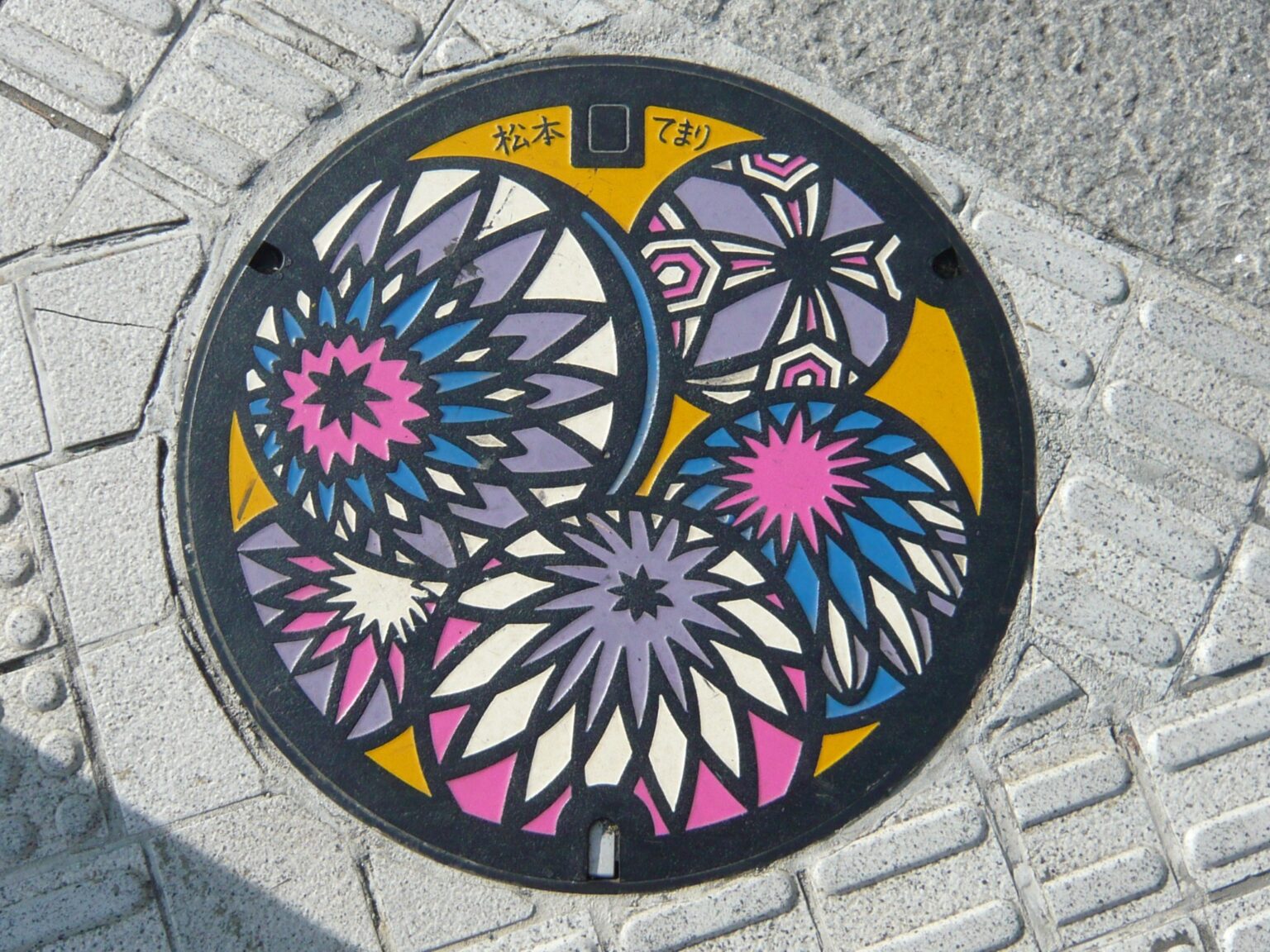
Picture an ordinary walk through a Japanese city. You are looking for a café or the next turning when a circle of pink and blue catches your eye. Set into the pavement is a manhole cover patterned with what look like tiny embroidered balls.
That is the pleasure of decorative manhole covers: a small discovery in a place you were about to walk past. Looking at the examples from Matsumoto, Himeji and Yokohama, another question follows. Why did these cities choose those particular pictures?
The answer takes us from local craft and flowers to the public service beneath the street.
A picture above a working system
Sewer manholes provide access from the surface to underground pipes so that workers can inspect and clean them. The cover is the visible part of that connection.1 Putting an image there gives a passerby something to recognize above infrastructure that usually stays out of sight.
An early example came from Naha, Okinawa. The prefecture records a fish design installed in 1977 and notes that it is said to be Japan’s first decorative manhole cover.1
Naha’s own explanation gives those fish a purpose: they express the intention to clean polluted water through the sewerage system and return it to an environment where fish can live.2 A picture of fish can become a simple way to explain the work happening below.
Matsumoto: a craft beneath your feet
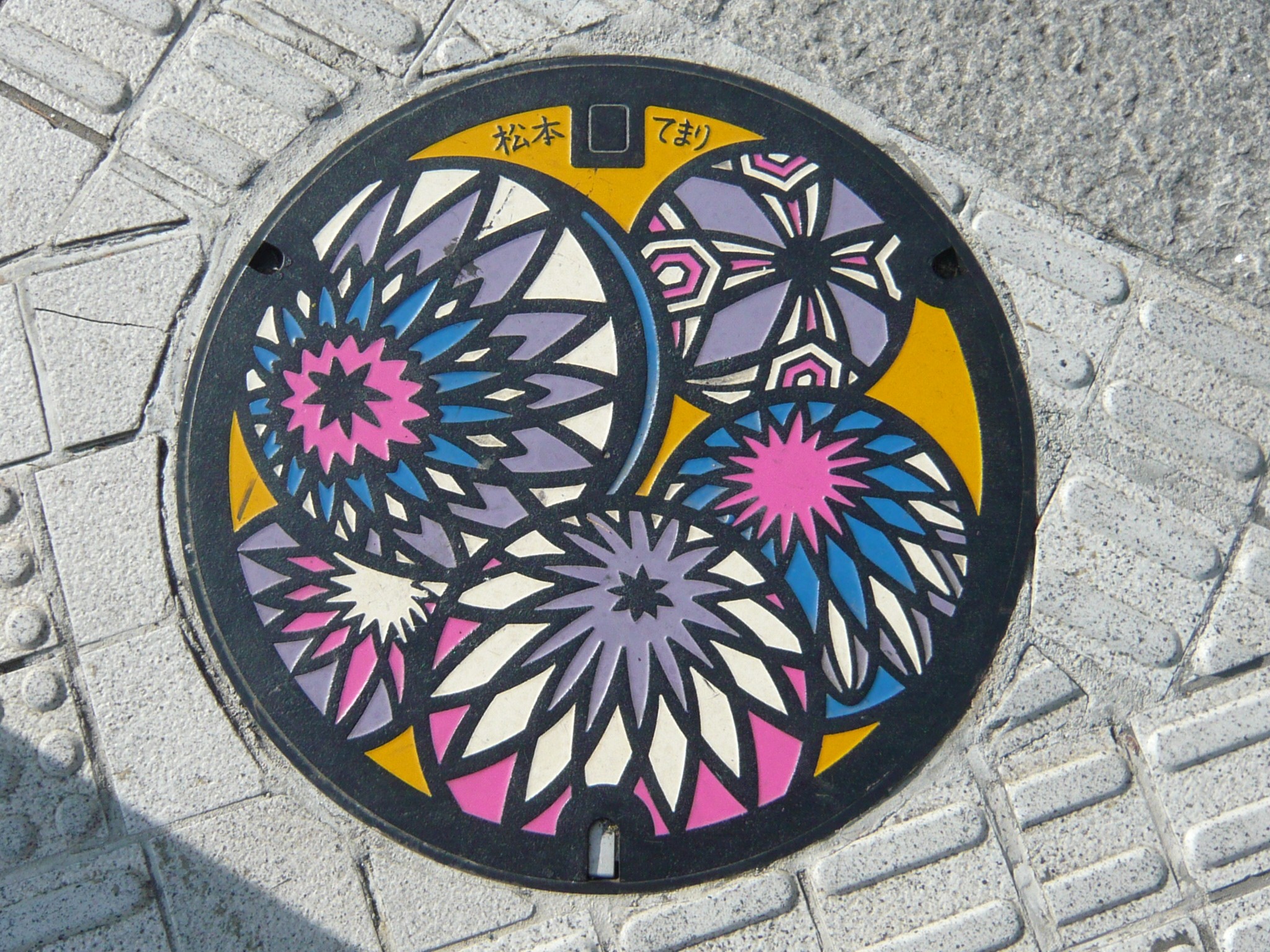
The colorful cover at the beginning of this article belongs to Matsumoto. Its overlapping circles represent temari, decorative balls wrapped with colored thread. The city identifies Matsumoto temari as a traditional local craft and one of its symbols.3
Look again and the pattern becomes easier to read. The lines crossing each ball suggest the threadwork; the separate colors distinguish one rounded form from the next. What might initially seem like abstract decoration carries a much more specific reference.
For a visitor, learning that reference changes the encounter. The cover offers a name to look up and a craft to notice elsewhere. One way to read this design is as a compact introduction to the city, available in the middle of an ordinary walk.
Himeji: the flower that resembles a bird
In Himeji, the white shapes need a closer look. The spreading forms may suggest wings, but the stems below them offer a clue: these are flowers. Himeji identifies the design as sagisō, the white egret orchid, which is the city’s flower.4
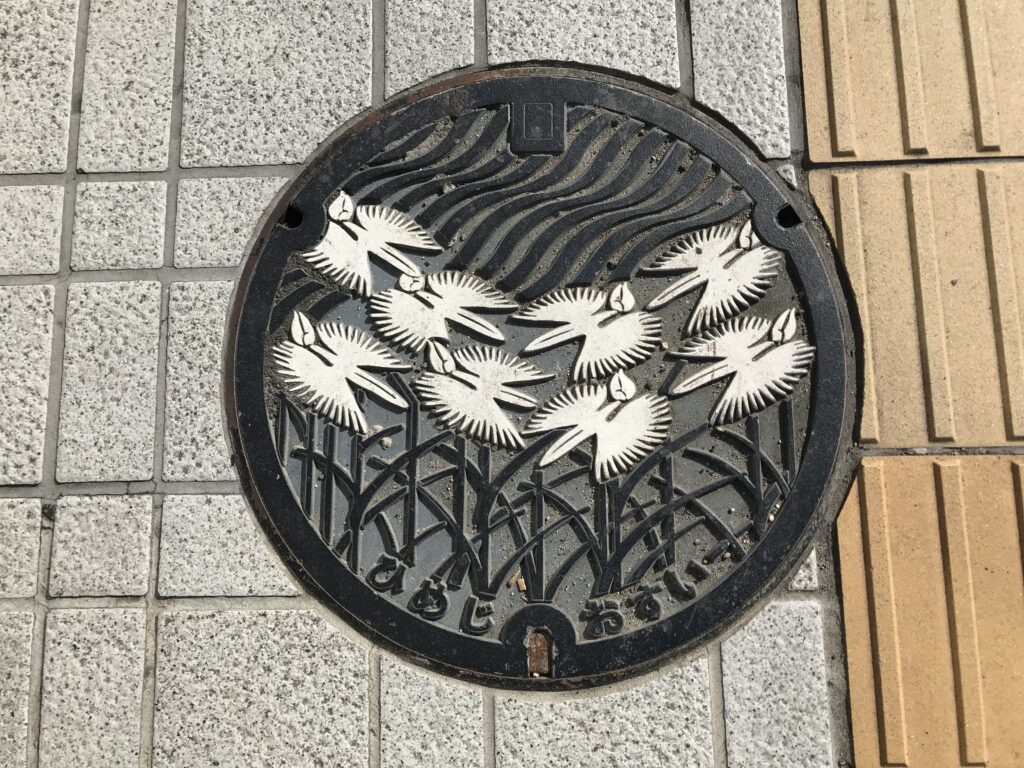
The city created the design in 1987 to mark fifty years of its sewerage service. It documents both a version in four pastel colors and a monochrome version in black and gray.4 The photograph here shows how clearly the flowers stand out without a rainbow of color.
There are two local stories in this one object: a flower chosen to represent Himeji and an anniversary of the system the cover belongs to. Knowing either adds something to the picture.
Yokohama: a port, and the people who chose it
Yokohama’s Bay Bridge cover takes a different approach. A bridge fills the center, while a ship’s wheel forms the surrounding frame. The city explains the design through the port’s development and its future.5
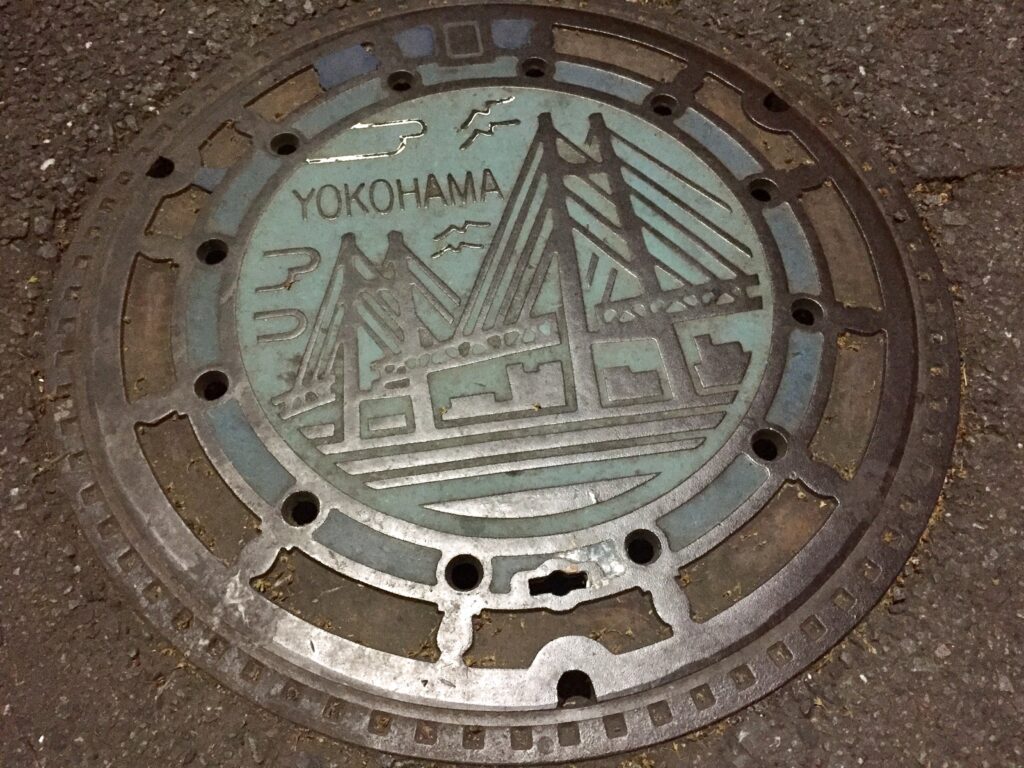
Its selection involved residents. The sewerage bureau prepared several candidates and used votes from participants at a facility tour event to help choose the design, which was adopted on October 1, 1997.6 That process adds another layer to the image: people had a part in deciding how their city would appear on its streets.
A local reference can also be more intimate than a landmark. In March 2023, Yokohama installed a commemorative cover for Kamishirane Junior High School as it approached closure. The design preserves the school emblem and the dates of its opening and closing.5 A former pupil might see a piece of personal history where a visitor sees an unfamiliar crest.
Color is part of a practical object
How do these covers get their color? Nagashima Foundry describes making colored designs by pouring colored resin into the cover. Its examples use motifs associated with plants, local products and events.7
The same manufacturer also makes decorative covers for fire hydrants, using conspicuous red and yellow to help people recognize their function.7 A decorated utility lid can therefore mark a different service from the sewer covers pictured here.
The objects have working lives, too. Yokohama says its older colored Bay Bridge covers beside Motomachi Park were replaced for safety with covers of an equivalent design.5 A photograph records a particular moment in that life, including its weathering.
Why people collect manhole cards
The curiosity that starts with a glance at the pavement has a paper counterpart. The first series of Manhole Cards launched on April 1, 2016. GKP, the sewerage public relations platform behind the project, describes the cards as a way to encourage interest in both local places and sewerage.8
The front shows a photograph and coordinates; the back explains the design’s origins and provides identifying information. Cards are handed out free at designated locations, with one per person as the general rule.8
The format gives a small street detail a second setting. You can examine the picture, learn what it represents and keep a record of the place associated with it. For someone drawn to collecting, the next unfamiliar design offers another reason to look closely.
If you decide to collect one, check the municipality’s current distribution information before making a special trip.
A different way to notice a city
These three covers suggest a useful question for a walk: what has this place chosen to put on an everyday object? In Matsumoto, it is a craft. In Himeji, a flower. In Yokohama, a view of the port.
You can enjoy the patterns immediately, then let their names open another door. A simple circle in the pavement becomes a prompt to learn something you had no reason to search for a moment earlier.
That is what makes looking down rewarding. The destination can wait for a few seconds while the street itself gives you something to think about.
Continue exploring
More stories from Japan’s streets
Sources & further reading
Sources checked on October 19, 2026. Municipalities’ own explanations are used to identify the designs. Photograph dates appear in the captions.
- Okinawa Prefecture — Sewerage Quiz 2023: answers and explanations. Manhole access and maintenance; the qualified account of Naha’s 1977 fish design. Japanese.
- Naha City — Naha’s sewerage system. The environmental meaning of the fish motif. Japanese.
- Matsumoto City — Manhole cards. Matsumoto temari and the cover’s local craft reference. Japanese.
- Himeji City — Manhole-cover designs. The city’s sagisō design, its 1987 introduction and its color variants. Japanese.
- Yokohama City — Decorative sewer manhole covers. Bay Bridge symbolism, replacement of older covers and the Kamishirane school memorial. Japanese.
- Yokohama City — FAQ: the origin and selection of Yokohama’s cover design. Resident participation and the October 1, 1997 adoption date. Japanese.
- Nagashima Foundry — Colored manhole covers. Colored resin and the role of conspicuous color on fire hydrant covers. Japanese and English.
- GKP — Manhole-card questions and answers. The April 2016 launch, card contents, distribution principles and public education purpose. Japanese.
Photograph credits and reuse licenses appear with each image.




Comments