Real Life in Japan · Culture & Traditions
Why Are There Yellow Bumpy Tiles on Japan’s Streets?
The small raised tiles beneath Japan’s feet began as an idea in Okayama—and reveal what it takes to make a city easier to navigate.
LAYERS OF JAPAN · 8 minute read
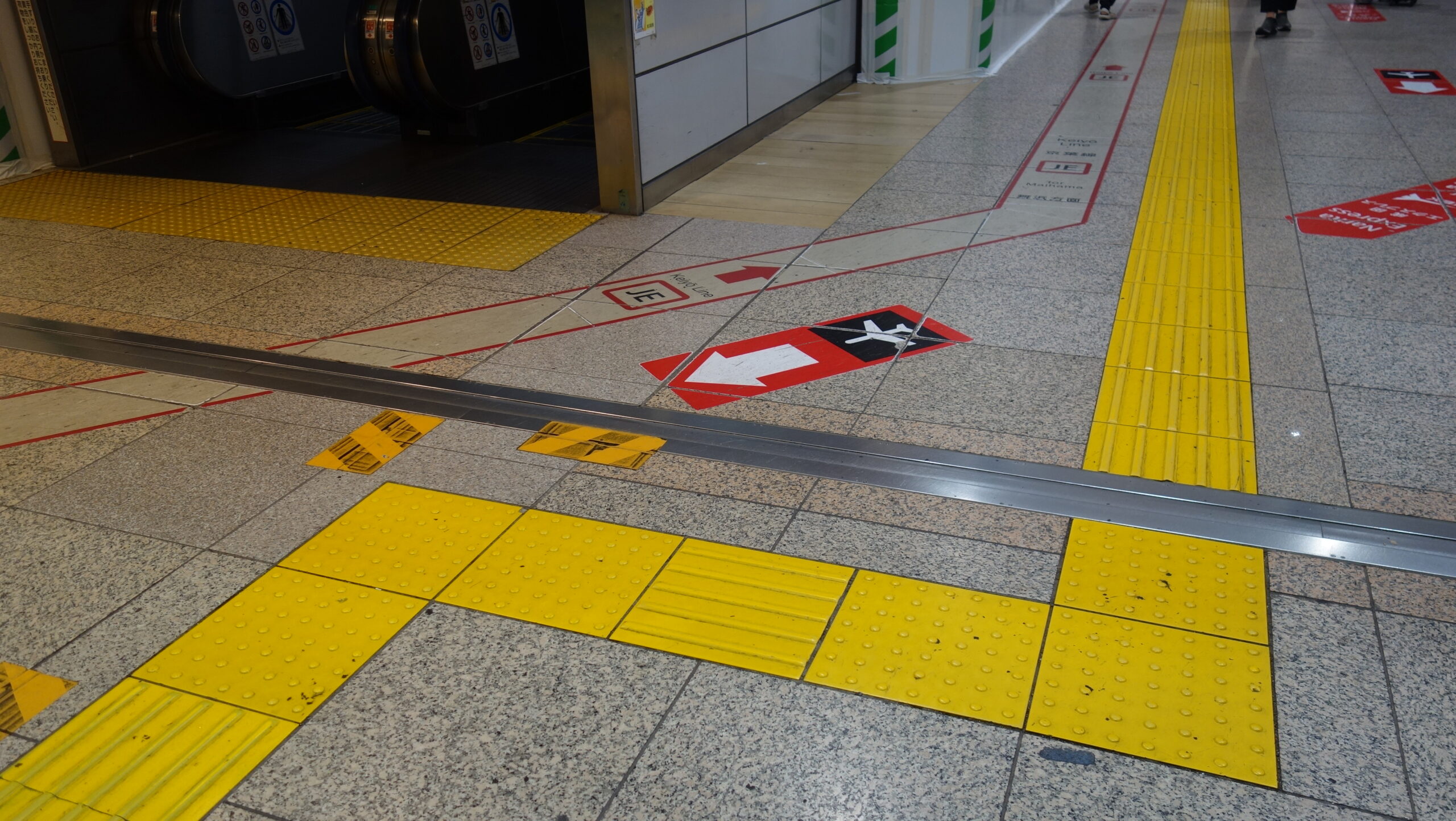
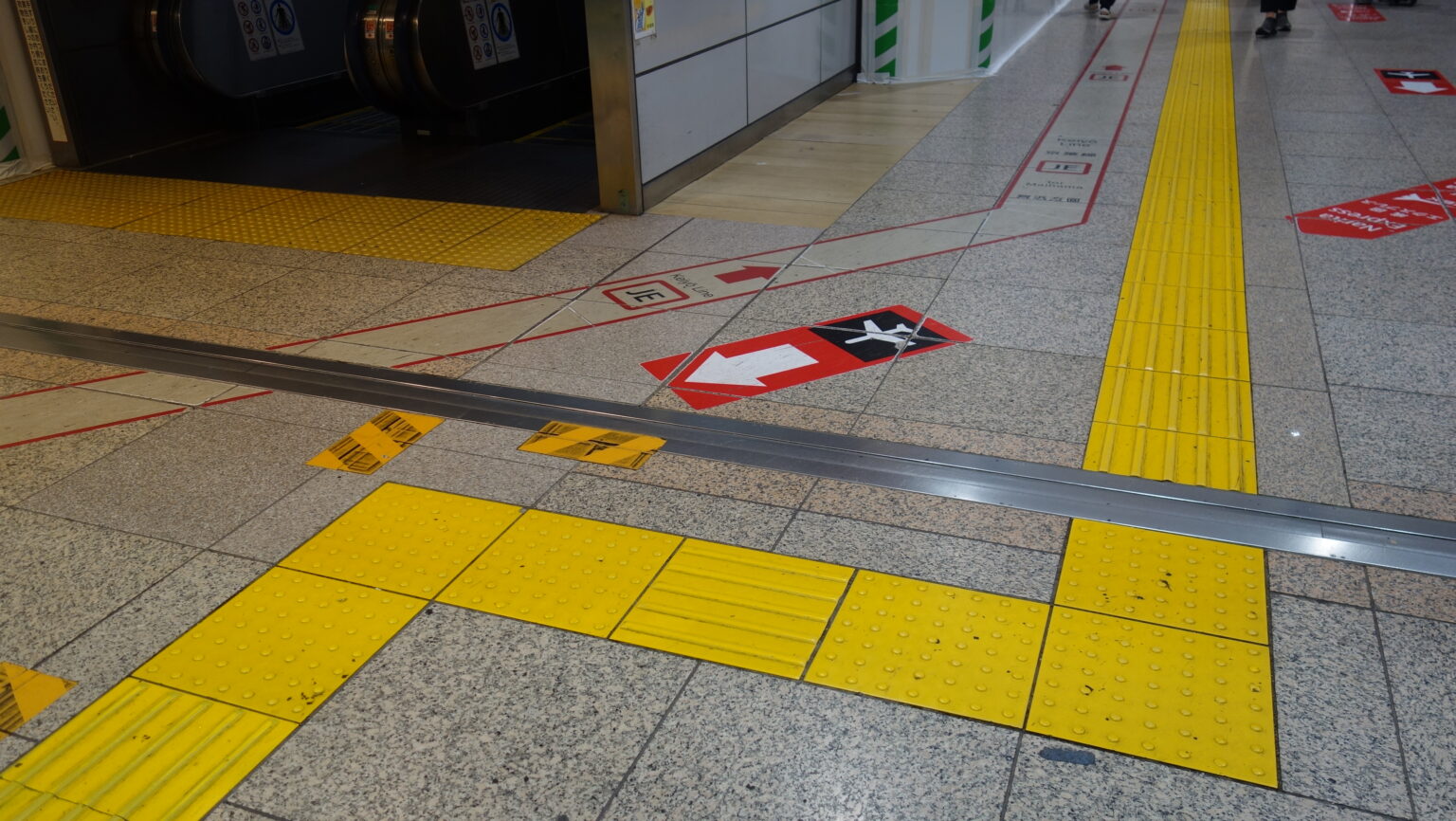
Look down while walking through a Japanese railway station. Among the signs, advertisements and hurried footsteps, bright yellow strips cross the floor. Outside, similar tiles may lead to a pedestrian crossing, curve around an entrance or stop just before the edge of a platform.
They are so familiar that many residents barely notice them. For visitors, the raised dots and ridges can seem like a curious part of the streetscape. But they are neither decoration nor a code that must be read by sight.
These are tenji blocks (点字ブロック), often called tactile paving in English. They help people with visual impairments find direction and notice possible hazards through touch. They also have a remarkable history: the idea began in Japan and later spread around the world.
1. Two Textures, Two Different Messages
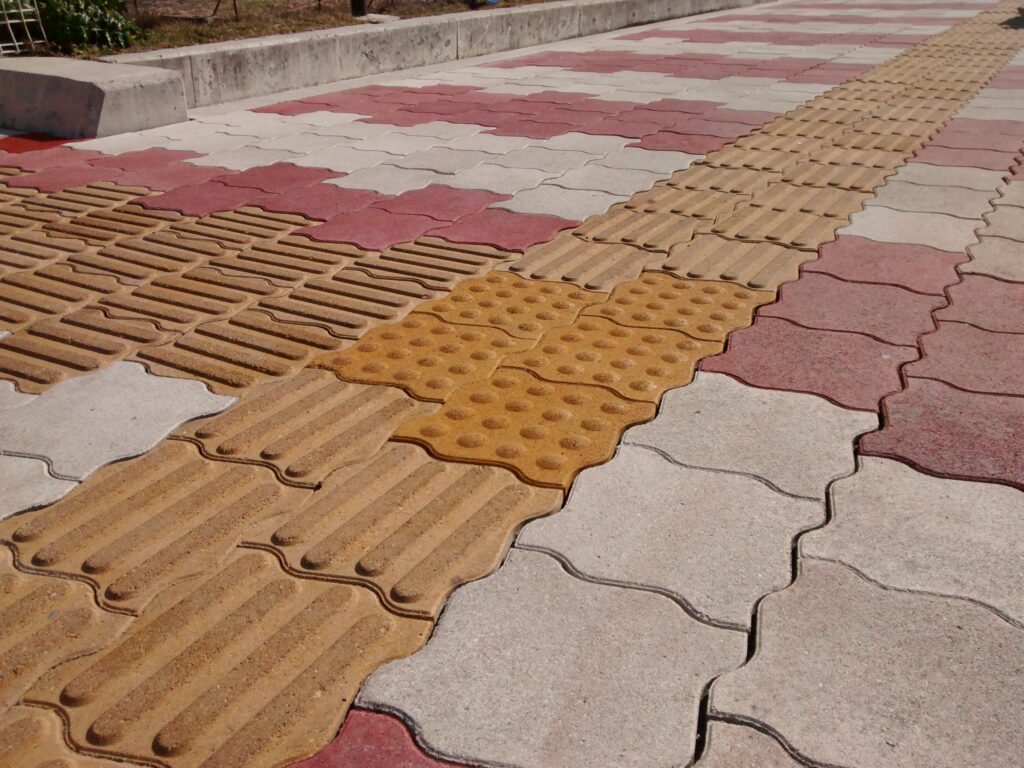
Not all yellow tiles say the same thing. The difference is in the pattern underfoot. Blocks with long parallel ridges generally provide a directional cue: follow the line to continue along a route. Blocks with raised dots signal that a traveler should pay attention, often near a crossing, staircase or other change in the surroundings.
The distinction matters because the paving is not a miniature map. Someone walking with a white cane might detect the texture with the cane; another person may feel the shape through their shoes. Individuals use it differently, and it does not replace orientation skills or other assistance.
At train platforms, Japan also uses specialized warning blocks that include an extra raised line to indicate the inward side, away from the track. The country’s transport authorities distinguish these from ordinary directional and warning blocks. An arrangement that looks like a decorative floor pattern can be carrying quite precise information.
2. Why Is It Often Bright Yellow?
The color is for people who can use some vision. Not everyone with a visual impairment is completely blind. Many have low vision and may be able to distinguish a bright strip from a darker surrounding surface, particularly when the contrast is strong.
Yellow became the familiar choice in Japan because it tends to be conspicuous against common paving surfaces. Japanese guidance generally calls for yellow blocks, but the practical concern is also contrast with what is around them. A yellow strip against a similarly pale floor can be harder to distinguish than its color alone might suggest.
The raised texture remains essential: a block should convey information through touch, not depend on a person being able to see yellow. That combination of visual and tactile guidance is what makes the design so useful.
3. The Idea Began in Okayama
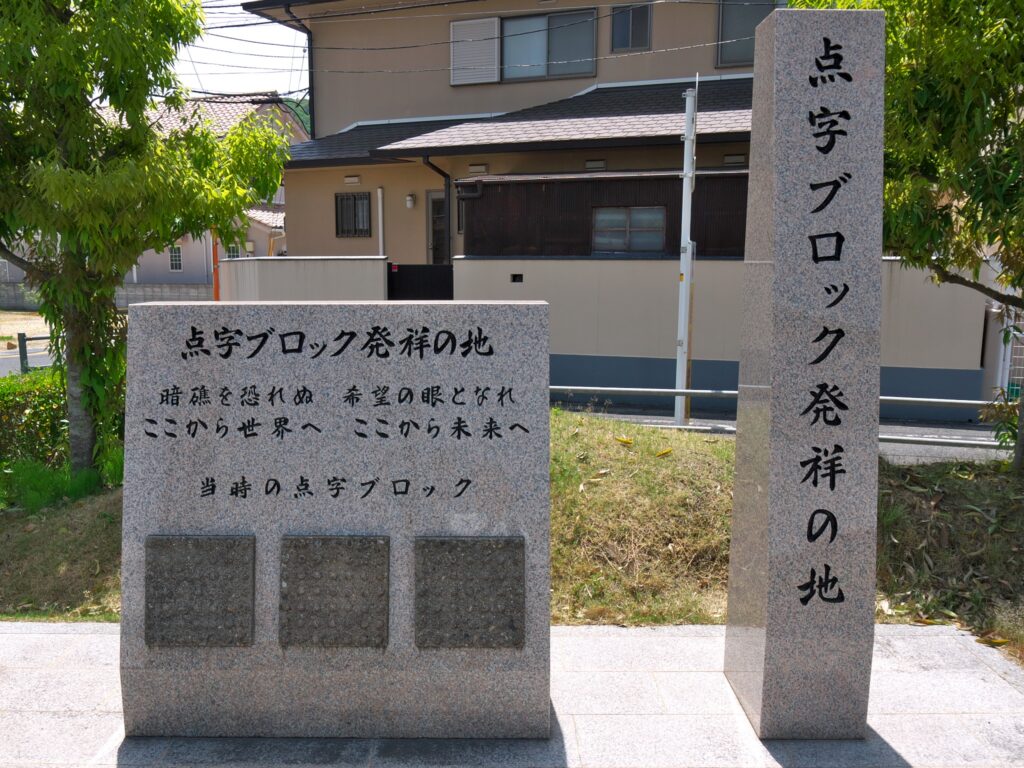
The story leads away from Tokyo to Okayama, in western Japan. According to the Okayama Prefectural Government, Seiichi Miyake developed the idea in 1965. On March 18, 1967, tactile paving was first installed near Haraoshima Intersection, close to the Okayama School for the Blind, in what is now Okayama City’s Naka Ward.
That first installation was not a station-wide network of bright lines and turning points. It was a local attempt to make a particular stretch of street easier and safer to navigate. The city’s birthplace monument is a reminder that widely adopted public designs can begin with one small, practical problem.
The concept gained wider recognition as people came to understand that information about the walking environment could be built into the ground itself. Later standardization also mattered: Japan established a Japanese Industrial Standard for block shapes and arrangements in 2001, making the messages more consistent.
Today, similar systems can be found beyond Japan. The broader lesson is less about a single remarkable inventor than about the long work of turning an invention into a public facility that others can reliably use.
4. A Route Through the City, Not Just a Strip of Tiles
A useful tactile path should connect places that people need to reach: an accessible station entrance, ticket machines, stairs, a crossing or a public building. One perfectly made tile cannot help much if the route stops abruptly or sends its user toward an obstruction.
Tokyo’s accessibility guidance identifies blocks in buildings, on streets and in stations. They may lead between entrances and counters, guide pedestrians to crosswalks or indicate caution near train platforms. This is why the pattern sometimes takes a surprising turn instead of following the straightest-looking line across a concourse.
For pedestrians who do not rely on tactile cues, a bend may look arbitrary. For someone following a planned route, it may reflect a crossing point, an entrance or another feature of the space. The surrounding environment matters as much as the tile.
5. Why the Pattern Is Not Literally Braille
The Japanese nickname tenji block contains tenji, the word for Braille. It is understandable that English speakers sometimes call the tiles “Braille blocks.” But the surface does not spell out words or street names in Braille.
Instead, the standard textures convey a smaller set of physical cues—broadly, direction and warning. The design has a different job from raised letters on a sign or information board. That distinction helps explain why the same two simple patterns can appear at different stations and on different streets.
Japan is not the only country to use tactile paving. Other nations have adopted variations suited to their own standards and environments. A traveler should not assume every country’s pattern, color or station arrangement means exactly the same thing.
6. The Problem with a Blocked Path
Imagine that a narrow strip of tactile paving leads along a sidewalk. Someone parks a bicycle across it, a shop sets out a signboard, or a group stops to talk directly on the route. What was meant to guide a traveler has now become an obstacle course.
The Tokyo Metropolitan Government explicitly asks people not to leave bicycles, signs or other objects on or around the blocks. Japan’s transport ministry also identifies abandoned bicycles and street obstructions as barriers to accessible pedestrian routes. The system depends on ordinary behavior as well as construction.
A photograph of the tiles can be reassuring, but a photograph cannot tell you whether a route stays clear on a crowded evening. Someone designing or maintaining a street needs to think about where people really walk, stop, wait and store things.
For another look at how unremarkable public routines depend on many people, see Why Are Japanese Streets So Clean?.
7. Accessibility Is More Than a Color
Look at tactile paving on older or unusually colored sidewalks and you may notice that not all blocks are bright yellow. Some appear tan or gray, while neighboring stones may have a similar tone. The photograph here shows how much the surrounding surface can change what the route looks like.
Accessibility requires thinking about more than whether blocks have been installed. The route must be understandable and continuous, and the visual contrast must work in its actual setting. It also needs to coexist with other users of the street, including people with mobility impairments, wheelchairs and strollers.
The aim is not to make every floor look the same or to treat one design feature as a cure for all difficulties. It is to provide usable information without creating new barriers elsewhere. Other tools—from audible guidance to accessible signs, safe crossings and helpful staff—remain important.
Questions of who can move safely through a neighborhood also appear in our story about Japanese children walking to school.
8. The Quiet Design Beneath Everyday Life
When the station is crowded, your eyes might go to the departure board, the train doors or the nearest exit. The tiles underfoot may not register at all. That invisibility, for people who do not need them, is part of what makes the design easy to overlook.
But the blocks are not meaningful merely because they were invented in Japan. Their value is measured every day, in whether a person can follow a route, notice a change and reach a destination with greater confidence.
The next time you cross a yellow strip, notice whether it leads somewhere sensible and whether the path is clear. That is a more interesting question than why a Japanese sidewalk has an unusual texture.
A city becomes more accessible not just when it installs a useful invention, but when it keeps the promise of the route open.
Frequently Asked Questions About Tactile Paving
What are the yellow bumpy tiles in Japan called?
They are commonly called tenji blocks in Japanese and tactile paving or tactile walking surface indicators in English. Their official Japanese term is shikaku shōgaisha yūdōyō burokku (visual-impairment guidance blocks).
What is the difference between the dots and the lines?
Raised parallel lines usually provide a directional guide. Raised dots warn people to pay attention near places such as crossings, stairs and platform edges; some station blocks have an additional inward-facing line.
Who invented tactile paving?
Seiichi Miyake developed the idea in Japan in 1965. The first installation was laid on March 18, 1967, near Haraoshima Intersection in Okayama.
Why are tactile blocks usually yellow?
Yellow offers useful visual contrast in many environments for people with low vision, while the textured shapes can also be recognized with a white cane or underfoot. Actual contrast with the surrounding surface matters.
Should I stand on tactile paving or leave my bicycle there?
No. Keep tactile routes and nearby space unobstructed. Standing, parking bicycles or placing signs on the blocks can prevent other people from following them safely.
Sources and Further Reading
The following government and public-education materials document the invention, block types, official design guidance and need to keep tactile routes clear. The opening scene is illustrative, not a reported interview.
- Okayama Prefectural Government: Tactile Paving Was Born in Okayama (Japanese).
- Kanto District Transport Bureau, Ministry of Land, Infrastructure, Transport and Tourism: Barrier-Free FAQ: Tactile Guidance, Warning Blocks and 2001 JIS Standard (Japanese).
- Tokyo Metropolitan Government: Tactile Paving and Keeping Routes Clear (Japanese).
- Ministry of Land, Infrastructure, Transport and Tourism: Universal Design in Walking Spaces (Japanese).
- Cabinet Office of Japan, KIZUNA: Autumn 2021: Japanese Innovations in Accessibility (PDF).
Editorial note: Tile color, textures and placement can vary with national standards, site design and age. Photo captions specify what is shown and the year it was photographed.









Comments