In the world’s largest urban landscapes, a narrow alley or an office courtyard can still hold a place of prayer. Tokyo’s small shrines tell a story not just about belief, but about land, community, memory, and change.
LAYERS OF JAPAN · 13 minute read
Walk through central Tokyo and the city seems to have an answer for every available square meter. Glass offices rise above crowded sidewalks. Shops occupy the ground floors. Railway entrances disappear beneath department stores. Even a modest patch of sky can feel carefully rationed.
Then, just beside a polished office lobby, you notice a torii gate.
Or you turn into a passage barely wide enough for two people and find red banners, a tiny shrine building, and perhaps a pair of stone foxes. The scene feels as if two versions of Tokyo have quietly made room for each other.
Why is a shrine here, in one of the world’s most expensive and intensively developed cities? Why was it not cleared away when the larger buildings arrived?
There is no single answer. Some shrines have stood in their neighborhoods for generations. Some have been rebuilt or moved. Others are kept by merchants, residents, or businesses whose relationships with the site continue even as the surrounding streets change.
These are not simply pieces of the past that Tokyo forgot to demolish. They are places that people have found reasons—and ways—to keep.
1. A Small Gate in a Very Large City
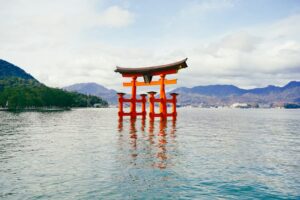
When people imagine a Japanese shrine, they might picture a vast wooded sanctuary, a long avenue of stone lanterns, or a famous vermilion gateway. Tokyo has places like these, but it also has shrines that occupy remarkably small sites.
Look down an alley in Ginza, cross a business district in Toranomon, or wander near the office towers of Nihonbashi and you may find one embedded in the city’s working landscape.
The Japanese word jinja means a Shinto shrine. These sites enshrine kami, a term often translated as “deities” or “spirits,” though it does not map perfectly onto either English word. Kami may be associated with natural forces, places, ancestors, or other aspects of the world.
Not every small place of devotion on a Tokyo street is a Shinto shrine. A roadside Jizō statue, for example, belongs to Buddhist tradition. And not every shrine is painted red, guarded by foxes, or freely accessible. Tokyo’s sacred places are more varied than a sightseeing photograph suggests.
What they have in common is that their meaning cannot be judged by their size.
2. The Shrines That Grew with Merchants and Neighborhoods
Many conspicuous little shrines in shopping and business districts are dedicated to Inari. Inari worship has historical connections with rice and agricultural abundance; over time it also became deeply associated with commerce, prosperity, and the fortunes of households and enterprises.
That helps explain why shrines can appear among warehouses, shops, offices, and department stores rather than only in quiet natural settings. A merchant might wish for business to thrive. A neighborhood might pray for safety from fire. The people maintaining a shrine may inherit that relationship from earlier generations.
Inari shrines often have fox statues. A useful distinction for visitors: in the familiar tradition, the foxes are generally regarded as messengers of Inari, not simply the gods themselves.
Of course, a shrine’s precise history matters. Some were tied to a particular family or property. Others became guardians of a street or district. It would be a mistake to treat every red gate as evidence of the same tradition or the same ownership.
Even so, these small shrines reveal something important about old commercial Tokyo: everyday economic life and everyday religious practice were not always kept in separate compartments.
3. Ginza’s Hidden Passage: Toyoiwa Inari Shrine
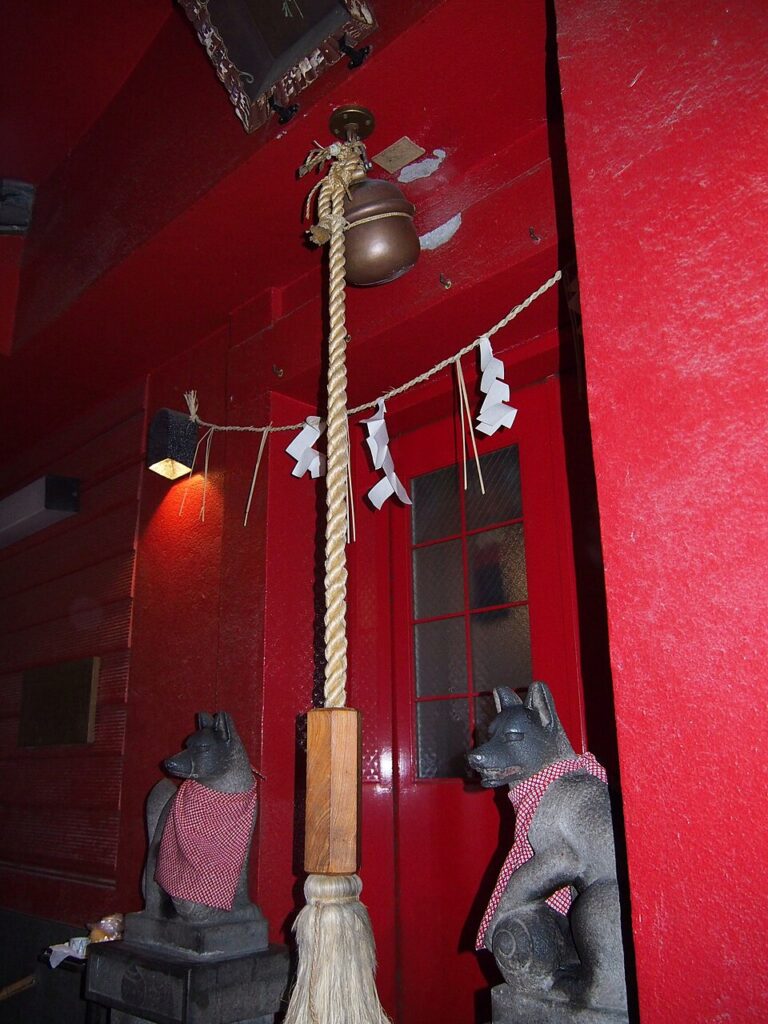
Ginza is known internationally for luxury retail, fashionable cafés, and expensive real estate. It is also full of less obvious histories.
At Toyoiwa Inari Shrine, in Ginza 7-chome, visitors approach a shrine through a narrow path between buildings. From the surrounding commercial streets, the entrance is easy to overlook. A person searching for a grand temple complex could walk past without suspecting that a place of worship is close by.
The official Ginza website’s series on neighborhood shrines describes the unusual passage and explains that the shrine has roots in the Edo period, when Ginza’s streets and buildings looked very different.
The encounter is memorable partly because the scale is so unexpected. The lanes and building walls make the shrine feel tucked into the city rather than set apart from it. But the site is not a stage set arranged to delight visitors. It exists within an ongoing neighborhood, and it is still a place to treat with care.
A narrow approach can be more revealing than a magnificent gate. It raises a simple question: who decided this little space should remain available, even while everything nearby changed?
4. The People Who Keep a Shrine Alive
A shrine cannot remain meaningful through architecture alone. Buildings need repair. Offerings and seasonal observances require care. Even a small approach must be kept clean and accessible where public access is intended.
Another Ginza shrine, Hodo Inari Shrine in Ginza 4-chome, provides a revealing example. According to an interview published on Ginza’s official website, a local neighborhood association continues to manage the shrine. The story links the shrine’s restoration to cooperation among people living and working nearby.
One of the people involved describes serving as a moribito, or caretaker, and explains how a building owner made private land available for the approach. The shrine’s present form, reconstructed in the late 2000s, is the result of choices and commitments, not simply an ancient object left untouched.
This is the human part of the story that urban photographs often miss.
A shrine may survive because a property owner makes room. Because a local organization accepts responsibility. Because businesses contribute to upkeep. Because people still visit on their way to work.
None of those arrangements is guaranteed to last forever. That is precisely why they matter.
5. Nihonbashi: A Shrine Rebuilt Among the Towers
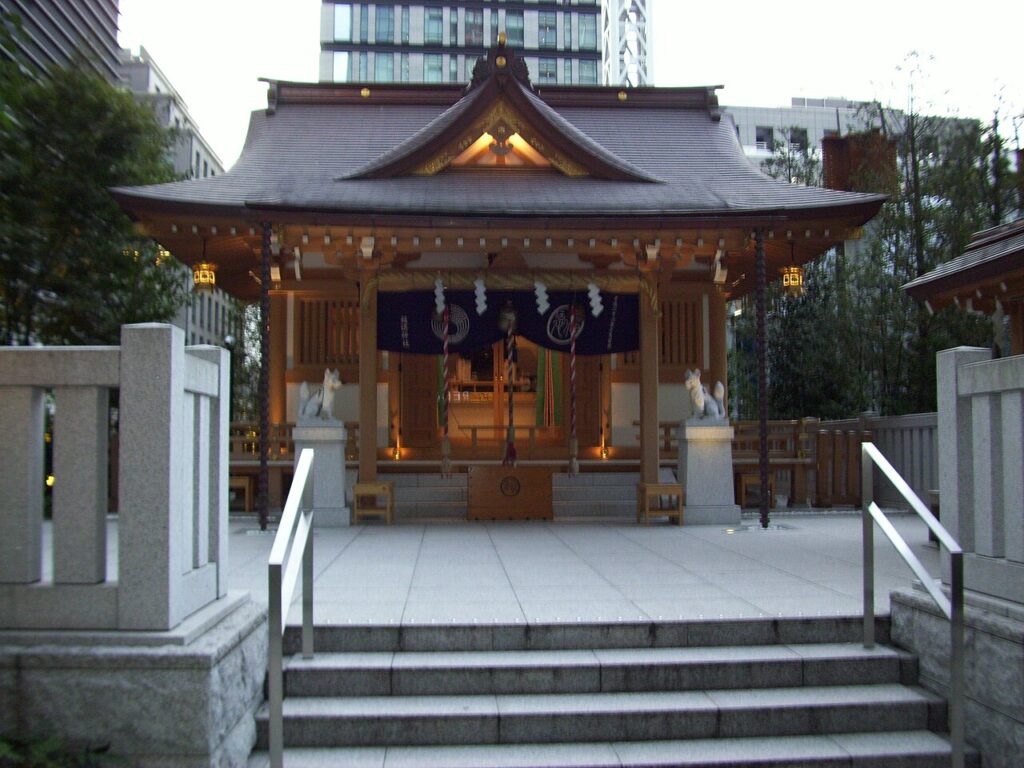
In Nihonbashi, Fukutoku Shrine tells a different story—one in which rebuilding became part of a larger urban redevelopment project.
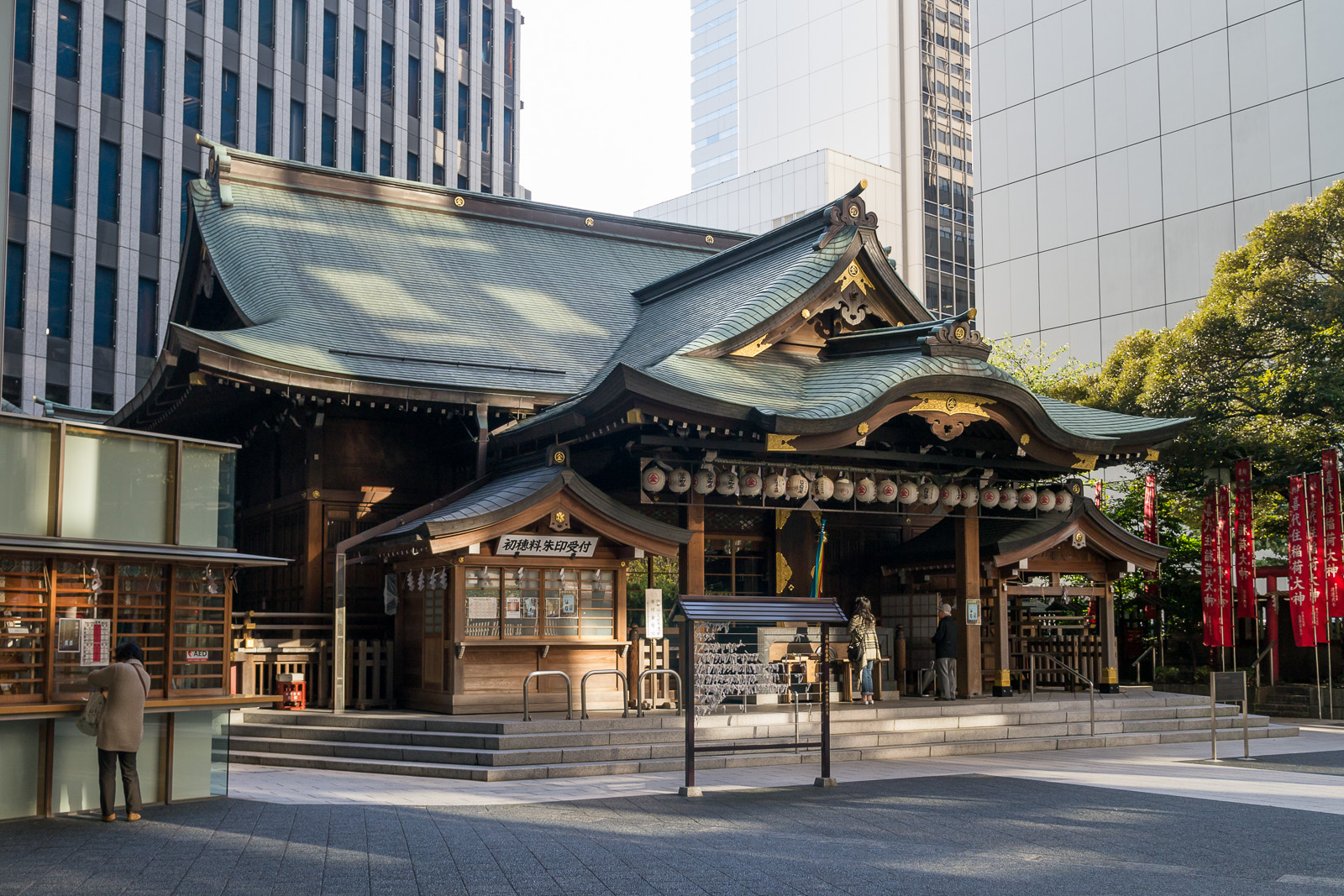
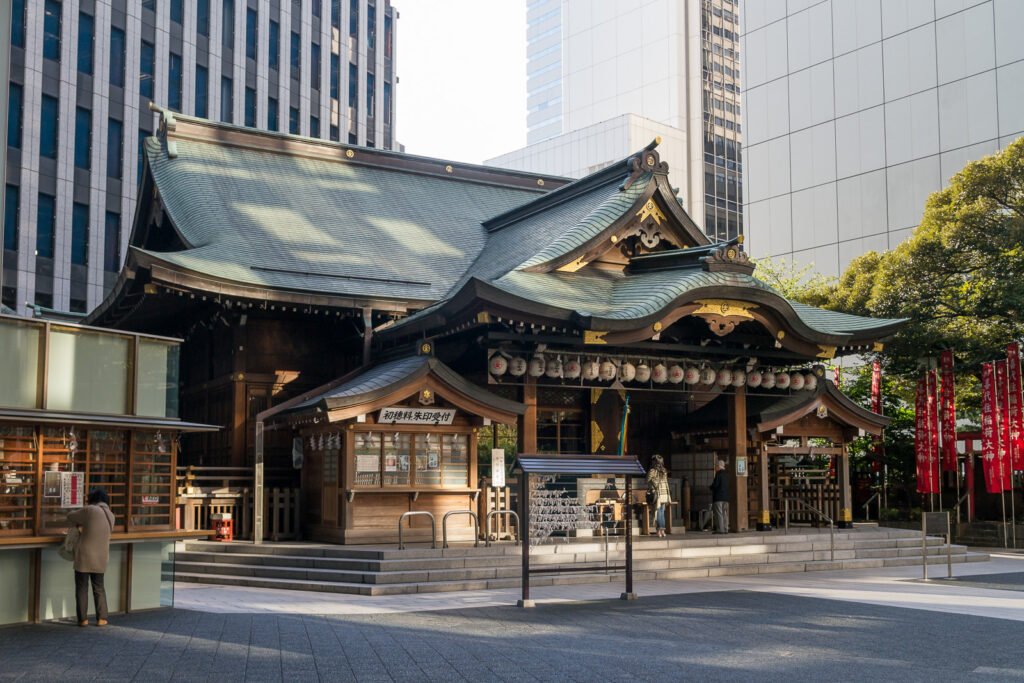
The shrine has a history commonly traced back more than a thousand years, but the wooden building visitors see today is not an untouched medieval structure. The shrine was reconstructed as part of the Nihonbashi Muromachi district’s revitalization, and the new building was completed in October 2014. The adjoining Fukutoku Garden followed in 2016.
Developer Mitsui Fudosan describes the wider Nihonbashi effort in terms of preserving, reviving, and creating. Those are ambitious words, and any major development deserves scrutiny. Yet the physical result is striking: offices, shops, public circulation routes, greenery, and a functioning shrine share the same modern district.
Here the question is not simply, “How did an old shrine escape the skyscrapers?” A more accurate question is, “How was a shrine’s place in the neighborhood reconsidered as the district was rebuilt?”
That difference matters. Cultural continuity is not always the preservation of every old stone and beam. Sometimes it is a new structure designed to carry an older relationship into a changing city.
And sometimes the redevelopment story is more complicated than the promotional photographs suggest.
6. Toranomon: The Office District Has a Shrine, Too
In Toranomon, Kotohiragu Shrine sits among high-rise business buildings. The Tokyo Metropolitan Government’s official tourism guide traces its founding to 1660 and notes that people visit with wishes connected to family health, business success, and maritime safety.
The setting makes the shrine especially interesting. A stone-paved precinct and traditional roofline interrupt an urban panorama of office façades and modern commercial movement. Workers can pass a place of prayer while going about an entirely ordinary weekday.
The shrine is not invisible, exactly. It is simply part of a city where past and present do not always occupy separate districts.
It is tempting to call this “ancient Japan surrounded by modern Japan.” But that phrase suggests a clean division. In reality, the shrine itself has continued through time, and the people who use it are thoroughly contemporary. Tradition is not necessarily the opposite of modern life; sometimes it is one of the things modern life contains.
7. When a Shrine Moves Up to the Roof
In a city with high land values, survival sometimes requires a different address—or at least a different level of the building.
The official Ginza shrine series documents shrines situated on rooftops. One example is Kakugo Inari Shrine, associated with GINZA SIX. Other shrines tied to neighborhood businesses or older properties occupy roof spaces that are not normally open to casual visitors.
The practice can seem surprising if a reader expects every shrine to stand at the end of a forest path. Yet the underlying relationship may continue even when the physical surroundings change.
This does not mean rooftop placement is always an ideal solution. Public access, visibility, maintenance, and the sense of connection to a particular location can all change. For some shrines, there is a real tension between continuity and convenience.
The city has not found a single formula. It has found many local compromises.
8. Not Every Shrine Stays Where It Was
There is a danger in telling only heartwarming stories of survival. Redevelopment can also displace shrines or change their relationship with the street.
The Ginza official website describes how Saiwai Inari Shrine was moved from a more visible street-facing location to an alley as the surrounding site was redeveloped. The shrine continued, but its setting changed.
Elsewhere, sites may become hard to reach, be restricted to particular occasions, or lose the buildings and streets that once gave them context. Some old places of worship may disappear altogether. Their outcomes depend on local circumstances; Tokyo does not have a magic rule that automatically protects every tiny shrine.
So rather than saying, “Japanese people never remove shrines,” it is more truthful to ask who has the power to make decisions, who pays for care, and whose memories count when land is rebuilt.
A shrine’s continued presence can be an achievement. It can also reveal the compromises demanded by an expensive city.
9. Is This About Religion, Tradition, or Something Else?
For some visitors, a neighborhood shrine is explicitly religious. For others, stopping to bow or offer a brief prayer may be a familiar custom carried into everyday life. Still others may not visit at all, even if they pass the gate every day.
It is impossible to describe all Japanese people as equally devout—or equally indifferent. A city’s shrines have many different kinds of relationships with the people around them.
What makes these places so compelling is that a small shrine can carry several meanings at once. It can be a place of worship, a landmark, a link to former residents or businesses, a reminder of a neighborhood’s boundaries, or simply a quiet visual interruption in a crowded street.
Visitors need not believe what worshippers believe to recognize that the space matters to someone.
That recognition is a better starting point than treating the shrine as an exotic decoration.
10. How to Notice One—and Visit Respectfully
If you want to look for smaller shrines in Tokyo, slow down in older commercial areas rather than focusing only on the famous sightseeing routes. Ginza, Nihonbashi, and Toranomon offer different kinds of examples.
A small torii gate, a sacred rope known as a shimenawa, a shrine name on a plaque, or a narrow approach marked by banners may signal a sacred site. But not every shrine uses all these signs, and small roadside Buddhist sites require different descriptions.
Where visits are permitted, allow people who are praying their space. Stay on the intended approach. Do not enter closed rooms or private roof areas, move offerings, or assume that a picturesque alley is a public photography studio.
If you are uncertain whether a passage is open, look for signage or ask locally. Some shrines are accessible most days; others are private, seasonally opened, or managed under special arrangements. Always check current access before making a special trip.
The best way to experience a tiny shrine may be to spend less time trying to capture the perfect image and a little more time noticing the neighborhood around it.
11. The City Around the Shrine Is Part of the Story
A shrine between skyscrapers is visually arresting because of contrast: wood against glass, a small roof below a tall façade, a narrow quiet approach opening off a busy shopping street.
But the contrast becomes more interesting when we stop treating one side as “real Japan” and the other as an intrusion.
Tokyo has been built and rebuilt many times. Commerce has long been part of its history. Religious sites, too, have been maintained, relocated, reconstructed, and reimagined across generations.
That is why these places deserve to be seen as more than charming remnants. They are evidence of ongoing choices: about land, care, community identity, and what people wish a rapidly changing city to remember.
A tiny shrine may appear to occupy almost no space on a map. In a neighborhood’s story, it can occupy much more.
12. A Different Way to See Tokyo
The next time you walk beneath Tokyo’s towers, look just a little to the side.
There may be no dramatic entrance, no huge sign, no line of tourists. Perhaps there is only a small gate set back from the street, a weathered stone, and someone who has come to make a quiet visit before work.
It is tempting to say that Tokyo is a city where the old and the new live side by side. That is true as far as it goes. But the more revealing story is how people keep making room for both—and what happens when making room becomes difficult.
The little shrine between the buildings is not an answer to every question about Japan. It is an invitation to ask better ones.
And once you begin to notice those small spaces, Tokyo can look surprisingly different.
Frequently Asked Questions
Why are there small Shinto shrines in Tokyo’s business districts?
Many have historical connections to local communities, property owners, merchants, and the protection or prosperity of businesses. Each shrine has its own history, so there is no single explanation that fits all of them.
Are the fox statues at Inari shrines gods?
In familiar Inari traditions, foxes are commonly understood as messengers associated with Inari. Their role should not be confused with the deity enshrined there.
Have the shrines remained unchanged while the city grew?
Not always. Some have been rebuilt, some relocated to alleys or rooftops, and some integrated into redevelopment projects. Fukutoku Shrine’s current building, for example, was completed in 2014.
Can tourists enter every small shrine in Tokyo?
No. Some are public; others are on private property or rooftops with restricted access. Check current access information and respect local signs and worshippers.