The small space inside Japan’s front doors tells a larger story about cleanliness, hospitality, architecture, and the line between public life and home.
LAYERS OF JAPAN · 11 minute read
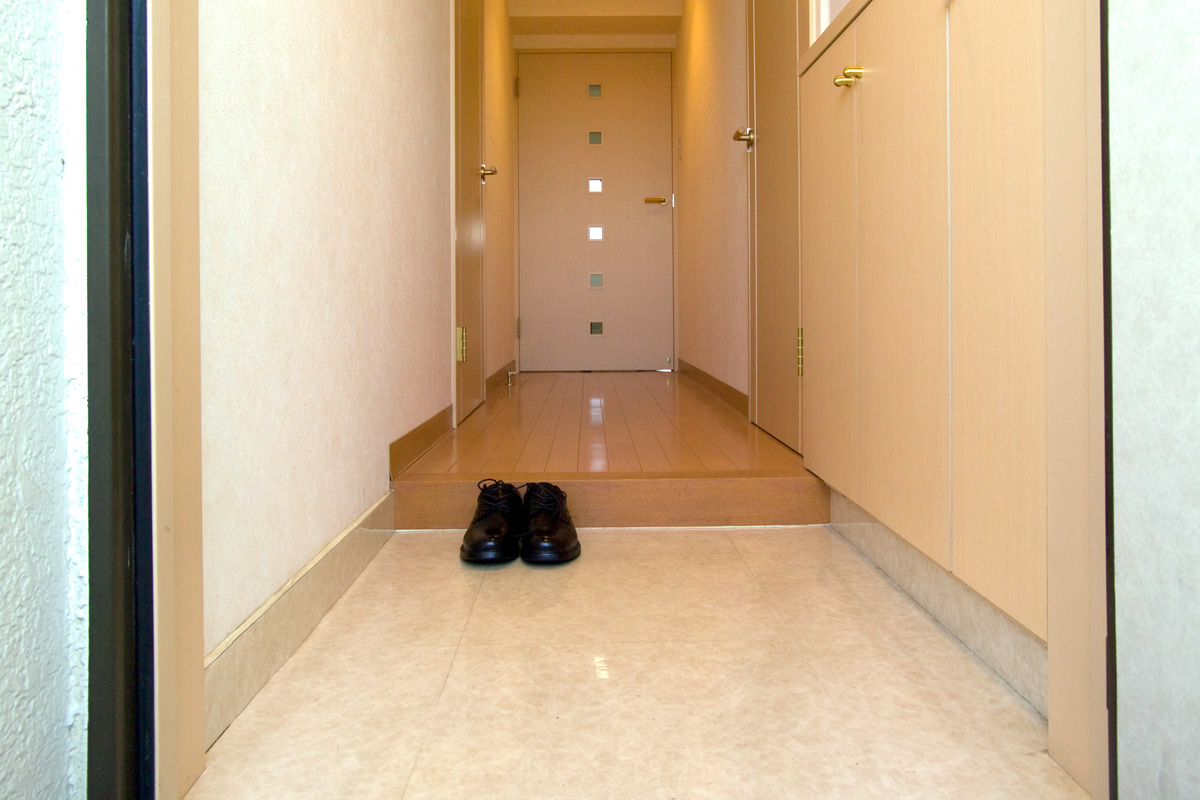
Imagine coming home to a Japanese apartment on a rainy evening.
You open the door, put down your bag, and pause on a small patch of tiled floor. Your shoes are damp from the street. Ahead of you, the floor rises by a few centimeters, and a pair of soft slippers waits on the wooden boards.
You remove your shoes, step up, and say tadaima—“I’m home.”
For many people in Japan, this moment is so ordinary that it hardly deserves a second thought. For a visitor, however, it can be the first clue that a Japanese home is organized according to rules they may not have noticed before.
The front door is not quite where the outside world ends. The genkan is.
The genkan (玄関) is more than a place to store footwear. It is a threshold built into the architecture of everyday life: practical, deeply familiar, and sometimes unexpectedly revealing.
1. A Doorway with Two Different Floors
Look carefully at the entrance to a typical Japanese home and you may notice two different surfaces.
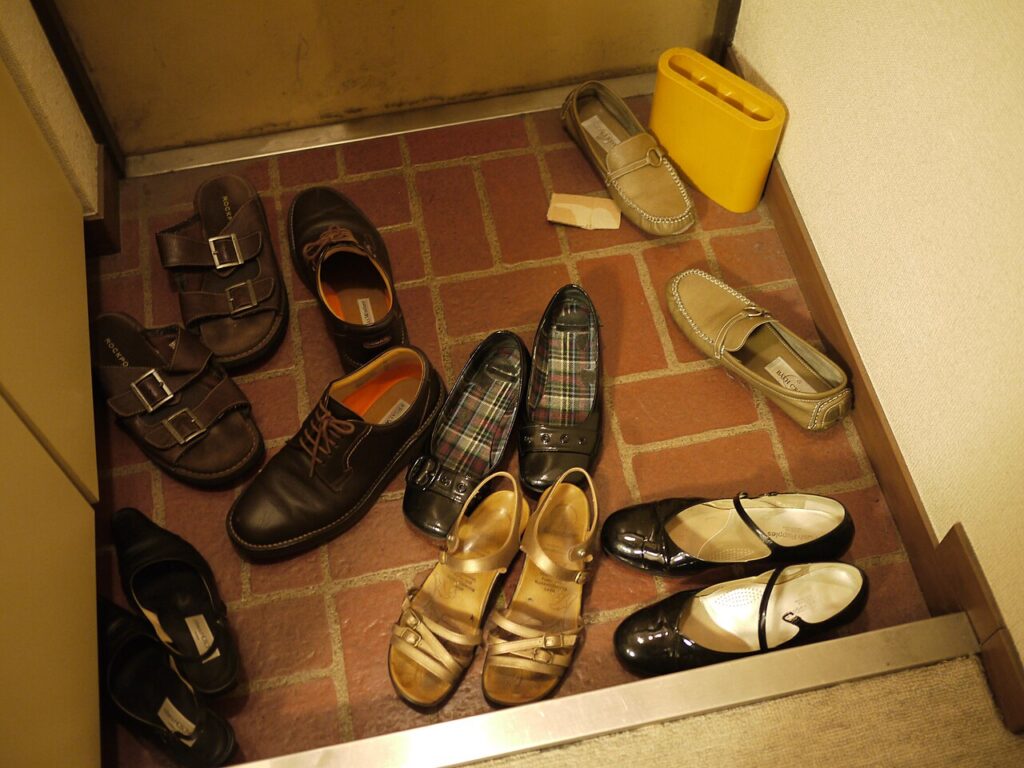
Immediately inside the door is a lower area, often tiled or finished in stone or another durable material. This is where outdoor shoes belong. Beyond it is the indoor floor, often wood or another cleaner, more comfortable surface. A step—or sometimes simply a change in material—marks the boundary between the two.
The lower area is sometimes called the tataki, while the raised edge may be referred to as the agari-kamachi. A cabinet for footwear is a getabako, though storage arrangements vary.
In a traditional house, this transition may be generous enough to sit down while removing shoes. In a compact city apartment, the space may be barely large enough for one person and two pairs of sneakers.
Either way, its message is easy to understand: the part of the floor touched by the street is not treated in the same way as the rest of the home.
It is a distinction you can see—and feel—when you cross it.
2. Why Shoes Come Off: The Floor Is Living Space
The most practical reason for removing shoes is to avoid carrying street dirt into the rooms where people live.
Historically, Japanese homes often used tatami mats for sitting, eating, and sleeping. A futon could be spread on the floor at night and put away in the morning, allowing the same room to serve different purposes at different times.
If the floor is also where you rest, play, or sleep, keeping outdoor footwear off it becomes more than a matter of appearance.
That history continues to influence contemporary homes, even though many now have wooden floors, sofas, beds, and little or no tatami. Taking off shoes is not limited to traditional houses; the practice remains common in modern apartments.
Of course, Japan is not the only country where people remove their shoes indoors. Families across Asia, northern Europe, Canada, and many other places have their own indoor-footwear customs. It would be inaccurate to present the habit as something only Japanese people do.
What makes the Japanese case especially visible is the way many homes give the act a dedicated architectural space.
The rule is not merely spoken. It is built into the floor.
3. The History Hidden in a Small Step
The raised floor has a practical architectural history, too.
Japanese housing developed in a climate where heat and humidity have long influenced building materials and ventilation. Traditional raised-floor construction helped separate living surfaces from moisture near the ground. A distinct lower entrance followed naturally from that arrangement.
Folklorist Takanori Shintani, writing in an explanation published by Kokugakuin University, connects the genkan’s level change to climate-responsive housing and to older ideas about separating the inside from the outside.
But the design was not always identical across social classes or historical periods. Formal genkan entrances were associated with particular buildings and households, while more modest row houses could have earthen-floored entrances or work areas without the kind of formal hall imagined today.
The entrance evolved, just as Japanese homes evolved.
And the step survived even after apartment construction, modern flooring, and contemporary household routines changed much of the architecture around it.
4. The Boundary Between Uchi and Soto
The Japanese words uchi and soto can mean “inside” and “outside.” They are also used when discussing social relationships, such as the difference between one’s own group and people beyond it.
It is tempting to turn the genkan into a grand theory of Japanese psychology. The doorway does not explain every social interaction, and not every resident attaches deep philosophical meaning to taking off a pair of shoes.
Still, the entrance offers a striking everyday example of how boundaries can be made visible.
On one side are wet pavements, crowded trains, work, errands, and the unpredictable outside world. On the other side are the rooms where a person can put down a bag, change clothes, sit on the floor, or simply rest.
The act of removing shoes can feel like a change of pace. A person who has hurried all day may finally slow down for a few seconds.
This is an interpretation of the routine, not a claim about what every Japanese person feels. But it helps explain why an apparently simple habit can carry emotional meaning as well as practical value.
5. The Etiquette of Arriving
For a visitor, the most important rule is straightforward: pause before stepping from the entryway into the living area.
Take off your outdoor shoes while standing on the lower, shoe-wearing surface. Then step onto the clean indoor floor without walking over it in your outdoor shoes. Try not to step back onto the lower surface in socks, since that can bring the very dirt you are avoiding into the home.
You may see people turn their shoes so that the toes face the front door. This is a common courtesy that makes footwear easier to put on when leaving. If slippers are offered, you can generally use them unless your host indicates otherwise.
There is no reason to become terrified of making a small mistake. The details of a household’s etiquette vary, and a good host can usually guide a guest through the routine.
A simple “Should I take my shoes off here?” is better than assuming that every threshold follows exactly the same rule.
Japanese hospitality does not require a visitor to know everything in advance. It begins with a willingness to pay attention.
6. Why Are There So Many Slippers?
The first pair of slippers may appear at the genkan, but a visitor can encounter more footwear rules farther inside.
Indoor slippers are common in some homes, inns, and facilities, but not universal. Families may prefer socks or bare feet at home. In many traditional tatami rooms, slippers are removed before stepping onto the mats.
Some homes and public facilities keep separate slippers for the toilet. Those are intended to stay in that area, rather than be worn through the rest of the house. Forgetting to change back is a small but familiar social mishap.
These distinctions can seem elaborate when listed as rules. In everyday life, they are simply ways of managing surfaces that serve different purposes.
An outdoor shoe belongs on the street-facing side of the home. A slipper belongs on certain indoor floors. A tatami mat may be used without either.
The system is not always identical or perfectly followed, and it is certainly not evidence that every Japanese household is spotless.
7. The Same Idea Beyond the Home
Shoe changing is not limited to private houses.
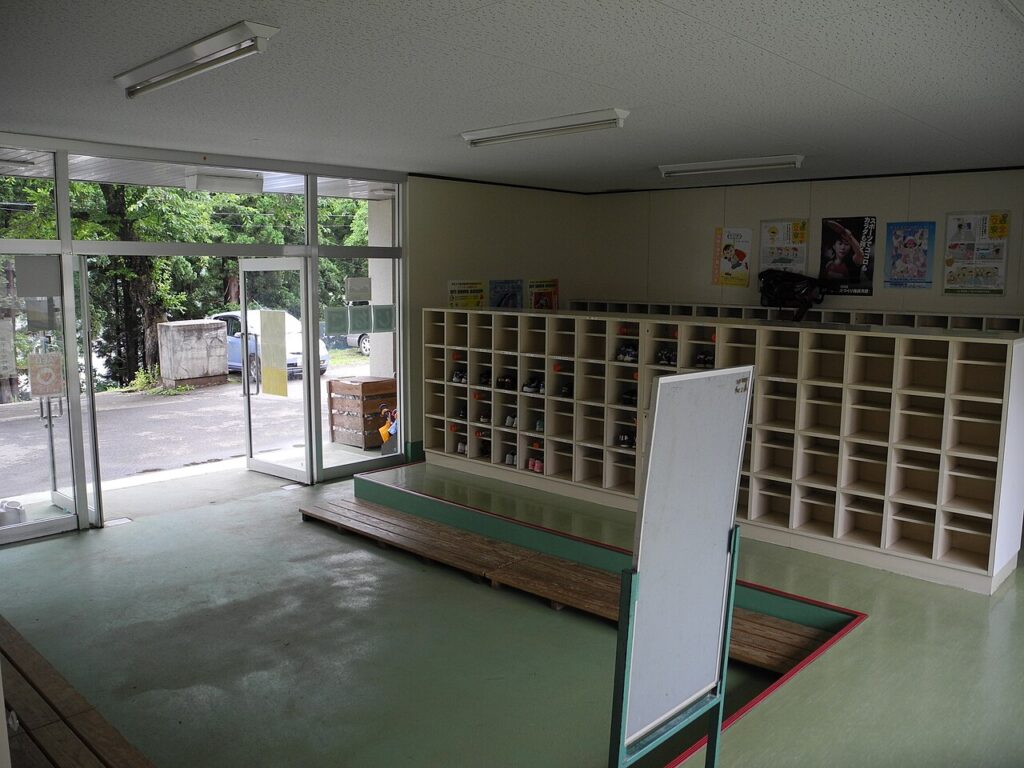
Many Japanese schools have entrance areas with rows of shoe lockers where students exchange outdoor shoes for indoor footwear, often called uwabaki. A photograph of the former Jinego Elementary School in Akita Prefecture, for example, shows shoe storage near the entrance.
Some traditional inns, temples, restaurants, clinics, and community facilities also ask visitors to remove outdoor footwear. Other buildings—including many shops and public spaces—expect customers to keep their shoes on.
That is an important distinction. “In Japan, always take off your shoes indoors” is not a useful universal rule.
The better approach is to notice the design of the entrance, signs, footwear storage, and what others are doing. If uncertain, ask.
A shoe cabinet near the door says something different from the entrance to an ordinary supermarket.
As with many customs, context matters more than a rigid formula.
8. The Genkan as a Place to Meet
A genkan is also a small social space.
A package may be accepted there. A neighbor may stop by for a short conversation without entering the living room. A child comes home from school and calls out a greeting. A departing guest pauses to put on shoes, exchanging a few final words with the host.
Japan’s Tourism Agency describes the genkan in a historical residence as a place where brief visits could take place without a guest being invited into the inner rooms. That basic function remains recognizable in modern life.
In some homes, the entrance is decorated with flowers, a seasonal ornament, a photograph, or a small artwork. In others, it is crowded with umbrellas, children’s shoes, shopping bags, and parcels waiting to be opened.
Both versions belong to everyday Japan.
A genkan can be the carefully arranged face of a home. It can also be the place where a family drops everything on a busy Tuesday.
The photograph-friendly ideal and the ordinary reality often share the same square meter.
9. The Problem with the Perfectly Raised Entrance
The traditional step is beautiful, recognizable, and often convenient for marking the boundary between shoes and living space.
But it can also create difficulties.
Someone using a wheelchair, walker, or other mobility aid may find a raised threshold difficult to navigate. An older person may need a handrail or a place to sit. A parent managing a stroller, groceries, and a small child may discover that a tiny genkan leaves little room to move.
Modern homes and renovations can respond with lower thresholds, ramps, seating, practical storage, and accessible layouts. The specific design depends on the building and the needs of its residents.
Japan’s broader barrier-free design policy recognizes that steps, door widths, and circulation routes can determine whether spaces are usable for older adults and people with disabilities.
The lesson is not that tradition should be discarded. It is that a tradition can change when people’s needs become clearer.
A home that is welcoming in principle should also be welcoming in practice.
10. Is a Shoes-Off Home Always Cleaner?
Removing outdoor shoes can reduce the dirt and moisture carried onto indoor floors. It does not automatically guarantee perfect hygiene.
Floors still need cleaning. Pets may track in dust. Children spill things. Shoes accumulate in the entryway. Carpets, tatami, and slippers all need appropriate care.
Nor does a carefully arranged row of footwear tell us everything about a household’s life.
Japan has untidy homes, rushed mornings, crowded apartments, and people who forget where they left their keys—just like anywhere else.
The custom is best understood as one practical way of organizing domestic life, not as proof of national superiority or flawless cleanliness.
For another look at how unwritten expectations can shape daily behavior, see Reading the Air: The Unspoken Rules of Everyday Japan.
The difference between looking clean and staying clean is often the work people do when no one is watching.
11. A Small Gesture of Respect
What should an overseas visitor remember about the genkan?
Notice the threshold. Follow the instructions of the place you are entering. Keep street shoes on the shoe side and indoor feet on the living side. Accept slippers if offered, remove them on tatami when appropriate, and ask if you are unsure.
There is no need to imagine that one mistake will cause a crisis. Most of the time, the ritual is ordinary and uncomplicated.
It may take less than a minute. Yet that minute gives visitors a chance to understand something about the relationship between Japan’s architecture and daily habits.
A home is not simply a smaller version of the outside world. It has its own surfaces, routines, and expectations, shaped by the people who live there.
12. What We Leave at the Door
Return to that rainy evening.
A pair of shoes stands on the lower tile. The small step catches the light. Somewhere deeper inside, water may be heating for a bath and dinner may be waiting.
There is no ceremony. No one has delivered a speech about tradition. The person who has come home simply changes into slippers and walks down the hall.
But look at the moment closely and you can see several layers of Japanese life: the history of rooms used for sitting and sleeping, architecture shaped by climate, habits of keeping shared surfaces clean, the etiquette of hospitality, and the challenge of making old designs work for changing lives.
All of it begins at the entrance.
In Japan, taking off your shoes is a small gesture. The space it creates between the street and home is the larger story.
Perhaps that is what makes the genkan such an interesting place to begin understanding everyday Japan.
Sometimes the most revealing part of a home is the moment before you step inside.