Nikko Toshogu: Carvings, Gold and the Forest of the Shoguns
Behind the famous Three Wise Monkeys is an extraordinary world of gilded gates, quiet cedar paths and the legacy of the shogun who shaped Edo Japan.
8 MIN READ
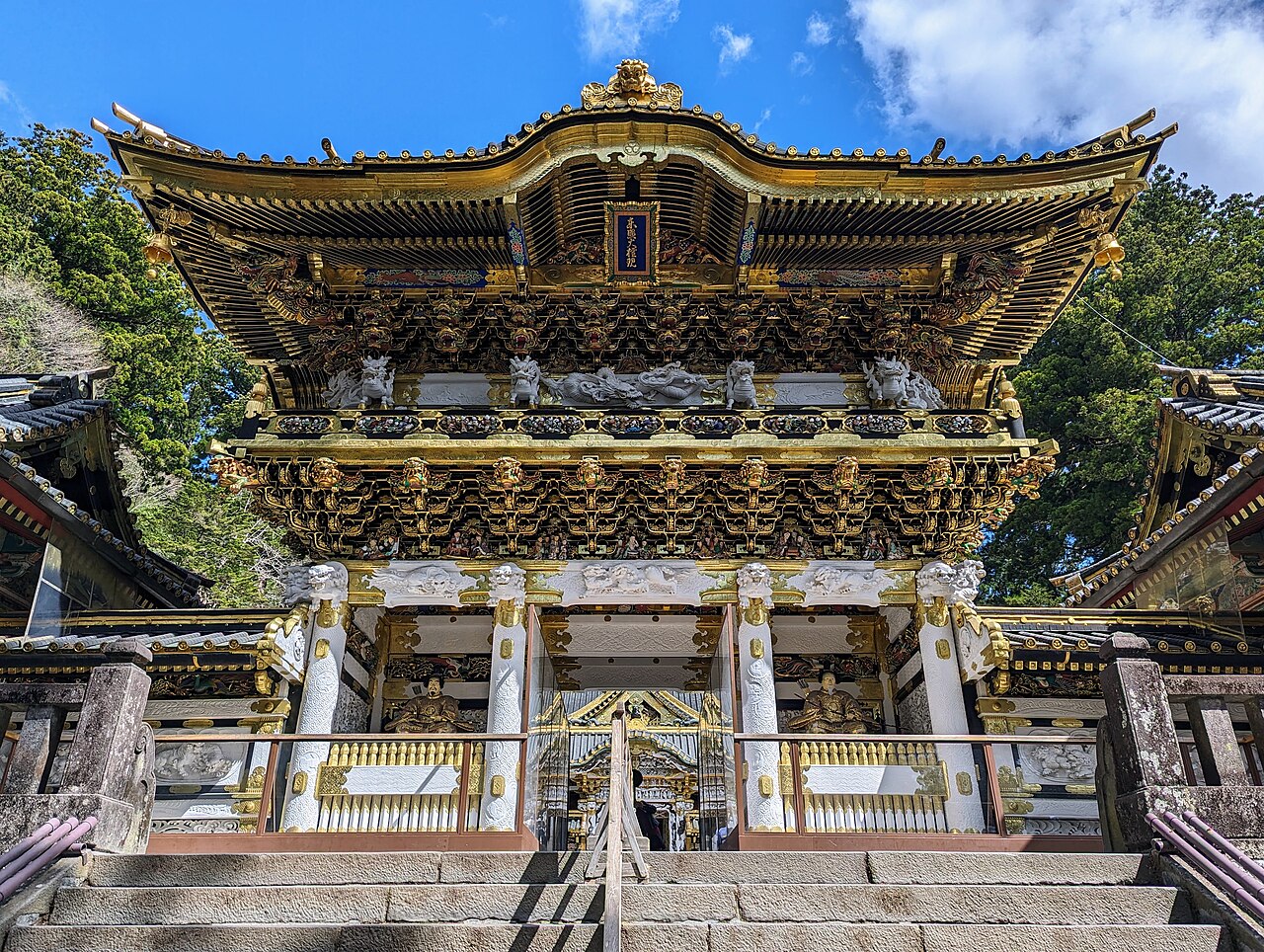
Photo: Jpatokal / Wikimedia Commons · CC BY-SA 4.0. Wikimedia Commons resized version, uncropped.
Gold catches the light above a white carved gate. Dragons, figures and flowers crowd its surfaces; then, just a few steps away, dark cedar trees make the whole scene feel unexpectedly still. In Nikko, extraordinary decoration and the quiet of the forest exist side by side.
Nikko Toshogu is a Shinto shrine in Tochigi Prefecture dedicated to Tokugawa Ieyasu, the founder of the Tokugawa shogunate. Visitors come for its spectacular gate and the famous carvings of three monkeys. Yet its richer story connects the rise of Japan’s Edo-period government to a mountain landscape already sacred long before the Tokugawa family arrived.1
The shogun who became a shrine deity
Tokugawa Ieyasu lived from 1543 to 1616. After decades of conflict between competing warlords, he established the military government that would rule from Edo, now Tokyo, for more than two and a half centuries. Following his death, he was enshrined at Nikko in 1617, giving his memory a permanent religious setting.2
The complex that visitors see today is closely associated with his grandson Tokugawa Iemitsu, the third shogun. He ordered a major rebuilding in the 1630s, transforming the earlier shrine into an elaborate architectural statement. The result honoured Ieyasu but also projected the prestige and stability of the new shogunal order.2
That political history matters. The gold is not simply decoration for decoration’s sake. A visitor arriving from far away would have encountered buildings filled with signs of authority, devotion, craftsmanship and extraordinary expense.
Yomeimon: a gate you could study for hours
The great Yomeimon Gate is one of Nikko Toshogu’s most famous buildings. Its white reliefs, gilded details and complex roof brackets seem to create new patterns every time you change position. Look for small carved figures and imaginative creatures among the ornament rather than trying to take in the whole facade at once.2
Yomeimon belongs to an architecture that uses materials, painting and sculptural detail to communicate status. It is intentionally different from the restrained timber construction often associated with Zen temples or Japanese domestic interiors. Nikko’s carvers and painters did not aim for simplicity: they made an overwhelming work of art.
UNESCO describes the Nikko shrines and temples as masterpieces of architecture and decoration integrated into their forested setting. The World Heritage inscription dates from 1999, and the designation covers not just Toshogu but also Futarasan Shrine and Rinnoji Temple.3
The Three Wise Monkeys are not on Yomeimon
It is easy to think all the famous carvings belong to the main gate, but the Three Wise Monkeys are found on the Sacred Stable, a building associated with the shrine’s horses. They form part of a larger series of reliefs depicting episodes in the life of monkeys.4
One monkey covers its ears, another its mouth, and the third its eyes: hear no evil, speak no evil, see no evil. These figures have become familiar around the world as a shorthand for discretion, morality and the relationship between what we take in and what we pass on.
In the context of the wider carvings, they are more than an isolated slogan. The reliefs tell a life story, suggesting that upbringing and good habits help shape a person. Stand back to see the stable as a whole, then move closer to appreciate how the monkeys have been carved into the building’s decorative band.
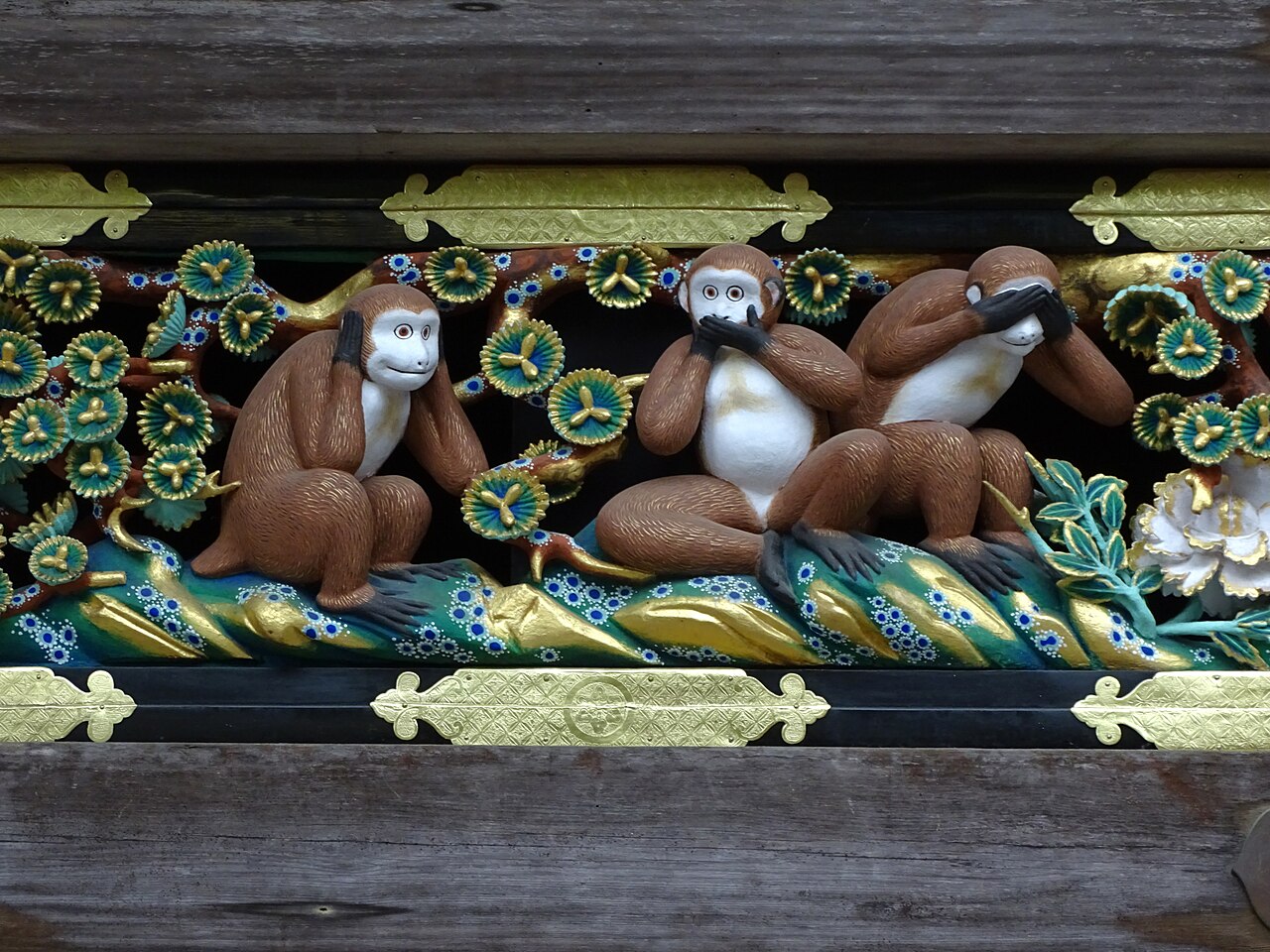
Photo: Adam Jones / Wikimedia Commons · CC BY-SA 2.0. Wikimedia Commons resized version, uncropped.
The Sleeping Cat and the long climb beyond
Another tiny animal has an enormous reputation here: Nemuri-neko, the Sleeping Cat. The carving is set over a passage on the route towards Ieyasu’s inner shrine. In a complex of dramatic creatures and dazzling gateways, the small cat can be surprisingly easy to miss.5
Popular tradition connects the carving to the sculptor Hidari Jingoro, although the attribution is part of the work’s legend rather than an established certainty. The peaceful animal is sometimes interpreted as a symbol of a world where danger has receded. What matters most as a visitor is the contrast: a modest moment of rest amid the theatrical decoration.4
From here, the route continues up stone steps through the trees to the Okumiya, the inner shrine associated with Ieyasu’s resting place. The change in atmosphere can feel dramatic. The noise of the main precinct fades, and the cedar trunks take over the composition.
Allow extra time if you want to take the full route. The steps can be tiring, especially in wet weather, and the shrine is still a place of worship. Keep entrances clear and respect any areas marked as off-limits.
Hear the dragon, if the hall is open
At the Honjido hall, visitors may encounter the celebrated Naki-ryu, or “Roaring Dragon.” A dragon is painted on the ceiling, and a demonstration of clappers can produce a striking resonant sound beneath its head. It is an architectural effect as well as a memorable ritual experience.4
The details of access and demonstrations depend on the shrine’s current arrangements. Follow staff directions and posted photography restrictions rather than assuming every interior can be photographed. The experience makes a point worth remembering: Nikko’s architecture is not only visual. Its spaces also shape sound.
A shrine inside a much older sacred landscape
Before Toshogu was built, Nikko was already a place of mountain worship. The religious tradition of the area is associated with the eighth-century monk Shodo Shonin and the worship of the local mountains. Toshogu later entered a landscape where Shinto and Buddhist traditions had long been closely connected.3
That is why the UNESCO property is called the Shrines and Temples of Nikko in the plural. The nearby Buddhist temple Rinnoji and Shinto Futarasan-jinja are essential parts of this wider historical world. A first visit does not have to include every building, but knowing they belong together changes how you see the area.6
Begin the walk at Shinkyo Bridge
Near the entrance to the shrine-and-temple district, the red Shinkyo Bridge curves above the Daiya River. It belongs to Futarasan Shrine and is part of the World Heritage property. According to a local founding legend, two sacred snakes formed a crossing so the monk Shodo could reach the other side of the river.7
The tale is not a historical engineering record. It gives the bridge its religious meaning: crossing a river becomes the beginning of a journey into sacred mountains. The scene is particularly beautiful when the bridge’s vermilion colour is framed by green leaves or autumn foliage.
Seeing the bridge from the public roadside is different from paying to cross it. The local tourist office lists a separate ¥300 crossing ticket, so there is no need to purchase that ticket simply to enjoy a view from outside.7
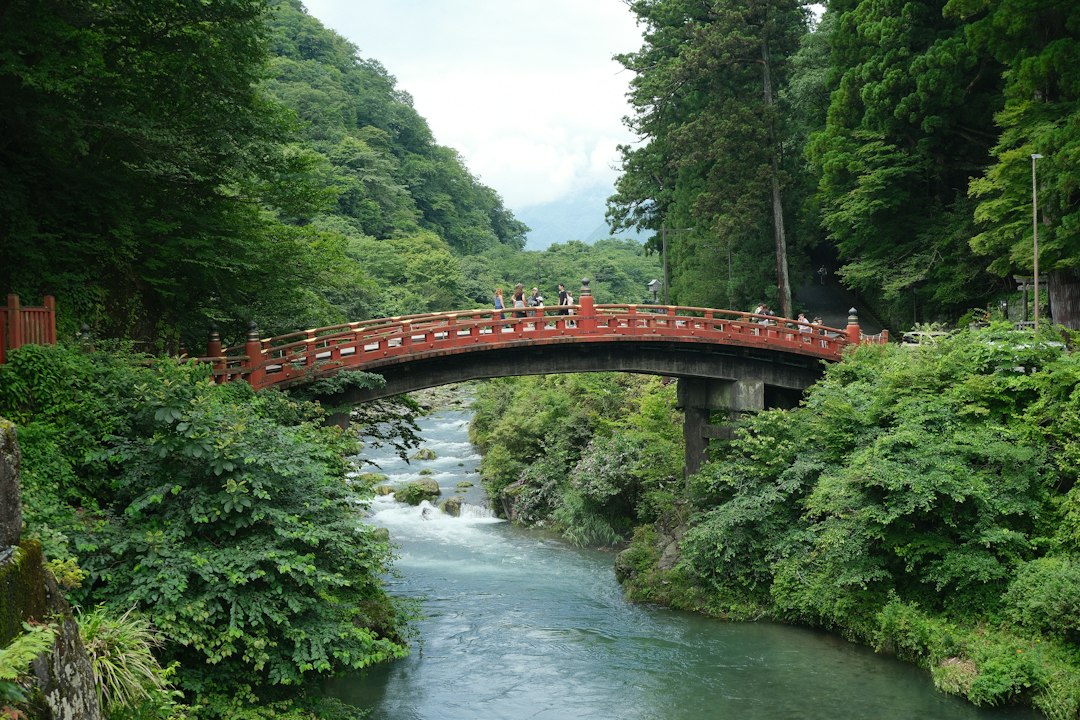
Photo: Roméo A. / Unsplash.
A practical first-visit route
Nikko is possible as a day trip from Tokyo, but a gentle pace makes the experience richer. Allow several hours for the main historic area rather than treating Toshogu as a quick photo stop.
- Arrive at Tobu-Nikko or JR Nikko Station. The stations are close to each other. Take the World Heritage sightseeing bus towards the shrine district; the local tourist office lists about 13 minutes to Omotesando for Toshogu.2
- Begin with Shinkyo Bridge. Appreciate its red shape against the river and wooded slopes, then continue uphill towards the historic precinct.
- Enter Toshogu and study Yomeimon. Take time to look up at the carvings and details rather than walking straight through the gate.
- Find the Three Wise Monkeys. They are on the Sacred Stable, not on Yomeimon. Notice the other panels in the series as well.
- Continue to the Sleeping Cat and Okumiya. If your mobility and time allow, make the climb for a quieter, forested conclusion.
- Add a nearby shrine or temple. Rinnoji or Futarasan Shrine is worth visiting if you have more time; they have their own admission arrangements.
Tickets, opening times and seasonal visits
As of November 2026, Nikko’s official visitor guide lists admission to Toshogu at ¥1,600 for adults and high-school students and the shrine’s own price list gives ¥550 for elementary and junior-high-school students. The standard hours are 9:00 a.m.–5:00 p.m. from April through October and 9:00 a.m.–4:00 p.m. from November through March, with final admission 30 minutes before closing.8
The museum and special visits are not necessarily included in the standard ticket. If you book an online voucher through one of the travel operators named by the tourism office, you must exchange that voucher at the designated station tourist centre rather than expecting it to be accepted directly at the shrine gate.2
The approach is beautiful in all seasons. Summer brings dense greenery, autumn brings bright colour, and winter can reveal the architecture against bare branches and snow. In cold or wet conditions, stone paths and steps may be slippery; choose shoes for walking rather than only for photography.
Questions before visiting Nikko Toshogu
Are the Three Wise Monkeys on Yomeimon Gate?
No. The carving is on the Sacred Stable in the Toshogu precinct. Yomeimon is the exceptionally ornate gate with numerous other figures and decorative motifs.
Is Toshogu the whole Nikko World Heritage Site?
No. The World Heritage property, inscribed in 1999, includes Toshogu, Futarasan Shrine and Rinnoji Temple, together with their historical landscape.3
Do I need a separate ticket for Shinkyo Bridge?
Only if you wish to cross the bridge itself. The local tourism office lists a separate ¥300 crossing fee. You can admire the bridge from public viewpoints without buying a crossing ticket.
How much time should I plan?
Allow roughly two hours to explore Toshogu at a comfortable pace, and half a day or longer if you also want to visit nearby shrines, temples and the river. Actual time depends on crowds and how long you spend examining the details.
Can I take photos inside every building?
No. Rules vary within the complex and some interiors or demonstrations restrict photography. Follow current signs and staff instructions, especially around worship and sacred images.
The small stories inside a grand monument
The most memorable thing about Nikko may not be the glitter of the great gate, even though it is extraordinary. It may be a monkey covering its mouth, a cat curled above a passage or a cedar path where the colour and noise suddenly fade.
Toshogu is a monument to political power, but its details invite quieter attention. Looking closely reveals how the Edo period used architecture, art and the natural landscape to tell a story that continues to reach visitors today.
Sources and further reading
- Nikko Official Guide: Nikko Toshogu Shrine — shrine history and main carvings.
- Nikko Official Guide: Tickets and Access — bus route, ticket types and exchange procedure.
- UNESCO World Heritage Centre: Shrines and Temples of Nikko — UNESCO inscription, architectural and sacred landscape context.
- Nikko Official Guide: Nikko Through the Lens — Three Wise Monkeys, Sleeping Cat and carved details.
- Nikko Official Guide: Sleeping Cat and Mausoleum — route and motifs.
- Nikko Official Guide: Shrines and Temples of Nikko — UNESCO area’s sites.
- Nikko Official Guide: Shinkyo Bridge — sacred legend, setting and crossing fee.
- Nikko Toshogu: Official Visiting Hours and Admission and Nikko Tourism Association: 2026 Admission Information — fees and seasonal hours.
Prices, opening hours and exhibitions may change. Check official sites before visiting.




Comments