Arashiyama Bamboo Grove: The Kyoto Walk Beyond the Photograph
Kyoto’s famous tunnel of bamboo is only the beginning. Follow the path to a Zen garden, a small shrine and the river that gives Arashiyama its sense of place.
7 MIN READ
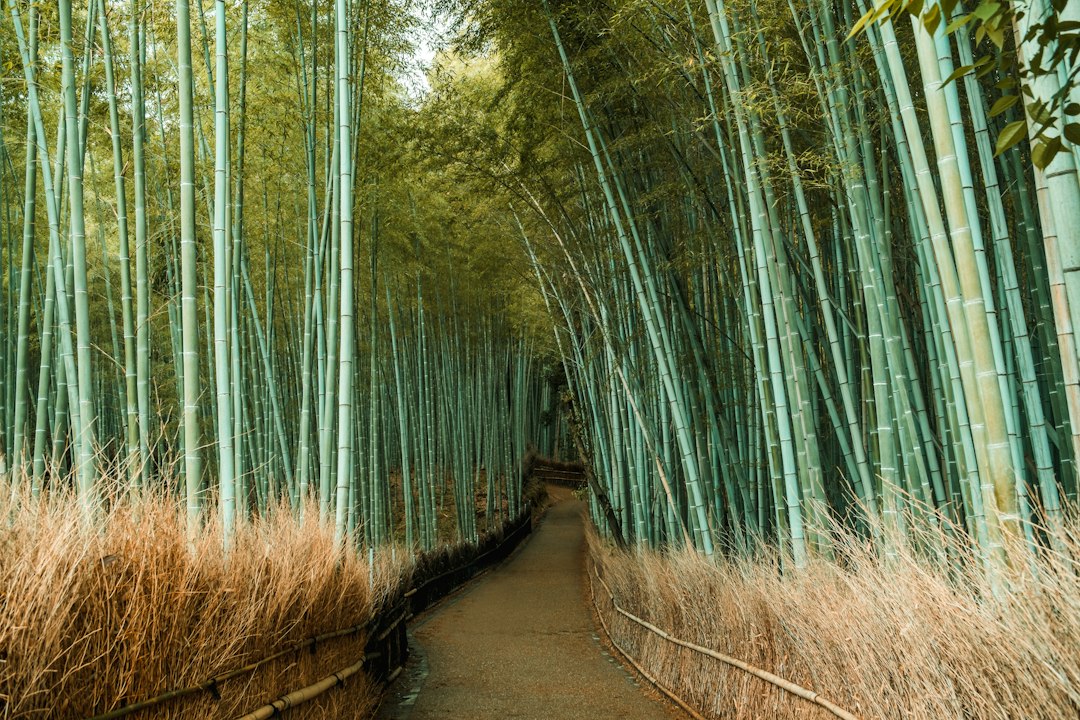
Photo: Adam Dillon / Unsplash.
The bamboo rises like a series of green columns, close enough to make the path feel enclosed. Look upwards, and the scene changes: leaves overlap high above while daylight filters through narrow spaces between the stalks.
This is the scene that draws visitors to Arashiyama Bamboo Grove, also called Sagano Bamboo Forest, on Kyoto’s western side. It is among the city’s most photographed places. Yet the grove is a relatively short walk. The real reward of Arashiyama lies in discovering how the forest connects with a temple, a shrine and a river.1
First, take the bamboo path slowly
There is no need to hurry towards a particular viewpoint. Listen to the leaves, notice the pale joints along each stem, and watch the light shift as people pass through. A cloudy day has a quieter kind of beauty: the colours turn softer and the forest floor is more evenly shaded.
The famous path is a public walkway rather than a ticketed garden. You can walk through without buying a ticket or reserving a time. But quiet is never guaranteed. Kyoto’s tourism office describes Arashiyama as an area that regularly attracts large crowds.2
An early visit may give you a calmer walk, but treat that as a possibility, not a promise. When the path gets busy, keep moving where it narrows and enjoy the scene without waiting for everyone else to disappear from your photograph.
Why the forest belongs to Sagano
Arashiyama is commonly used for the whole visitor area. Sagano names the historic district north of the river. Aristocrats from old Kyoto visited this landscape centuries ago to enjoy its wooded hills, seasonal colours and river journeys.3
That history changes the way to look at the bamboo. Rather than one isolated attraction, it is part of a setting that combines religious sites, mountain views, traditional streets and daily life.
Tenryu-ji: a garden that borrows the mountains
Near the grove stands Tenryu-ji, an important Zen Buddhist temple established in the fourteenth century. Its pond garden offers a wonderful contrast to the upright lines of the bamboo. Instead of looking up, the eye travels outwards across water, rocks and trees.3
The garden uses shakkei, or borrowed scenery: nearby mountains become part of the composition even though they lie beyond its boundaries. Look across the pond and the separation between designed garden and natural landscape becomes less obvious.1
Tenryu-ji is a separate paid attraction with its own hours. As of November 2026, its official website lists garden admission at ¥500 for visitors of high-school age or older and regular garden hours of 8:30 a.m. to 5 p.m. (last admission at 4:50 p.m.). Check the official website for current and seasonal arrangements.4
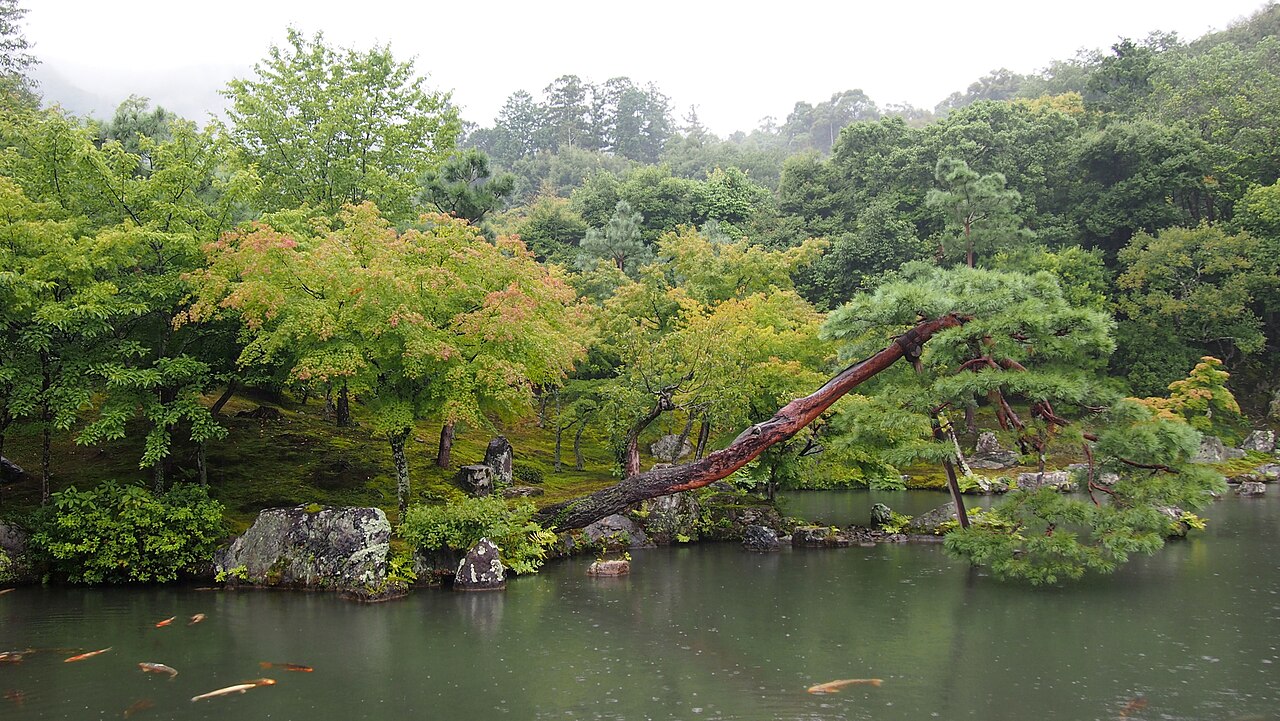
Photo: Andrew Kehoe / Wikimedia Commons · CC BY-SA 3.0. Wikimedia Commons resized version, uncropped.
Nonomiya Shrine: a quiet religious stop
Nonomiya Shrine is tucked close to the bamboo route. It is linked to the custom by which imperial women underwent purification before taking up religious duties at Ise Jingu, one of Japan’s most important Shinto shrines.5
Visit as you would any place of worship. Watch where people pause to pray, leave space around them and follow the shrine’s signs regarding photography. A few thoughtful minutes can tell you more than a hurried picture.
Togetsukyo Bridge: where the view opens
As you approach Togetsukyo Bridge, the setting changes completely. The narrow green corridor gives way to open sky, moving water and a broad sweep of wooded hills. The bridge spans roughly 155 metres across the river and is one of Arashiyama’s best-known landmarks.6
The name means Moon Crossing Bridge. Japan’s official tourism guide recounts a story in which Emperor Kameyama watched the moon and remarked that it seemed to cross the bridge. Whether you arrive in bright daylight or soft evening light, the name invites you to notice the landscape as much as the bridge itself.1
The river’s name also changes along its course: it is called the Oi in the upper reaches, the Hozu in the middle and the Katsura further downstream. Those layers of local geography are easy to miss when all attention is on the best-known view.1
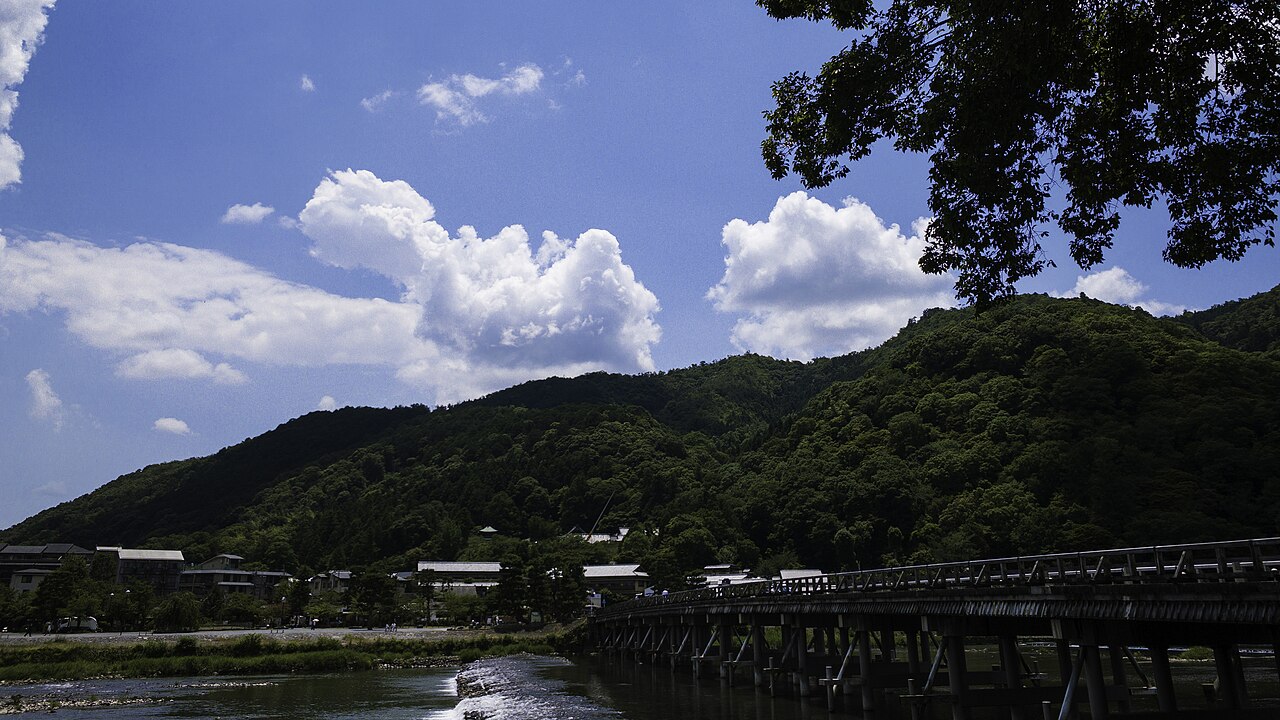
Photo: Rakuten0708 / Wikimedia Commons · CC BY-SA 4.0. Wikimedia Commons resized version, uncropped.
A simple Arashiyama walking route
For a first visit, a few connected places are more rewarding than a long checklist.
- Arrive by train. JR Saga-Arashiyama, Randen Arashiyama and Hankyu Arashiyama stations serve the area. The bamboo grove is about a ten-minute walk from JR Saga-Arashiyama Station.5
- Enter the bamboo grove. Slow down to notice the sounds and patterns of the forest, and share the route considerately with others.
- Choose a cultural stop. Explore Tenryu-ji’s Zen garden or pause at Nonomiya Shrine, according to your interests and available time.
- Walk down towards Togetsukyo. Finish with the broad river view and leave some time for the surrounding streets.
Allow half a day if you want to linger over a garden visit, a meal and a walk by the water. Japan’s official tourism organisation recommends a leisurely half or full day for the wider Arashiyama area.1
Questions before you go
Is the Arashiyama Bamboo Grove free?
Yes, the public bamboo path is free to walk through. Nearby gardens and temples may charge entrance fees. Check each site’s own conditions before your visit.
When is the best time to visit?
Early morning generally offers a better chance of walking with fewer people, though it cannot guarantee an empty path. Daylight is best for experiencing the colour and details of the bamboo.
Are the bamboo grove and Tenryu-ji the same place?
No. The grove is a public walkway, while Tenryu-ji is a temple with its own grounds and admission arrangements. They are neighbours, making them easy to enjoy together.5
The view is bigger than the photograph
The bamboo corridor may be the picture that first brings you to Arashiyama. Try to leave with more than that one image: the reflection on a Zen garden pond, a shrine tucked beside the forest and a bridge that opens the view towards the mountains.
Together, they show something essential about Kyoto. Its beauty does not belong only to famous monuments. It lives in the connections between spaces.
Sources and further reading
- Japan National Tourism Organization: Arashiyama — landscape, bridge, garden and visiting advice.
- Kyoto City Official Travel Guide: Saga & Arashiyama — local context and crowd conditions.
- Japan National Tourism Organization: Sagano & Arashiyama — heritage and Tenryu-ji.
- Tenryu-ji official admission and access page — hours and fees, checked November 2026.
- Japan National Tourism Organization: Arashiyama Bamboo Grove — access and Nonomiya Shrine.
- Japan National Tourism Organization: Togetsukyo Bridge — the bridge and its setting.
Travel details can change. Check current local and transport information when planning a visit.



Comments