Performing Arts · Takarazuka, Part Two · 12 minute read
Behind the Feathers: The Making of a Takarazuka Star
The dazzling feathers, the grand staircase, the perfect gestures. Behind Takarazuka’s extraordinary beauty lies a world of discipline, ambition, and difficult questions about the price of perfection.
LAYERS OF JAPAN
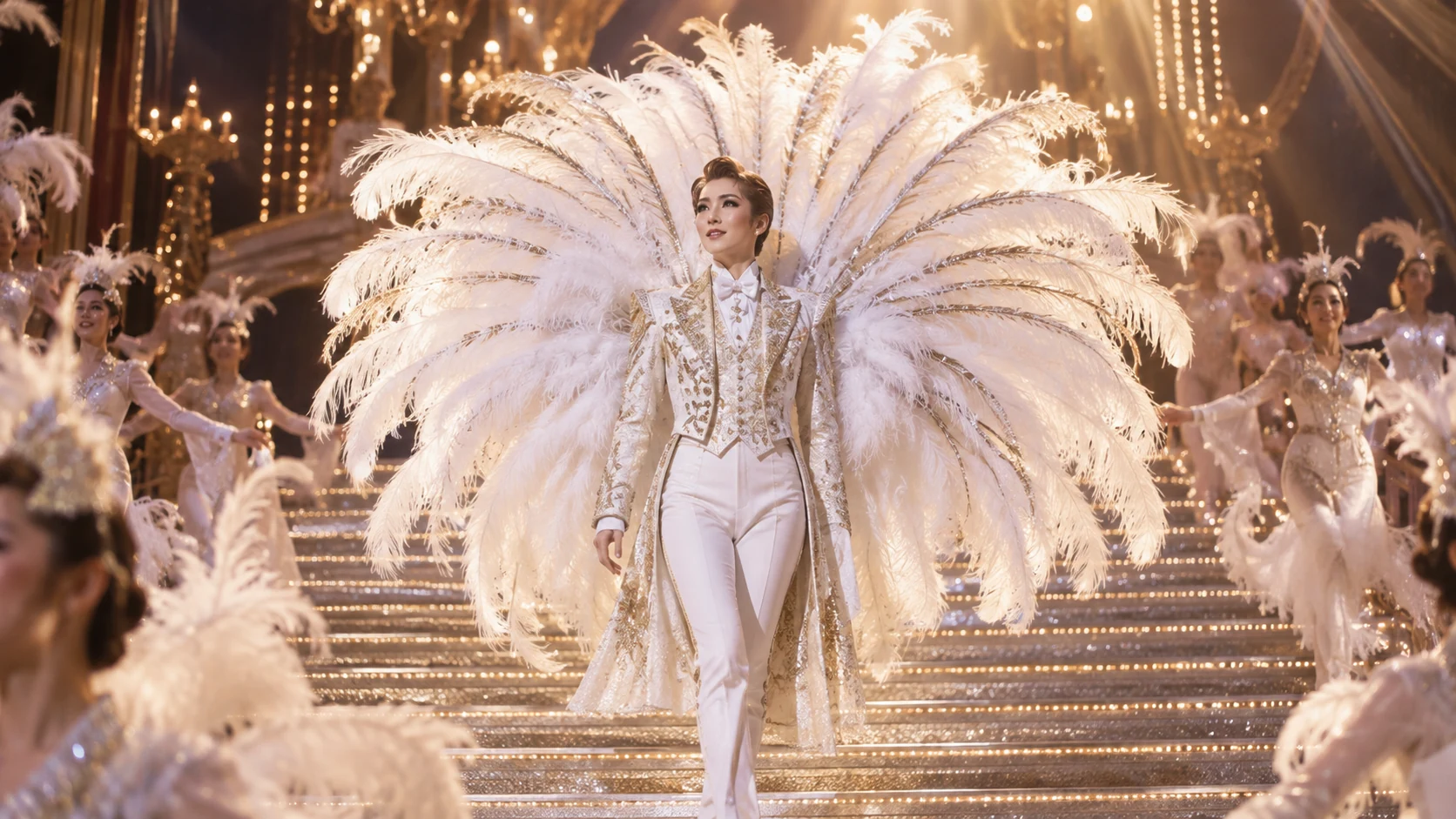
There is a moment in a Takarazuka performance when everything seems to become more beautiful than reality.
The music swells.
The lights illuminate a grand staircase.
And then, at the height of the finale, a star appears wearing an enormous arrangement of feathers that rises behind her like a pair of magnificent wings.
She begins to descend.
The costume glitters. The audience watches. Every step seems effortless.
For those unfamiliar with Japan’s Takarazuka Revue, the spectacle may seem almost impossible to believe.
But the most extraordinary thing about this moment is not the size of the feathers, the brilliance of the lights, or even the precision of the performance.
It is the years of work that have brought a human being to that staircase.
The audience sees the beauty. It rarely sees everything required to create it.
And that is where another story of Takarazuka begins.
1. A Dream That Begins with an Almost Impossible Entrance
Long before anyone becomes a Takarazuka star, she must first enter the Takarazuka Music School.
Located in Hyogo Prefecture, the school is the exclusive route into the Takarazuka Revue, Japan’s celebrated all-female musical theater company.
For generations of young women, admission has represented the first step toward a cherished dream.
But getting in is difficult.
In the entrance examinations for the school’s 114th class in March 2026, 422 applicants competed for 40 places.
That meant roughly one successful candidate for every ten applicants.
The competition was less intense than in many earlier years, and the number of applicants was the lowest since 2000. Even so, admission remained highly selective.
Applicants are assessed through interviews, singing, and dance examinations, with attention given to their potential as future performers.
They may arrive with years of ballet training, music lessons, or experience in other forms of performance.
They may have imagined themselves standing beneath the theater lights since childhood.
Yet passing the entrance examination does not make anyone a star.
It merely opens the door to the training that follows.
The dream, it turns out, has only just begun.
2. Two Years in Which Everything Is a Lesson
Takarazuka Music School has a two-year program.
The first year is the preparatory course. The second is the final course.
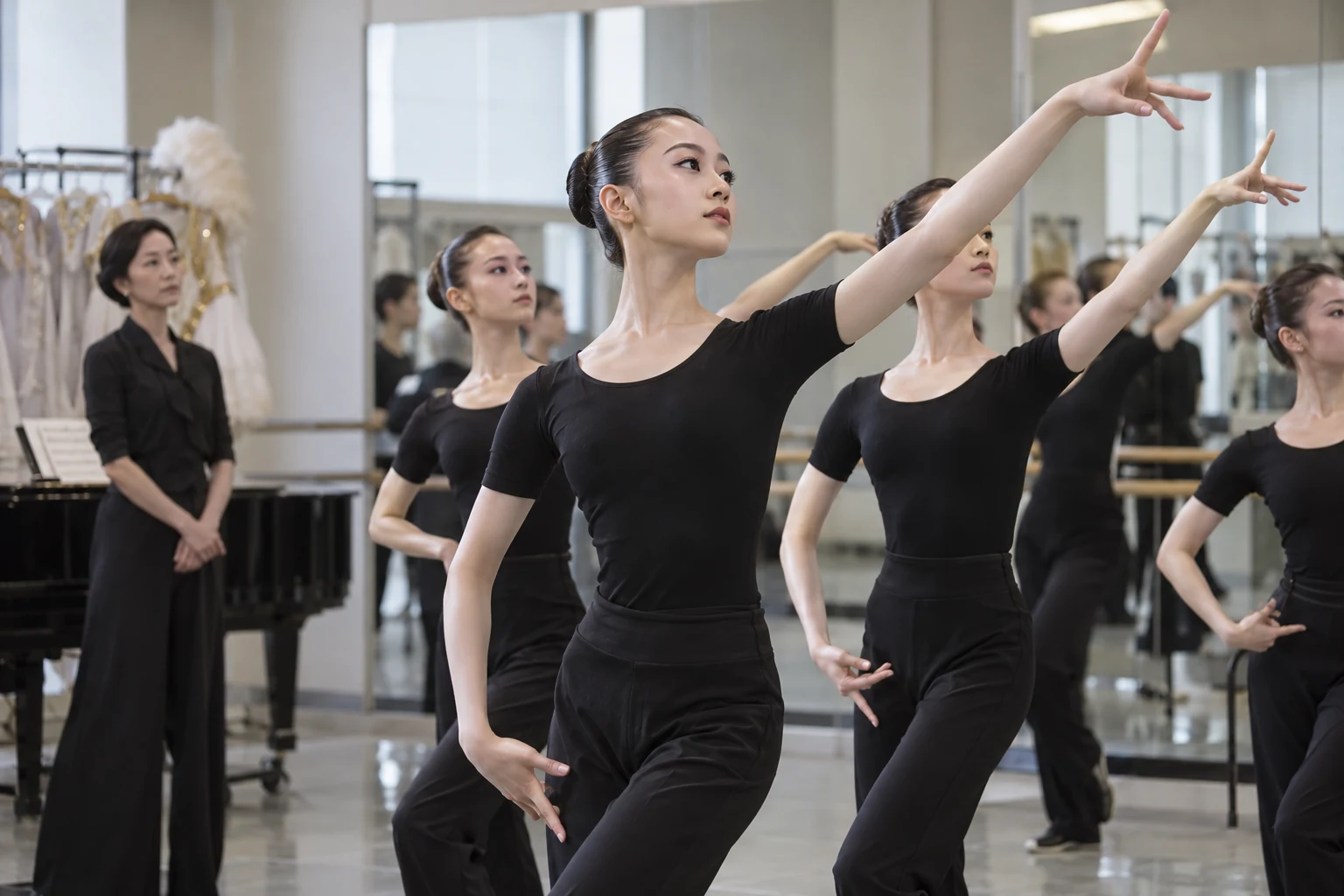
According to the school’s published curriculum, students study singing, acting, ballet, modern dance, tap dance, classical Japanese dance, piano, and other musical disciplines.
The range is remarkable.
A student must develop her voice while training her body.
She must understand dramatic expression while learning the precision of dance.
She must acquire skills associated with Western musical theater while also studying traditional Japanese performance.
This education is not simply about learning individual techniques.
Takarazuka depends on collective precision.
A single performer may captivate the audience, but the world around her must be equally convincing.
A line of dancers must move together.
A romantic duet requires two performers to understand the rhythm and intention of one another.
A grand finale depends on many individuals contributing to a unified image.
From the audience, the result appears natural.
Yet naturalness is often the final achievement of countless repetitions.
The steps must be practiced until they can be performed without visible hesitation.
The gestures must become expressive without seeming exaggerated.
And a performer must learn to communicate emotion while remaining aware of everyone sharing the stage.
What appears effortless is often the result of extraordinary effort.
3. The Discipline Behind the Beauty
For decades, Takarazuka Music School was famous not only for its demanding artistic education but also for its strict codes of conduct.
Respect for senior students, formal manners, and careful attention to behavior formed part of its institutional culture.
Some former customs would seem astonishing to international readers.
Junior students were once expected to follow unwritten rules such as bowing toward passing Hankyu trains because a senior might be aboard, limiting certain replies to seniors, and observing prescribed forms of greeting and behavior.
These customs were not ordinary requirements of professional theatrical training.
They reflected a hierarchical student culture that had developed over time.
Importantly, several such rules were abolished in 2020 as the school responded to changing social expectations and concerns about harassment.
It would therefore be misleading to describe those historical practices as if they were all still enforced today.
Yet their existence raises an enduring question.
Where does useful discipline end, and where does unnecessary obedience begin?
In theater, discipline has an obvious artistic purpose.
Performers must respect one another’s timing, prepare carefully, and develop the stamina and concentration required for demanding productions.
But discipline and unquestioning submission are not the same thing.
A rehearsal can be rigorous without being humiliating.
A student can learn respect without losing the ability to speak.
And a beautiful performance does not, by itself, justify every practice used in its preparation.
Understanding Takarazuka requires recognizing both the value of artistic commitment and the importance of those distinctions.
4. Learning to Become an Otokoyaku
After graduating from the music school, performers enter the professional world of the Takarazuka Revue.
There, their artistry continues to develop.
Some specialize as otokoyaku, performers of male roles. Others specialize as musumeyaku, performers of female roles.
For an otokoyaku, the challenge is especially fascinating.
She is not simply copying the behavior of men.
She is developing a theatrical language of masculinity.
A slightly lowered voice.
A particular way of standing.
The controlled movement of a hand.
The angle of a shoulder.
The pause before turning toward a partner.
These small choices can create an extraordinary impression.
An audience may see a romantic hero, a charismatic leader, or an impossibly elegant figure who seems to belong to another world.
Yet that presence is not created in a single lesson.
It evolves through experience, through the roles a performer receives, through observation, experimentation, and years of practice.
The same is true of the musumeyaku.
Her grace and femininity are artistic creations that require technical skill, physical control, and expressive intelligence.
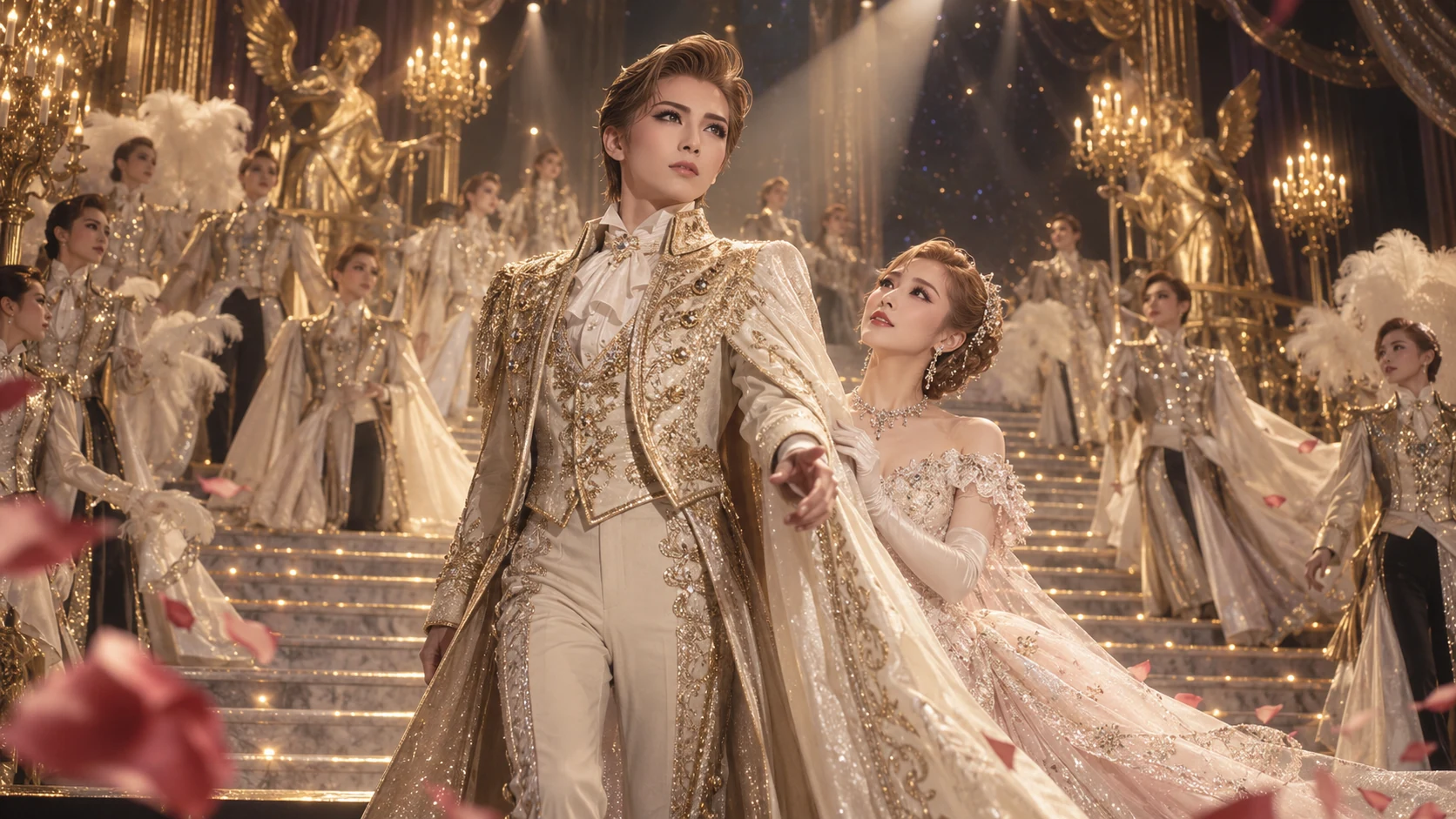
When the two perform together, the effect can be deeply moving.
And when a performer finally discovers a stage presence that feels unmistakably her own, audiences may witness something very special.
The emergence of a star.
5. The Feathers: More Than a Beautiful Costume
Now we return to the image that began our story.
The staircase.
The music.
The dazzling feathers.
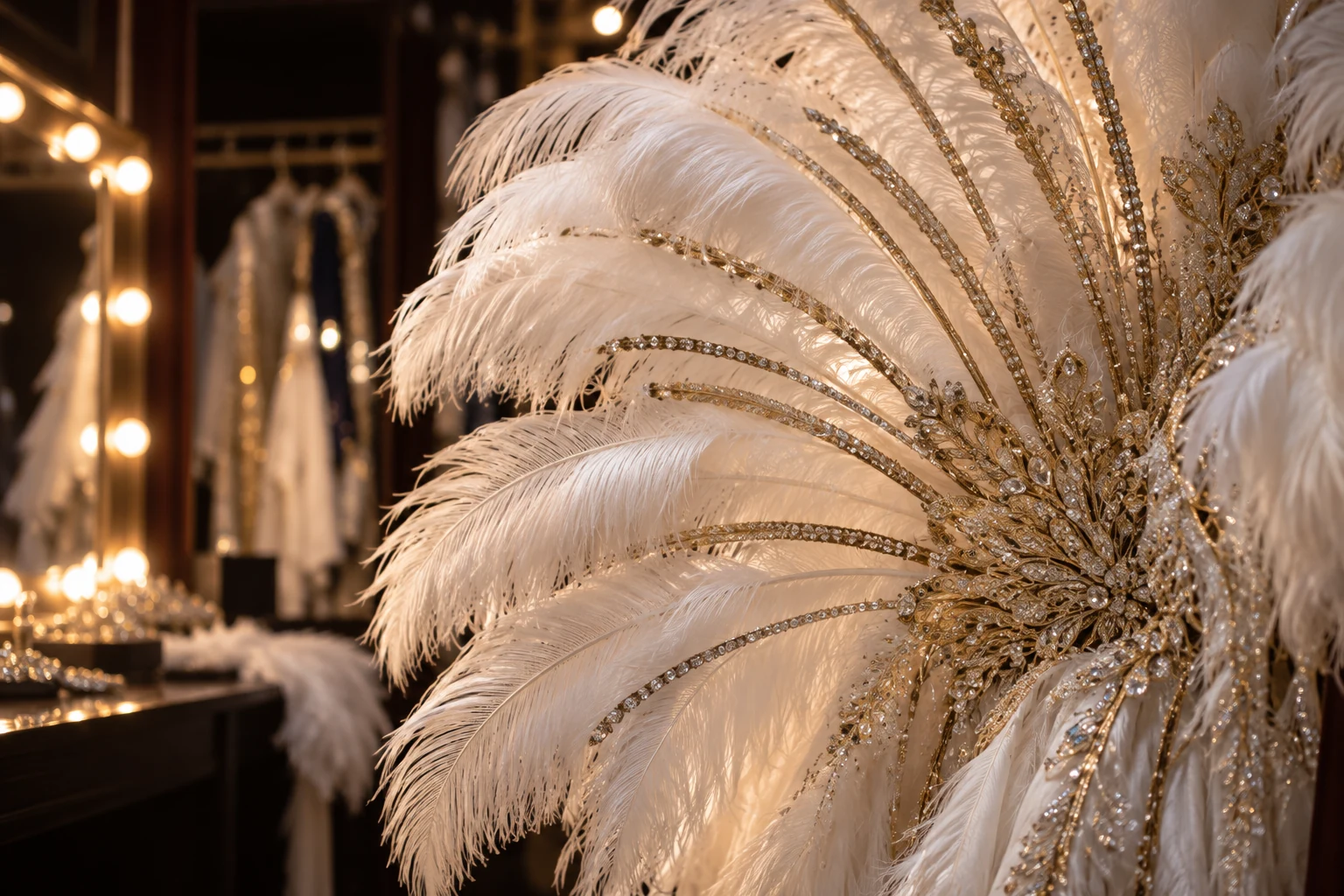
In Japanese, the elaborate feathered backpiece worn by a leading performer is often called an ōbane, meaning a large feather adornment.
It is among the most recognizable visual symbols of Takarazuka.
During a traditional revue finale, performers may appear in an elaborate parade before a leading star descends the grand staircase wearing magnificent feathers.
Takarazuka’s official descriptions of its finales emphasize this scene as a distinctive highlight of the Revue.
But why does it feel so powerful?
Part of the answer is visual.
The feathers enlarge the silhouette, transforming an individual performer into an almost monumental presence.
Their shape catches the light.
Their movement adds softness and grandeur.
The staircase provides height and anticipation.
Together, costume and architecture create an image of theatrical triumph.
But the feathers also carry meaning beyond their appearance.
They are associated with prominence, achievement, and the hierarchy of the stage, even though designs vary between productions.
For audiences who have followed a performer’s career, seeing her descend in such a costume can be especially emotional.
It may bring to mind the earlier years, smaller roles, and gradual development that preceded that moment.
What appears onstage as a magnificent ornament may represent years of aspiration.
And the performer wearing it is still a person.
Beneath the glittering costume is someone who once entered a classroom as a student.
Someone who learned, failed, practiced, and tried again.
Someone whose art was shaped over time.
The feathers make the star appear larger than life. But the achievement beneath them is profoundly human.
6. The Grand Staircase and the Moment of Arrival
The grand staircase has become inseparable from Takarazuka’s identity.
During the finale, it transforms the descent of performers into a ceremony of recognition.
Music, choreography, lighting, costumes, and the order of appearance work together to create anticipation.
The audience knows that a culminating moment is approaching.
And when the leading star appears, the image can seem to contain an entire career within a few seconds.
For some spectators, the effect is exhilarating.
For others, it can be surprisingly tender.
Because a star does not arrive at the top of the staircase all at once.
Her journey may have involved years of ensemble performances, demanding rehearsals, unfamiliar roles, setbacks, and gradual artistic discoveries.
The staircase reveals none of this directly.
It shows the finished image.
That is the paradox of theatrical beauty.
The more complete the illusion, the less visible the labor that sustains it.
And yet the audience may feel the presence of that labor without being able to see it.
Perhaps that is one reason the feathers can be so moving.
They are not simply a decoration.
They are the visible climax of an invisible journey.
7. The Human Cost of Perfection
It would be easy to end the story here.
To say that talent, discipline, and sacrifice produce extraordinary beauty.
But doing so would leave out an essential part of Takarazuka’s recent history.
In September 2023, a 25-year-old member of the Takarazuka Revue died.
Her death brought allegations of harassment, excessive workloads, and harmful working conditions into public view.
In March 2024, the company acknowledged harassment identified by the performer’s family, apologized, and reached an agreement with them.
The case became a major moment of reckoning for the institution.
It also made an important distinction impossible to ignore.
Artistic excellence and harmful treatment are not the same thing.
The allegations and subsequent acknowledgment concerned the professional troupe. They should not be confused with the Takarazuka Music School’s separate institutional history or its 2020 changes to student rules.
Nevertheless, both histories prompt questions about hierarchy, responsibility, and the culture surrounding performance.
How can an institution preserve its remarkable artistic standards while protecting the people who make those standards possible?
What happens when an expectation of endurance makes it difficult to ask for help?
And how can young performers develop confidence and individuality within a system that places such importance on collective discipline?
These are not questions unique to Takarazuka.
They exist in ballet companies, orchestras, professional sports, and many other environments where young people pursue excellence.
But the beauty of Takarazuka’s performances makes the contrast especially striking.
The world onstage appears perfect.
The people creating it remain vulnerable.
8. Can Tradition Change Without Losing Its Beauty?
The Takarazuka Revue and its parent organizations have announced reforms in response to the problems brought to light.
Those efforts have included reviewing performance schedules and organizational structures, strengthening harassment-prevention measures, and improving systems related to working conditions.
The Revue also underwent corporate restructuring in 2025.
Such changes are significant, but the announcement of a reform is not proof that every problem has been resolved.
The real test lies in how the reforms affect daily life for performers and staff.
For people who love Takarazuka, this can be an uncomfortable conversation.
It is possible to admire the theater’s extraordinary artistry while questioning practices that may have caused harm.
It is possible to value tradition while recognizing that some traditions should change.
And it is possible to believe in discipline without accepting cruelty as the price of achievement.
Indeed, perhaps this distinction is essential to the future of the Revue.
A performer who feels safe enough to learn, explore, and grow may find new possibilities in her art.
A culture of respect need not diminish standards.
It may help sustain them.
The challenge is not to make Takarazuka less beautiful.
It is to ensure that the pursuit of beauty does not come at the expense of the people creating it.
9. What the Audience Cannot See
When a Takarazuka performance begins, the audience enters a carefully constructed world.
The dancers move in formation.
The costumes shimmer.
The otokoyaku appears effortlessly commanding.
The musumeyaku responds with extraordinary grace.
And finally, the great feathers appear.
For a moment, everything seems complete.
But the stage can never show us the whole story.
It cannot reveal every hour spent in practice.
It cannot communicate every disappointment or moment of determination.
It cannot tell us everything about the individuals behind the roles.
And it cannot, simply by being beautiful, assure us that those individuals have always been treated well.
To admire a performance deeply is not to ignore those realities.
Perhaps it is to care more about them.
Because once we understand how much human effort lies behind a moment of beauty, the people responsible for creating it matter even more.
Their wellbeing should not be a secondary consideration.
It should be part of how we understand artistic excellence itself.
10. The Weight of the Feathers
Imagine the finale once more.
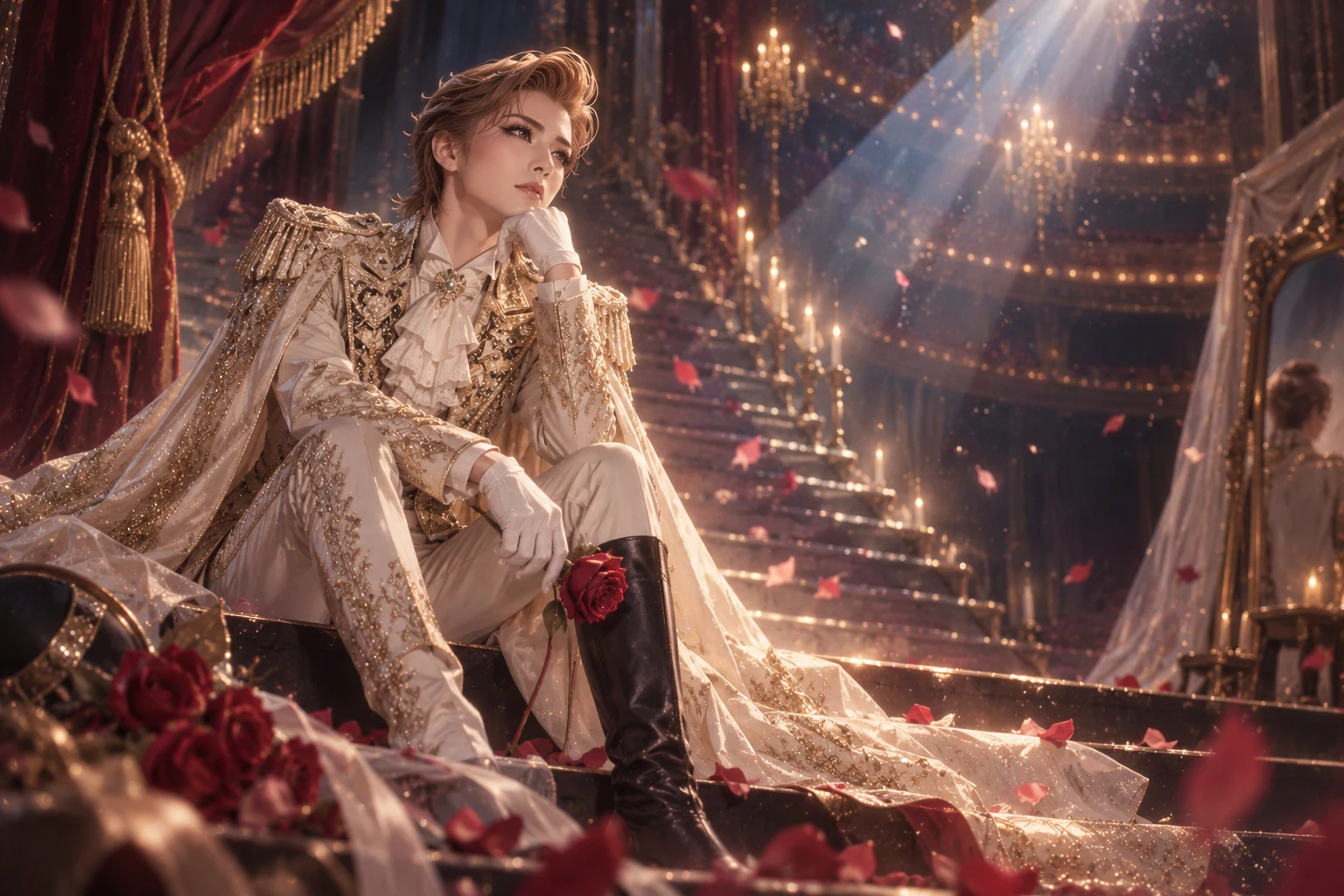
A performer stands at the top of the staircase.
Behind her, the feathers spread outward in a brilliant display of white, gold, or color.
The orchestra reaches its crescendo.
And she begins to descend.
From the audience, the feathers may seem almost weightless.
They float in the light, turning a human figure into something larger, grander, almost dreamlike.
Yet the image contains a lifetime of possibilities.
The child who dreamed of the theater.
The student who earned a place at the music school.
The performer who trained and learned and developed her craft.
The colleagues who helped create the performance.
The many people, both onstage and behind the scenes, who made the moment possible.
And the responsibility of the institution to care for them.
Perhaps this is the truest meaning we can find in Takarazuka’s feathers.
They are beautiful because of what we see.
But they become more meaningful when we remember what we cannot see.
The dream is extraordinary.
The effort behind it is real.
And the people who create it deserve more than admiration.
They deserve respect, dignity, and the freedom to pursue excellence without fear.
Behind every feather is a human story.
And the future of Takarazuka’s beauty depends not only on how brightly its stars shine, but also on how carefully they are allowed to grow.
Continue exploring Takarazuka
Read the first part of our Takarazuka series: The Unreachable Beauty of Takarazuka’s Otokoyaku.





Comments