Performing Arts · The Human Side of Tradition
Kyogen: Japan’s Comedy of Everyday Trouble
A forbidden container, an awkward excuse, a servant with ideas of his own. Japan’s classical comic stage begins with familiar weaknesses.
5 MIN READ · PERFORMING ARTS
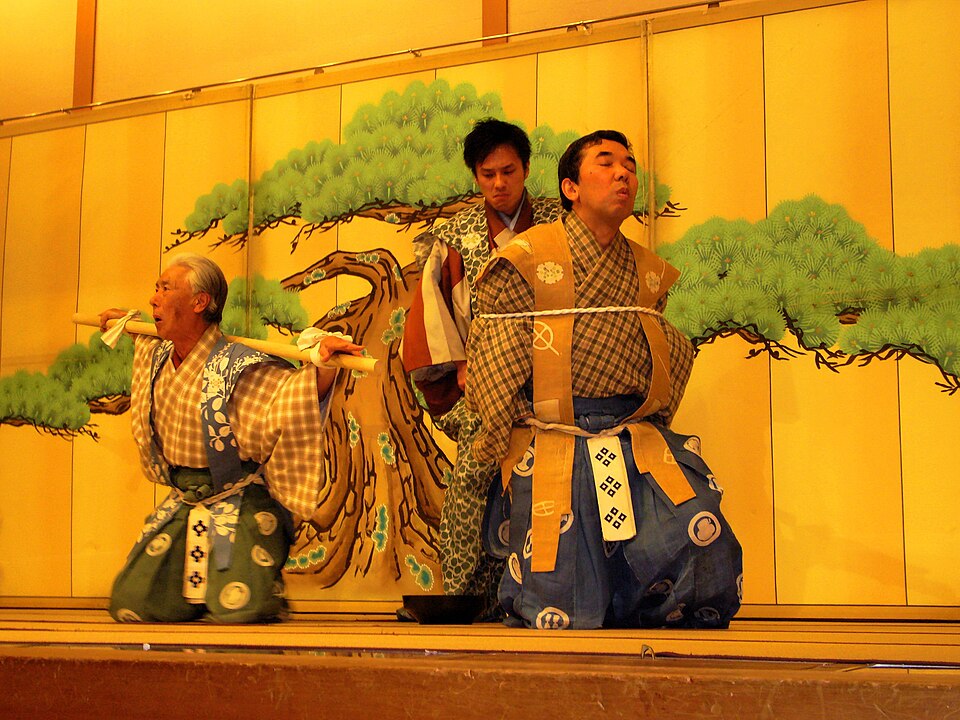
Photo: lienyuan lee / Wikimedia Commons / CC BY 3.0. Resized to 960 pixels wide; original composition retained.
Two servants are told to guard a container—and, whatever they do, never look inside.
That is the opening problem in Busu, one of kyogen’s best-known plays. Their master says the contents are dangerously poisonous. His warning makes the servants nervous, but it also makes them curious. A simple instruction begins to unravel.[3]
You do not need an elaborate knowledge of court life to recognize the situation. The temptation to investigate something forbidden is a useful way into a theatrical tradition that makes human shortcomings its material.
Another voice on the same stage
Kyogen (狂言) and Noh together form nohgaku. They share a long history and a stage, while giving audiences different kinds of stories. Noh builds its drama through chant, instrumental music and dance, often bringing spirits or ghosts into view. Kyogen puts conversation and the actions of ordinary people at the center.[1]
Music and dance can also be part of kyogen. Its comedy comes through recognizable character types, exaggerated gestures and the frictions of daily life. A traditional stage can hold an argument, a mistake or an attempt to get away with something as readily as a solemn encounter with a spirit.[1]
The servant has something to say
A recurring figure is Tarōkaja, a servant who appears across many plays. His low position does not prevent him from answering a master with ingenuity or a stubborn argument. He can also be tricked, or let his fondness for sake spoil a plan. The character changes with the story.[2]
That gives the audience more to watch than a contest between a clever person and a foolish one. Notice whose confidence lasts, whose instructions survive contact with reality, and who has to explain the result.
Begin with the forbidden container
The Nagoya-based company Kyogen Kyodosha lists Busu as a play of about 25 minutes. Its synopsis emphasizes the servants’ growing interest in the contents while their master is away. The company also traces related stories through older collections, with earlier versions using a monk and young novices.[3]
For a first viewing, knowing the setup is enough. Watch the gap between what the characters have been told and what they want to do. The hesitation, negotiation and gathering courage are part of the pleasure; the plot summary cannot supply the performers’ timing.
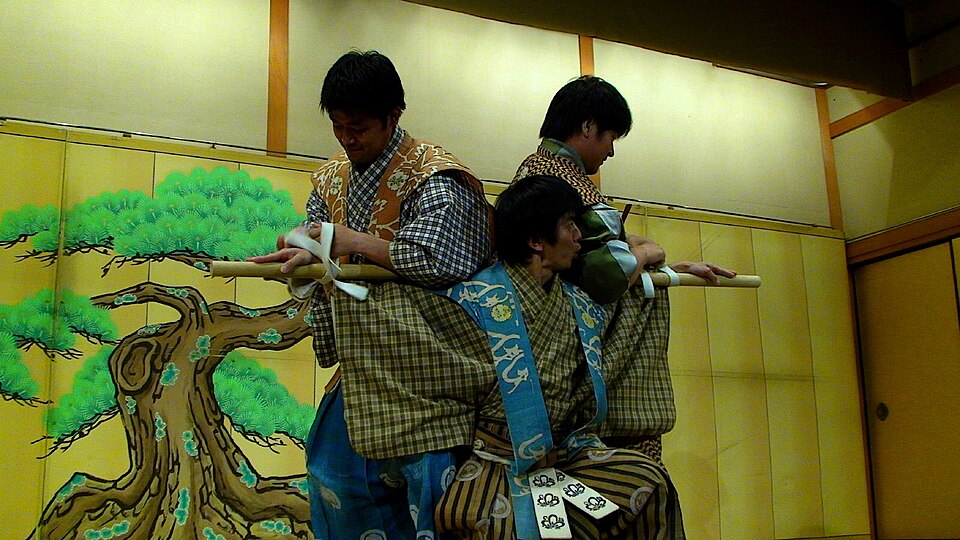
Photo: CH L / Wikimedia Commons / CC BY 2.0. Resized to 960 pixels wide; original composition retained.
The body can carry the joke
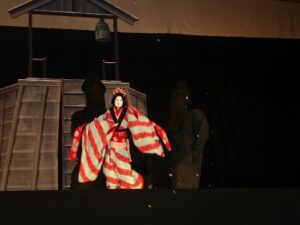
Another good entry point is Bōshibari, usually translated as Tied to a Staff. Gion Corner describes it as the story of two servants who manage to get drunk and cause trouble during their lord’s absence, despite his precautions. It is the kyogen piece featured in the venue’s traditional arts program.[4]
Look at the staff and outstretched arms in the photograph. Before hearing any dialogue, you can see a practical obstacle. Watching the performers work within that obstacle is already a way of following the scene.
Kyogen’s movement has a trained foundation: a steady torso, a sliding walk and set gestures for actions such as drinking, crying or rowing. The Nohgaku Performers’ Association describes familiar movements enlarged for the stage, often accompanied by expressive sounds. Delivery and timing give those patterns life.[2]
Try watching one exchange closely: an instruction, a pause, then a response. Give the actors time to reveal what each character thinks they can get away with.
Faces—and the masks that do appear
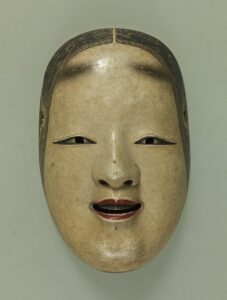
Most kyogen roles are performed without masks. Masks are used for characters such as gods, demons, animals and spirits, so an unmasked performance is no less traditional. The smiling object below belongs to the same theatrical world as the visible faces on stage.[2]
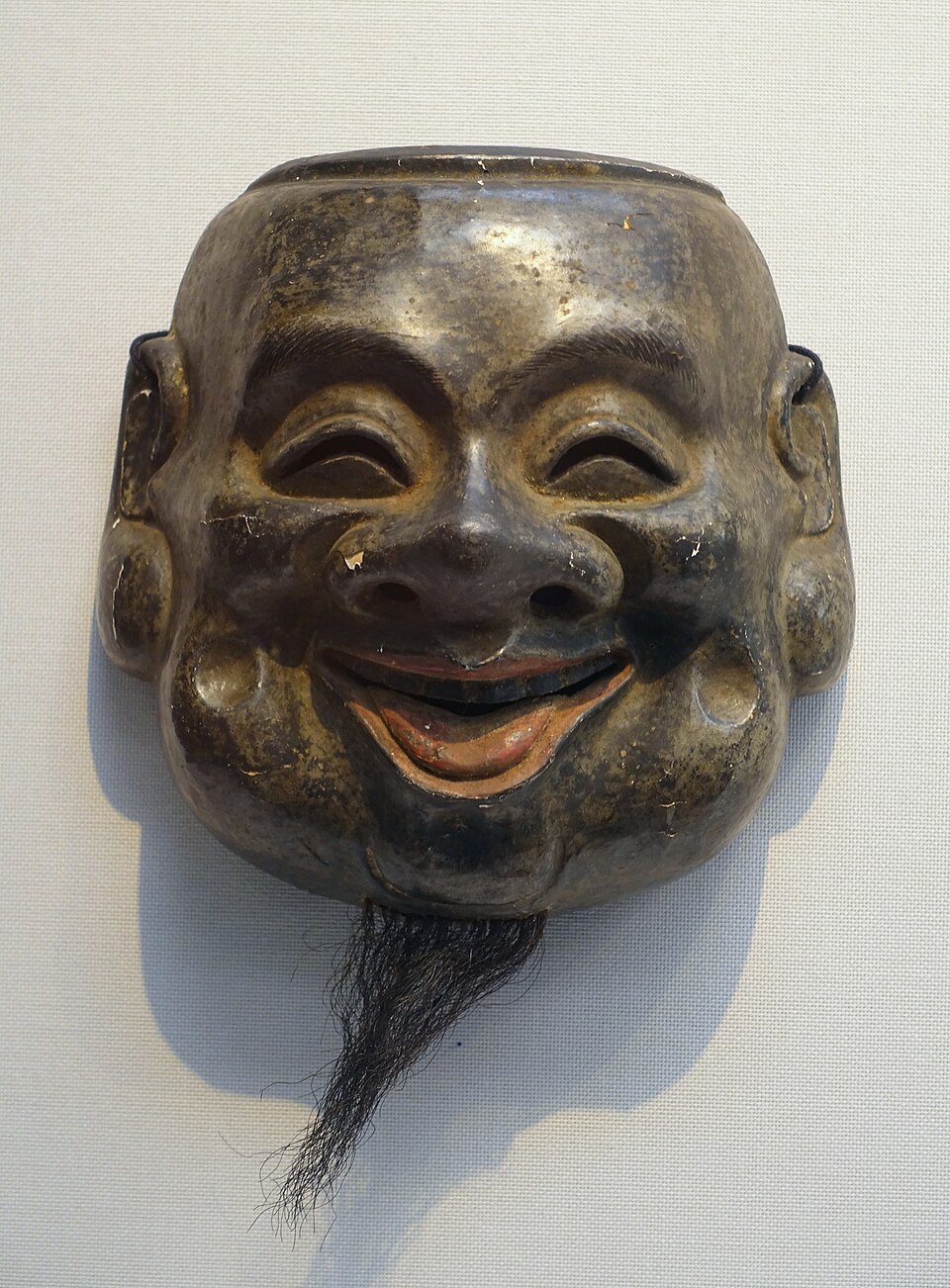
Photo: Daderot / Wikimedia Commons / CC0 1.0. Resized to 960 pixels wide; original composition retained.
A first performance, with room to laugh
Kyogen uses classical Japanese, and wordplay may need explanation. Reading a short synopsis beforehand helps you follow the relationships and stakes. You can then look up from the translation to catch a face, a gesture or a reaction.[5]
For a full Nohgaku program, start with the National Noh Theatre’s English listings in Tokyo. The theatre presents Noh and kyogen and publishes individual program information. Check the particular performance before booking.[6]
Japan Arts Council’s visitor guide describes English subtitle monitors for National Noh Theatre-produced performances. Check the listing for language support, especially for independently organized events. The same guide makes a welcoming point: laughing during kyogen is part of the experience.[5]
In Kyoto, Gion Corner includes kyogen within a mixed program of traditional arts. This offers a different introduction from an evening devoted to Noh and kyogen. Confirm the current program and any translation options directly with the venue.[4]
Follow the theatre’s photography and recording rules. The archival photographs here are licensed images, not permission to photograph a performance yourself.
What may stay with you is a small, recognizable moment: someone certain of their authority, someone else finding a way around it, and the instant an excuse stops being convincing. That is a lively place to begin looking at Japan’s classical stage.
Sources & further reading
- Japan Arts Council — Introduction to Noh and Kyogen
- The Nohgaku Performers’ Association — Introduction to Kyōgen
- Kyogen Kyodosha — Busu synopsis (Japanese)
- Gion Corner — Kyogen and the traditional arts program
- Japan Cultural Expo / Japan Arts Council — A beginner’s guide to Noh and Kyogen
- Japan Arts Council — National Noh Theatre and current programs
The stage photographs are archival views of Gion Corner; they are not presented as scenes from Busu. Program details and language support should be checked with each venue. Individual image credits and licenses appear above.






Comments