Japanese Fandom · Making & Sharing
At Comiket, Fans Become Creators
A first printed book, a game handed to a new player, a reader who comes back: the personal exchanges behind Japan’s vast fan gathering.
ANIME & FANDOM · 5 MIN READ
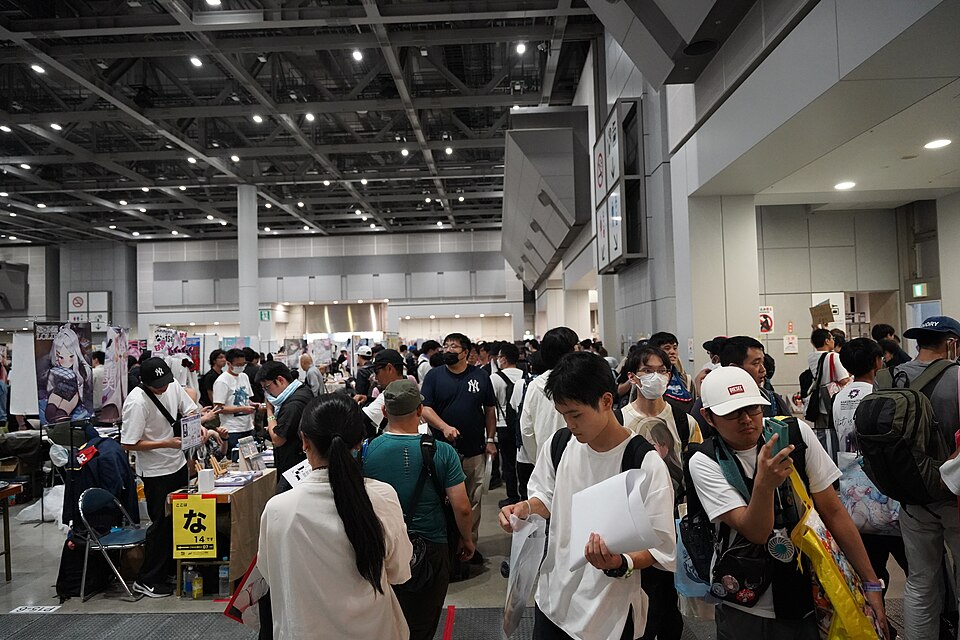
Photo: Benlisquare, via Wikimedia Commons · CC BY-SA 4.0. Reduced resolution; full composition retained. This photograph remains under CC BY-SA 4.0.
To understand Comiket, start with one of the tables.
In the photograph above, books and displays line an aisle at Tokyo Big Sight. The crowd is the first thing to catch the eye. Looking closer shifts attention to a smaller exchange: a table, something someone has made, and another person pausing to look.
Comic Market, usually shortened to Comiket, brings self-published work into a shared physical space. Its scale can make it seem difficult to approach. Two creators’ published memories offer a more personal way in: what it felt like to finish something, put it in front of other people, and find a reason to make the next one.
A few words to help you read the room
The Comic Market Committee’s historical introduction places self-expression at the centre of the event. It describes doujinshi as publications made by individuals or groups, with roots extending into literary and artistic circles.
| Term | What it means here |
|---|---|
| Doujinshi | Self-published books or magazines. The word describes a way of publishing; it does not, by itself, tell you the subject. |
| Circle | The person or group participating as a creator and distributing their work. |
| Doujin games | Independently made games within this wider creative culture. ZUN’s early Touhou games provide one example below. |
Keep that breadth in mind as you explore. A familiar character on a cover may draw your attention, while a completely original project can invite you into an unfamiliar world.
Everyone has a part in making the event
In its statement of ideals, the committee describes a space where amateurs and professionals can distribute creative work. It also sets out an unusually clear view of the people who gather there: “Everybody is a participant at Comiket.”
Creators, general visitors, cosplayers, company exhibitors and staff each help the event exist. These roles can change from one occasion to another. Someone browsing today may return with work of their own.
The statement emphasises direct responses from readers and the inspiration creators find in one another. That gives the small table a wider meaning: it is a place where making something and finding someone interested in it can happen face to face.
The first book can be gloriously imperfect
In a 2019 pixivision interview, manga creator Onoderasan recalled preparing his first doujinshi after entering university. Friends who made books had helped spark his interest.
He planned a 32-page publication, allowing two weeks for storyboards and two for inking. The plan unravelled. The finished book had 20 pages, combining new material with earlier comics. Some images originally posted online had too little resolution for print.
Holding his own book still excited him, even as turning its pages exposed mistakes. His account makes the process tangible: page counts, deadlines, file quality, and the surprise of seeing work become a physical object.
The interview is labelled PR and includes a printer promotion. His account of that first attempt also shows how learning can remain visible in a finished object.
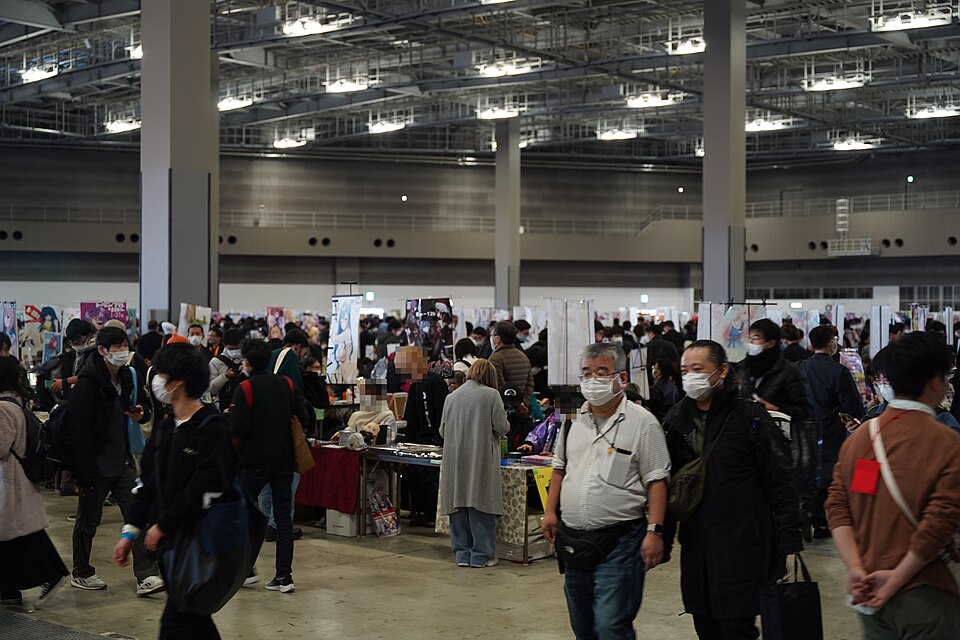
Photo: Benlisquare, via Wikimedia Commons · CC BY-SA 4.0. Reduced resolution; full composition and the photographer’s original face blurring retained. This photograph remains under CC BY-SA 4.0.
The reader who comes back
Game creator ZUN described a different beginning in Touhou Garakuta Magazine’s published interview. His first Comiket visit, in August 1997, was already as a participating circle. He brought the first two Touhou games.
He recalled being surprised when all his copies sold quickly. At the following winter event, people returned, said they had enjoyed the earlier game, and bought the new one. He described making another, and then another.
This memory is striking because the response is so specific: someone played something he made and came back. Read alongside Onoderasan’s account, it suggests two different rewards of creating: the satisfaction of giving an idea a finished form, and the encouragement of discovering an audience.
These are individual experiences. Their appeal lies in the detail, and in the different ways each creator found a reason to continue.
Approach it with a small curiosity
For a first visit, choose something you would genuinely like to discover. It might be an illustrator you already follow, a game you want to try, or a subject you would enjoy reading about. Give yourself a manageable starting point before opening a map of the whole venue.
The official beginner guide asks visitors to think about what they want to do and prepare in advance. It explains that admission arrangements can vary between editions, as can the halls and layouts in use.

Photo: 先従隗始, via Wikimedia Commons · CC0 1.0. Reduced resolution; full composition retained. This photograph remains under CC0 1.0.
Make room for the person behind the work
- Plan for your particular edition. Start with the official visitor information. Check entry requirements, the relevant catalogue and the event layout; an old travel article may describe a different arrangement.
- Prepare for the season. The organiser’s beginner guide highlights heat and cold as practical considerations. Leave yourself enough energy to enjoy the work you came to see.
- Keep an exchange comfortable. If a table is busy, make your question brief and leave space for others. A simple thank-you is a perfectly good beginning.
- Ask before photographing a person. The committee’s personal photography guidance calls for advance consent when someone is identifiable, including an explanation of your purpose and intended use. Permission to publish also matters. Follow staff directions and local restrictions.
You can take an interest without needing to become an expert immediately. Notice a cover, ask about a work when there is time, or remember a circle you would like to look up later.
For an overseas reader, that offers a rewarding way to approach this part of Japanese fandom: pay attention to what people choose to make, and to the care involved in sharing it. A book on a table is also an invitation to spend time with somebody’s interests.
Sources & image credits
- Comic Market Committee: What is Comic Market? (PDF) — historical background and self-publishing terminology; not used for current admission rules.
- Comic Market Committee: ideals and vision — participant roles, creative exchange and the short quotation above.
- pixivision: Onoderasan’s first doujinshi — published interview, labelled PR; recollections paraphrased here.
- Touhou Garakuta Magazine: ZUN’s first Comiket — the creator’s recollections of selling games and meeting returning players.
- Comic Market Committee: beginner guide, visitor information and personal photography guidance.
This article draws on published interviews and organiser materials; it is not an account of an on-site visit or interviews conducted by LAYERS OF JAPAN. The photographs show the event and venue, not the named interviewees. Each photograph’s source and licence appear in its caption.









Comments