Anime Pilgrimage · Toyosato, Shiga
K-On! in Toyosato: The School Beyond the Screen
Visit a familiar white school building in Shiga—and discover the local history and everyday uses that keep it alive.
ANIME & FANDOM · 5 MIN READ
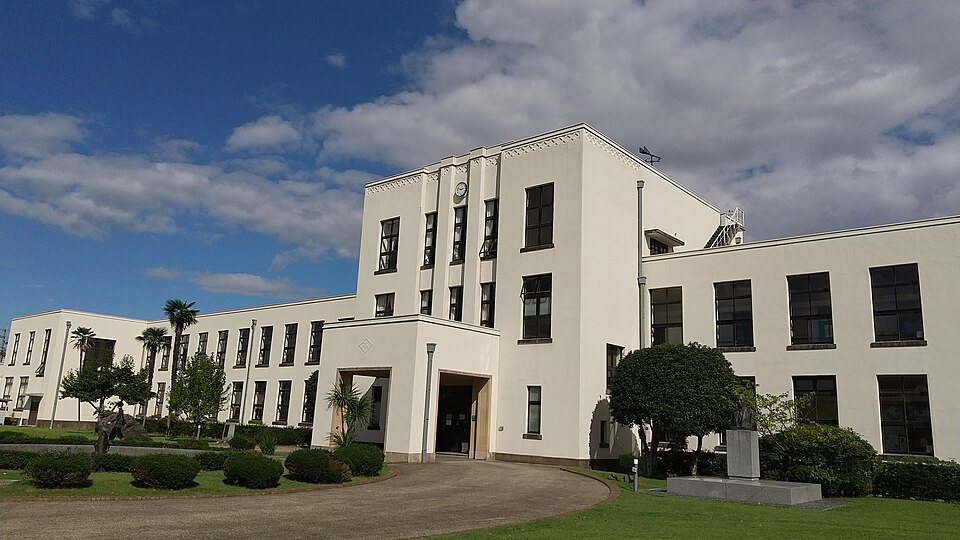
Photo: Suikotei, 4 September 2022, via Wikimedia Commons · CC BY-SA 4.0. Resized and JPEG-compressed for this article; no cropping or retouching by LAYERS OF JAPAN.
A familiar school can hold memories of a place you have never attended.
A white school building can carry more than one set of memories. To a K-On! fan, the former Toyosato Elementary School in Shiga is a recognisable destination associated with the anime’s school setting. Shiga’s official tourism guide introduces that connection as a reason to visit. [1]
But this is also a building with a much longer story: a gift to a community, an ambitious piece of school architecture and a place that has found uses beyond its original classrooms.
The most rewarding visit gives those stories room beside the anime. Come for the familiar silhouette, then look at what made the real building worth preserving.
A school before it became a pilgrimage
The school buildings and auditorium were completed in 1937, designed by William Merrell Vories and funded through the contribution of local benefactor Tetsujiro Furukawa. [2], [3] Those names belong to the place as surely as the characters that later drew visitors to it.
The official building history records a new school building in 2004, work to adapt the old complex beginning in 2008 and completion of that refurbishment in 2009. The historic buildings were registered as tangible cultural properties in 2013. [2]
That timeline changes the way you might photograph the facade. Instead of looking only for resemblance, look at the long wings, the rhythm of the windows and the prominence of the entrance. Imagine the ordinary school mornings that gave those spaces a purpose long before they became familiar on a screen.
Look at the whole group of buildings
Start outside, where you can take in the relationship between the main block, open grounds and neighbouring buildings. The auditorium is part of the original history, not simply an extra backdrop. [2] Its quieter exterior is worth a pause even if you cannot go inside.
Once you enter the areas open for visitors, let the architecture guide your attention. The way a doorway frames a view, the proportions of a corridor and the change from daylight to shade can be more memorable than a hurried sequence of scene comparisons.
Shiga’s visitor guide notes that special guided tours can include spaces beyond the ordinary visiting areas. [1] If a particular room matters to you, ask what is accessible rather than assuming every door is part of the sightseeing route.
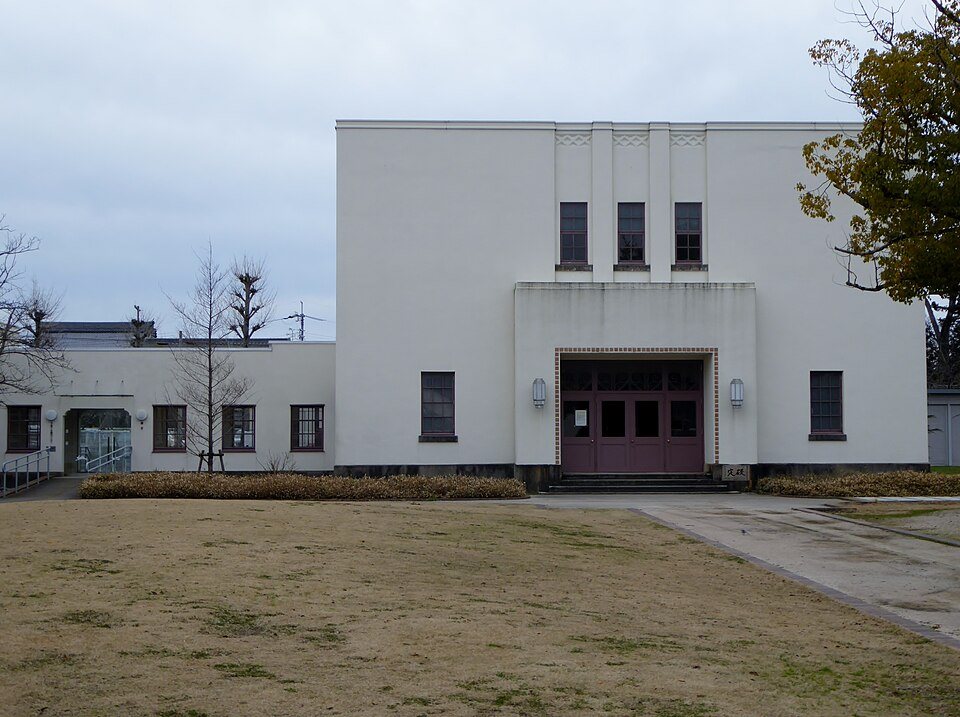
Photo: Tokumeigakarinoaoshima, 28 January 2015, via Wikimedia Commons · CC BY-SA 4.0. Resized and JPEG-compressed for this article; no cropping or retouching by LAYERS OF JAPAN.
A building that still belongs to the town
The local tourism association describes the old school complex as a community facility that includes a town library and a child-rearing support centre. [3] That is a useful detail to keep in mind while exploring: visitors and local users are sharing the place.
Move quietly, leave passageways open and follow the signs for the areas you may enter. Ask before photographing a staffed room, a display or someone using the facilities. A welcoming building stays welcoming when its ordinary activities can continue.
Rooms are also available for organised uses through a separate application process. [5] A casual visit does not amount to permission to reserve a space, arrange a performance or set up a large photo shoot. If you are planning something beyond a walk around, contact the tourism association in advance.
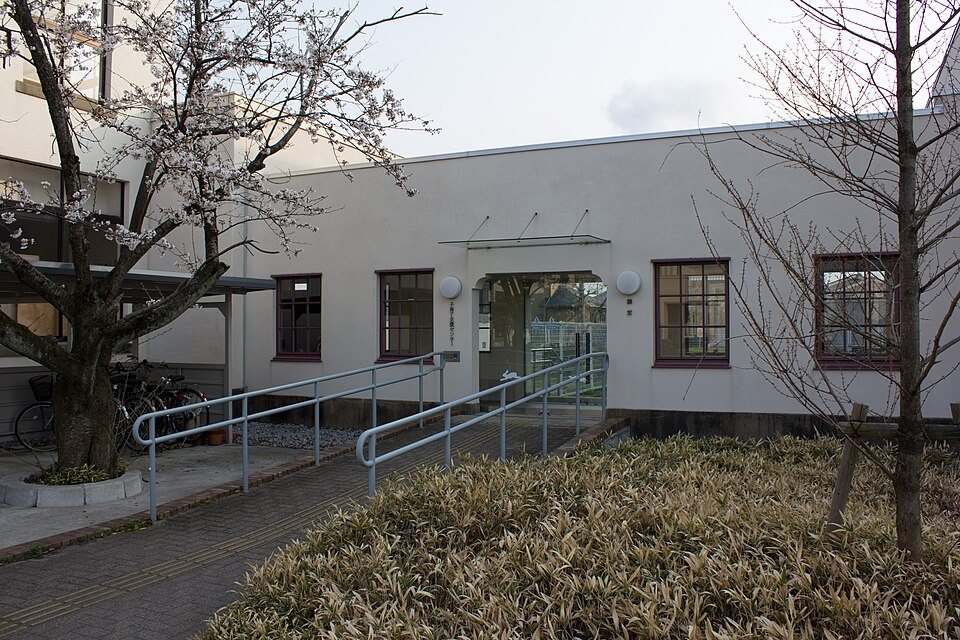
Photo: Thibaut120094, 5 April 2014, via Wikimedia Commons · CC BY 4.0. Resized and JPEG-compressed for this article; no cropping or retouching by LAYERS OF JAPAN.
Check the opening day before the train
The current local visitor listing gives 10 a.m.–5 p.m. opening hours. The complex is closed on Mondays; when Monday is a public holiday, the closure moves to the following Tuesday. It also closes over the year-end and New Year period. [3]
The opening time changed to 10 a.m. in April 2026. [4] This matters if you are using an older travel article or saved itinerary that suggests arriving earlier. Check the tourism association’s current information and any notices before leaving.
Plan around what is actually open on the day rather than around photographs of a past event. If you have limited time in Shiga, an open building with a relaxed hour to explore is more useful than an ambitious itinerary that reaches a locked door.
The last part of the journey is a local one
The former school is approximately 10 minutes on foot from Toyosato Station on the Ohmi Railway. [3] From the Kyoto direction, the tourism association describes travelling by JR to Hikone and changing to the Ohmi Railway for Toyosato. [6]
Check the actual connections in both directions. A short ride on the local line still depends on the timetable, and leaving a margin means you can enjoy the walk from the station without watching the clock.
A simple visit needs only a few parts: the journey in, time with the buildings, a local break and the journey back. If you want to add more of Toyosato, ask the tourist information desk for a town walking map rather than assuming the school is the whole story.
Take something more than a matching photograph
The recognition is part of the fun: that moment when a fictional place seems to acquire real depth and weather. But the building’s earlier life makes the encounter richer. Windows were placed for real classrooms; an auditorium was made for real gatherings.
A visit to Toyosato can hold both kinds of affection. You can enjoy the connection to K-On! and leave with an interest in the people who built, preserved and continue to use the place.
About the photographs: The photographs were taken in 2014, 2015 and 2022. They show the real school complex; room displays, opening arrangements and surrounding details may have changed. Image credits and reuse terms appear with each photograph.
Sources and useful links
- Shiga Tourism: Toyosato Elementary School and its K-On! connection
- Former Toyosato Elementary School: building history (Japanese)
- Toyosato Tourism Association: current visitor information (Japanese)
- Toyosato Tourism Association: change of opening hours (Japanese)
- Toyosato Tourism Association: room hire and use arrangements (Japanese)
- Toyosato Tourism Association: access (Japanese)
Check current opening information, transport and local notices before travelling.






Comments