Anime & Fandom · 7 minute read
More Than a Fan: What Oshikatsu Means in Japan
The objects are easy to see. The affection behind them is more personal: watching someone grow, finding company, and giving an ordinary day something to look forward to.
LAYERS OF JAPAN
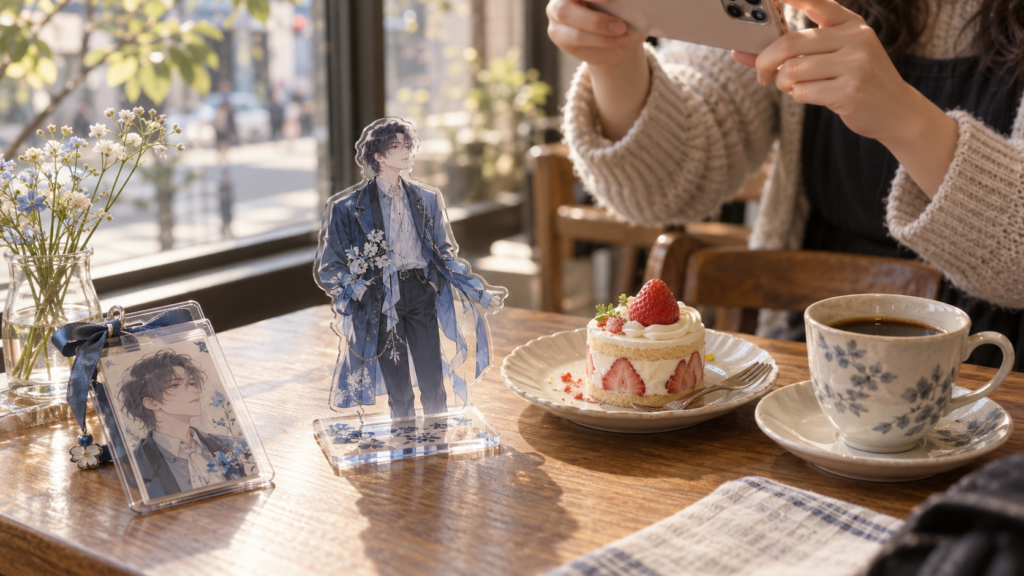
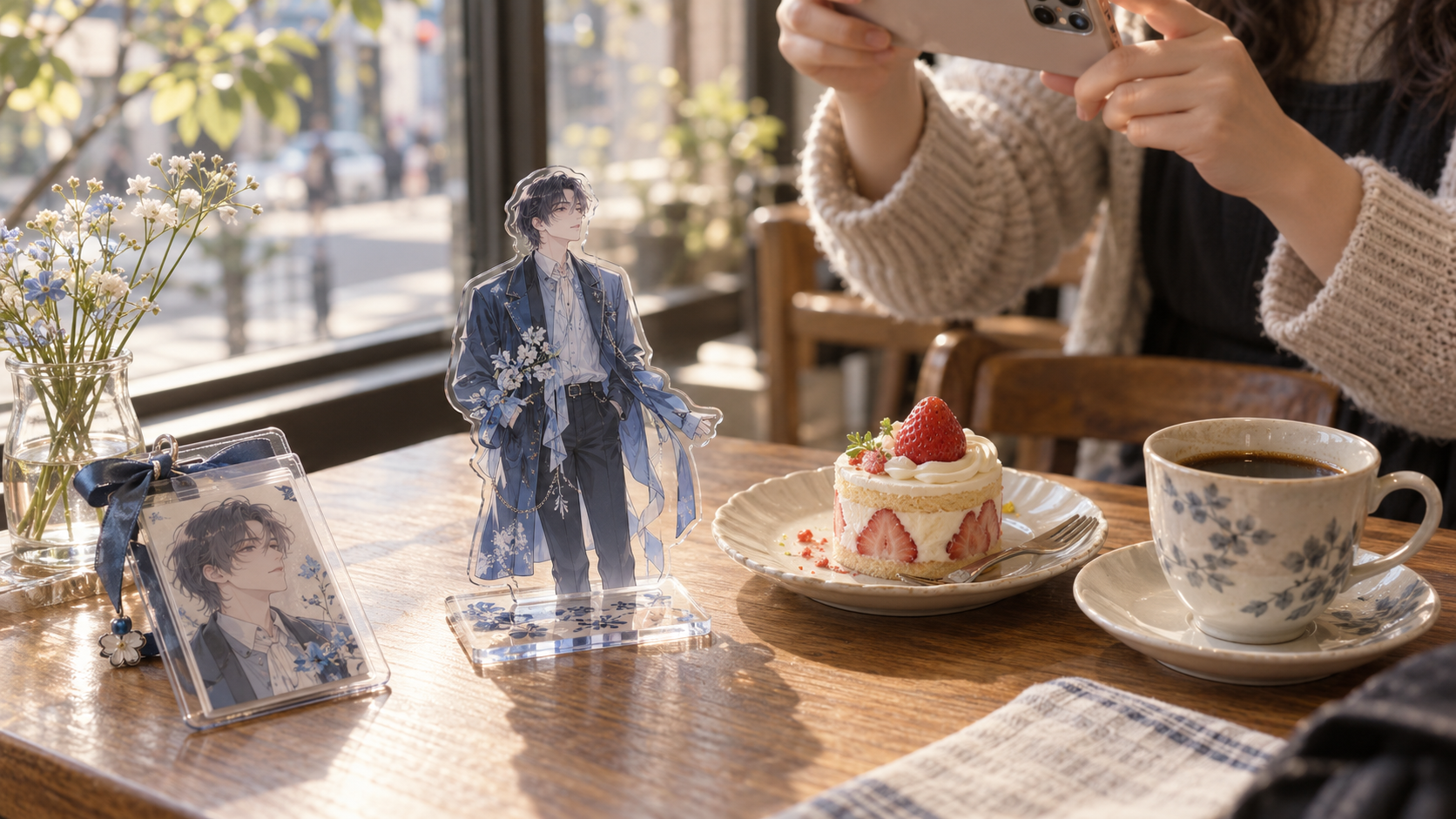
Imagine a café table: a cup of coffee, a small cake, and an acrylic figure carefully placed beside them for a photograph. To someone unfamiliar with the habit, the figure might seem an unexpected dining companion. To the person taking the picture, it could make an ordinary afternoon feel connected to something they love.
This imagined scene offers one way into oshikatsu, the activities through which people enjoy and express support for an oshi: a favourite performer, creator, character, or other cherished focus of their enthusiasm. The visible objects are only a beginning. The more interesting question is what that attachment brings into a person’s life.
What does it mean to have an oshi?
In Japanese, oshi carries the sense of someone or something you champion; katsu is short for katsudō, meaning activities. Put together, the word makes room for the things a fan does with that affection. Someone might follow a singer, an actor, a voice performer, or a fictional character. The activities and the depth of involvement differ accordingly.
Fans elsewhere will recognise much of this. Japan has no monopoly on devotion, collecting, or the thrill of finding someone who loves the same work. What deserves attention here is how a Japanese word gives these activities a shared name, while leaving room for very different attachments. An oshi need not be a romantic ideal. Admiration, delight, identification, and affection can exist in different proportions.
The pleasure of watching someone grow
Following a performer over time adds another dimension to admiration: memory. Imagine hearing an assured solo from a singer whose earlier appearances you remember as tentative. You hear the performance in front of you, but you also bring those earlier moments into the room. For a newcomer it may be an impressive song; for a longstanding fan, it may feel like a milestone.
This desire to witness development is one strand of idol fandom discussed by researchers Atsuko Inoue and Yutaka Ueda in their 2023 study of fans’ attachment to favourite idols. Their account helps explain why an established star’s polish is only one possible source of appeal. The feeling of accompanying a career can matter too.
There is tenderness in that possibility. A fan can be pleased that someone persevered, took a chance, or found a larger audience. Yet the performer’s achievement remains their own. Enjoying the journey does not mean being responsible for its outcome. Affection can be generous without becoming a duty to secure another person’s success.
How affection enters an ordinary day
A 2022 SHIBUYA109 lab. report describes fans taking acrylic stands, photo cards, and plush toys to cafés and photographing them there. It also records clothing and accessories chosen for colours associated with an oshi. The report combined a survey of 525 female students aged 15–24 in Tokyo and three neighbouring prefectures with group interviews. It offers a specific window into these practices, rather than a portrait of everyone in Japan.
These details suggest a way to think about the small figure on our imagined table. A photograph can become a playful record of an afternoon. A coloured accessory can hold a private association that a stranger would never notice. To its owner, a modest object may carry a memory that has little to do with its price.
This is also where personal taste becomes visible. Two people can love the same character and arrange entirely different photographs. One favours careful composition; another enjoys the joke of placing a tiny figure beside an enormous dessert. Enthusiasm leaves room for creativity, and for the pleasure of making something simply because it amuses you.
A way of introducing yourself
An oshi can also become an opening in a conversation. Researcher Ryo Hirose’s 2023 commentary for the NLI Research Institute describes fandom, particularly among younger people, as a form of identity and a means of communication. He also notes that interests can shift or coexist. This is an interpretation of consumer culture, not a rule about an entire generation.
Consider the difference between being introduced only by your job and being asked what you are excited about. The second question gives you room to reveal a preference, a sense of humour, perhaps an unexpected enthusiasm. Talking about a favourite performance can offer that opening without requiring an account of your whole life.
No single interest has to explain a person completely. Someone can be a devoted fan and also feel indifferent to the rituals other fans enjoy. They can keep their enthusiasm private, share it with a few friends, or make it a lively part of their social life. None of those choices tells us how deeply they care.
The people beside you
Sometimes the most meaningful relationship to emerge from fandom may be with another fan. Imagine leaving a performance with someone who noticed the same fleeting gesture you did. There is a particular pleasure in having an observation understood without needing to explain why it mattered.
The Inoue and Ueda study found that a sense of companionship with fellow fans was associated with both wellbeing and an intention to continue supporting the same idol. Its model also linked competitive feelings with wellbeing, but with a lower intention to continue. These are survey-based relationships, not proof that fandom causes happiness or that rivalry inevitably makes people unhappy.
For a reader trying to understand this world, that complexity matters. A crowd is not a single mind. Shared enthusiasm can make room for friendship, but people may disagree about performances, etiquette, or what support should look like. Belonging does not remove the ordinary difficulties of being around other people.
When enjoyment begins to feel like an obligation
There is a difference between looking forward to something and feeling unable to miss it. A concert can involve travel, accommodation, and time away from work or family. An attractive display of merchandise can prompt a purchase; someone else’s collection can invite comparison. The question is how those possibilities fit into the rest of a person’s life.
Research gives reasons to resist a simple verdict. A 2024 study by Kosuke Mizukoshi, published by Japan’s National Consumer Affairs Center, analysed responses from 464 people in their twenties who supported an idol or celebrity. Different forms of attachment had different associations with wellbeing and consumer behaviour. Some stronger forms were associated with both reported happiness and anxiety about consumption. The survey cannot establish which came first.
Our editorial view is straightforward: spending should never be a test of whether someone is a worthy fan. Neither should constant availability. Enjoyment needs room for other commitments, changing circumstances, and days when attention is elsewhere. Choosing fewer events, keeping a smaller collection, or taking a break need not invalidate the affection that came before.
Admiration leaves room for distance
For fans of real people, there is another boundary worth preserving. A performer’s public work can mean a great deal to someone they have never met. That emotional importance does not create a right to the performer’s private life, relationships, or future decisions.
Readers of our feature on the unreachable beauty of Takarazuka’s otokoyaku will recognise a related theme: admiration can remain powerful across a distance. Oshikatsu takes many forms beyond theatre, but the distinction between feeling close and actually knowing someone is useful here too.
Affection also has room to change. A career takes a new direction; a story ends; a fan’s own priorities move. An interest does not have to last forever to have mattered. The memories, friendships, or discoveries it leaves behind can retain their value after the most intense period has passed.
Something to look forward to
Return to that imagined café table. There is no way to read a whole life from a small acrylic figure. It might mark a new enthusiasm, a longstanding attachment, an outing with friends, or simply a photograph its owner enjoyed arranging.
That uncertainty is a useful place to begin. Instead of treating the scene as an oddity to be explained away, we can ask what the person finds in it. Perhaps the answer is beauty. Perhaps it is company, anticipation, or a little space in the week that belongs to them.
Supporting someone else can become one way of paying attention to what moves us. In the most ordinary moments, that may be what makes an oshi matter: there is something to look forward to, and a feeling worth making room for.