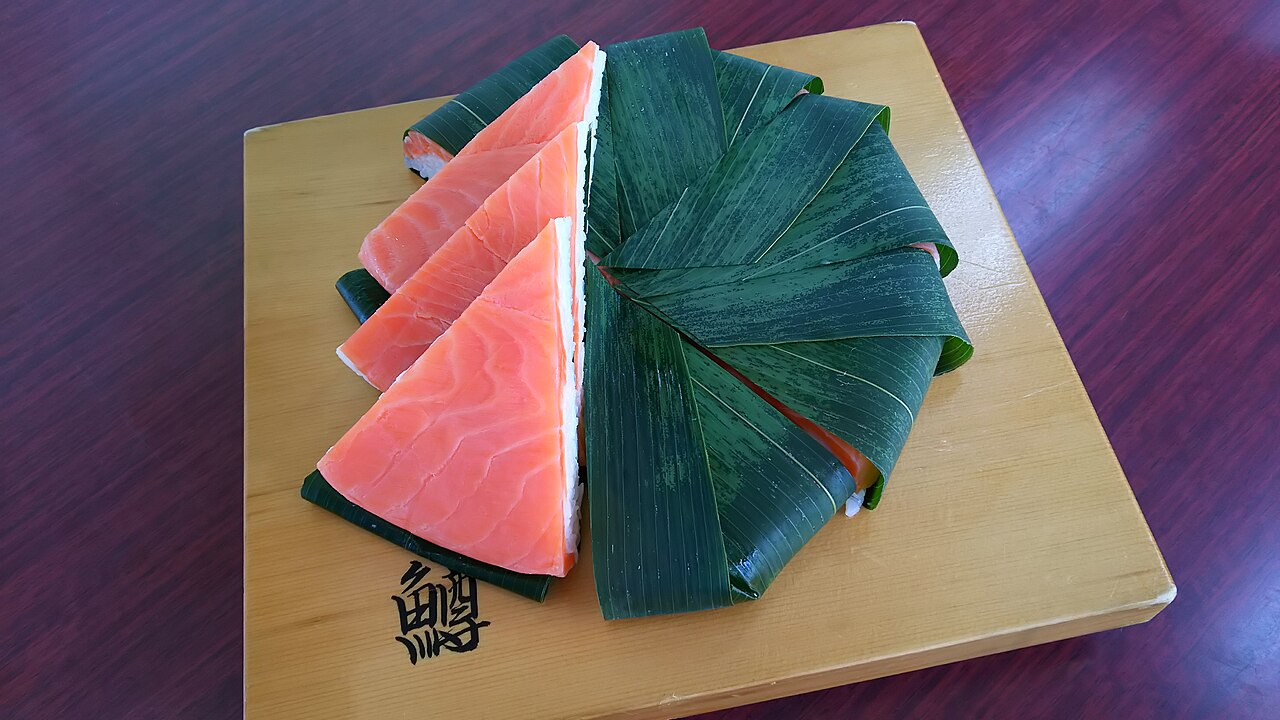
You have bought the round wooden tub at Toyama Station. The label says trout sushi. You lift the lid, fold back a bamboo leaf and find a smooth bed of white rice. Where is the fish? In one of Toyama’s established ways of packing masuzushi, it is right underneath. Before pulling the rice apart with chopsticks, give the container a second look.
One round of sushi, two ways up
Masuzushi is pressed sushi: trout and vinegared rice are packed together in a leaf-lined mould. Toyama’s regional food guide distinguishes omote-oki, which presents the fish uppermost when opened, from ura-oki, which presents the rice. Makers choose how they pack theirs. A white surface can be part of the presentation. It also gives you the option of turning out the whole round to reveal the fish.
That gentle pressure explains the unusual shape of this railway lunch. The portion is yours to decide. A narrow wedge can give everyone at the table a taste, while a larger slice can be held in its leaf and eaten in a few bites. If you bought a small ready-portioned box for the train, it may already have done the dividing for you.
Open only as much as you want to eat
For a concrete example, Chitose, a Toyama producer, shows two approaches to its round pack. To serve on a table, use the lid for support while turning the wrapped sushi out, then cut it into wedges on the lid. To eat from the container, leave it in place and cut through the leaves. Keep the leaf around a wedge while lifting it, then peel it back as you eat. The leaf is the wrapper.
Look at your own maker’s directions first, especially if the wooden tub is held closed with bamboo and bands. Those pieces have been keeping pressure on the lid. If someone else is sharing, let them see the round before the first cut. The way the leaves fan out is one of the pleasures of opening an entire box, and the first wedge makes that pattern disappear.
One bite from the centre and one from the rim
For Minamoto’s version, Toyama’s official tourism site describes a detail you can taste: fattier belly meat is placed toward the centre and back meat toward the outside. In a wedge, those land at opposite ends. Try the pointed tip and the outer edge separately. Another maker may arrange the fish differently, which makes comparing two small portions interesting as well.
Minamoto has a shop in front of the central ticket gate at JR Toyama Station. Its smaller boxes are worth looking for if your departure is close. A whole round is easier to appreciate with a table and someone to share it with.
Toyama’s explanation of the two packing styles · Chitose’s opening guide · How Minamoto arranges the trout · Minamoto’s Toyama Station shop.
How regional railway lunches fit into Japan’s bento culture · 閱讀繁體中文版
Cover image: Toyama trout sushi cut with its bamboo leaves, photographed in 2015. Resized. Sougenma / Wikimedia Commons · CC BY-SA 4.0.


Comments