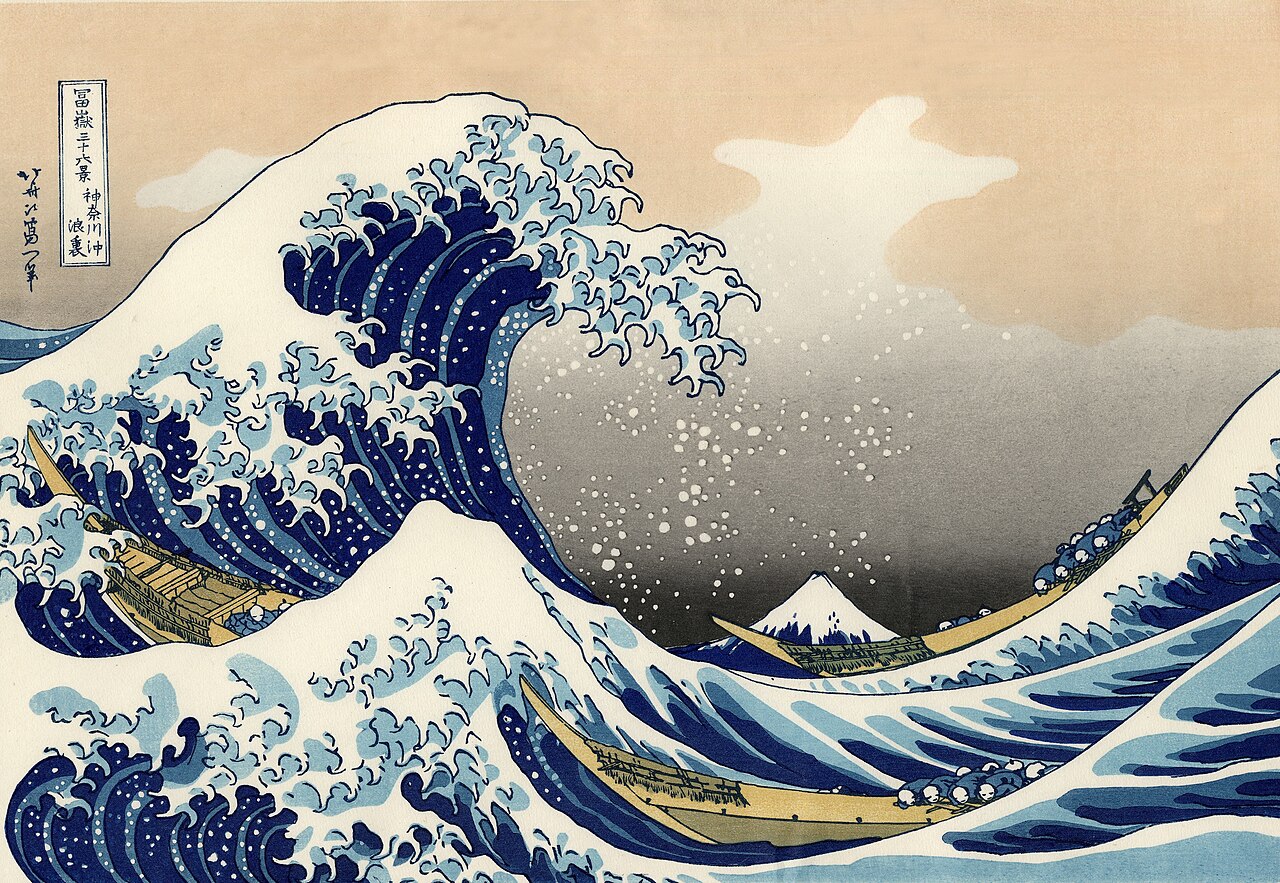
Cover the tallest curl of Hokusai’s Great Wave with your hand for a moment. What remains is a picture of people at work, bent low in three long boats. Behind them is a small, almost steady triangle. That distant mountain supplies the subject of the whole series: Mount Fuji.
Find the boats before you find the mountain
Start at the bottom edge. Follow the long wooden hulls past the rows of blue backs. A boat partly hidden by water is easy to miss. Then look through the space under the crest. Fuji sits far enough away that the little wave in the foreground can seem like its double, white tip and all.
Uncover the crest. The spray curls into fingers over the boats, but nothing on the paper has moved. Hokusai gives the eye two ways to measure the size of the wave: the bodies immediately below it and a mountain familiar for being enormous, reduced here to a small shape on the horizon.
Why two museums can both own a Great Wave
The work commonly called The Great Wave is a colour woodblock print from the series Thirty-six Views of Mount Fuji. A print exists in impressions: paper was brought into contact with inked blocks to build the image. Multiple sheets could therefore come from the design. A museum’s sheet has its own history.
Open two collection entries side by side. Compare the blue in the hollow of the wave, the outline around Fuji and the amount of margin around the design. Colour on a screen depends on the photograph as well as the sheet, so use the museum’s description when drawing conclusions.
Read next · Where to See Mount Fuji at Lake Kawaguchi: Two North-Shore Views
Sources and visitor information
Lead image · Katsushika Hokusai, digital reproduction by Aude · Wikimedia Commons · Public domain


Comments