Arriving in Okinawa, it is easy to notice shisa in souvenir shops and then miss them on the street. Look up at a tiled roof, along the top of a gate, or across an open space at the edge of a settlement. A lion-like guardian changes character with the place it watches.
At a house, look at the direction of the gaze
A pair may sit on either side of an entrance, while a single figure can occupy a roof. Before trying to assign a fixed meaning to each open or closed mouth, look at the way the maker has set the body. A crouching figure projects forward. Another settles its weight into the curve of a roof tile.
From a public street, look back after passing a gate. What you saw head-on becomes a silhouette against the sky. An ordinary walk can become a lesson in how potters and builders fitted the figure to a particular house.
At Tomori, the guardian belongs to the village
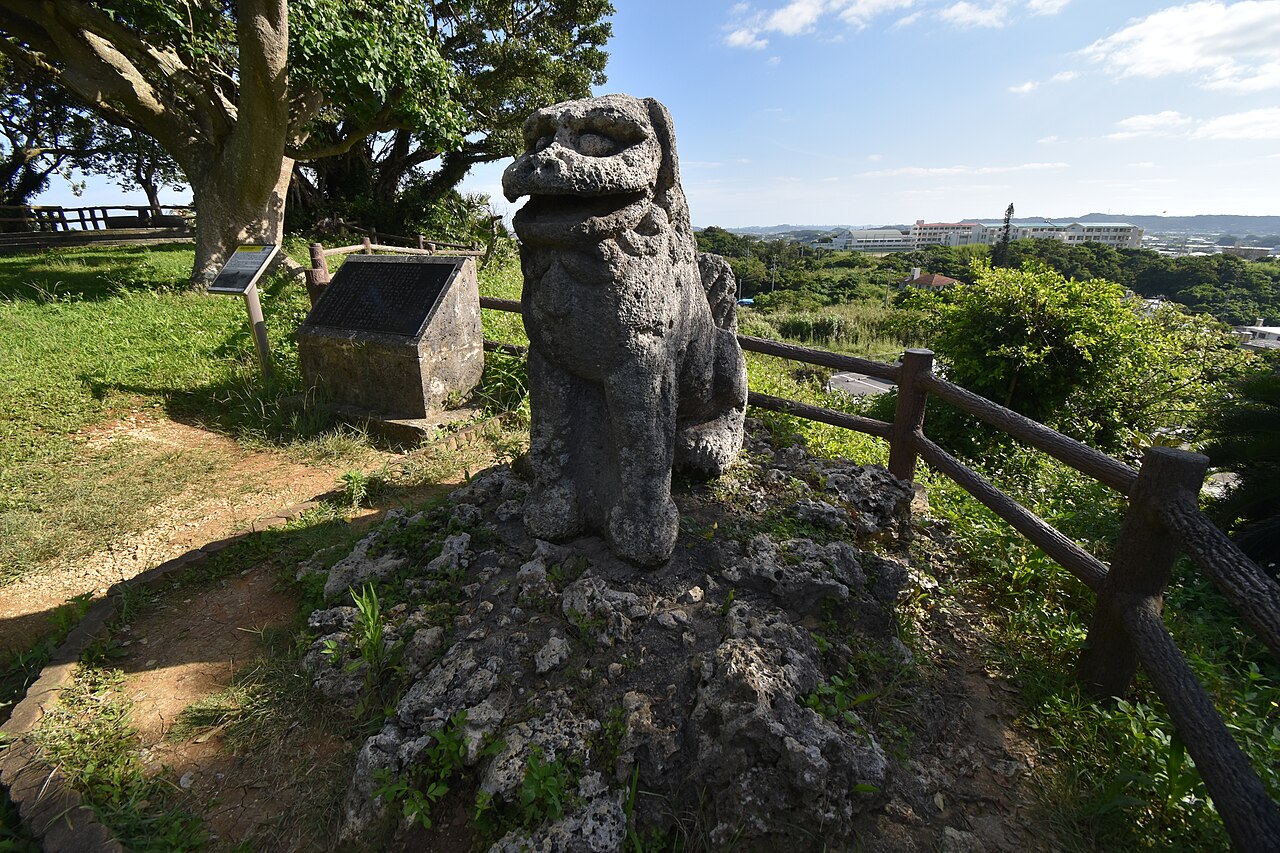
The stone lion at Tomori in Yaese, southern Okinawa, stands on a different scale of meaning. The town recounts a tradition recorded for 1689: after repeated fires, a lion figure was set facing Mount Yaese to protect the settlement. This is the community’s account of why the lion faces that way.
The important question here is where the stone lion looks. Try tracing that direction across the landscape before looking for decoration on its surface. The roof figure made sense in relation to one house. The Tomori lion makes sense in relation to an entire village and the hill beyond it.
Read next · Two Views of a Whale Shark: The Tank-Top Route at Okinawa Churaumi Aquarium
Sources and visitor information
Lead image · Fred Cherrygarden · Wikimedia Commons · CC BY-SA 4.0


Comments