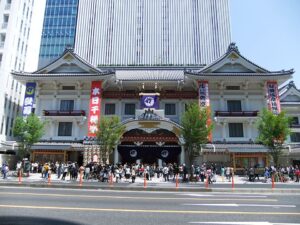
Film can bring an actor’s wrist so close that a small adjustment fills the screen. A kabuki performer has to make that adjustment mean something to a spectator several floors away. If Kokuho has made you curious about the distance between those experiences, Tokyo’s Kabukiza offers an unusually practical experiment. You can buy a seat for a single act.

Take one question with you from the film
Lee Sang-il’s film follows Kikuo and Shunsuke into a world where inheritance, apprenticeship and talent do not always point toward the same future. Ryo Yoshizawa and Ryusei Yokohama play the two men. Watch a rehearsal for the moment one seems to be copying precisely what the other has done. Then ask what still looks different. Where a hand begins its journey, how a shoulder turns, when the eyes move after a sleeve has fallen: any of those can be a better preparation for live theatre than trying to learn every specialist term at once.
What a single act buys
A kabuki program may contain several plays or dances. A single-act seat, often listed under hitomakumi, admits you to a particular portion, with its own start time and duration. Shochiku’s English ticket guide distinguishes advance reserved tickets from the non-reserved allocation sold on the day. Consult the program for your month and the seat type actually offered for the act. Buying one segment of a matinee doesn’t give you the whole afternoon, and caption services should be checked for the performance and seat you plan to book.
Choosing between a dance and a dialogue scene
If what stayed with you in Kokuho was a performer changing the apparent weight of a costume with a small movement, look for a dance piece in the synopsis. If the rivalry between the two men was what held your attention, a dramatic scene with an identifiable conflict may be easier to enter. Read a short summary first. Knowing who is meeting whom lets you look up from the text and keep your attention on the stage.
Where to put your eyes
Pick a single entrance and watch from the moment the performer first becomes visible until another person takes over your attention. At a live performance there is no cut to tell you when your gaze should move. Two people sitting together can see substantially different things. Ask your companion which gesture would have deserved a close-up. Then compare that with the movement they were glad to see from head to toe.




Comments