Listening Culture · Tokyo & Yokohama
Japan’s Jazz Kissaten: Where Listening Comes First
Records, coffee and the people who keep a room’s musical memory alive.
ENTERTAINMENT & CELEBRITIES · 6 MIN READ
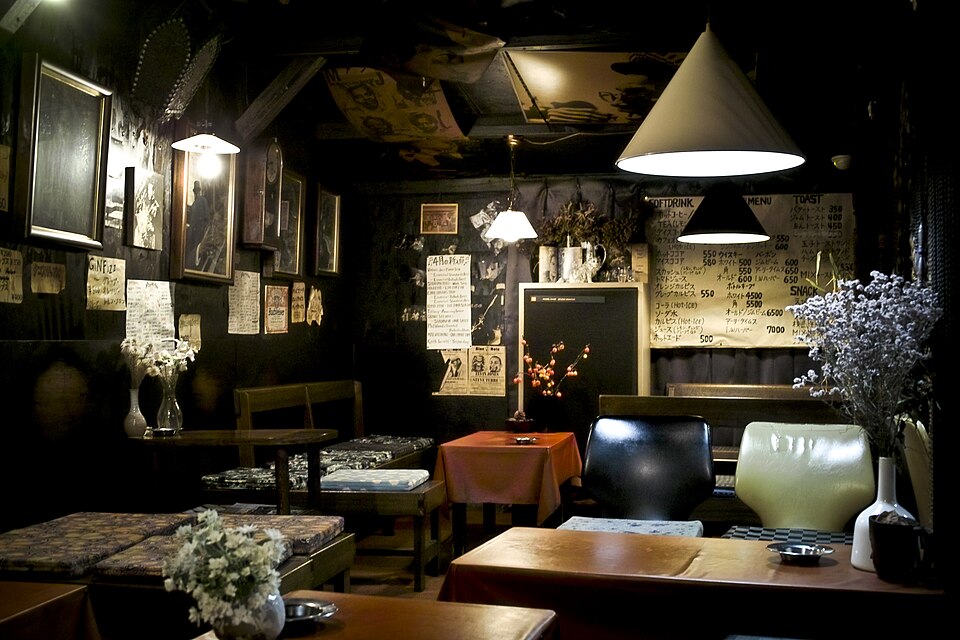
Photo: Guwashi999, 20 September 2009, via Wikimedia Commons · CC BY 2.0. Reduced-resolution version; no crop or retouching by LAYERS OF JAPAN.
A seat, a drink, a recording given room to unfold: this is the invitation of Japan’s jazz kissaten.
There is something generous about letting somebody else choose the next record. You can arrive without knowing the musicians, settle into a chair and discover what holds your attention. A bass line becomes easier to follow. A familiar song takes a different shape. For a little while, listening is enough.
Japan’s jazz kissaten—often shortened to jazz kissa, or ジャズ喫茶—give that kind of attention a physical home. Their stories lead through coffee, records and sound systems, but also through the people who keep a place going when buildings, neighbourhoods and listening habits change.
When a café becomes a listening room
Tokyo’s official tourism guide describes jazz kissa as cafés where recorded jazz, on vinyl or CD, is central to the visit. It connects their development to a period when records and stereo equipment were costly: a shared room offered access to music that an individual listener might struggle to hear at home. [1]
That history gives the coffee a different role. Ordering a drink brings you into a room arranged around a particular way of hearing. The selection, the speakers and the time you spend with a recording all become part of the experience.
The word also helps when choosing an evening out. For a concert, look for a venue’s live-performance programme. For recorded listening, look for its café or listening-room information. A business may offer both at different times, so its own programme matters more than the label on a map.
The person choosing the next record
Eagle, in Tokyo’s Yotsuya district, offers a useful example of how a long history can accommodate new music. In a 2024 visit and interview, music writer Mitsutaka Nagira described founder Masahiro Goto’s selections reaching across classic recordings and more recent releases. Goto established Eagle in 1967. [2]
Nagira’s account also describes an approach that welcomes both records and CDs, according to the music being played. The attraction is the judgement behind the sequence: how one recording opens a path towards another, and how a newer artist can be heard alongside an older one.
For a newcomer, that offers a comfortable starting point. Let the selection do some of the work. If something stays with you, note the album information when it is displayed, or ask the staff at a suitable moment. A title you take home can become the beginning of your own listening trail.
Masako: what survives when a room changes
The archive photographs in this article show the original Jazz & Coffee Masako in Shimokitazawa, Tokyo, in September 2009. They preserve a particular room at a particular moment; the photographed premises should not be treated as a picture of the present-day café.
TV Tokyo’s reporting traces Masako’s beginnings to 1953 and its closure in 2009 during station-area redevelopment. A former member of staff revived the café in spring 2020, carrying forward records, speakers and some furniture from the earlier shop. Even its familiar sweet-bean toast returned. [3]
Those details make continuity tangible. A name survives because someone takes responsibility for objects, recipes and daily work. The old room may be gone, yet something of its musical life can travel into a new one.
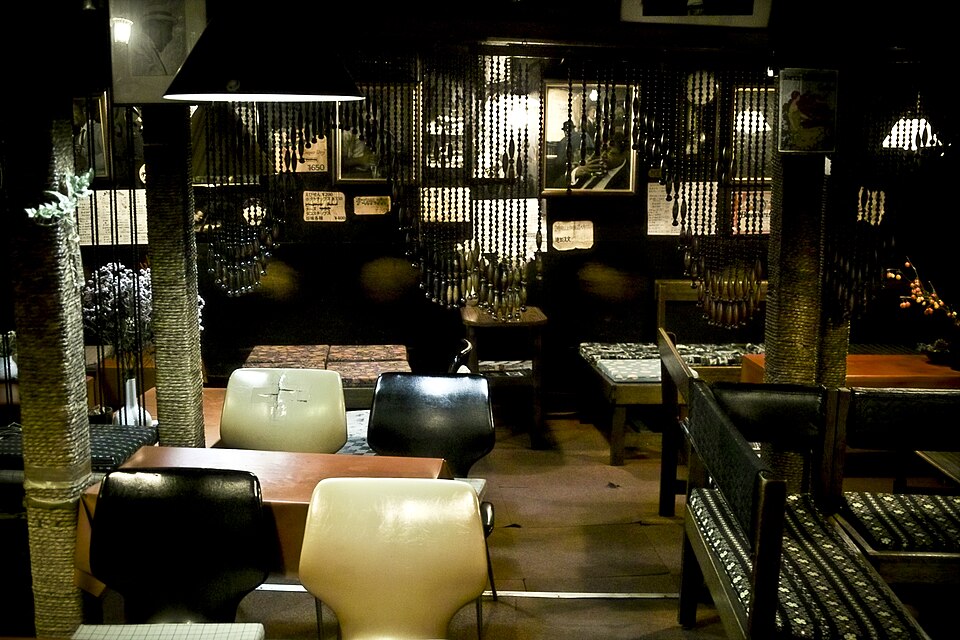
Photo: Guwashi999, 20 September 2009, via Wikimedia Commons · CC BY 2.0. Reduced-resolution version; no crop or retouching by LAYERS OF JAPAN.
Chigusa: keeping a musical inheritance together
In Yokohama, Chigusa’s own history begins in 1933. It records the wartime loss of the café and its record collection, a reopening in 1948, and another return in 2012 after a closure in 2007. Its account also remembers young musicians using imported recordings to study jazz. [4]
This was listening with consequences beyond the room: a recording could help someone learn what to play next. The café’s history is inseparable from the people who used it, looked after it and wanted that opportunity to continue.
Its more recent story requires care when planning a visit. Chigusa’s official website announced the postponement of the planned Jazz Museum Chigusa opening. A later notice introduces Music Chronicle Yokohama, a community listening space in Kannai operated by the preservation group caring for Chigusa’s records and audio equipment. Follow the official site’s current links and notices before setting out. [5]
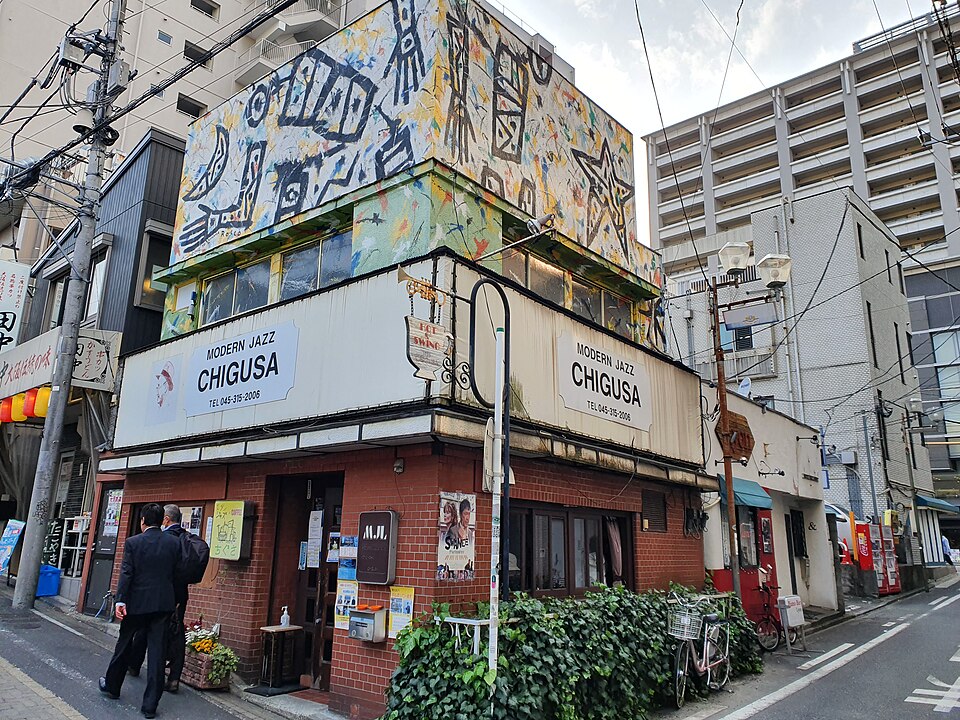
Photo: Syced, 31 March 2022, via Wikimedia Commons · CC0 1.0. Reduced-resolution version; no crop or retouching by LAYERS OF JAPAN.
Finding your place in the room
Quiet listening is part of the attraction, but customs vary. Japan’s national tourism organisation notes that conversation is discouraged in some music-focused kissaten. The sensible approach is to learn the rules of the room you have entered, rather than assuming every café works the same way. [6]
- Check the current information. Confirm the address, opening day, event schedule and any reservation requirements through the venue’s own channels. Old photographs and older travel articles can describe a previous location.
- Read the menu and house notices. Check drink orders, any additional charges, payment methods and conversation rules before settling in.
- Give the music and other listeners space. Silence your phone and keep calls outside. Follow staff guidance about conversation, seating and belongings.
- Ask before taking photographs. A room can be intimate even when it is open to customers. Seek permission for the interior and avoid including other guests without their agreement.
Something to carry home
You might leave with the name of a musician, a recording to find later, or simply a clearer sense of what it feels like to listen without hurrying. None of those requires an encyclopaedic knowledge of jazz.
The histories of Eagle, Masako and Chigusa suggest a way to understand these places: as small spaces maintained through everyday choices. Someone selects the music, cares for the equipment and opens the door. Someone else arrives, orders a drink and gives the record their time.
That exchange is a quiet part of Japanese music culture—and a reason to leave a little room in an itinerary for a chair and a song.
Sources & further reading
- GO TOKYO Gourmet: Tokyo’s Kissaten Culture — the role of jazz kissa, records and shared listening.
- NiEW: Masahiro Goto’s approach to curating at Eagle — Mitsutaka Nagira’s 2024 visit and interview.
- TV Tokyo, Adomachi: Masako’s return — reporting on the café’s history and 2020 revival (Japanese).
- Jazz Museum CHIGUSA: the café’s own history (Japanese).
- Chigusa’s official website — museum-opening notices and the link to Music Chronicle Yokohama.
- Japan National Tourism Organization: Japan’s old-school coffee shops — music cafés and listening etiquette.
Venue arrangements can change. Consult the venue’s own current information before travelling. The photographs are archival records of the locations identified in their captions.






Comments