Performing Arts · A Closer Look at the Stage
Watching Kabuki: A First-Timer’s Guide to the Stage
An entrance through the audience. A sudden stillness. A face drawn in bold lines. Small things to notice on your first visit to kabuki.
6 MIN READ · PERFORMING ARTS
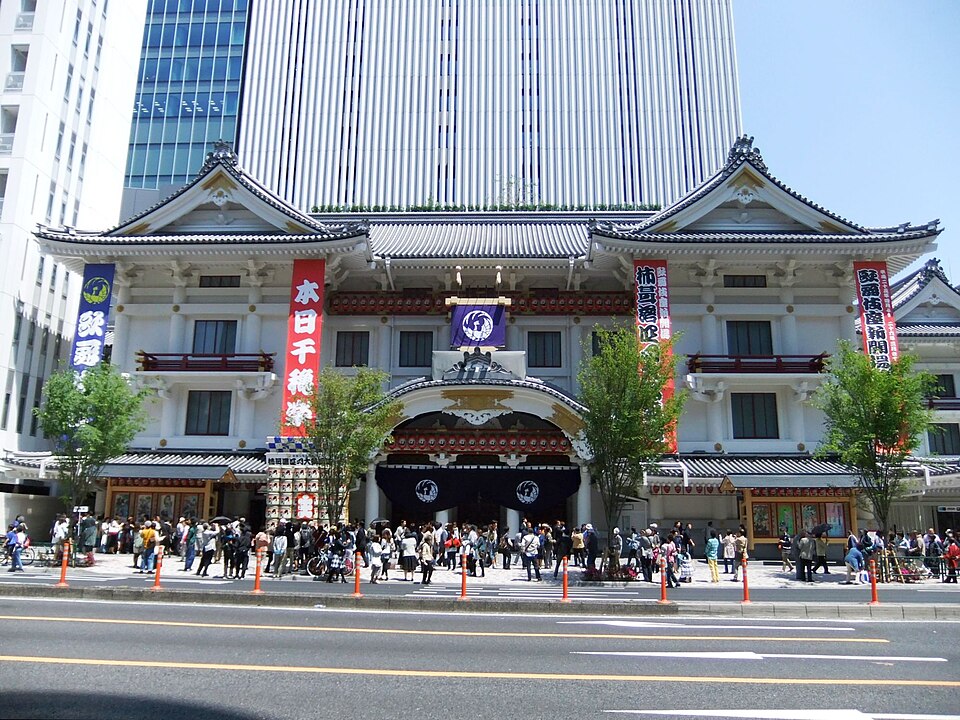
Photo: Tak1701d / Wikimedia Commons / Public domain (released by the photographer). Resized to 960 pixels wide; original composition retained.
An actor stops moving. For a moment, the pose holds the whole scene.
You may not yet understand the words, but you can see where the performance wants you to look. This kind of pause, called a mie, is one of kabuki’s ways of making an emotional turning point visible.[3]
Kabuki brings acting, dance and music together. Its repertoire includes centuries-old works and new theatrical experiments, and its history is rooted in popular entertainment for townspeople.[1] A first visit can begin with a few things to watch, alongside a short outline of the story. You do not have to arrive knowing every convention.
Follow the entrance, wherever it begins
Keep an eye on the walkway that runs through the audience on the left as you face the stage. This is the hanamichi. Depending on the scene, it can become a road, a corridor or even a riverbank. An actor can enter from behind the audience and approach the main stage through the auditorium.[2]
That changes the direction of your attention. A character’s arrival may begin beside you, while the people on the main stage are still waiting. If your seat has a view of the runway, watch the journey as well as the arrival.
The photograph below makes the arrangement easy to see. At Kanamaruza in Kagawa, the wooden runway cuts through the seating area. It is a reminder to check the whole acting space before settling your gaze on the curtain.
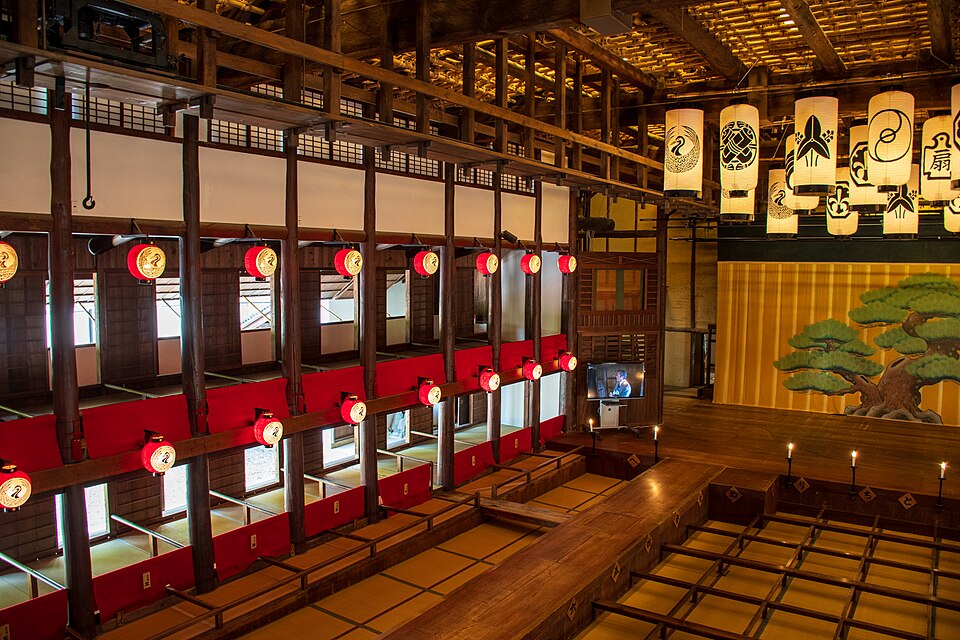
Photo: Photos of Japan / Wikimedia Commons / CC0 1.0. Resized to 960 pixels wide; original composition retained.
Notice when movement stops
In a mie, an actor may turn the head, extend an arm or step forward before becoming still. The surrounding performers can stop too, concentrating attention on one character. Some poses emphasize force; others use smaller movements or arrange several characters into a final composition.[3]
Listen for the sharp wooden beats known as tsuke. Made by striking pieces of wood against a board at the side of the stage, they accent movement and often accompany a mie.[3] Try following a single sequence: movement, sound, then stillness. Give that last moment time to register before looking back at a translation.
Read the face as part of the role
The bold lines associated with kabuki are called kumadori. They exaggerate the muscles and blood vessels of the face, making a character’s qualities visible at a distance. Crimson lines can suggest courage or youthful intensity; indigo can suggest a powerful villain or a vengeful spirit. The shape of the pattern matters as well as its color.[4]
Kumadori is one approach within a much broader range of makeup. A performance without those dramatic stripes is still kabuki. Rather than trying to label every face immediately, notice how makeup, wig and costume work together to introduce a role.
Watch how a character is built
In the traditional professional form, male actors play female roles as onnagata. The term describes both those roles and their performers. The craft includes the use of voice, gesture, costume and wigs; the face is visible rather than concealed behind a mask.[5]
Choose a small detail to follow: the placement of the hands, a turn, or the way someone crosses the stage. Looking closely at how a performer sustains a character can be as absorbing as following the next event in the plot.
The tradition also lives beyond the big theatres
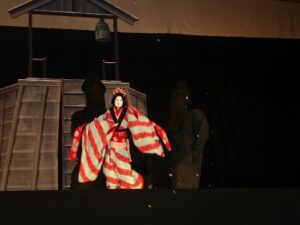
Tokyo’s Kabukiza is one setting for kabuki. In Ōshika, a village in Nagano, local people have passed on their own theatrical tradition through performances on shrine stages. The village’s account describes generations of residents performing plays and reciting their musical narration.[6]
The outdoor audience in the photograph offers another view of the art’s place in everyday life. These are different venues and different occasions; the photographs are not scenes from a single production.
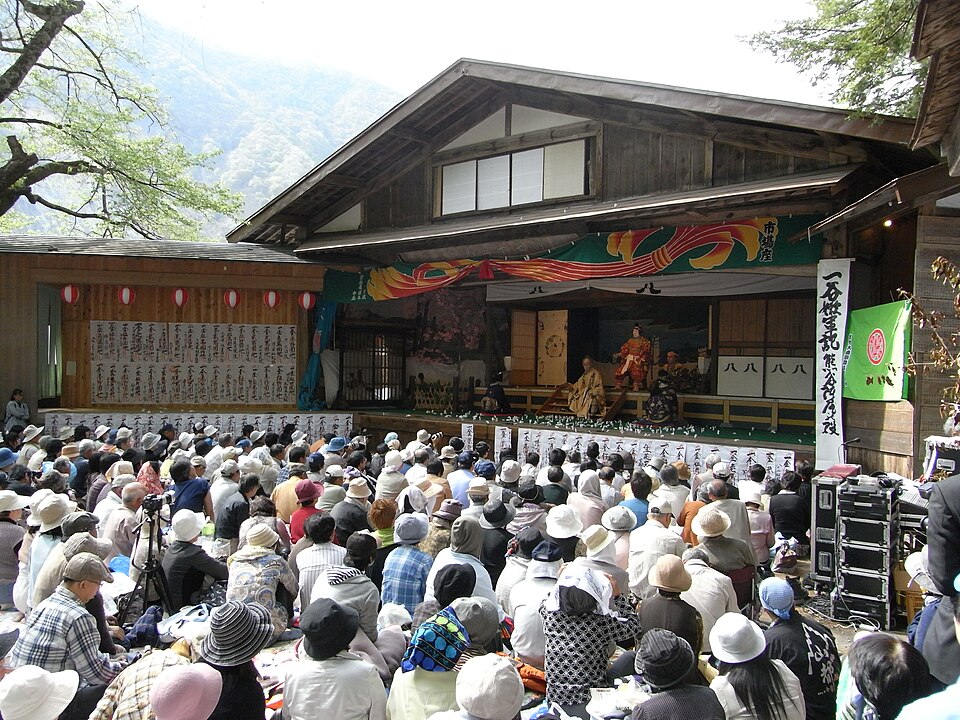
Photo: Mobnoboka / Wikimedia Commons / CC BY-SA 3.0. Resized to 960 pixels wide; original composition retained. This photograph remains available under CC BY-SA 3.0.
Plan a first visit around the performance
Start with the program on Shochiku’s KABUKI WEB. Read a synopsis, check the running time, and decide whether you want a full program or one act. Duration varies considerably: an individual act should not automatically be treated as a short show.[7]
Kabukiza offers fourth-level Single Act Tickets, but the view comes with a trade-off. Shochiku states that the hanamichi cannot be seen from these seats and that part of the main stage may also be out of sight.[8] If entrances along the runway are what you most want to watch, check the seating plan and sightlines before choosing a ticket.
A useful question before booking: do you want a brief introduction to the performance, or a seat from which to follow the hanamichi? Choose with that difference in mind.
English captioning is available at Kabukiza; support at other theatres depends on the production. Confirm the service, availability and current fees for your chosen performance. Shochiku also provides English synopses and says there is no special dress code.[7]
During the play, put your phone away, refrain from photography and recording, and avoid leaning forward into someone else’s view. Follow the theatre’s instructions about electronic devices, food and drink.[9]
You may leave remembering a particular entrance or the way a hand stopped in midair. That is a worthwhile beginning. A synopsis can explain what happened; watching closely lets you discover how the actors made it happen.
Sources & further reading
- Shochiku — About Kabuki
- Japan Arts Council — Kabuki stage mechanisms
- Japan Arts Council — Performance styles and mie
- Japan Arts Council — Stock characters and makeup
- Japan Arts Council — Female roles and onnagata
- Ōshika Village — About Ōshika Kabuki (Japanese)
- Shochiku — Kabuki questions and answers
- Shochiku — Single Act Tickets, fourth level
- Shochiku — Theatre rules and etiquette
The photographs show Kabukiza in Tokyo, Kanamaruza in Kagawa, and an archival Ōshika Kabuki performance in Nagano. Check current programs, ticket conditions and language support with the theatre. Photo credits and reuse terms appear beneath each image.






Comments