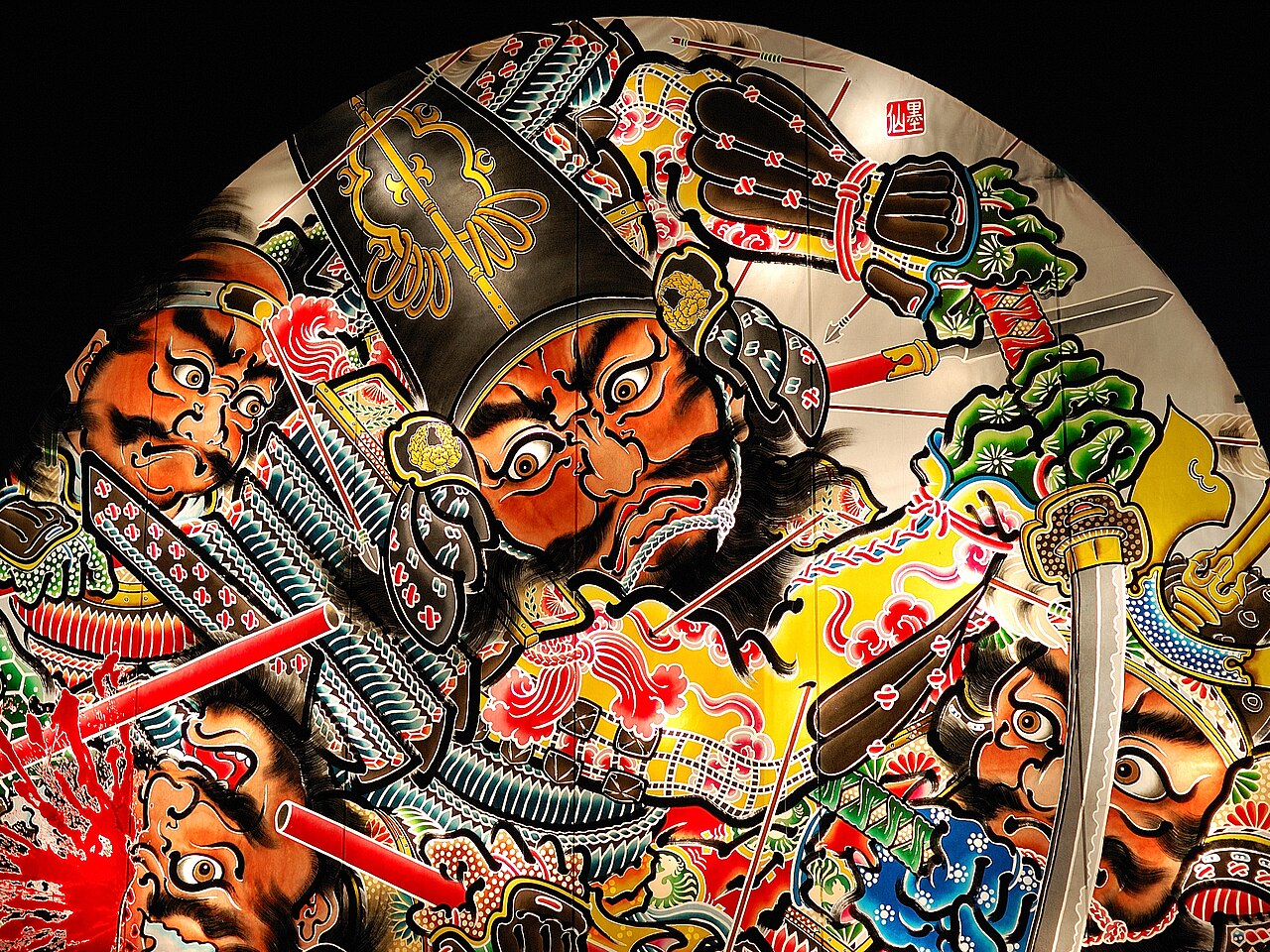
Two summer festival names on an Aomori itinerary differ by a single consonant: Nebuta in Aomori City and Neputa in Hirosaki. If you are looking at photographs with the captions covered, do more than compare the faces. Try to work out what you would see if the float went past and you turned to watch its back.
A figure in space or a picture on a fan
Aomori City is famous for large illuminated floats built as figures in three dimensions. Look for a projecting arm, the space between two characters or the way a costume turns around a body. As the angle changes, different parts of the story come forward.
Hirosaki is especially associated with its fan-shaped floats, though it also has figure-shaped floats. On a fan, front and back give artists two large surfaces for different pictures. After a dramatic warrior scene on the front, stay to see the image moving away. The contrast is part of the experience; one photograph from the front records only half the object.
Where to see floats outside festival season
In Aomori City, Nebuta Museum Wa Rasse stands near Aomori Station. It provides a chance to study the construction and the large figures without a moving crowd between you and them. In Hirosaki, Tsugaru-han Neputa Village displays festival floats and introduces local crafts.
Choose the museum in the city you are actually visiting. If you see both, try making two sketches with a finger in the air: the silhouette of a three-dimensional figure, then the outline of a broad fan. That gesture is often enough to remember which town’s name ends in which sound.
Read next · Kyoto’s Gion Matsuri: Which Float Parade Starts Where?
Sources and visitor information
Lead image · Rosino · Wikimedia Commons · CC BY-SA 2.0


Comments