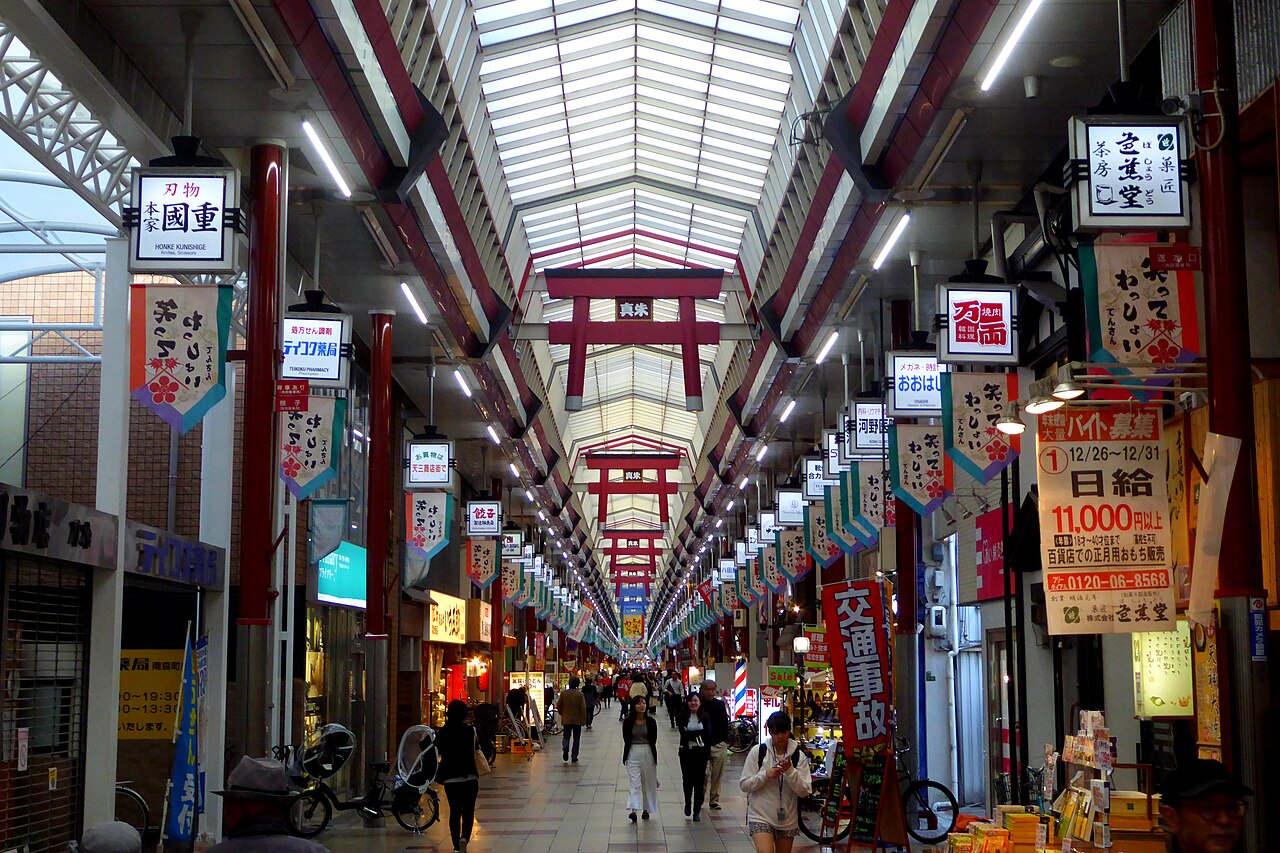
Photograph: Inside Tenjinbashisuji shopping street in Osaka. Ethan Doyle White · CC BY-SA 4.0
There is a perfectly good pair of scissors on the table. Someone points at them and says, “Hasami, naoshitoite” (はさみ、なおしといて). If your textbook taught you that naosu means “to repair,” you might start testing the blades. In Osaka, the request may be much simpler: put the scissors away.
The drawer changes the sentence
Add one small detail: はさみ、引き出しになおしといて。Now there is a drawer in the sentence. Hikidashi ni tells you where the scissors should end up. “Put the scissors away in the drawer” makes sense of the whole request. Nobody has mentioned a loose screw or a damaged blade.
Osaka Prefecture’s teaching material pairs the expression katazukeru (tidy up or put away) with naosu in an exercise on Osaka dialect. The ending -toite is worth listening for, too. It is a conversational shortening of -te oite, a request to do something and leave it done. In everyday English, “put those away for me” gets closer to the tone than a formal instruction.
Put the brake back, or fix it?
Now imagine a bicycle with a brake that no longer works. 自転車のブレーキを直す means “fix the bicycle brake.” An Osaka speaker can use the repair meaning perfectly naturally. The two scenes give you better clues than a one-word translation: in one, an object has a place to go; in the other, a part has stopped working.
If someone hands you an ordinary object and the intended action is unclear, try どこにしまえばいいですか (Doko ni shimaeba ii desu ka?), “Where should I put it?” That gives the speaker an easy opening to point to a shelf or explain the fault. Listen to the answer before reaching for a toolbox. Dialect varies among families and speakers, but a drawer in the conversation is a very good lead.




Comments