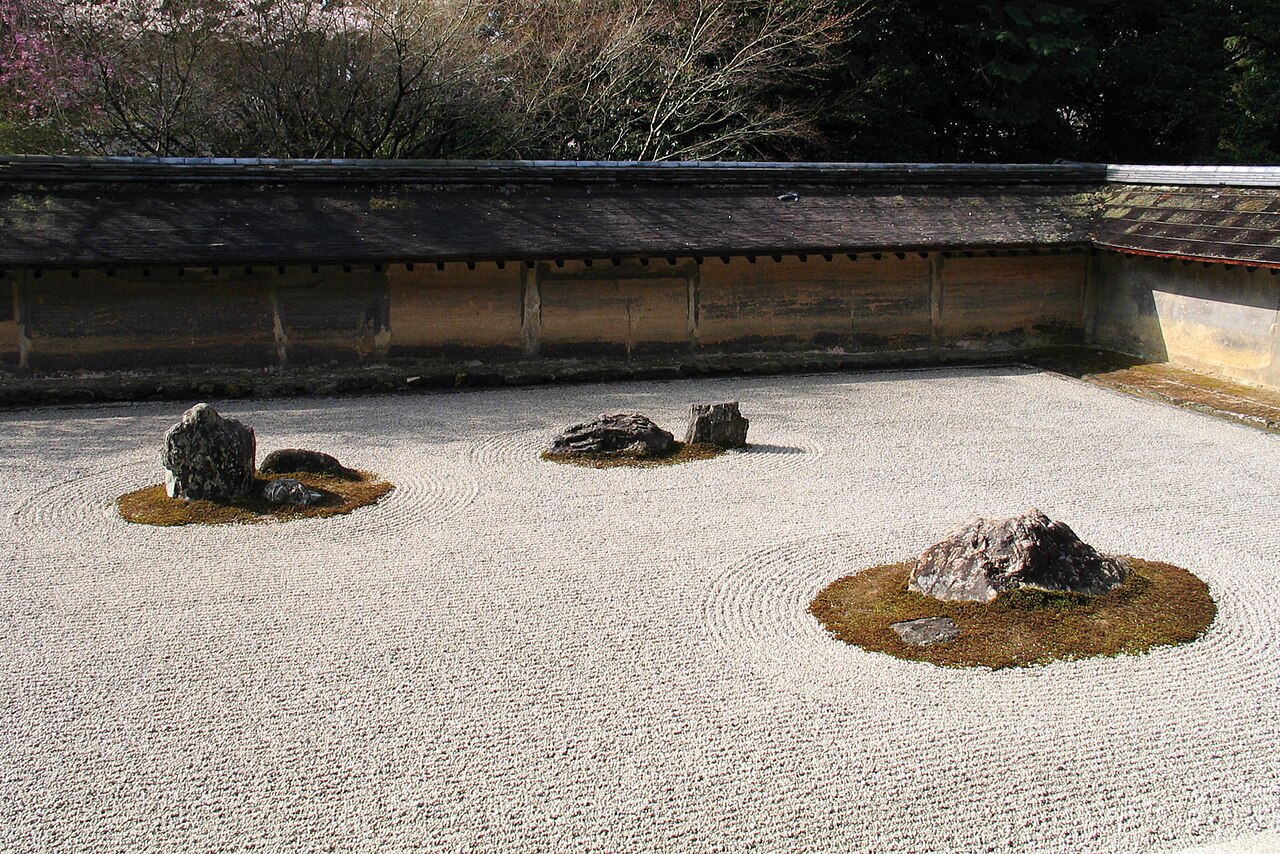
If you have just looked across the pond at Kinkaku-ji, the first thing you notice at Ryōan-ji might be the absence of a reflection. The best-known garden here is dry. Fifteen stones rise out of a pale bed of gravel, in a rectangle bounded on two sides by earthen walls. Pick a place along the veranda and resist counting for a moment. Which two rocks look close enough to belong together?
Five groups, fifteen stones
The garden lies on the south side of the abbot’s quarters, the hōjō. Kyoto Prefecture records the stones in five groups of five, two, three, two and three. A group count and a head count make different impressions. A high stone can catch your eye before you notice the low one beside it; a patch of moss can lead you to see a cluster as one shape.
Look first from a position that naturally catches your attention. Then shift a little way along the veranda when there is room. Watch the gap between two clusters as you move. The stones sit still, and yet the amount of white ground separating them can seem to change quite abruptly. You can enjoy that trick of perspective even on a day when other visitors make the perfect seat elusive.
Give the wall a turn
Once you have spent a minute with the stones, follow the top of the ochre wall with your eyes. The stones have irregular surfaces, the gravel has fine repeated lines, and the earthen wall gives the whole composition an edge. Beyond it, branches and leaves can move. It is a surprisingly active picture for a garden whose most famous features do not budge.
Kyoto’s prefectural account records a traditional name comparing the arrangement to a tigress taking her cubs across water. The Nara National Research Institute for Cultural Properties calls attention to the abstract design. Try both readings from the same seat. Where would the water be in the first? What shapes compete for your attention when you put the tiger aside?
If you visit both temples
Keep one picture from each stop in mind. At Kinkaku-ji the real pond can give you a second image of the pavilion. At Ryōan-ji the spaces between the stones ask you to supply an image of your own. A morning with both gardens is more memorable when you can describe what your eyes did in each.



Comments