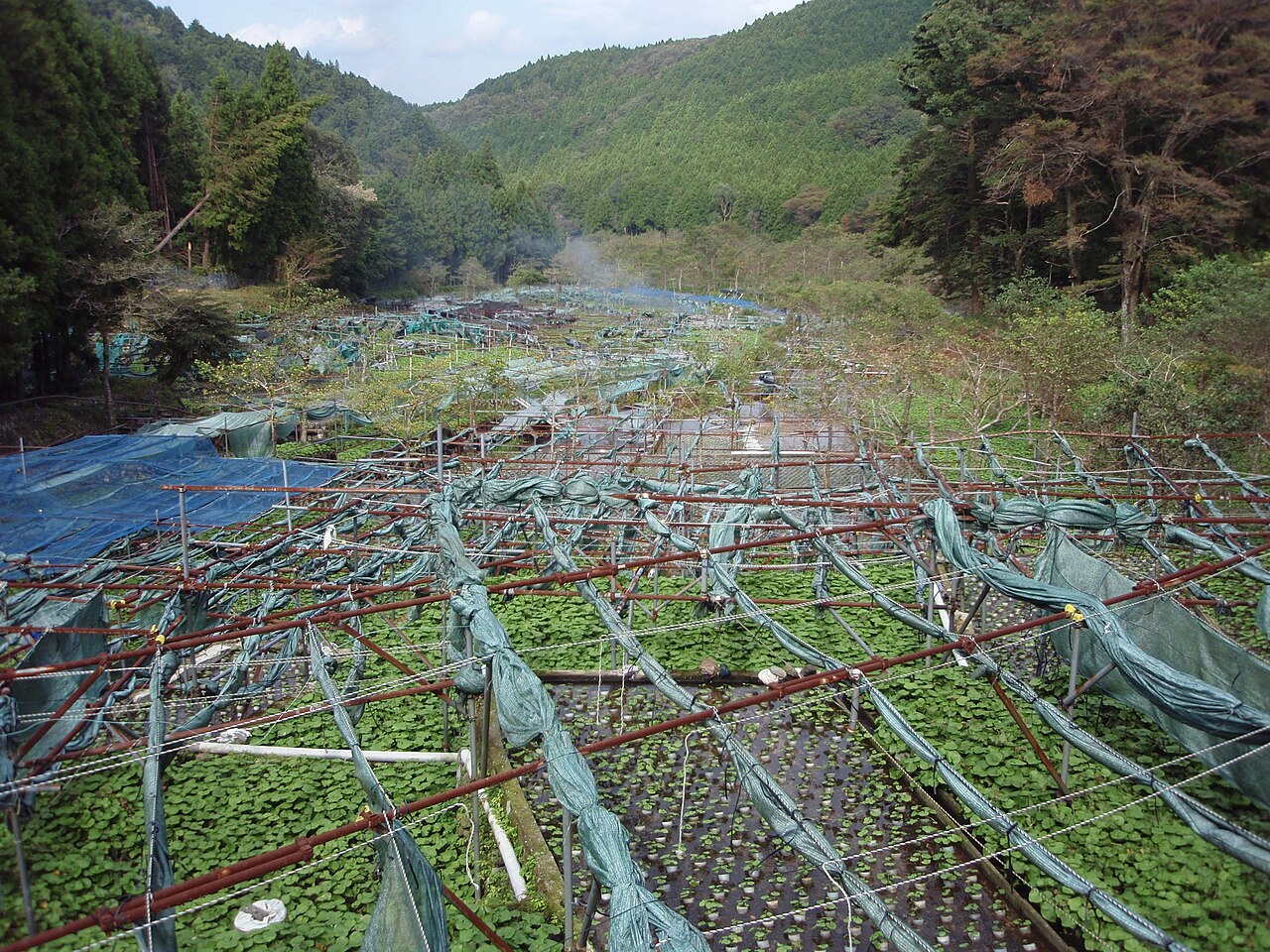
From a distance the wasabi beds at Ikadaba in Izu look like a staircase carpeted with green leaves. The visible stones hold the steps in place. Other stones you cannot see do just as much work. In the tatamiishi method developed in Izu, each growing bed is built in layers that let spring water move through the field as well as across it.
Take an imaginary slice through one terrace
Start at the bottom with large rocks. Above them come progressively smaller stones and gravel, with sand at the surface. The leaves you see in a photograph occupy the thinnest visible part of this arrangement. Underneath, the spaces between the stones give spring water a way through the bed. Clear water running off the lower edge is only the part of that flow you can see again.
Why build a field like this? The account published by the Japanese government describes a regular flow that helps keep the water temperature steady and delivers oxygen and nutrients. There is a crop-specific reason for all this engineering. Traditional water-grown wasabi thrives in cool flowing water, and the green condiment is normally grated from the swollen stem, or rhizome. A puddle left standing above the sand would be a poor explanation for what the grower is trying to achieve.
Look up as well as downhill
Alder trees are another detail worth looking for. In parts of the growing area their shade limits warming from direct sun. Taken together, the trees, the stone walls, the water channels and the beds explain the pattern of green steps more fully than the leaves alone. Shizuoka’s traditional water-wasabi cultivation was recognised as a Globally Important Agricultural Heritage System in 2018.
If you see the beds from a public road or viewing point, follow one line of water with your eyes. Where does it enter the next bed? Where might it pass under the surface? The edges are part of a working farm. A view from outside often gives the best sense of the whole staircase and the stream that ties its levels together.
Read next
- Japan’s Rice Terraces: The Work Behind the View
- Why Water Climbs the Far Side of Tsujun Bridge in Kumamoto
Sources and photograph
- Highlighting Japan on the layers in a wasabi terrace (English PDF)
- Japan’s agriculture ministry on Izu’s stone terraces
- Shizuoka’s agricultural heritage system
Cover photograph: Stone-edged wasabi fields at Ikadaba in Izu City, Shizuoka. Batholith · Public domain





Comments