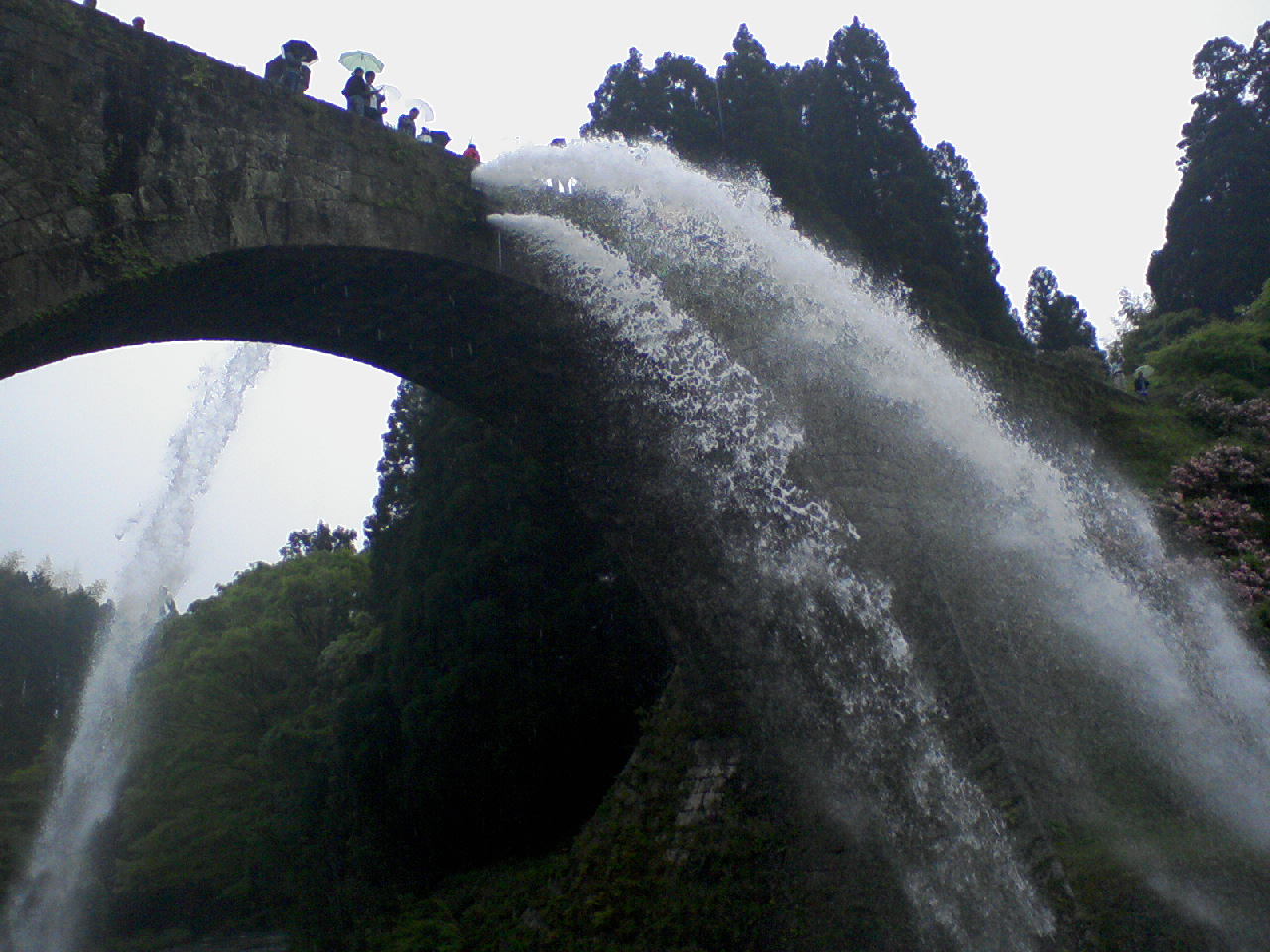
Photograph: Water discharged from Tsujun Bridge in 2007. Sanjo · Public domain
In the famous view of Tsujun Bridge in Yamato, Kumamoto Prefecture, water shoots sideways from the middle of a stone arch. Follow that jet with your eyes and you end up at the stream below. To find the water the bridge was built to deliver, look the other way: toward the rice fields of the Shiroito Plateau beyond the valley.
How the water gets back uphill
The aqueduct was completed in 1854 to bring irrigation water to a plateau short of water. Its stone arch spans the gap, but the waterway has another problem. The bridge sits lower than the land it needs to reach. An open ditch could carry water down to the crossing, then leave it stranded below the fields.
Three enclosed stone conduits make a different route possible. Water descends, crosses the valley and rises on the far side. The inlet is higher than the outlet, so the pressure from the upstream water is enough to bring it up the far slope without a pump. Engineers call this arrangement an inverted siphon. Trace it with a finger: down, across and up, finishing a little lower than you started. The agriculture ministry gives the difference between the two levels as 1.7 metres.
What the dramatic jet was for
Dirt can settle in a conduit. Open a discharge outlet at the middle of this bridge and water can carry accumulated sediment out. What looks like the main event in a photograph began as a way to keep the irrigation system working. On a day without a scheduled release, the point of the bridge is still visible in the relationship between the channel and the fields.
For a visit, treat a water release and access to the bridge deck as separate arrangements. As of November 2026, the official site says deck viewing is suspended for fiscal 2026 while earthquake effects are investigated. Check the current notices and release calendar before travelling. The photograph here records a discharge in 2007; you can understand the route from below even on a day when no plume appears.
Sources and further details
- Yamato Town on the history of Tsujun Bridge
- Japan’s agriculture ministry on its irrigation design
- Official visitor and discharge information


Comments